


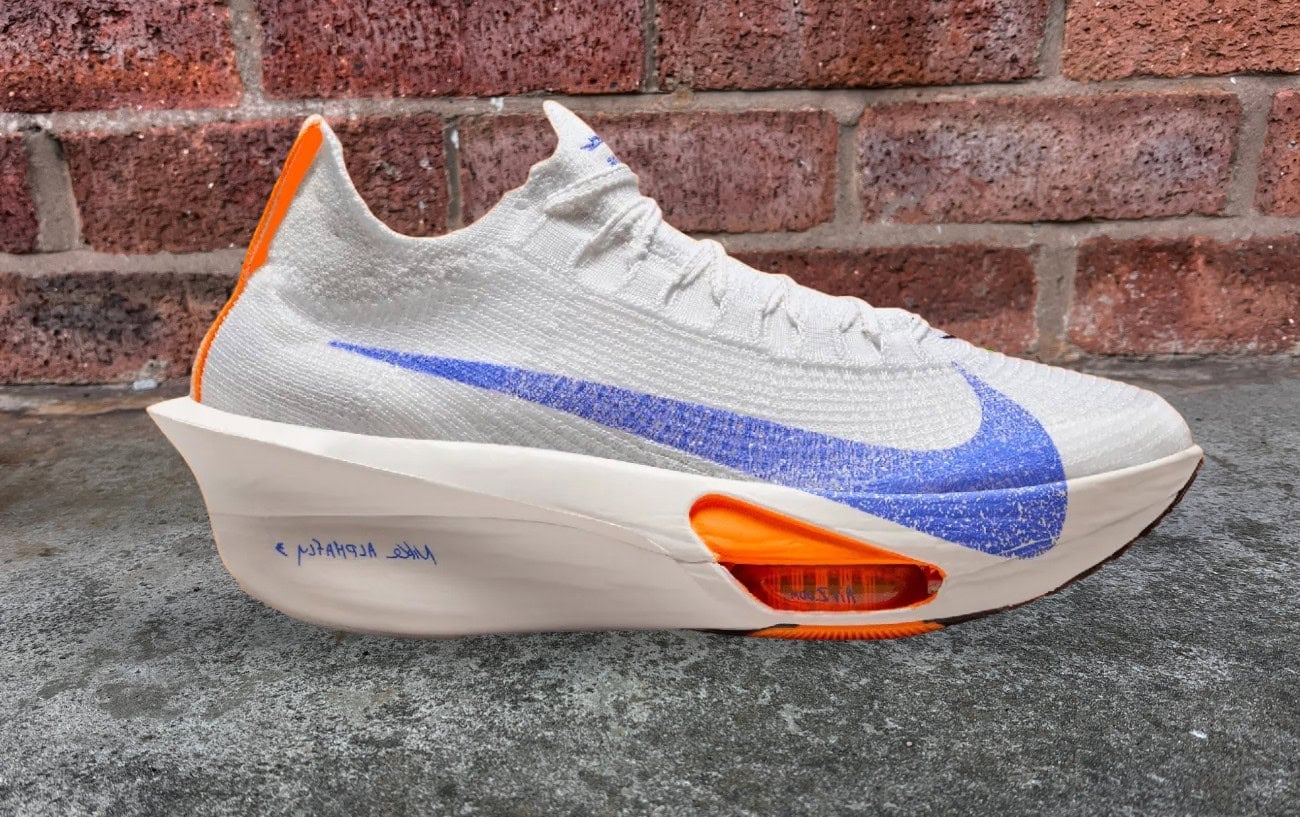
The two fastest road shoes Nike has ever made sit in the same lab, run on the same ZoomX foam, and answer two different physiological questions. Vaporfly 3 is the marathon racer for runners who want to feel light and responsive; Alphafly 3 is the marathon racer for runners who want maximum forward propulsion at the cost of a few grams. Choosing between them isn’t about brand loyalty — it’s about your weight, your foot-strike, and how late in the race your form holds together.
Vaporfly 3 vs Alphafly 3: Quick Verdict
For most runners targeting marathon-pace efforts at 5:00–6:30/km (3:30–4:50 marathon), the Vaporfly 3 is the more versatile racer — lighter, more responsive, equally efficient at submaximal pace. For runners who finish marathons fatigued, are heavier (typically 75 kg+), or have a history of late-race form breakdown, the Alphafly 3 is the smarter pick — its dual-Air-Zoom forefoot returns more energy when your form is collapsing, and its slightly higher stack absorbs more late-race impact load.
The Honest Truth: Vaporfly vs Alphafly Is About When Fatigue Hits
Both shoes share the ZoomX midsole foam and a full-length carbon plate — the same two ingredients that drove the original 4% running-economy paper that started the super-shoe era. What separates them is everything that happens above the plate, and the right pick depends on the specific physiology of your fatigue curve. Here’s what the literature says.
1. Both deliver the 4% economy bump — but at different paces
The original Hoogkamer paper measured the Vaporfly 4% prototype against a Nike Streak 6 and Adidas Adios Boost at 14, 16, and 18 km/h pace and found a consistent ~4% reduction in oxygen cost per km1Hoogkamer W, Kipp S, Frank JH, et al. A comparison of the energetic cost of running in marathon racing shoes. Sports Medicine. 2018;48(4):1009–1019.. Subsequent biomechanics work by Hunter and colleagues showed that the Alphafly with its dual Air Zoom forefoot units returns slightly more energy at faster paces (sub-3:30/km), while the Vaporfly’s lower-mass advantage gives it an edge at slower paces2Hunter I, McLeod A, Valentine D, Low T, Ward J, Hager R. Running economy, mechanics, and marathon racing shoes. Journal of Sports Sciences. 2019;37(20):2367–2373.. So if your goal is sub-2:45 marathon, Alphafly; sub-3:00 onward, Vaporfly is at least equal and usually better.
2. Stack height and rocker geometry — different fatigue resilience
The Vaporfly 3 sits at 40 mm under the heel with a moderate rocker; the Alphafly 3 stacks 39.5 mm under the heel but pairs it with twin 8 mm Air Zoom units in the forefoot, putting the effective forefoot stack closer to 47 mm. That extra forefoot cushioning matters most in late-race miles, when your propulsive stride degrades and you spend more time on the forefoot under fatigue3Lieberman DE, Warrener AG, Wang J, Castillo ER. Effects of stride frequency and foot position at landing on braking force, hip torque, impact peak force and the metabolic cost of running in humans. Journal of Experimental Biology. 2015;218(21):3406–3414.. So Alphafly is the better choice if you historically lose 30+ seconds in the back third of marathons; Vaporfly suits runners who hold form to the line.
3. Weight matters — and the gap is real
The Vaporfly 3 weighs roughly 199 g (men’s 9); Alphafly 3 around 218 g — a ~20 g per shoe gap, or ~40 g per pair. Hoogkamer’s shoe-mass studies established that every 100 g of added shoe mass costs about 1% in oxygen cost at submaximal pace, so the Alphafly is roughly 0.4% less efficient at marathon pace purely on mass4Franz JR, Wierzbinski CM, Kram R. Metabolic cost of running barefoot versus shod: Is lighter better? Medicine & Science in Sports & Exercise. 2012;44(8):1519–1525.. The Alphafly compensates with greater energy return from its dual Air Zoom — net-net it equalises or pulls ahead at fast paces, but at slower marathon paces (3:30 onward), the Vaporfly wins on pure mass arithmetic.
4. Foot-strike and stride mechanics — different platforms reward different runners
The Vaporfly 3’s smoother heel-to-toe rocker rewards rearfoot and midfoot strikers — runners whose contact pattern starts behind the metatarsals and rolls forward. The Alphafly’s twin forefoot Air Zoom units reward forefoot strikers and runners with longer ground contact times that need a bigger trampoline at toe-off. EMG research on super-shoes shows that heel/midfoot strikers in Vaporfly maintain calf-soleus economy better than the same runners in Alphafly5Healey LA, Hoogkamer W. Longitudinal bending stiffness does not affect running economy in Nike Vaporfly Shoes. Journal of Sport and Health Science. 2022;11(3):285–292.. If you’re uncertain of your strike pattern, treadmill video at marathon pace is the cleanest diagnostic.
5. Durability and life expectancy — the unspoken cost
Lab work by Wang and colleagues on PEBA-foam super-shoes found meaningful energy-return degradation after 200–400 km of high-impact use6Wang IL, Graham RB, Bourdon EJP, et al. Biomechanical comparison of running cycles in normal and worn shoes. Journal of Sports Sciences. 2022;40(15):1739–1746.. The Alphafly’s dual Air Zoom units add structural durability — the air units don’t compress-set the way foam does — giving the Alphafly a longer useful life at peak energy return. Practical translation: Vaporfly is better as a one-marathon-block racer; Alphafly is better if you’re going to use the same pair across multiple goal races over a year.
Vaporfly 3 vs Alphafly 3: Side-by-Side Specs
| Spec | Vaporfly 3 | Alphafly 3 |
|---|---|---|
| Weight (men’s 9) | ~199 g | ~218 g |
| Stack heel | 40 mm | 39.5 mm |
| Stack forefoot | 32 mm | ~36 mm + 8 mm Air Zoom |
| Heel-toe drop | 8 mm | 4 mm |
| Foam | ZoomX | ZoomX + dual Air Zoom forefoot |
| Plate | Full-length carbon | Full-length carbon |
| Best for | 3:00–4:30 marathon, even pacing | Sub-3:00 marathon, late-race fatigue |
Where to Buy
More Shoe Roundups From Marathon Handbook
Vaporfly vs Alphafly: Pros & Cons
Vaporfly 3
- ✅ Lighter (~199 g men’s 9)
- ✅ Smoother heel-to-toe transition
- ✅ Better at marathon paces 3:00 onward
- ✅ Cheaper than Alphafly
- ❌ Less forefoot cushioning when fatigued
- ❌ Foam degrades faster than air units
Alphafly 3
- ✅ Higher effective forefoot stack (Air Zoom)
- ✅ Better fatigue resilience late in race
- ✅ More durable air units
- ✅ Edge at sub-3:00 marathon pace
- ❌ Heavier (~218 g men’s 9)
- ❌ More expensive
Frequently Asked Questions
Is the Vaporfly or Alphafly faster?
Neither is universally faster. Lab data shows the Alphafly returns slightly more energy at sub-3:30/km marathon pace because of its dual Air Zoom forefoot units, while the Vaporfly’s lower mass gives it the edge at slower paces (3:30/km onward). For sub-2:45 marathon, Alphafly. For 3:00–4:30 marathon, Vaporfly.
How long do Vaporflys and Alphaflys last?
Lab studies on PEBA-foam super-shoes show meaningful energy-return degradation after 200–400 km of high-impact use. The Alphafly’s air units are more durable than foam, giving it a slightly longer useful life — typically 350–500 km vs the Vaporfly’s 250–400 km. Both should be reserved for racing and key tempo sessions, not daily mileage.
Can heavier runners wear Vaporflys?
Yes, but the Alphafly is generally the smarter choice for runners over 75 kg / 165 lb. The dual Air Zoom forefoot provides more cushioning under higher impact forces, and the additional structural rigidity helps the shoe perform consistently late in a marathon when form deteriorates. Lighter runners (under 65 kg) typically extract more benefit from the Vaporfly’s lower mass.
Are Vaporflys good for half marathons?
Yes — the Vaporfly is arguably the better half-marathon shoe than the Alphafly because the shorter race duration means late-race fatigue resilience matters less, and the Vaporfly’s lower mass advantage compounds over the 21.1 km distance. For races shorter than half marathon, the Vaporfly’s versatility makes it the standard pick.
Should I train in Vaporflys or Alphaflys?
No — both are race-day shoes. Their PEBA-foam construction degrades quickly under high-volume training, and using them for daily mileage burns through their useful life before race day. Save them for marathon-pace tempo sessions, the goal race itself, and 1–2 race-pace dress rehearsals. Build daily mileage in a more durable trainer.
References
RunClub — Free
Join 300,000+ runners in RunClub
Free training plans for every distance, a daily running game, exclusive coaching content, and a real community of runners. Create your free account in 20 seconds — no card.
Already a member? Log in →



Start the conversation