


While Sebastian Sawe and Yomif Kejecha were tapering last week and then enjoying their sub-2-hour Sunday-morning jaunt through London, I was still mulling over the previous week’s Boston Marathon results.
The famous sleuth and logician, Sherlock Holmes, once said: “Don’t let theory overrule data.” I wanted to see if this was true about the Boston Marathon course.
You may know that the Boston course is considered “ineligible” for world records because it is point-to-point and downhill. Sounds like a reasonable rule.
But does the data support the theory? Not in my view.
So I’ve got a proposal: It’s time to rewrite the existing rule that blacklists Boston Marathon performances.
Statistics And Damned Lies
Let me begin by acknowledging that statistics can be twisted and tortured to almost any purpose. That’s one reason I’m choosing to present just a few findings here. More isn’t better in this pursuit.
Second, we must understand that world records are, by their very nature, extreme outliers. Looking at averages doesn’t help. We should look at only the fastest of the fast.
I’m going to start with just three stats that cover the six classic World Marathon Majors, where 95% of fast times are recorded. Further below, I’ll provide a bit more history and context.
To begin, if Boston is an “aided” course, it should have faster course records than the other Majors. It doesn’t.
Courses Records, 6 Classic Marathon Majors
| Marathon | Combined M + F | Men’s record | Women’s record |
| Chicago | 4:10:31* | 2:00:35 | 2:09:56 |
| Berlin | 4:13:02 | 2:01:09 | 2:11:53 |
| London | 4:14:55 | 1:59:30 | 2:15:25 |
| Tokyo | 4:18:11 | 2:02:16 | 2:15:55 |
| Boston | 4:19:14 | 2:01:52 | 2:17:22 |
| New York | 4:24:49 | 2:04:58 | 2:19:51 |
- Or 4:14:16 if you replace Ruth Chepngetich’s 2:09:56 with Sifan Hassan’s 2:13:44
Fastest Times Of The Year Since 2000
Every year, millions of runners finish a marathon somewhere in the world. But only one man and one woman run the fastest time of the year.
These are the best of the best marathon runners in the world, and the courses where they log such extraordinary performances must be the fastest courses.
So if Boston is an aided course, it should sit at or near the top of a compiled list. It doesn’t. Not even close.
Here are the World Marathon Majors courses where the fastest marathon times of the year have been run from 2000 through 2026. That’s a total of 54 performances, male and female. (I’m assuming that the current records for 2026, Sebastian Sawe’s 1:59:30 in London, and Fotyen Tesfay’s 2:10:51 in Barcelona, will remain on December 31.)
Courses Where The Fastest Time Of The Year Has Been Run (2000-2026)
| Marathon | Fastest time of the year |
| Berlin | 18 |
| London | 13 |
| Chicago | 11 |
| Boston | 1 |
| New York | 1 |
| Tokyo | 0 |
Note: The total does not equal 54 because several fastest times were set in Valencia, Rotterdam, and other marathons.
So Far, Boston Is Not Looking That Fast
So far, we’ve found little to no evidence that the Boston Marathon course is faster than others. But let’s not cherry-pick the data.
Let’s look for some indication that Boston might be an unusually fast course. In fact, this particular data is perhaps the strongest, most relevant we’ve seen.
Let’s compare the times of some elite runners who have raced a known fast course (Chicago) and a tailwind-assisted Boston Marathon just six months apart. Where did they run faster?
Chicago 2025 Vs Tailwind Boston 2026
| Runner | Chicago 2025 | Boston 2026 |
| Alex Masai | 2:04:37 | 2:05:32 |
| Rory Linkletter | 2:06:49 | 2:06:04 |
| Zouhair Talbi | 2:07:27 | 2:03:45 |
| Wesley Kiptoo | 2:09:02 | 2:07:55 |
| Ryan Ford | 2:09:37 | 2:05:46 |
| Haftu Knight | 2:11:39 | 2:07:38 |
| Galen Rupp | 2:09:41 | 2:08:15 |
| CJ Albertson | 2:10:38 | 2:09:52 |
| Loice Chemnung | 2:18:24 | 2:19:35 |
| Mary N-Cooper | 2:19:26 | 2:20:07 |
| Dakotah Popehn | 2:24:20 | 2:24:04 |
| Gabi Rooker*** | 2:26:32 | 2:32:13 |
*** Rooker had to train for Boston through uterine fibroids and IVF treatments
Now we have to adjust our conclusions. On a year with a tailwind, there’s strong evidence that Boston might be faster than a “legal” course like Chicago.
And The Verdict Is?
From a data perspective, it appears that Boston is only an “aided” course in years with a clear tailwind (such as 2011 and 2026). This seems to happen roughly once per decade.
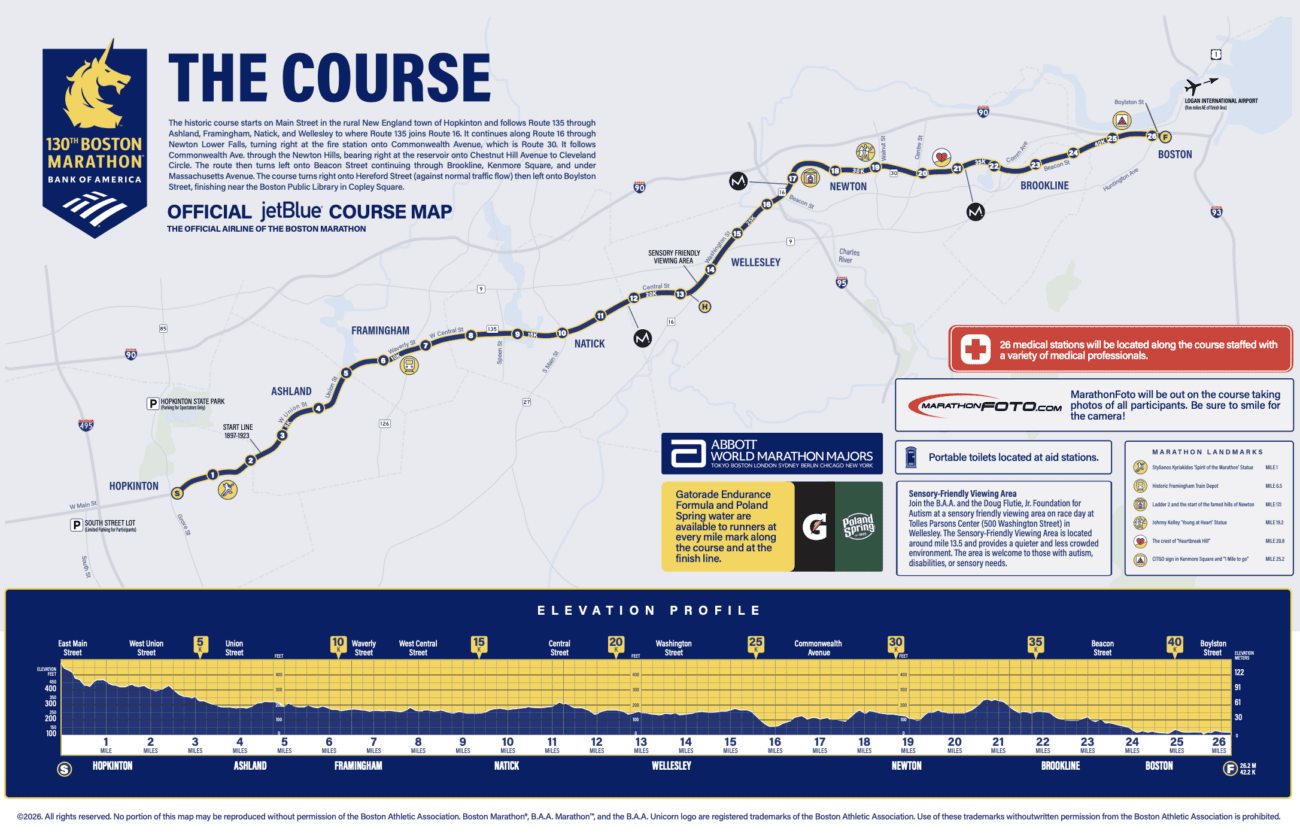
In the other nine years, Boston is no easier/faster than the other World Marathon Majors and should not be considered ineligible for world records. But wait, how can it be possible that an extreme downhill course is not faster than a flat course? (Boston drops about 460 feet from start to finish.)
We actually have several mechanical and biological explanations for this. First, research has shown that uphill running “costs” more than downhill running gives back. And Boston has plenty of infamously famous hills. Also, the downhills produce strong eccentric muscle contractions, which fatigue the legs and slow a runner’s pace.
So here’s my proposal for a new Boston Marathon rule. It’s simple and elegant because it exactly copies an existing track rule.
Boston Marathon performances should be record-eligible when, as in the 100 meters, the tailwind is less than 2 meters/second (4.47 miles/hour). It would be simple to place four or five wind gauges on the Boston course and to average the readings.
Believe me, this won’t upset the apple cart in any significant way. The marathon world records won’t drop to 1:58 and 2:08 next year at Boston, or any year soon.
But at least this rule will take Boston off the ineligible list. And that’s important, because the world’s oldest, most famous marathon course shouldn’t be outright blacklisted. That’s just plain stupid.

If You’d Like More Background
The current rule for road-race world records states that legal courses must have start and finish lines separated by no more than 50% of the race distance, and courses may drop no more than 1 meter per kilometer.
This rule was adopted by World Athletics in 2004 following the recommendations of Ken Young. Young, who died in early 2018, was the best road-race statistician the world has ever known, and a PhD in meteorology to boot. He once told me that he had spent 40 hours a week for 40 years manually entering road race stats into a custom-designed computer program. The result was an astonishing website at ARRS.run (Association of Road Race Statisticians) that has sadly withered since his death.
The problem is that Young’s own stats deny his theory. When he compared various marathon courses in 2013, he concluded that Boston was harder than most others, not easier. On his “Race Time Bias” page, he rated Berlin as 81 seconds faster than a typical marathon course, while Boston was 91.3 seconds slower.
A Public Library of Science research paper1Maffetone, P. B., Malcata, R., Rivera, I., & Laursen, P. B. (2017). The Boston Marathon versus the World Marathon Majors. PLOS ONE, 12(9), e0184024. https://doi.org/10.1371/journal.pone.0184024 published in 2017 analyzed performances at the World Marathon Majors using more sophisticated techniques than I used above and reached the following conclusions: Boston times are highly variable, generally slower than those at the other WMMs, and more affected by weather than by the drop in elevation.
There is a substantial body of scientific research showing that eccentric (downhill) muscle contractions cause greater damage than concentric contractions. Here’s a 2025 study2Effects Of A Predominantly Downhill Full-marathon On Knee… : Medicine & Science in Sports & Exercise. (2026). LWW. https://doi.org/10.1249/01.mss.0001155616.19014.c2 that’s specific to downhill running in marathons. Here’s another paper.3Vernillo, G., Giandolini, M., Edwards, W. B., Morin, J.-B., Samozino, P., Horvais, N., & Millet, G. Y. (2016). Biomechanics and Physiology of Uphill and Downhill Running. Sports Medicine, 47(4), 615–629. https://doi.org/10.1007/s40279-016-0605-y exploring the cost of uphill and downhill running.
The data is in. The theory is wrong. It’s time to let Boston’s results stand.
References
RunClub — Free
Join 300,000+ runners in RunClub
Free training plans for every distance, a daily running game, exclusive coaching content, and a real community of runners. Create your free account in 20 seconds — no card.
Already a member? Log in →











Start the conversation