


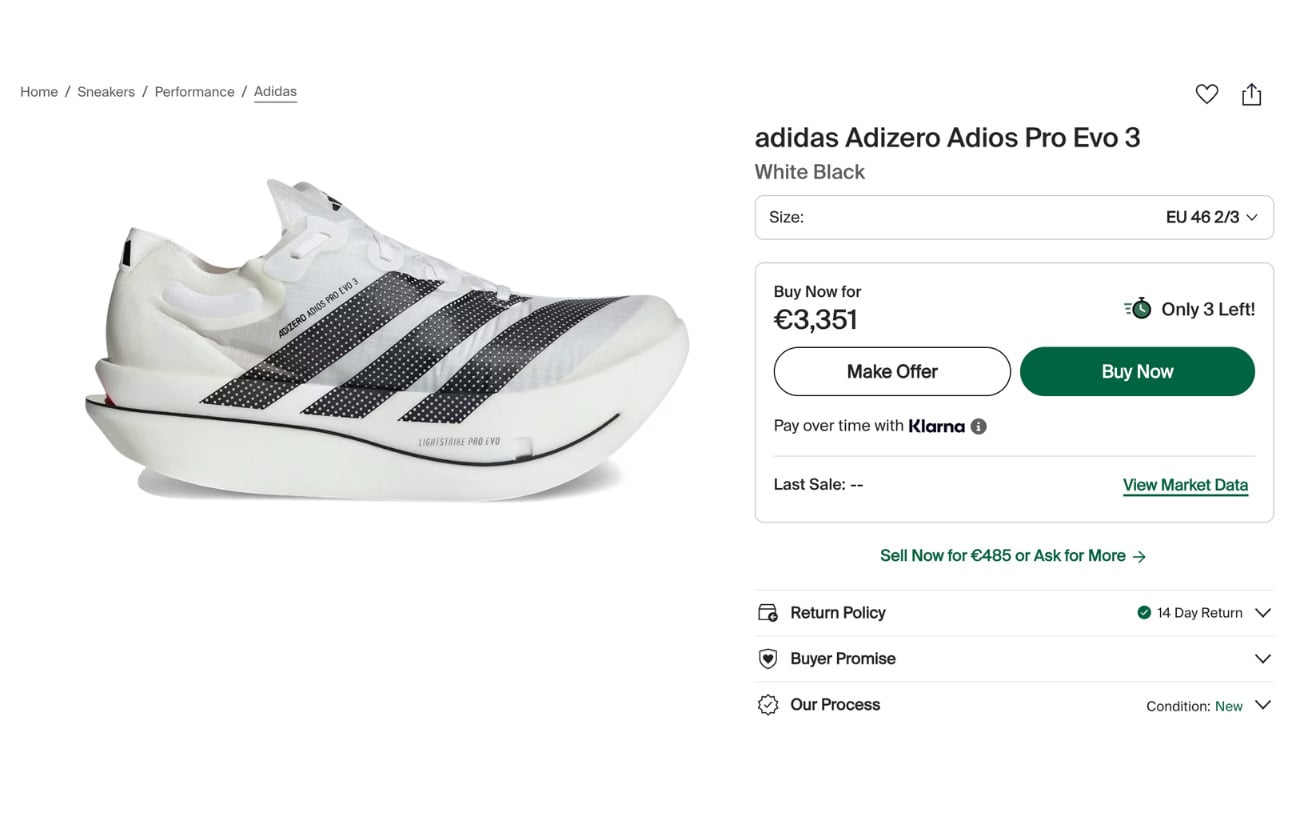
The Adidas Adizero Adios Pro Evo 3 went on sale Monday through the brand’s Confirmed app at $500. By that afternoon, larger sizes were listed on StockX for as much as $5,500.
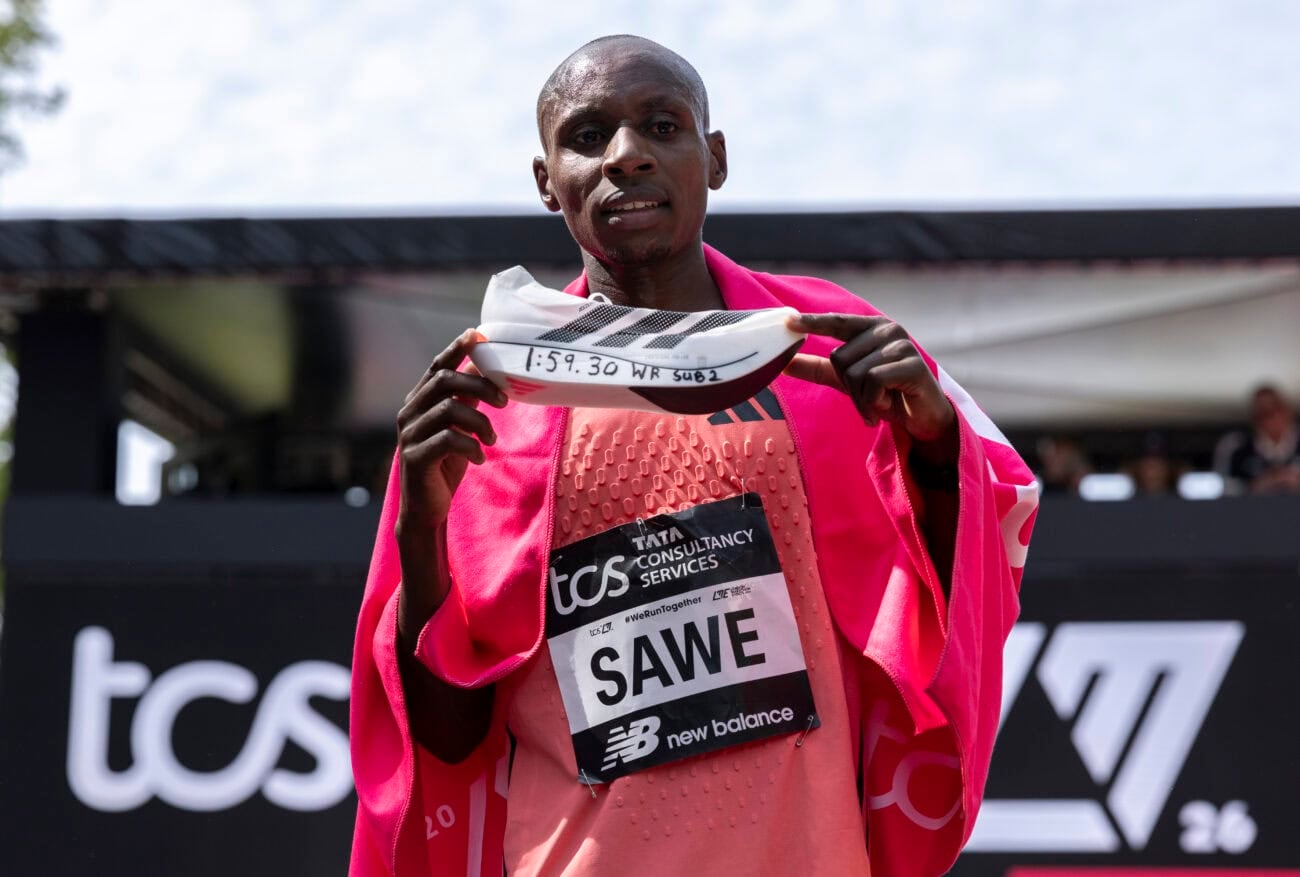
That’s the eye-popping figure, but the wider picture is just as telling. According to reporting from WWD, the lowest StockX bid on Monday sat at $1,671 for a men’s size 8, the average asking price was $2,627, and the highest completed sale so far reached $1,855. Other pairs moved for $957, $800, $750, and as low as $417. The shoe was worn on Sunday by both London Marathon winners.
Why this shoe in particular
Race-day super shoes have been hard to buy at retail for years, but the Pro Evo 3 is in a category of its own. Adidas says it weighs 97 grams in a men’s size 9.5, making it the lightest race-legal running shoe ever produced. That’s a 30 percent weight reduction from the Pro Evo 2, achieved largely through a new Lightstrike Pro Evo foam compound the brand says is 50 percent lighter than its previous version. The upper, according to Adidas, was inspired by kitesurfing sails.
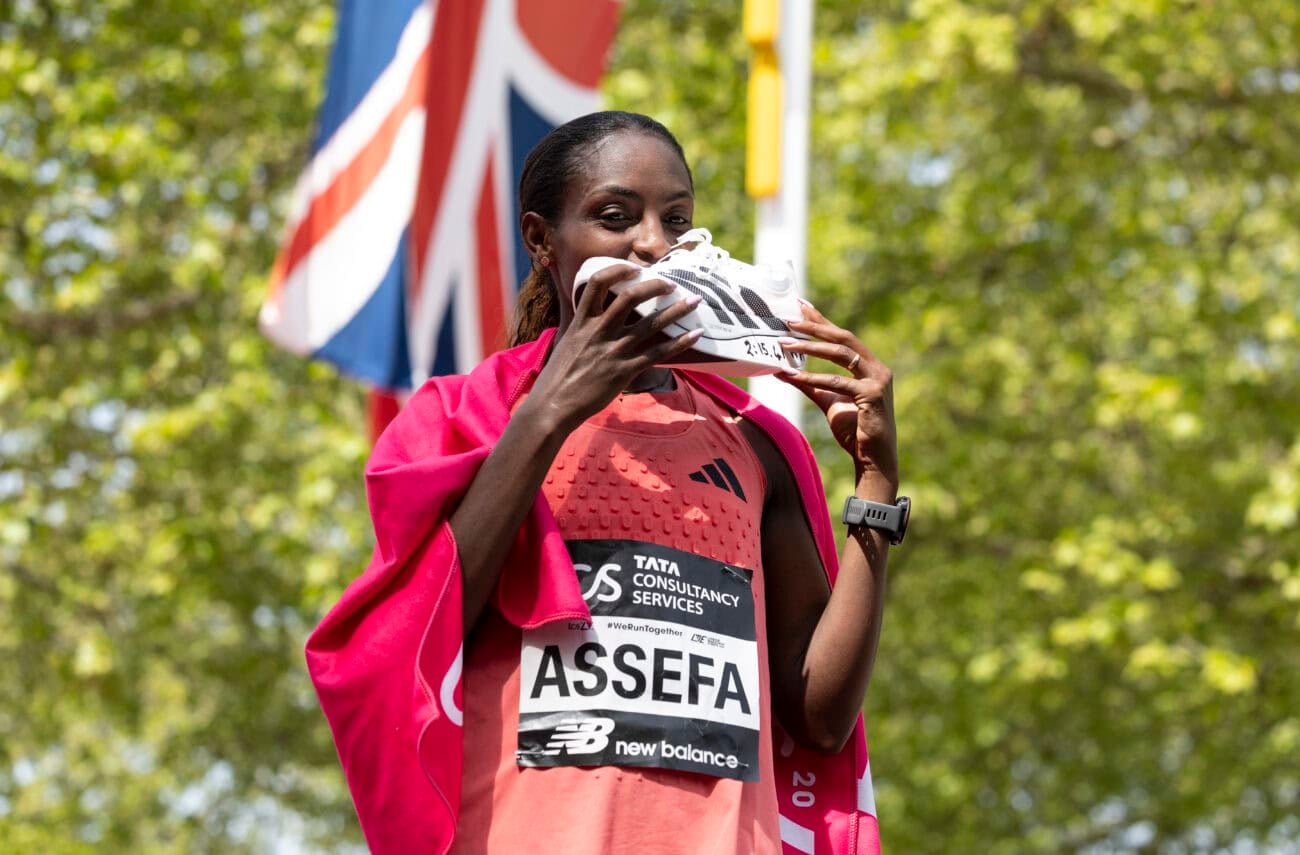
The brand also claims the Pro Evo 3 improves running economy by 1.6 percent over the Pro Evo 2. For context on what those gains buy you on race day: Sabastian Sawe wore the shoe to win the men’s race in London in 1:59:30, the first sub-two-hour marathon ever recognised by World Athletics. Yomif Kejelcha finished second at 1:59:41, also in the Pro Evo 3. Tigst Assefa won the women’s race in 2:15:41 wearing the same shoe and broke the women’s-only world record.
Adidas notes that since the original Pro Evo launched in April 2025, athletes racing in the line have set three world records, won six World Marathon Major titles, taken seven national records, set five course records, and posted one Olympic record time. Marathon Handbook covered the Pro Evo line’s evolution earlier this year in a deep look at why the Adios Pro Evo is so often misunderstood.
The resale market is unusually hot for a running shoe
Performance running shoes don’t usually behave like Sambas. The fact that StockX is seeing four-figure asks on the Pro Evo 3 is a real shift, and the platform’s own search data shows it didn’t come out of nowhere.
StockX told WWD that the platform recorded nearly 50,000 searches for the term “Adizero” in the first quarter of 2026. The top five Adidas models searched in that period were the Samba, Spezial, Superstar, Adizero, and Campus — four lifestyle staples and one race shoe.
“What stands out here is that a performance running shoe — at a relatively high price point — is competing from a search-demand perspective with some of Adidas’ most iconic lifestyle models on the platform,” Brendan Dunne, senior director of customer community and engagement at StockX, told WWD and FN.
That kind of crossover demand is part of what’s driving the resale prices. Buyers chasing the Pro Evo 3 are a mix of serious marathoners who couldn’t grab one through Confirmed, collectors, and people who treat sneaker drops as investments. The result is the same: a race shoe most people will never train in, listed for the price of a used car. (For where Adidas sits in the broader super shoe market, see our Adidas vs. Nike super shoe breakdown.)
Should runners actually pay this?
Probably not, and not just because of the price.
The Pro Evo line is built for one job. Adidas has positioned earlier versions as race-day-only shoes with a short usable life, and the lighter the shoe gets, the more that becomes a real consideration. Stripping a shoe down to 97 grams means stripping away material, and material is what gives a shoe its mileage. We’ve covered this question in more depth in our piece on whether anyone should be buying a $500 super shoe in the first place.
For most runners, the math doesn’t work. A pair of Pro Evo 3s at retail is already a steep buy-in for one or two marathons. At $1,671 and up, it becomes a per-mile cost that’s hard to defend unless you’re chasing a specific time and you’ve already done the training that justifies it.
There’s also the question of whether the shoe is the limiting factor in the first place. The 1.6 percent running economy improvement is real, but it scales with the runner. For an elite chasing a sub-two-hour marathon, that margin is everything. For a recreational runner targeting a Boston qualifier, training, pacing, and fueling will produce far bigger gains than any shoe on the market. If you’re shopping the broader category, our round-up of the best carbon plate running shoes for 2026 is a better starting point than chasing a Pro Evo on StockX.
RunClub
Get more running stories — join RunClub
Daily running news, a community of 300,000+ runners, free training plans for every distance, and a daily running game. Free to join — no card.
Already a member? Log in →






Start the conversation