


We normally choose running routes for convenience, distance, terrain, or traffic. But the setting itself may affect how hard we run and whether we want to repeat it.

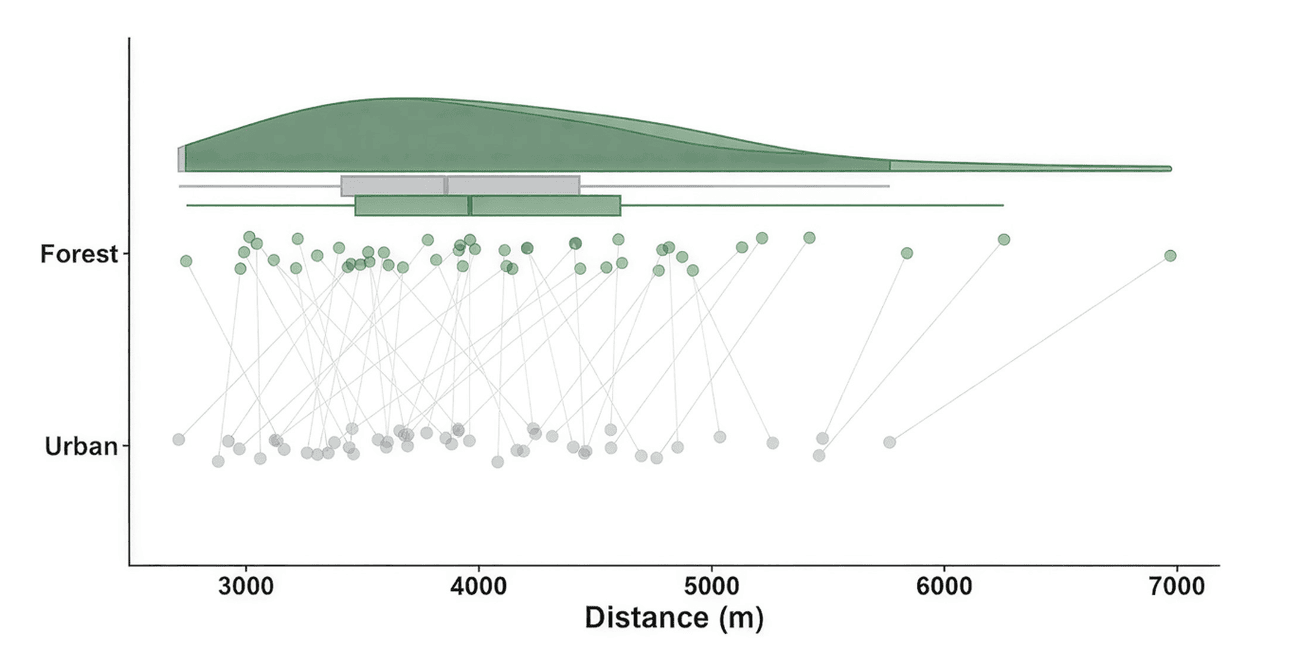
In a recent study, forty-seven healthy adults completed two 30-minute self-paced run/walk sessions. One took place on a forest circuit and the other in an urban industrial setting. Participants were asked to maintain the same moderate perceived effort of 4 out of 10.1Putland, M. J., Bailey, S. J., Chrismas, B. C. R., Clemes, S., Ewers, M., Ho, Y.-L., Jones, E., Lintuluoto, A., McEwan, K., Naik, R., Rahimi, H. L., Xiang, H., Willems, E. P., Shaw, C. N., & Longman, D. P. (2026). Running wild: Forest running enhances performance, enjoyment, mood, and future exercise intentions. Evolution, Medicine, and Public Health, 14(1), 1–14. https://doi.org/10.1093/emph/eoag018
- They covered more ground in the forest: 4,118 versus 3,936 meters, a difference of 182 meters or approximately 4.6%.
- Heart rate and perceived exertion were nearly identical between conditions. Average heart rate was 158 beats per minute in both workouts, and perceived effort was 4.3 versus 4.4.
- The psychological differences were larger. Enjoyment scores averaged 98.7 after the forest session and 73.9 after the urban session.
- The runner’s short-term willingness to repeat the activity was 77.4% versus 30.6%, while long-term intention was 71.5% versus 21.0%.
- Mood also improved more after the forest run.
What this means for runners
If motivation and consistency are your limiting factors, route selection may be a free training tool. A park, trail, waterfront, or tree-lined loop that you genuinely enjoy can make it easier to accumulate work without adding another metric or gadget.
Do not read this as proof that forest running creates superior fitness adaptations. The performance difference was modest, and one short experiment cannot establish adherence. The better takeaway is that the environment that makes you want to run may be the environment that best supports your training.
References
RunClub — Free
Join 300,000+ runners in RunClub
Free training plans for every distance, a daily running game, exclusive coaching content, and a real community of runners. Create your free account in 20 seconds — no card.
Already a member? Log in →










Start the conversation