


One promise of a very-low-carbohydrate diet is that, once you get better at burning fat, you should depend less on carbohydrates during long endurance sessions.
That sounds logical. But better access to fat does not necessarily eliminate the usefulness of glucose—especially when exercise is prolonged, moderately hard, and begun with limited carbohydrate availability.

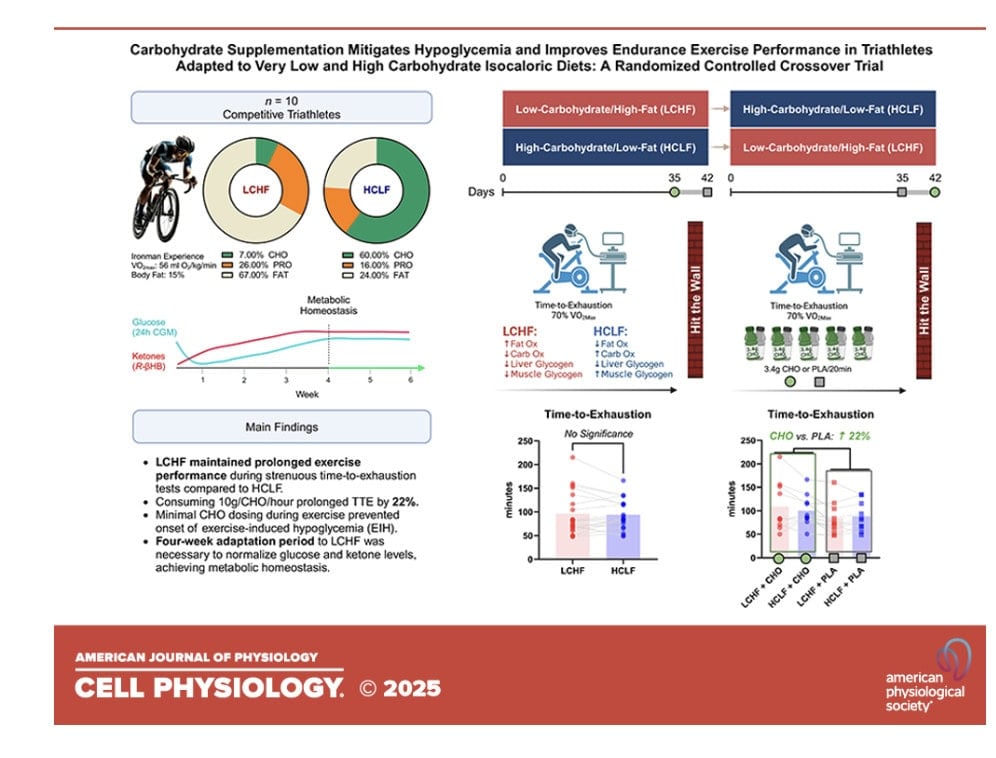
A randomized crossover trial tested that distinction in 10 competitive male triathletes. Each athlete completed six weeks on two diets: a high-carbohydrate diet providing roughly 380 grams per day and a very-low-carbohydrate diet providing about 40 grams per day. After each diet phase, the athletes performed fasted cycling tests at 70% of VO₂ max while consuming either a carbohydrate-free placebo or just 10 grams of carbohydrate per hour.1Prins, P. J., Noakes, T. D, Buga, A., Gerhart, H. D, Cobb, B. M., D’Agostino, D. P., Volek, J. S., Buxton, J. D, Heckman, K., Plank, E., DiStefano, S., Flaming, I., Kirsch, L., Lagerquist, B., Larson, E., & Koutnik, A. P. (2025). Carbohydrate Ingestion Eliminates Hypoglycemia & Improves Endurance Exercise Performance in Triathletes Adapted to Very Low & High Carbohydrate Isocaloric Diets. AJP Cell Physiology. https://doi.org/10.1152/ajpcell.00583.2024
(Ten grams per hour is a tiny dose by modern endurance standards. Depending on the event, current race-fueling strategies commonly provide several times that amount.)
The small dose still mattered.
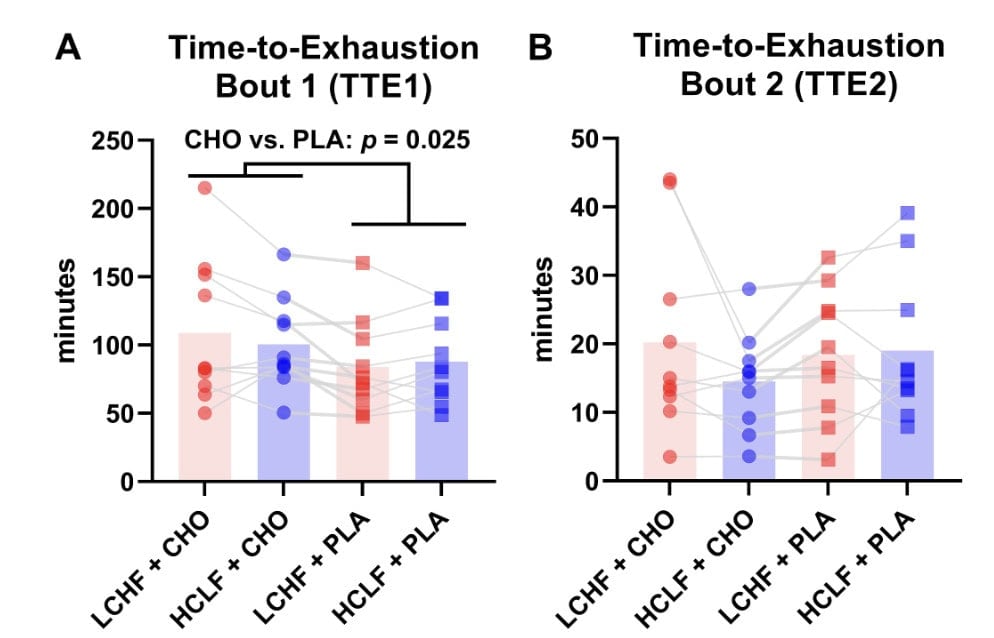
- Carbohydrate extended time to exhaustion by 19 minutes on average—about 22% across diets—and prevented the exercise-induced drop in blood sugar seen in the placebo trials when the athletes weren’t consuming any carbs.
- The benefit appeared after both diets. Meanwhile, six weeks of eating very little versus a lot of carbohydrate did not meaningfully affect average time to exhaustion once the athletes had adapted.
There are two interesting findings here. First, the athletes maintained performance after adapting to the low-carbohydrate diet under this protocol. The second is that becoming highly reliant on fat did not make carbohydrate irrelevant during exercise.
Carbohydrates may have helped by maintaining blood glucose rather than supplying a large amount of energy. At 10 g/h, it could not have contributed much fuel compared with the ride’s total cost. But the brain and working muscle still care about glucose availability, particularly late in a prolonged effort.
The study did not compare 10 g/h with 30, 60, or 90 g/h. It tells us that a small dose was better than none under deliberately low-fuel conditions. It does not tell us that a small dose was best.
What this means for runners
Fat adaptation is not permission to ignore fueling. Even after six weeks on a very-low-carbohydrate diet, these athletes performed better when they consumed a small amount of carbohydrate during exercise.
Treat 10 g/h as evidence that some carbohydrate mattered here, not as a race-fueling recommendation. If you are training or racing long enough for carbohydrate availability to become limiting, the more useful question is not whether you can survive on the smallest possible dose. It is how much carbohydrate you can comfortably absorb and use for the demands of that session.
References
RunClub — Free
Join 300,000+ runners in RunClub
Free training plans for every distance, a daily running game, exclusive coaching content, and a real community of runners. Create your free account in 20 seconds — no card.
Already a member? Log in →










Start the conversation