


Durability describes when—and how much—your physiological capabilities, like VO₂ max and running economy, deteriorate during prolonged exercise. The thresholds and exercise economy measured when you’re fresh can change as the miles accumulate.
For runners, this raises the question of how much of that deterioration we can influence through fueling.
Three recent studies approach the question from different directions. Together, they invite a closer look at what we mean when we say carbohydrates help us keep going.

Carb Intake vs. Carb Oxidation: Why the Difference Matters
Before getting into them, we need to distinguish three things.
- Carbohydrate intake is what you consume.
- Exogenous carbohydrate oxidation is how much of that incoming carbohydrate you burn for energy.
- Whole-body carbohydrate oxidation includes both incoming fuel and carbohydrate supplied by your body, including its glycogen stores.
Burn Through Your Own Carbs Faster, and Durability Takes a Bigger Hit
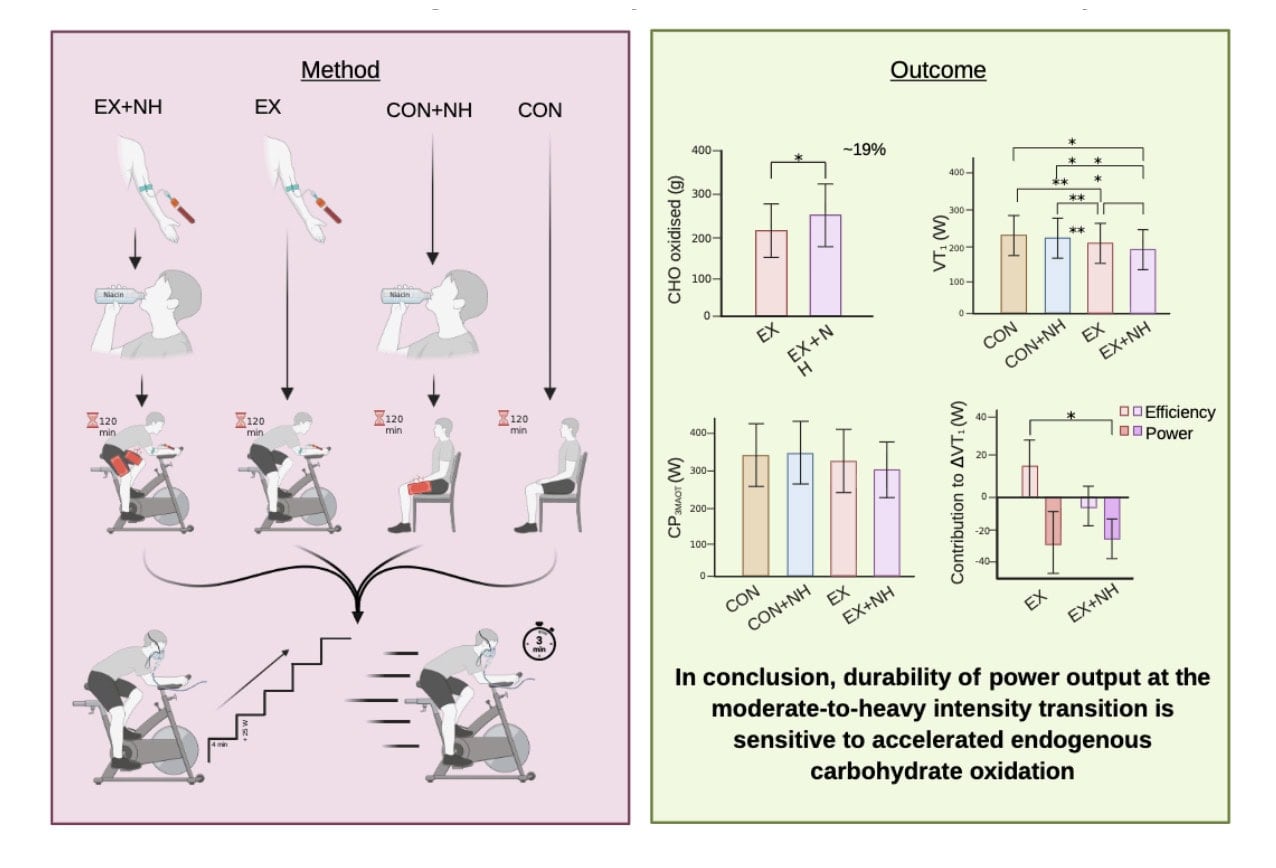
The first experiment examined what happens when athletes burn through their own carbohydrate faster.1Maunder, E., Hofmeyr, S., Rothschild, J. A., Schaloffsky Bate, I., Prandoni, E., Chang, W.-L., Plews, D. J., & Kilding, A. E. (2026). Accelerating endogenous carbohydrate oxidation impairs durability of the moderate-to-heavy intensity transition. Journal of Applied Physiology. https://doi.org/10.1152/japplphysiol.90100.2026 Ed Maunder and colleagues studied 11 trained cyclists—eight men and three women—under four conditions: fresh and after two hours of cycling, each with and without a combination of niacin and mild heating of the thighs.
That might sound like an unusual intervention, but it served a specific purpose. Niacin suppresses the release of fat from adipose tissue, reducing its availability as fuel, while warming the muscles can accelerate glycogen breakdown. Together, these techniques increased estimated endogenous carbohydrate oxidation during the ride by approximately 19%.
The two rides used the same workload: 90% of each cyclist’s initial power at the first ventilatory threshold, the marker used for the transition from moderate to heavy exercise. Participants ate a carbohydrate-containing meal beforehand but drank only water during the rides.
After ordinary cycling, power at that threshold fell approximately 7%. With accelerated carbohydrate use, it fell a further 7%—about 13% below the fresh condition overall. In other words, burning through more of their own carbohydrate roughly doubled the deterioration in this measure of durability.
The additional decline was explained by differences in metabolic efficiency—how effectively the cyclists converted energy into pedaling power. After ordinary cycling, efficiency actually improved, partly offsetting the decline in threshold power. That improvement was absent when carbohydrate use was accelerated.
One possible explanation is that greater glycogen depletion in slow-twitch muscle fibers forced the cyclists to recruit more of their less-efficient fast-twitch fibers. That’s the authors’ proposed mechanism.
The findings also depended on which physiological boundary the researchers examined. Critical power—the higher boundary between heavy and severe exercise, estimated here with a three-minute all-out test—didn’t differ significantly between conditions.
The experiment supports the idea that the rate at which we use our internal carbohydrate supply can influence how well we preserve our physiological capabilities during prolonged exercise. It doesn’t establish exactly which glycogen stores were responsible, whether feeding would prevent the deterioration, or how much carbohydrate an athlete should consume.
For the fueling question, we need to look at the next two studies…
100 g/Hour Beat 60 g/Hour, but Not by Sparing Muscle Glycogen
The second study tested a more recognizable fueling decision: 60 versus 100 grams per hour.2Mazza, O. B., Ørtenblad, N., Nielsen, J., Lundby, C., & Gejl, K. D. (2026). Carbohydrate intake of 100 vs. 60 g·h⁻¹ during prolonged cycling improves durability without altering muscle glycogen utilization in male endurance athletes. Medicine & Science in Sports & Exercise. https://doi.org/10.1249/MSS.0000000000004180 Oscar Brogaard Mazza and colleagues studied 15 trained male cyclists and triathletes in a randomized, double-blind crossover experiment. After a carbohydrate-rich day of eating (a “mini carb load” if you will), participants completed four hours of cycling with high-intensity intervals, then a 15-minute time trial.
Compared with their fresh performance, average time-trial power declined 9.3% with 60 g/hour and 6.4% with 100 g/hour. The higher intake preserved an additional 9 watts, on average.
When researchers looked at their muscles, it revealed substantial glycogen depletion, but no detectable differences between the lower and higher carb intake. Meanwhile, whole-body carbohydrate oxidation was better maintained with 100 g/hour, and blood glucose remained stable in both trials.
That combination tells us something useful—better performance occurred without detectable additional muscle glycogen sparing. It doesn’t establish the mechanism or make glycogen unimportant, but it does show why “more carbs preserve more muscle glycogen” is an incomplete explanation for their performance-boosting and durability-enhancing effects.
Is There a Ceiling? Do 120 and 150 g/Hour Beat 90?
The third study pushed intake higher, asking whether the benefits kept increasing.3Martyn, H. J., Gonzalez, J. T., Stellingwerff, T., Burke, L. M., Owens, D. J., Pugh, J. N., & Morton, J. P. (2026). Effects of 10, 90, 120 and 150 g·h⁻¹ CHO on substrate metabolism, exogenous oxidation and exercise capacity: Implications for CHO personalization. Medicine & Science in Sports & Exercise. https://doi.org/10.1249/MSS.0000000000004176 Henry Martyn and colleagues studied eight trained men using a three-hour cycling protocol followed by a demanding exercise-capacity test (they cycled at 150% of their lactate threshold for as long as possible).
The 10 g/hour condition came first as familiarization; subsequent trials used 90, 120, and 150 g/hour.
Average exogenous carbohydrate oxidation increased across the three higher intakes: 1.23, 1.48, and 1.62 g/minute, respectively. Yet whole-body carbohydrate oxidation was identical at 120 and 150 g/hour, and exercise capacity did not differ significantly among the three higher doses—though ALL of the higher doses improved exercise capacity compared to the 10 g/hour dose and maintained blood glucose throughout exercise, whereas the lowest dose did not.
The estimated optimum intake from this study was 107 g/hour. Given eight participants and no significant separation among the higher doses, I would be careful about treating that estimate as a precise prescription. And burning more incoming carbohydrate did not establish an additional performance benefit (at least among the three highest doses).
The Big Picture: Grams Eaten, Fuel Burned, Performance Preserved
The connection I see across these papers is that carbohydrate availability can influence durability, but grams consumed, fuel burned, and performance preserved describe different steps in the process.
The practical takeaway is still what you can do late in exercise. A fueling strategy deserves evaluation against that endpoint, alongside whether you can execute it comfortably and consistently. That’s something I think we often fail to discuss in fueling conversations. More is better, until it’s not. You have to TRAIN to be able to consume more carbs during exercise. It’s not simply a problem that can be solved on race day by eating more.
What this means for runners
My practical approach would be to rehearse an intended fueling strategy during relevant long sessions and keep a simple record: intake, pace, perceived effort, and stomach comfort. Repeating reasonably comparable sessions will tell you more than judging a strategy from one unusually good or bad day. I’d recommend conducting your own personal “fueling experiment” to find an intake that works for you.
These are all cycling experiments, and the two intake studies enrolled men. They leave uncertainty about exact doses for runners, women, and different event demands. They also examined immediate responses; they don’t tell us whether a particular fueling strategy produces superior training adaptations over months (although I think the intuitive answer is “yes.”)
For now, I’d put fueling alongside pacing and training when thinking about the strength of your finish. Ask whether your nutrition plan helps you sustain the work your event requires.
References
RunClub — Free
Join 300,000+ runners in RunClub
Free training plans for every distance, a daily running game, exclusive coaching content, and a real community of runners. Create your free account in 20 seconds — no card.
Already a member? Log in →











Start the conversation