


The 2026 TCS London Marathon runs Sunday, April 26. It is the 46th edition of the race, the largest marathon in history by finisher count, the richest fundraiser in sport, and the flattest and fastest course on the World Marathon Majors circuit.
After the elite women step onto the line at 9:05 a.m. local time, what follows is six hours of elite racing, mass-participation scale, and a closing-mile atmosphere on the Embankment that no other city marathon matches.
Below is everything worth knowing before Sunday morning: how and where to watch, the weather forecast, an insider breakdown of the course, the three major withdrawals that reshaped the elite fields, the British contingent, and the men’s and women’s races as they now stand.
How to watch
BBC One and BBC iPlayer carry live coverage from 8:30 a.m. UK time, running through the elite races and most of the mass field. Coverage shifts to BBC Two from around 2 p.m. for the tail end of the mass race. Evening highlights air on BBC Two around 6 p.m.
In the United States, Canada, and Australia, the live feed is on FloTrack (subscription required). In Kenya, Citizen TV has typically carried the race live. Official live tracking for individual runners is available via the London Marathon app, which lets spectators follow athletes by bib number with 5K split updates.
Start times on Sunday, April 26:
- 8:50 a.m. — Elite wheelchair race
- 9:05 a.m. — Elite women
- 9:35 a.m. — Elite men, followed by the first mass wave

Marathon Handbook watchalong at Knees Up, Hackney
Our Marathon Handbook crew is hosting a live London Marathon watchalong at Knees Up, the running-and-coffee space at 455 Hackney Road in east London, starting around thirty minutes before the elite women’s gun. Coverage will run from the elite women’s start through the men’s finish, with cortados, Brunswick East bakes, and a room full of people who know who to cheer for at each 5K split.
Knees Up was founded by Matt and Oli, two runners who built the space around the idea that a cafe and a running store can share a room. The shop side carries a tight curation of apparel and kit. The cafe side runs on quality espresso and rotating pastries. On marathon morning it becomes the closest thing London has to a clubhouse for runners watching the race they could not get into the ballot for.

Weather
The forecast for Sunday, April 26 is close to ideal racing weather. High of 59°F (15°C), low of 41°F (5°C), a 7 percent chance of rain, light winds, and dry conditions with sunny spells. For elite athletes, that is the kind of morning that puts course records in play. For mass runners, it is cool at the start, warming on the Embankment, with enough cloud to keep heat off the back stretch.
London’s record book is full of fast times run in exactly this kind of weather. Kelvin Kiptum’s 2:01:25 men’s course record and Tigst Assefa’s 2:15:50 women’s-only world record, both set in the last three spring editions, went down under similar conditions.
The course, mile by mile
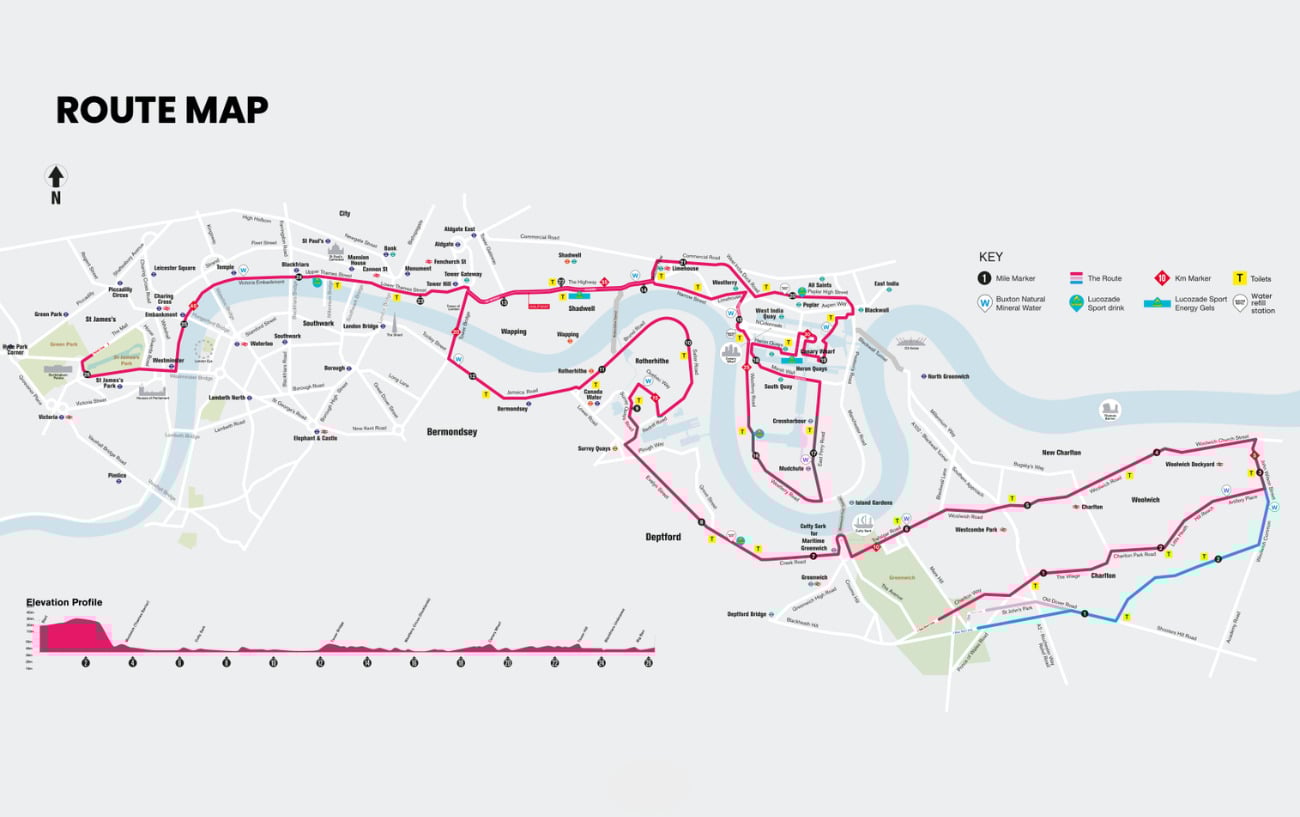
London is the flattest course on the World Marathon Majors calendar. Total elevation gain sits between 119 and 138 meters, there is no sustained climb, and the start is slightly higher than the finish. On paper, that makes it fast. On the ground, runners who do not know the course still lose time in predictable places. The following is where the race actually bites.
The three starts (miles 0 to 3)
There is no single starting line for non-elite runners (aka most of us). Runners are assigned one of three color-coded starts, confirmed by the organizers roughly three weeks before race day. The Blue Start is on Blackheath. The Red Start and Green Start sit a short walk apart in Greenwich Park, with the Red Start on Charlton Way and the Green Start near St John’s Park. The elites use the Blue Start.
The three routes merge around mile 2.8 in Charlton. The first three miles are the biggest downhill of the course, and the electric atmosphere tempts new runners into banking time they cannot keep. Marathon Handbook’s guidance is consistent with every London coaching group’s: run the first 5K 5 to 10 seconds per mile slower than goal pace. The drop is real. The pace it pulls out of you is worth more later.
Cutty Sark to Tower Bridge (miles 3 to 13)
The course picks up the Thames at the Cutty Sark in Greenwich at roughly mile 6.5, one of the first major landmarks and one of the loudest crowd sections of the first half. The route then winds north through Deptford, Surrey Quays, and Rotherhithe before crossing Tower Bridge at roughly mile 12.5, just before the halfway mark. The Tower Bridge crossing is the emotional high point of the mass race, with sound reflecting off the bridge structure from both ends.
Halfway sits on the Highway, just past Tower Hill, at 21.1 kilometers.
The Isle of Dogs and Canary Wharf (miles 15 to 20)
This is where the race is won, lost, or survived. After the Highway, the course loops south into the Isle of Dogs and Canary Wharf. It is the toughest section of the course and the one that regular London runners flag first when asked what new runners underestimate.
Three things matter here. First, the crowd thins. Westferry Road at mile 17 and Poplar High Street at mile 20 are the quietest crowd sections of the course, and they land at exactly the stretch of the race where the legs are starting to complain. Second, the tall buildings block GPS signals, so watches drift and pace readings go strange. Runners who rely on watch pace can panic. Trust effort, use the mile markers. Third, the course doubles back on itself through Canary Wharf, so slower runners see the leaders coming the other way, minutes ahead. It is either a huge boost or a huge demoralizer depending on where the head is.
The Isle of Dogs also has the sharpest turns on the course. Runners who hold the outside of those bends are adding meters they do not need.
The Highway and the Blackfriars tunnel (miles 21 to 24)
Once the course leaves Canary Wharf and rejoins the Highway, the road opens up again and the crowds come back. Mile 23 has a short incline that is barely on the elevation chart but feels considerably bigger than it is at that point in the race. The Blackfriars underpass around mile 24 is the quietest stretch of the back end: dark, enclosed, no spectators. Survive it and the course pops up onto Victoria Embankment.
The Embankment and the finish (miles 24 to 26.2)
The Embankment is the best two miles of crowd support in marathon running. The road bends gently along the Thames with Big Ben growing in the distance. Runners pass Parliament Square, Birdcage Walk, the Queen Victoria Memorial, and take the sharp right turn in front of Buckingham Palace onto The Mall for the final 385 yards to the finish. The Mall is wide and short. Most runners report the last 385 yards feeling like one of the easiest segments of the race, because the crowd carries them through.
Fueling and aid
Official fuel stations on course at mile 13 and mile 18 offer Lucozade Sport gels in one flavor. For most runners, those are too late and too infrequent to be the primary fueling strategy. Mass-wave runners should plan to carry their own gels or chews, taking the first one by 30 minutes in. Drinks stations are spaced roughly every three miles, with sponges and shower stations at several points along the back half.
The mass race is breaking every record on the books
The 2026 London Marathon received 1,133,813 ballot entries, a world record for any marathon. The event is on track to again stage more than 56,000 finishers, which would extend London’s hold on the title of largest marathon in history. In 2025, London runners raised £87.3 million for charity, a single-race fundraising record in sport. The 2026 Charity of the Year is Marie Curie, extending a fundraising tradition that has become the defining feature of the event.
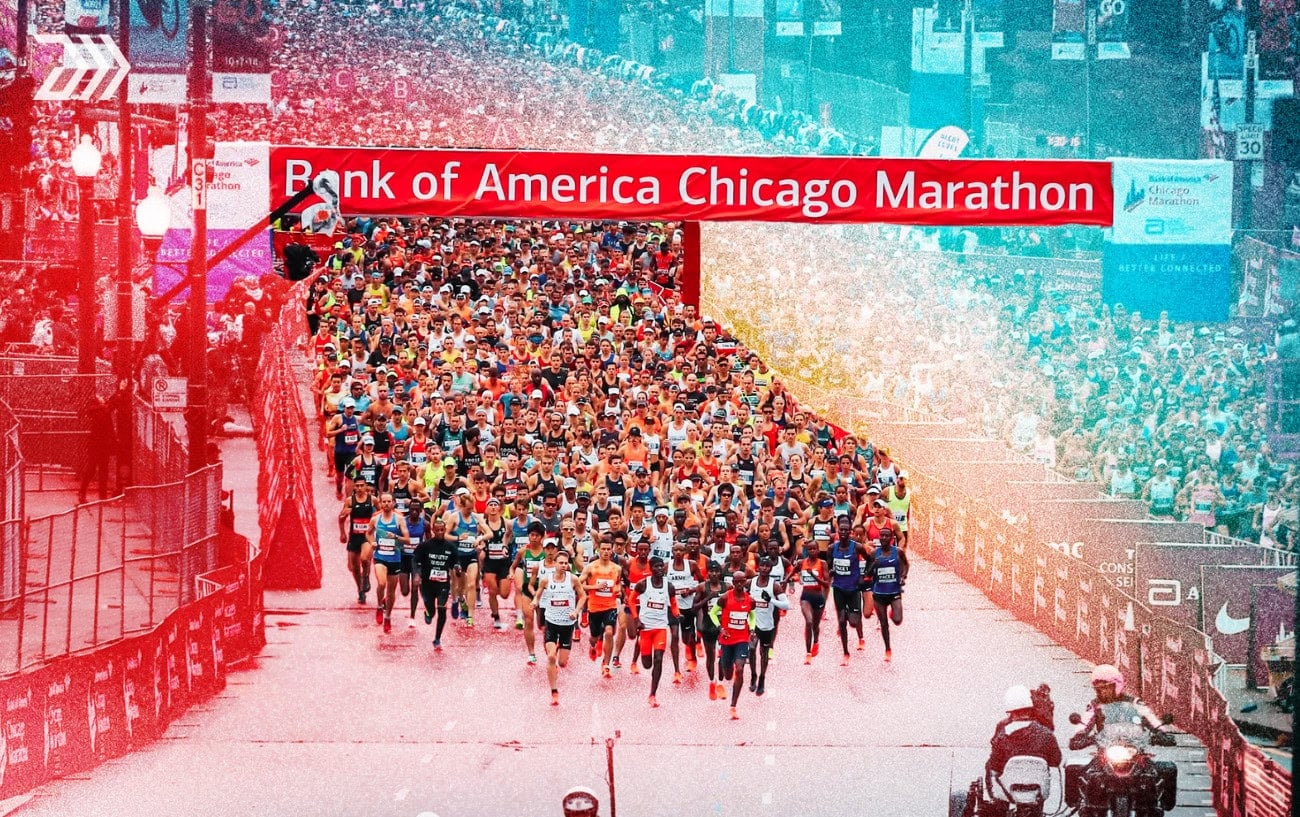
No other major marathon combines elite competition with mass-participation scale the way London does. The Boston Marathon is smaller and selective. Chicago is comparable in size but smaller in fundraising. Berlin is faster on the clock but half the scale. London sits alone at the intersection of elite racing, mass numbers, and charitable fundraising.

The three withdrawals that reshaped the elite field
The 2026 field has lost three of the four names the pre-race coverage was built around.
Sifan Hassan — the 2023 London champion and reigning Olympic champion from Paris — withdrew in early April with an Achilles injury. Hassan had been the runner most likely to push Tigst Assefa into a world-record attempt.
Peres Jepchirchir — the 2024 London champion, Tokyo Olympic gold medalist, and women’s-only world record holder at 2:16:16 before Assefa broke it last year — pulled out with a stress fracture. Jepchirchir’s withdrawal followed Hassan’s by a matter of days and removed the second of the three women capable of winning.
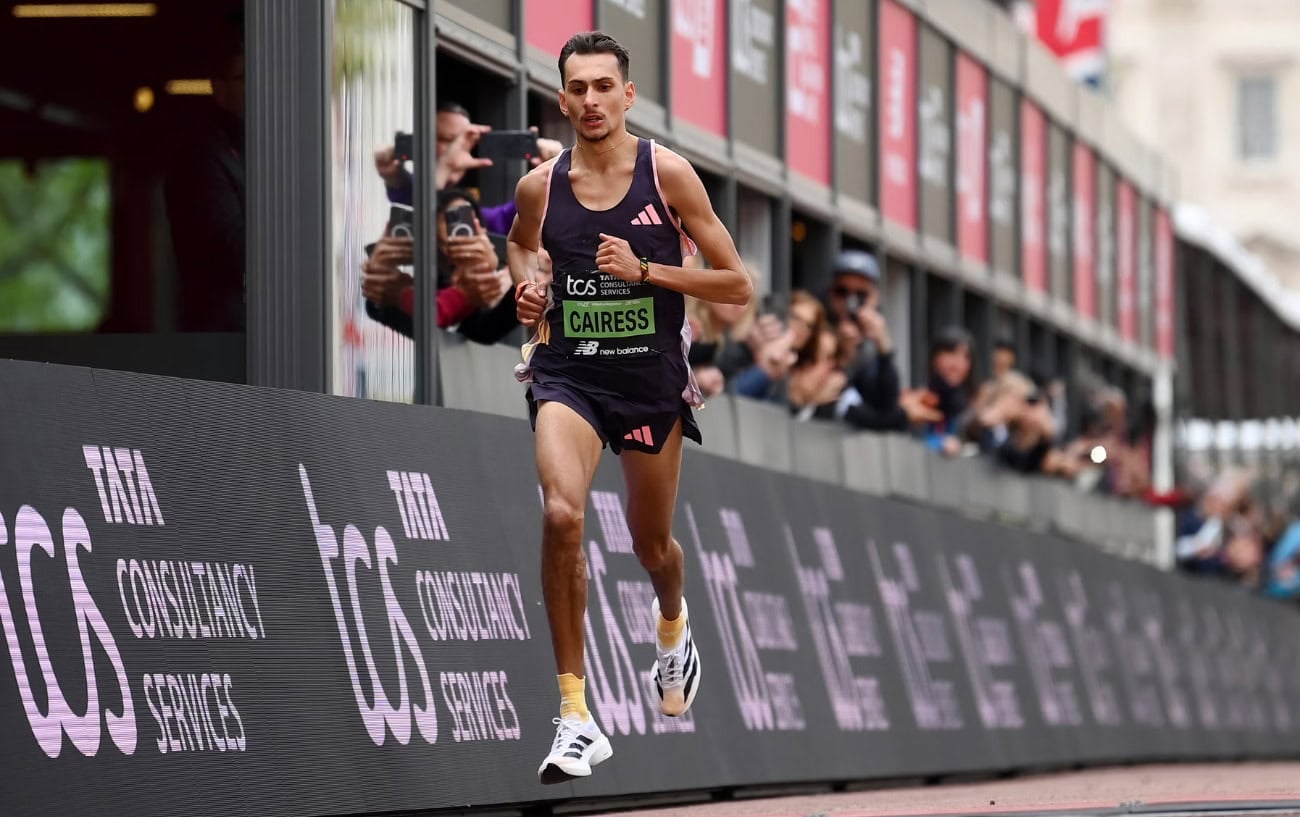
Emile Cairess — the British runner who finished fourth in 2024 in 2:06:46 and third in 2025 in 2:08:42 — is out for the second consecutive April with a calf injury. Cairess was on course for the biggest British men’s marathon result in a generation. Losing him for the second year in a row is the kind of setback that reshapes the British coverage of the race entirely.
British contingent
Men
With Cairess out, Mahamed Mahamed and Phil Sesemann are the British leaders on the start line. Both have moved into the 2:07 to 2:08 range over the last two years. A top-ten on home soil is within reach for either. Jonny Mellor, the Commonwealth Games runner, is the third British name to watch. Nobody in the British men’s group has run under 2:07, which is the honest cost of losing Cairess twice.
Women
The women’s side is deeper. Eilish McColgan, who set the British record at London in 2024, is building toward another attempt at 2:22. Charlotte Purdue, the 2:22:17 runner and two-time top-ten finisher at London, returns. Phily Bowden, Rose Harvey, Calli Hauger-Thackery (sixth at Boston last week in a hot race), and Jessica Warner-Judd round out a British women’s group deeper than any in recent memory. A British woman in the top-ten is more than plausible. A British woman running under 2:22 is the realistic upper bound.
Men’s Elite Race
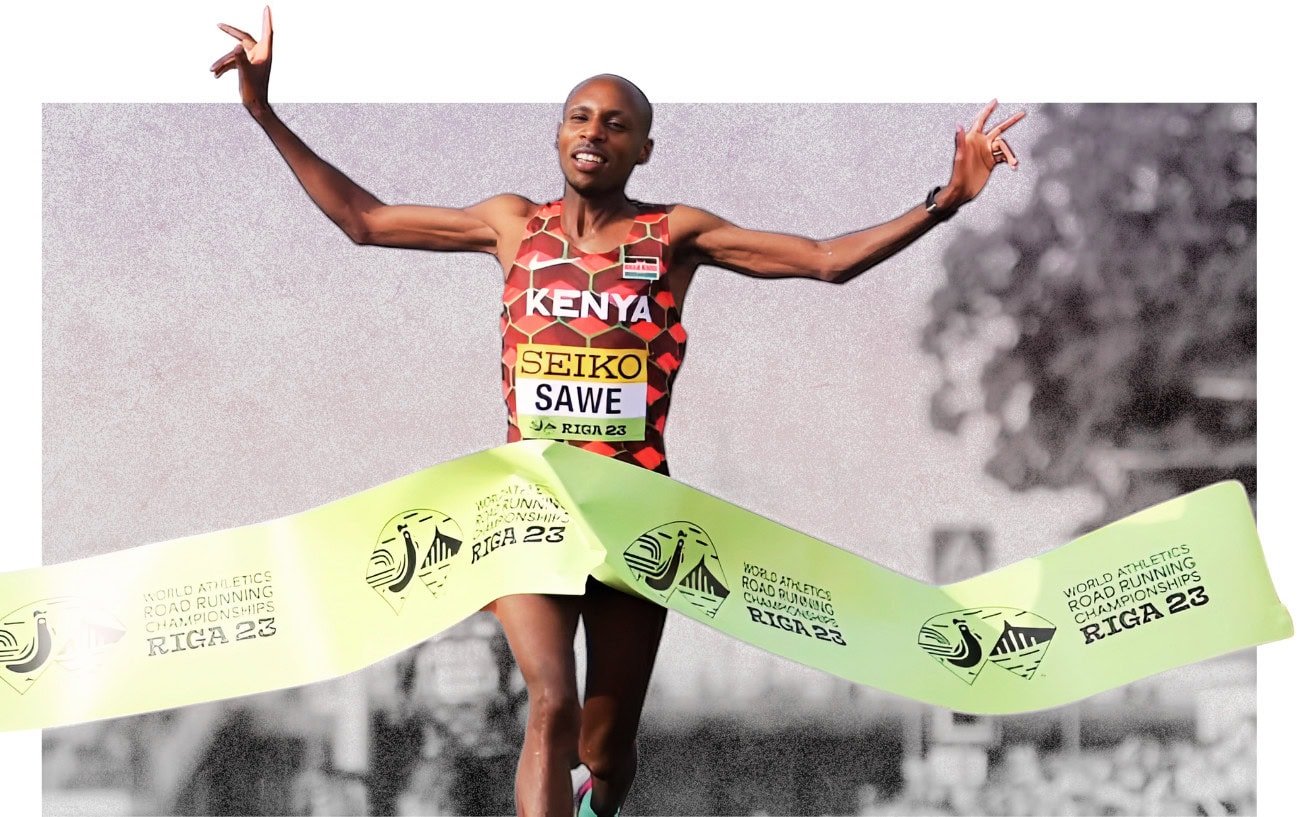
Sabastian Sawe returns as defending champion. The Kenyan won London in 2025 in 2:02:27, then doubled up with a 2:02:15 win at Berlin in September. He has arrived Sunday as the clear candidate to win back-to-back London titles. The question is not whether he can contend, but whether anyone in the field can drag him into the kind of fast race that threatens Kelvin Kiptum’s 2:01:25 course record from 2023.
Jacob Kiplimo is the one runner who can. The Ugandan finished second to Sawe in his marathon debut here last April, running 2:03:37 on a course he had never raced before. In March, he ran 57:20 at the Lisbon Half Marathon to reclaim the half-marathon world record. A year more experienced, with the fastest legal half-marathon ever run on his resume, Kiplimo is the clearest threat to Sawe and to Kiptum’s record.
Hagos Gebrhiwet, the 2024 Olympic 10,000m silver medalist, is making his marathon debut and arrives with the fitness of a track runner who has never been tested over 26.2 miles.
Joshua Cheptegei, the 5,000m and 10,000m world record holder, has returned to marathon racing after a difficult debut in Valencia in 2023. His most recent major marathon result was his best yet, and London is the course where he has the clearest shot at putting together a complete race.
Women’s race
After Hassan’s and Jepchirchir’s withdrawals, the women’s race has one obvious answer at the top.
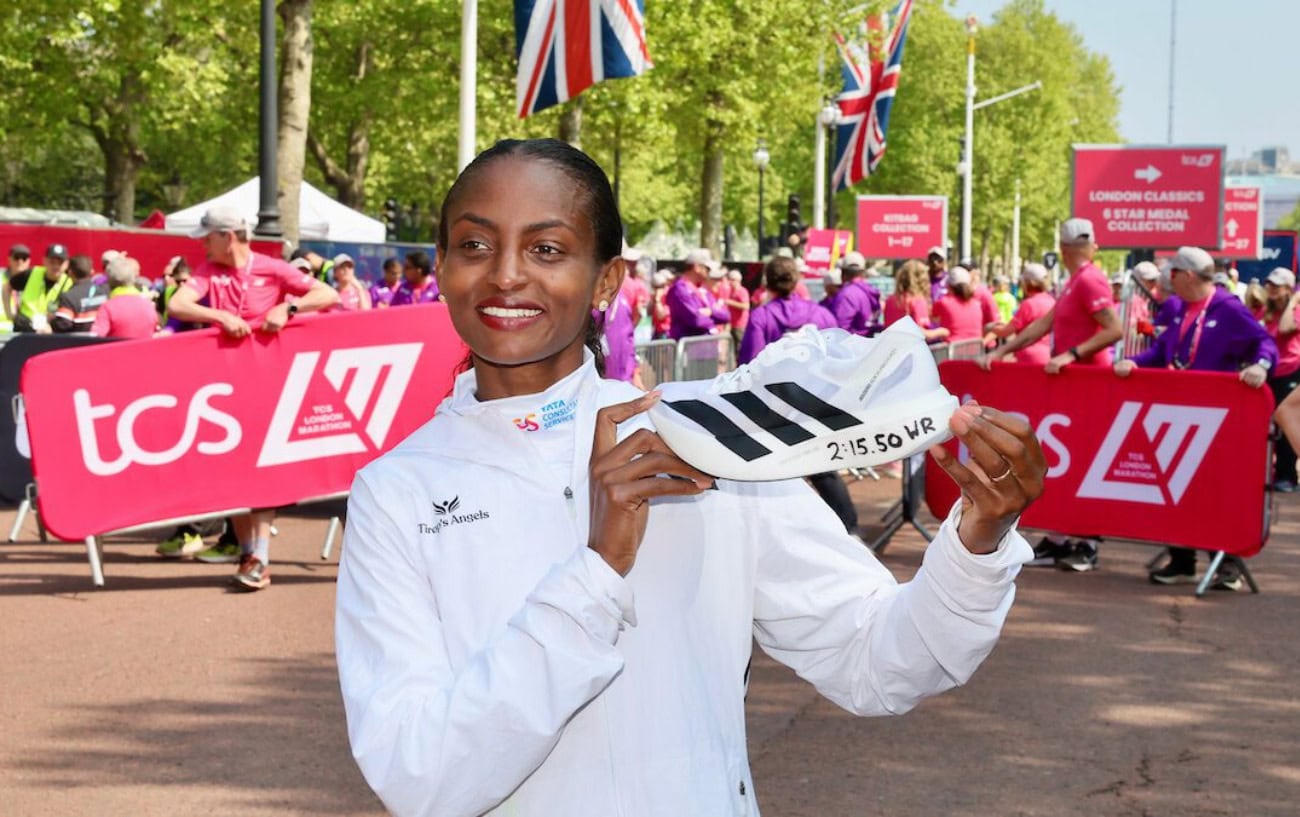
Tigst Assefa owns the women’s-only world record of 2:15:50, set at London last April. The Ethiopian was second in 2024 in one of the closest sprint finishes in major marathon history, and in 2025 she came back to run the fastest women’s-only marathon ever recorded. With Jepchirchir and Hassan out, the only runner in the field with a credible case against Assefa is Assefa herself. Her own record is within reach on Sunday, and the forecast favors it.
Joyciline Jepkosgei, the Kenyan who has run 2:16:24 and won London in 2021, returns as the most experienced contender now that the other names have fallen away. Her PB is elite, her recent marathons have been uneven, and a strong Jepkosgei is the runner who could force Assefa to choose between defending the win and chasing the record.
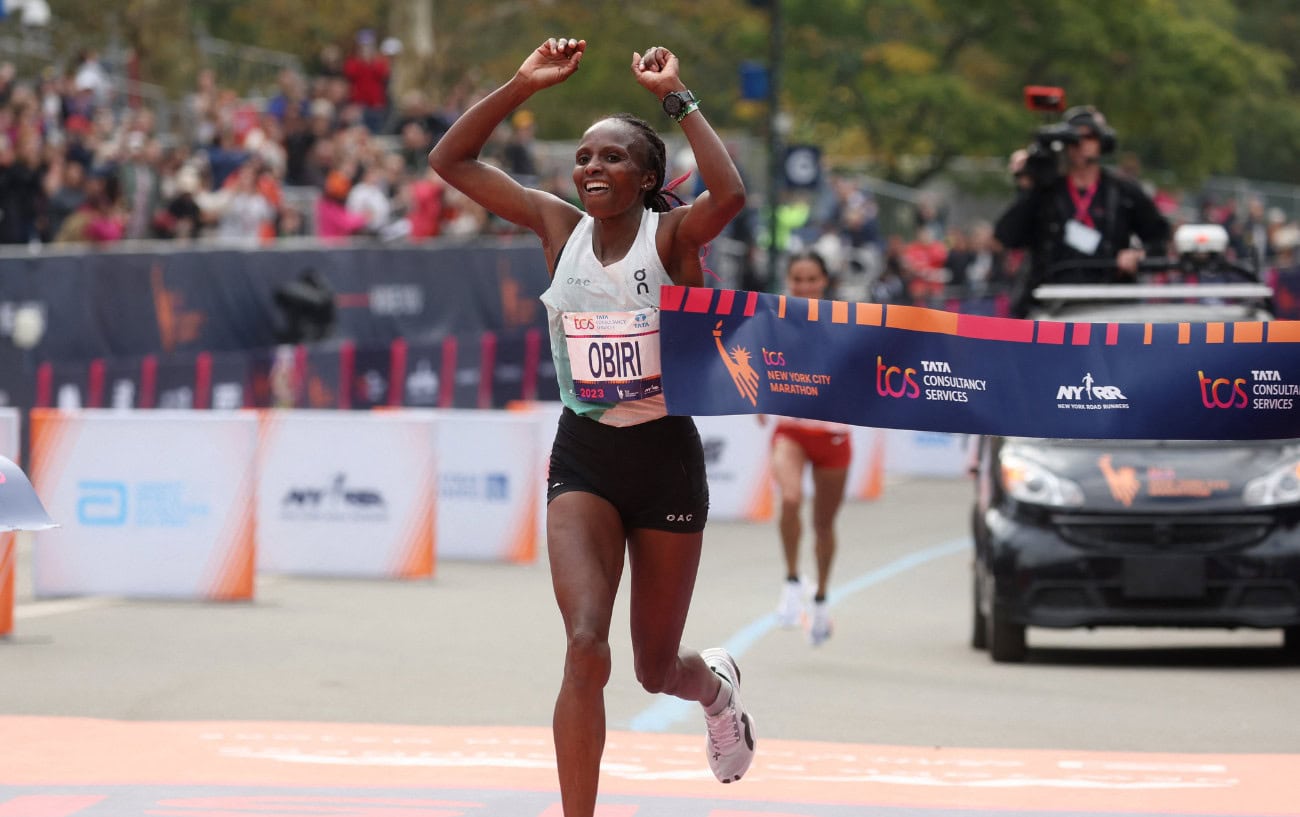
Hellen Obiri, the two-time Boston champion, is making her London debut. Obiri’s choice of London over Boston this spring, revealed in February, was the move that reshaped both spring major fields. She is running here instead of defending her Boston crown, where Sharon Lokedi took the title for the second year running last Monday. Obiri has never run a flat, fast course at this level. Whether she wins on Sunday or not, her debut is the most interesting watch of the morning on the women’s side.
Megertu Alemu, the 2:16:34 runner from Ethiopia, and Vivian Cheruiyot, the four-time Olympic track medalist with a 2:18:31 PB, round out a front group that still has genuine depth.
RunClub
Get more running stories — join RunClub
Daily running news, a community of 300,000+ runners, free training plans for every distance, and a daily running game. Free to join — no card.
Already a member? Log in →






Start the conversation