

Adirondack Marathon
Must See/Must Avoid
MOST OF the activities that bring people to the Schroon Lake region are outdoor activities such as fishing, boating, hiking, and other sports-oriented events, but there are still a few things to do and see, especially if you don’t mind driving about 60 miles north to Lake Placid or 30 miles south to Lake George. And the fall foliage is just about peak, so the drive on the New York State Northway is very scenic.
GO SEE IT
Lake Placid Olympic Village & Museum. Lake Placid was home of the 1932 and 1980 Winter Olympics. The museum includes video highlights of the Olympic Games plus sports memorabilia and equipment. It is also the site of three ongoing Olympic Training Centers, so you might catch the athletes at practice. There is a self-guided tour, and the chairlift offers incredible vistas of the surrounding mountains and foliage.
Lake George Boat Cruises. A boat cruise on Lake George may sound hokey, but it is a great way to see the lake, especially in September when most of the summer boaters have left the lake and the waves to the locals. It’s a pleasant way to spend an afternoon, or you can opt for the dinner cruise.
Strand Movie Theater, Schroon Lake. A classic/vintage movie house, The Strand Theater, built in 1937, has been restored by the current owners to painstaking detail and shouldn’t be missed. They plan to feature a showing of Marjorie Morningstar, which was filmed in Schroon Lake.
Pharaoh Mountain Wilderness Trails. Great hiking trails and vistas are close to town. Some of the trails are near the marathon course. You can’t go to the Adirondacks and not hike, and these trails are accessible for every level of hiker.
Natural Stone Bridge and Cave. This has been a favorite destination for over 200 years. The self-guided tour of the cave and stone bridge features unusual rock formations, waterfalls, and The Cave of the Lost Pool. It is located 10 minutes from Schroon Lake on Stone Bridge Road, and marathoners pass the entrance at mile marker 18.
AVOID IT
Route 9. Avoid driving anywhere on the morning of the marathon, as the primary thoroughfare, Route 9, the only road into and out of town, is closed at different times to traffic from 8:45 A.M. to 2:30 P.M.
If Boston Can Do It, So Can We
Dan Perry came up with the idea for the town’s marathon. As the legend goes, Dan went to Boston to watch his son-in-law in the 100th running of Boston in 1996 and wanted to capture the thrill of the event and bring it back home to Schroon Lake. Providentially, one loop around Schroon Lake measured 26 miles; add a quick jog around the school building, and he had his 26.2. With marathon plan in hand, Dan gathered a small committee and pitched his idea. After initial comments—”What’s a marathon?” “How many miles is that, you say?”—things began to fall into place quickly.
Raising the money to put on a marathon is always a concern, especially for a small town. Jen Parker, the local physical education teacher and head of the sponsorship committee, came up with the idea to auction each mile for $1,000 and soon reached the goal of $20,000. Parker, a non-runner at the time, was so taken with the idea of the marathon that she trained for and ran the marathon the following year and has done so every year since, going so far as to drag her husband into the act. The beauty of a small-town marathon is the attention to detail: the committee gave Parker #150 in recognition of running her first marathon at age 50.
Parker has become the town crier for the marathon, using the lessons she learned in training to teach her kids about the importance of exercise. She challenged her students to run 25 miles in 25 days, with a mile race tagged on to the end to make it an official marathon for them. The kids were so inspired by her courage and seemingly impossible goal that at her first marathon in 1998 they formed a gauntlet with arms raised high for her to run through at the start line.
Dr. Sheridan Albert, a dentist from Schroon Lake, has been part of the organization committee since its inception and has the rewarding job of announcing the race. “The marathon committee is like one big family,” he says. “We all know each other, work well together, and respect one another. It doesn’t get better than that.”
Approximately one year and five months after the formation of his dream, Dan and his committee members held the inaugural race in September 1997. The committee set their goal for an initial field of 500, which they achieved with a little help from their Canadian neighbors—the Montreal Marathon was cancelled that year, sending disappointed runners across the border to run Schroon Lake instead. Dan likes to tell the story of the couple from Belgium on their way to the Montreal Marathon who pulled off the thruway for lunch in Schroon Lake and decided to run the Adirondack Marathon instead. The open women’s winner that first year came from Germany.
Small-Town Charm
Schroon Lake, settled in 1804, has a year-round population of 1,800, which swells to 5,000 during the summer months. The town is a throwback to a quieter, gentler kind of living. You almost expect Sheriff Andy Taylor and Opie to come whistling down the street with their fishing poles over their shoulders.
The town has one main street, locally referred to as Main Street, but technically known as Route 9. The Sugar Bowl Restaurant is the place to grab a carbo-breakfast the day before the marathon, where the fashion code is marathon T-shirts from all over the world. The friendly waitresses offer a 10 percent discount if you’re running their marathon.
French-Canadian blends with English, and everyone has a grand time. It’s homey. Almost every store has a crayoned “Welcome Runners” sign in the window, a refreshing reminder of a simpler time before commercialism and merchandising took precedence over the actual lore of the marathon.
Next door to the Sugar Bowl is the Marathon Hospitality center, where Lil Richardson greets the runners and their families, offering a place to sit for a spell and study the marathon course, ask questions, or spend a few minutes’ work on the 1,000-piece jigsaw puzzle under way in the corner near the complimentary coffee and donuts. Lil knows everything about the marathon and Schroon Lake and is glad to explain how Schroon Lake got its name. It’s a very romantic story about an Indian princess and her lover. Unfortunately, the story has a sad ending, as the lovers ended up drowning in the lake. Lil might also inform you that houses in Schroon Lake had no street numbers until this past spring when the emergency phone number 911 was introduced, which brought along a requirement to affix numbers to houses.
TLC Registration
Pete Johnson handles registration at the Schroon Lake Central School, conveniently located a few steps across the street from the Sugar Bowl. This year, the complimentary race shirts were nylon water-repellant pullovers—very practical, although some runners were disappointed they didn’t get the second year’s popular long-sleeved “Adirondack Green” shirt.
The race registration is a bargain $30 in advance of the deadline; the $7 pasta dinner the night before the race is held at a campsite, making for lots of family fun. Other than that, dinner choices are rather slim, as the town is small and you probably don’t want to get back on Northway and drive 20 miles to the next town.
However, Terrio’s on Route 9 (at the 23-mile marker on the course) offers a full menu and a bar upstairs and is the location of the postrace party. DeCesare’s Pizzeria, south of Schroon Lake and also along the marathon course, offers pizza and pasta. Another place for pasta is Drake’s Restaurant on Route 9, where Chef Tony will be happy to serve you a great Italian meal.
With the marathon’s boost in popularity, a new feature was added to this year’s registration: a Circle of Champions’ press conference, where everyone has an opportunity to meet and talk with the elite and special entrants. This year, Japanese runner Hajime Nishi, whose goal is to run in 250 countries, ran the Adirondack Marathon. Hajime is running with the mission of bringing awareness of environmental issues to all the countries he visits. He believes we are all connected beyond our borders through the environment and we need a better awareness of how to solve problems causing environment degradation. Hajime also insists on being the last finisher at each marathon he runs, so if you’re fearful of finishing last, run with Hajime. His Web site is www.ecomarathon.org.
Another participant in the Circle was Moroccan runner Youssef Ennaciri, who has a PR of 2:11:50; his presence added speculation of a new course record.
Establishing an Attainable Goal
Race director Mark Elmore has set a goal for the marathon that doesn’t involve making money or setting PRs, although these could occur as byproducts. He wants the runners to have a great weekend and enjoy the hospitality of Schroon Lake. Elmore puts on a world-class event with a downhome feel. Runners feel good about the time they spend in the village. When asked about the use of ChampionChips to curtail cheating, Mark laughs and says they aren’t needed here. “There’s no place to go or hide for cheats,” he said. “It’s one long road for 26 miles surrounded on one side by woods, so a potential cheater would have to weigh the possibility of running into wildlife, and on the other side by water, which would require the cheater to be a darn good swimmer to get away with it.”
Running the Course
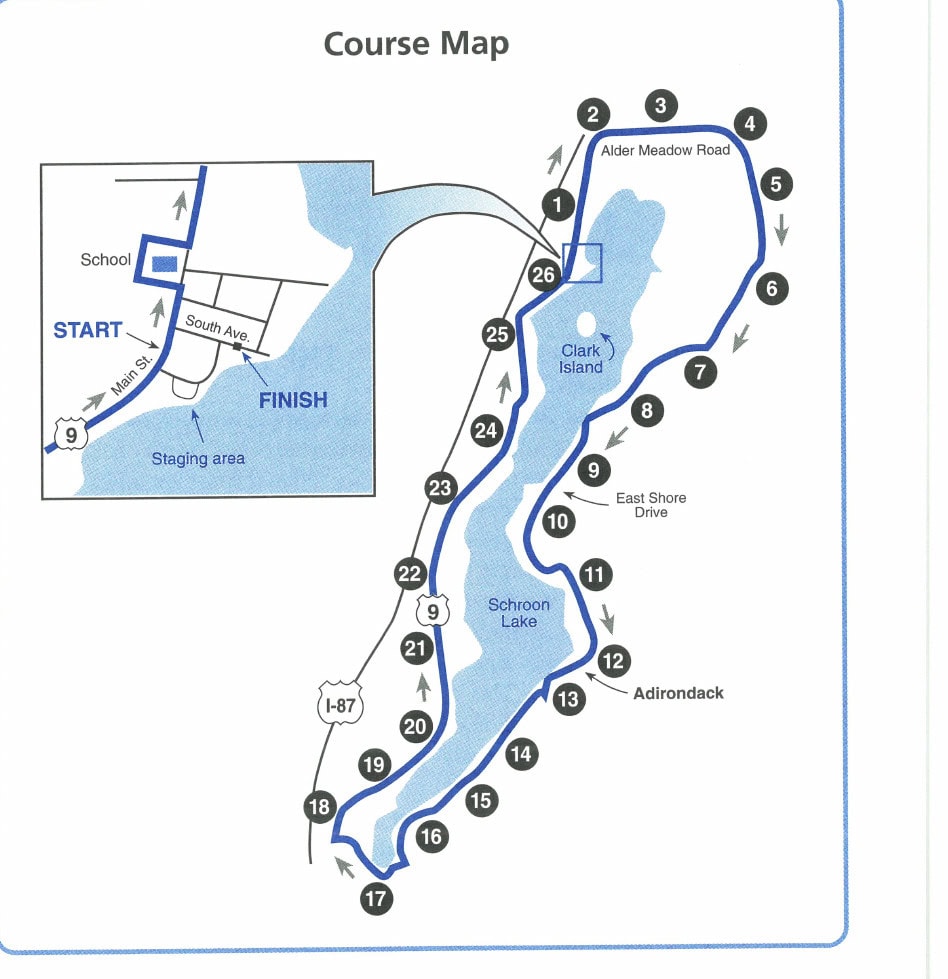
Called “probably the most beautiful 26 miles, 385 yards you’ll ever run,” the Adirondack Marathon lives up to its billing. The course showcases the best of the picturesque lake and foothills ablaze with a full fall spectrum of colors. The start line is smack in the middle of Main Street. Runners mill about with their family and friends right up to the last minute, shedding warm-up clothes, taking photos, and getting well wishes, hugs, and kisses.
When the gun goes off, the runners race up Main Street, taking a quick left turn into the school parking lot to circle the small red brick school building in order to cover the extra 385 yards needed before heading off to circle the 26-mile lake.
At mile two, runners turn right onto Alder Meadow Road. Those new to the course may wonder what all the hill-hype is about since the going has been nice and easy so far. But the Adirondacks never do anything nice
and easy. They do hills. Big ones. Steep ones.
Passing Andrew Wyeth–looking barns, pretty little streams, ancient cemeteries, and apple orchards ripe with fruit falling off the laden branches, it’s easy to get tricked into thinking you’re strolling a country lane. But your balloon bursts about mile four, when the incline starts and just keeps going and going, getting longer and steeper all the time. You start thinking you’ve found a stairway to heaven, but you’re actually being lured into hell. Around mile seven, a handmade sign greets you: “Welcome to the jungle. Beware of the bears.” A man sits beneath the sign ominously beating a drum.
But soon the lake comes into view, with lovely, serene vistas among the white pine branches. Lake cottages are nearly hidden in the distance, with mile-high stacks of neatly chopped wood ready for the first frost—expected any day now.
By mile 8 the climb is beginning to wear down the runners as they pass a cottage address that proclaims simply, “The Loony Bin.” Hardly inspirational at this point in the climb. The hill begins to take its toll, and some runners become walkers. At mile 10, another cottage reads “Shangri-La,” which is either a bad joke for the marathoners or an inviting mirage. A stretch during miles 11 and 12 is the worst. Just when you think you can’t take it anymore, the hill gets steeper. Runners are heard muttering between gasps for breath. “This is insane. Are you kidding? What was I thinking?”
Runners Keep Coming Back for More
Dan Dominie has placed second every year since the marathon’s inception. “I keep coming back because it’s a great race and they take good care of the runners,” he says, “but the course is difficult. Besides the steep and numerous inclines in the first 12 miles, the race offers little incentive except to finish. It’s a very lonely race. There are long sections with no spectators at all, no crowds to cheer you on. It’s just me and the squirrels out there. But that works to my advantage because I train alone and am used to it.”
Another reason Dan keeps running is to add to his collection of Adirondack woodcarvings. The first year he won a bear, which he prominently displayed in his yard until it was stolen. Dominie, a sheriff’s deputy, didn’t take that theft too well, as it meant he had to run again to replace the stolen award.
Back on the course, the runners, totally exhausted from the grueling hillwork, are finally rewarded at the crest of the halfway point by a man standing in the back of his pickup truck playing his banjo and singing “You Are My Sunshine.”
Entering the town of Adirondack at mile 13, the runners are greeted by cheering spectators who have been bused to the halfway point by a courtesy shuttle from the village. The noisy crowd is a refreshing and well-deserved respite from the loneliness of the woods. Edgar Wiggins, a veteran of 25 marathons, ran the course last year and knew what he was getting into. He uses the town of Adirondack for his visualization technique. “Turning the corner and coming face-to-face with this magnificent wide-open view of the lake and the fishing boats and hearing the cheers of the people make it all worthwhile. It gives me a rush, and I know I can make the next 13 miles. I’ve run the big ones such as Marine Corps and New York City, but this marathon is special to me. I know they care about me personally. The volunteers at the water stations remembered me from last year and
| Runner’s High/Runner’s Low | |
|---|---|
| HIGHS | LOWS |
|
|
called out my name. And they are interested in my feedback, although I distinctly remember last year asking them to level some of the hills.”
The next three miles take runners along the east shore of the lake, with the crystal clear water on the right and cozy cottages on the left. Turning the final corner of the lake at mile 17, runners start the last stretch of the lake from mile 18 to the finish line at Schroon Lake town beach. This is perhaps the least favorite section of the course, and not just because body parts are wearing down. The concrete feels extra hard on the already sore feet, and although Route 9 is closed to traffic, one lane remains open for police and ambulances and is sectioned off by traffic cones.
The Final Miles
By now, some runners are swerving between the cones. And the nasty little secret is that the last six miles are an incline. No rest for the weary at this marathon. Mile-marker 20 is at the top of a hill, also marking the spot where Ennaciri, the Moroccan who was trying to break the course record, collapsed on the course from dehydration and had to be taken to the hospital. Mile 23 is also where Terrio’s Restaurant is located. Later that day, with the postrace party in full swing, Father John Malecki, at age 79 the oldest runner in the race and still on the course, got a little help from his friends. Father John took up running at the age of 64 when his physician told him to take up some sort of exercise for his severe arthritis. The Adirondack Marathon was his 19th marathon, and he was not about to quit. With Route 9 reopened to traffic, Father John plodded on at his walk/run pace. When the crowd at Terrio’s saw him, they poured out of the restaurant to cheer him on. Along with a state police escort the final two miles, two young women stayed with him to the finish, where a large crowd of race volunteers waited for him to cross the finish line and receive his medal. His time was 9:53:12. Wherever Father John runs, he inspires the crowds—and perhaps gets a few sedentary types to change their lifestyles.
The incline that began at mile 20 continues to climb. Runners are few and far between, which gives the volunteers at the water station a chance to check out bib numbers through binoculars so they can match up the runners’ names and give them a much-appreciated personal greeting.
Lori Crowingshield of nearby Keene was running her first marathon. A biker and rock climber, she thought she was in good shape and didn’t bother training, but veterans know better than to underestimate a marathon. “The last three miles were awful,” Lori says. “And to make matters worse, the concrete was unbearable. I didn’t train properly and did everything wrong my first time, but this race has become special to me. It was a lot of fun because of the interesting characters I met and the support from the locals. I ran behind Edgar Wiggins for the first half, and everybody called out his name. I was so jealous. Maybe next year they’ll cheer for me. I was afraid of this race because of the hills and its reputation, but now I know I can do it. That’s a great feeling that I’ll carry with me all year until next September.”
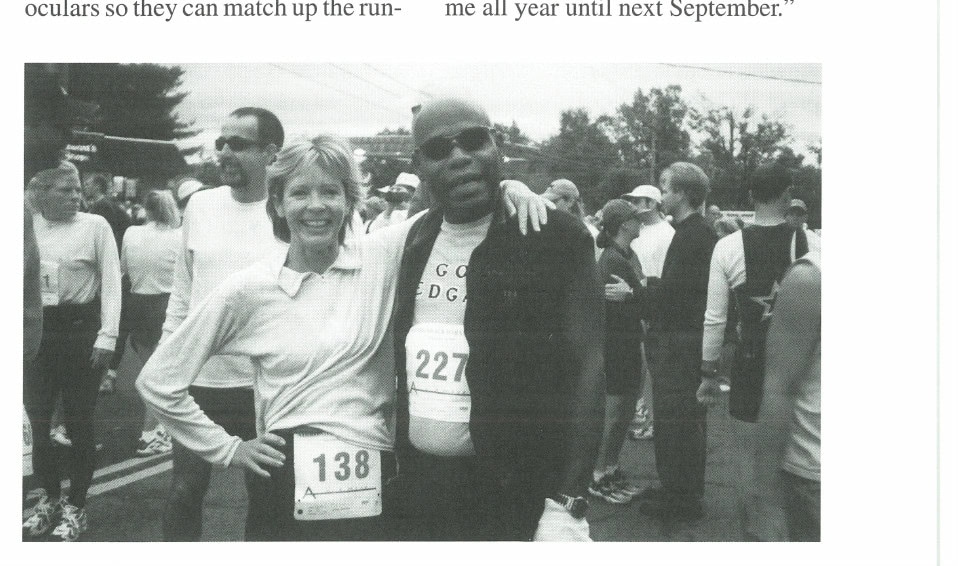
Entering Schroon Lake Village at mile 24, runners are met by applauding crowds. A quick right turn at mile 26 from Main Street brings them within sight of the finish line at the entrance to Town Beach. The crowds are three-deep by now and screaming for the tired runners. Almost every finisher has a smile as they are greeted by volunteers, wrapped in Mylar blankets, and handed a finisher’s medal before being led to the beautiful beach at the foot of Schroon Lake.
THE 2000 RUNNING POSTRACE BEACH PARTY
Not many marathons can boast of a beach party atmosphere after the race. Tents are set up at the foot of the beach, and volunteers hand out all sorts of energizing food, as well as homemade brownies, cookies, and other local treats. Massage and medical tents stand by for the needy, and nice hot showers are available right down the street at Central School.
The awards ceremony begins at 2:30, and this year a four-foot-high carved wooden eagle was the grand prize. Dan Dominie, who placed second again, received yet another bear for his collection. “I think I could have run a faster race, but I won the 5K the day before and lost a little bit of my edge,” he said. “But somehow I don’t mind being second to champion Peter Heimgartner for the third year in a row, as he’s a heck of a gentleman and a pleasure to run with—I mean behind.”
Even though they ran a small-town marathon, all the finishers came away feeling like big-time heroes. The good news for the first-timers who braved the course is that every other marathon will be a piece of cake. Veteran runners who have done Boston proclaim the Adirondack course much tougher: more hills and more unforgiving—just the way they like it. Those who use the course as a trainer for New York, Marine Corps, Hartford, or other fall marathons will surely miss the small-town charm of Schroon Lake, as they get swallowed up by thousands of other runners jostling for position.
The Adirondack Marathon is a great civic lesson in communities coming together to share a common goal: the safety of the runners and the assurance of a good time in their Adirondack region. Local and state police do an incredible job of protecting the runners and the roads, and ambulance corps from several communities are poised to save a runner from dehydration or exhaustion or to administer a quick high-five when needed.
So when you’re planning your fall marathon schedule, don’t think twice; it’s all right to think small. Be different. Be tough. The Adirondack Marathon is looking for the few, the bold, and the brave. And rumor has it that the 2001 field may be officially limited to 500 runners, so check out the Web site before it’s too late.
The Bottom Line
We have weighed various aspects of a marathon within a 1,000-point scoring grid. Besides the author of the article, two dozen runners at the race were randomly chosen to score the race for us (AM = Adirondack Marathon). The results follow:
1. HISTORY/TRADITION
Evaluate the race’s sense of history and tradition.
[Possible points: 30 AM score: 20]
2. ENTRY FORM
Is the race entry form clear, concise, attractive, complete, and easy to fill out?
[Possible points: 20 AM score: 20]
3. ENTRY COST
For most races, the entry fee covers between 30 and 50 percent of the cost of putting on the event. Rate the value of your dollar relative to this race.
[Possible points: 30 AM score: 30]
4. LOCALE/SCENICS
Is the race held in an area that is easy to get to and scenic and offers adequate food and housing services and nonrace activities for family and friends?
[Possible points: 50 AM score: 45]
5. REGISTRATION
Is registration well organized and efficient? Does it bog down unnecessarily?
[Possible points: 20 AM score: 20]
6. PRERACE ACTIVITIES
Evaluate activities such as pasta feeds, parties, and so on, during the days before the race.
[Possible points: 50 AM score: 40]
7. EXPO
Does the expo offer a fair number and variety of booths relative to the race’s size? Are there quality exhibitors and good guest speakers?
[Possible points: 50 AM score: 30]
8. COURSE
Take into consideration the following: degree of difficulty, certified, sanctioned, quality of road or trail surface, adequate mileage and directional markers, aid stations, medical coverage, race communications, accessibility to course for friends and family, typical weather, and so on.
[Possible points: 400 AM score: 300]
9. RACE AMENITIES
This category includes race T-shirt, finisher’s medal, finisher’s certificate, adequate and efficient finish area, ease of sweatbag retrieval, showers, postrace refreshments, awards ceremony, raffles, results postcard, results book, and so on.
[Possible points: 250 AM score: 250]
10. VOLUNTEERS
Are the volunteers experienced and adequate in number?
[Possible points: 100 AM score: 90]
TOTAL SCORE FOR ADIRONDACK MARATHON
845 points
The Rest of the Pack
Below, listed alphabetically, are other marathons profiled in Marathon & Beyond, the volume and issue number in which each race’s profile appeared, and the overall score each race received.
- Aspen Fila Skymarathon (vol. 4, issue 1) — 863 points
- Atlanta Marathon (vol. 4, issue 5) — 840 points
- Calgary Marathon (vol. 3, issue 2) — 876 points
- Cincinnati Flying Pig Marathon (vol. 3, issue 6) — 901 points
- Dallas White Rock Marathon (vol. 4, issue 6) — 856 points
- Edmonton Marathon (vol. 2, issue 2) — 814 points
- Fox Cities Marathon (vol. 3, issue 4) — 865 points
- Governor’s Cup Ghost Town Marathon (vol. 2, issue 1) — 795 points
- Grandma’s Marathon (vol. 3, issue 1) — 968 points
- Honolulu Marathon (vol. 2, issue 4) — 906 points
- Humboldt Redwoods Marathon (vol. 2, issue 3) — 809 points
- Key Bank Vermont City Marathon (vol. 4, issue 2) — 888 points
- Las Vegas International Marathon (vol. 1, issue 5) — 789 points
- Philadelphia Marathon (vol. 1, issue 4) — 838 points
- Pittsburgh Marathon (vol. 1, issue 6) — 904 points
- Portland Marathon (vol. 3, issue 3) — 943 points
- Quad Cities Marathon (vol. 4, issue 3) — 885 points
- San Francisco Marathon (vol. 1, issue 2) — 804 points
- Santa Clarita Marathon (vol. 4, issue 4) — 866 points
- Shamrock Sportsfest Marathon (vol. 2, issue 6) — 866 points
- Steamtown Marathon (vol. 3, issue 5) — 892 points
- Sutter Home Napa Valley Marathon (vol. 2, issue 5) — 913 points
- Vancouver International Marathon (vol. 1, issue 1) — 823 points
- Wineglass Marathon (vol. 1, issue 3) — 839 points
- Yukon River Trail Marathon (vol. 5, issue 1) — 870 points
I AM A novice runner who wants to run the Marine Corps Marathon next year. How much should I be running now, and when and how much should I increase to be ready? Right now I run once a week for 3 to 4 miles. I am 27 and in fairly good shape.
Andrew Carbaugh
via e-mail
YOUR GRACIOUS request that I pitch in my two cents’ worth toward your hoped-for Marine Corps Marathon run next year is hauling these ol’ bones back to a training era when the ability to outsprint a dinosaur could have made the difference! Here, for what it may be worth, are my thoughts for you.
Since your present running consists of a single weekly session of 3 to 4 miles, I infer that a substantial starting platform here is your enthusiasm (to do the marathon) and basic good health—and youth. No small advantages. So, my idea for your advance toward reasonable 26-mile competence would be for you to visualize the process as a longish flight of stairs, to be ascended as methodically as possible.
The most important thing is to avoid injury as you go, especially since a year is a critically short period in which to build from next to nothing to topping this personal mountain of yours. Try not to skip single steps in your ascent. There are, as you must know, many excellent programs for runners in your position. I would recommend anything by Jeff Galloway, Bill Rodgers, or Hal Higdon that spells out the building process.
For my part, I would suggest that you move soon from your present single weekly workout to a 3- to 4-day program, at nontaxing speeds, totaling 12 to 20 miles. Stay with that for no more than 3 weeks before adding a fifth day, still keeping your running free and easy. One month into your training, you should get into a 5- to 6-day per week routine, keeping good notes on your responses to the increasing mileage. At the slightest sign of impending injury, back off, get whatever good advice/treatment you can, and substitute walking for running during your return to full running health. Remember the old adage “an ounce of prevention . . .”
During your second month of ascent, you can start holding your mileage to 25 to 35 miles per week, and at this point institute the one-long-run-per-week that will point up your program from here. You may require company to sustain you as your commitment increases, but I think your choice (or rejection) of training partners is entirely a subjective matter.
After four months, you will have learned how to incorporate speed intervals into your long runs. Whether you prefer to use a watch or a more loosely defined (“Pick it up to the second boulder”) speed play is, too, a subjective matter. I used to try for at least two days of incorporated speed per week.
The first months behind you, you can begin to reach for true marathoning training distances, with an occasional 2- to 3-hour run (I prefer time to distance, at first, mainly because projected distance can impose too great a burden).
Approaching race day (say, during your final 6 weeks), you should be feeling strong and nervously confident. Mileage at this stage may range between 55 and 80 miles per week. Be sure to monitor your body’s signals continuously. Add awareness of dietary and sleep requirements, and adjust your running output to the demands of your job and social life.
I hope this long-winded answer didn’t put you to early training sleep, but that’s what happens when you ask a fugitive school teacher/ancient marathoner to make a brief reply!
John J. Kelley
won the 1957 Boston Marathon and the Yonkers Marathon eight times in a row.
IF YOU are 27 and in fairly good shape with running only once a week, you are probably doing some cross-training to stay fit. If the Marine Corps Marathon is your goal, you have lots of time to build up properly to enjoy your first marathon. The key to successful running is consistency and a gradual approach. I recommend building your mileage up between now and the end of April and then as of May 1 following a 5-month training program (approximately 26 weeks).
If you are running 3 to 4 miles once a week, I recommend gradually building your mileage so that by May 1 you are comfortably running six times a week. That’s a good point from which to begin your marathon-specific training program. To increase your mileage from one run a week to six runs a week, gradually increase your mileage by no more than 10 percent per week. Make sure to plateau your weekly mileage for a couple of weeks to allow your body a chance to adjust to the workload before increasing your mileage.
I suggest using the first-time marathoner schedule from The New Competitive Runner’s Handbook by Bob Glover and Pete Schuder. It provides a visual for maintaining and increasing your mileage as you train for the marathon.
Here are some points to remember:
- If you feel the onset of an injury, back off a bit with your training.
- If your personal or professional life demands extra time, make the best of the situation and do what you can with the time you have left.
- Don’t skip your long runs. They are the most important workouts in your program.
- Allow a 2- to 3-week taper before the marathon to recharge your body for your big day.
- Have fun.
Sandy Jacobson
has several times won the Edmonton Festival Marathon in Alberta, Canada, and won the 2000 Mercury Interactive Silicon Valley Marathon.
GREAT CHOICE on selecting the Marine Corps Marathon for your first experience of running a marathon. The marathon is affectionately called “The Peoples’ Marathon” and for good reason. This is the marathon Oprah Winfrey and Al Gore selected as their first marathons. The support is terrific, and you get a great tour of Washington. Better than your last election, you’ll finish the same day.
Here is what I suggest as you prepare for your marathon. Start by adding two additional days to your 3- to 4-mile run. These should be very gentle running days, or preferably combinations of running and walking. I highly recommend that all of your running be 10 minutes of running with one minute of brisk walking. These combinations allow you to increase your distance while minimizing any injury risk.
Learn to hold yourself back in both intensity and mileage for the first couple of months. Think of this stage as a preconditioning phase to your marathon build up. Run your 4-mile run as a long run with walking breaks. Run twice more during the week, doing two sets of 10-and-1s. Once you are comfortable running 3 days per week, start adding one mile per long run day until you are at 6 miles. Then hold this as your long run day for 3 weeks. During this time, add one more day of running during the week.
Once you can comfortably run 5 days per week with one longer day of 6 miles, you’re ready to start your marathon build up safely and injury-free. You can run your shorter runs continuously (with no walking) if you’re feeling strong, but your long run should be a combination of running and walking.
Eighteen weeks before the Marine Corps Marathon, switch to the following program:
| Week | Sun. | Mon. | Tues. | Wed. | Thurs. | Fri. | Sat. |
|---|---|---|---|---|---|---|---|
| 1 | 6 | Off | 4 | 6 | 4 | Off | 4 |
| 2 | 6 | Off | 4 | 6 | 4 | Off | 4 |
| 3 | 8 | Off | 4 | 6 | 5 | Off | 4 |
| 4 | 8 | Off | 4 | 6 | 5 | Off | 4 |
| 5 | 10 | Off | 4 | 6 | 5 | Off | 4 |
| 6 | 10 | Off | 4 | 6 | 5 | Off | 4 |
| 7 | 12 | Off | 4 | 4 | 5 | Off | 4 |
| 8 | 14 | Off | 4 | 5 | 6 | Off | 4 |
| 9 | 16 | Off | 4 | 6 | 6 | Off | 4 |
| 10 | 12 | Off | 4 | 7 | 6 | Off | 4 |
| 11 | 18 | Off | 4 | 8 | 6 | Off | 4 |
| 12 | 18 | Off | 4 | 9 | 6 | Off | 4 |
| 13 | 20 | Off | 4 | 10 | 6 | Off | 4 |
| 14 | 14 | Off | 4 | 6 | 6 | Off | 4 |
| 15 | 18 | Off | 4 | 6 | 6 | Off | 4 |
| 16 | 20 | Off | 4 | 6 | 6 | Off | 4 |
| 17 | 14 | Off | 4 | 6 | 6 | Off | 10 |
| 18 | 4 | Off | 4 | 6 | Off | Off | 2 |
Your long runs should be at an easy, conversational pace. Run for 10 minutes, then walk for 1 minute. Have fun with your training, and enjoy yourself. Remind yourself constantly of your ultimate goal: to finish smiling!
John Stanton
is founder of The Running Room and author of Running: Start to Finish.
This article originally appeared in Marathon & Beyond, Vol. 5, No. 2 (2001).
← Browse the full M&B ArchiveMore like this
1,000+ stories from 19 years of Marathon & Beyond
The complete archive of the legendary long-distance journal — digitized and free to read.
