

From Within the Ashes
The Belgrade Marathon reflects the ups and downs of Yugoslavia, a country torn apart by war that is now learning to live in peace, although the crisis in the southern Yugoslav province of Kosovo threatens to plunge the region into war once again. Each year the marathon has gotten bigger and drawn more runners and more spectators. It has been, wrote one local, “the only event apart from the war that has attracted international attention to Belgrade.”
THE POLITICS OF MARATHONING
The Belgrade Marathon is covered like a political event, with the prerace press conference taking place in the city hall, where Serbian kings used to reign. Journalists with cigarettes hanging from their lips quiz the runners from a score of countries.
Every year a different sports celebrity promotes the marathon, stars such as Bob Beamon, Emil Zatopek, Fred Lebow, Carl Lewis, Ibrahim Hussein, Lasse Viren, and, this year, Sergi Bubka.
“It is important that the Belgrade Marathon has progressed,” says pole vaulter Bubka, the only athlete to win a gold medal in every World Championships. “It is good for the world’s spirit; sports need to do many things in society today. This marathon is about more than sports. It is good for the future and is something important for the younger generation.”
Adds new mayor Zoran Djindjic, “The marathon is important to our city. It gives a nice, better image of Belgrade to the world. There have been hours of TV coverage from Belgrade, but for other reasons.”
Indeed, the world has watched as Yugoslavia, made up of six republics, split apart in 1991 and ’92, leading to war. For several years, a U.N.-sanctioned embargo meant a lack of basics for the marathon. The city’s spirit was gloomy and gray.
Then, like the flower in Picasso’s Guernica springing up out of the destruction of war, the embargo was lifted and democracy blossomed during the Belgrade winter. The masses took to the street, and, says Bubka, “the changes now in Belgrade are very good. There is a big attention on Belgrade.”
The marathon has grown in large part because of Nikolic. He is a race director made in the spirit of Fred Lebow, the kind of guy you see out timing at local Saturday fun runs. He is dedicated to his marathon, stubborn enough to believe it must go on, and clever enough to keep it going despite all obstacles.
And there have been obstacles. When the embargo was in force against Yugoslavia, runners were flown into neighboring capitals, such as Sofia or Budapest, and then bused to the race. Somehow Nikolic has always managed to have both a competitive elite race up front and a large citizens’ race in the back of the pack. Belgrade is in the group of marathons ranking just behind the biggest in the world: New York, London, and Boston.
“Dejan is a survivor,” says one city official.
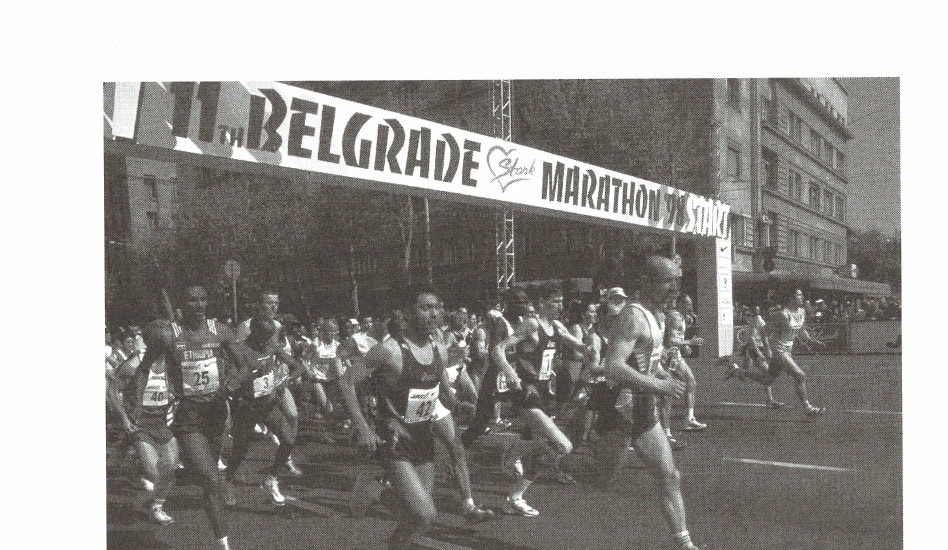
The marathon starts in front of the Eastern Orthodox St. Mark’s Church and finishes in Terazije Square, where demonstrators gathered daily during the protests. A few months earlier the square had been full of protesters, blowing whistles and defying authority; this day, it is bursting with runners and their families and fans.
Many of the students who had walked the streets during the winter ran in a 5K that started after the marathon. They brought a festive, happy atmosphere to marathon day. Looking out over the square and the thousands of people milling about after the finish, Nikolic allowed himself a smile and says, “The marathon won this time.”
GETTING TO THE HISTORY
The best part of traveling to foreign marathons is getting to know another history and another inflection of the sound and fury of the human condition. And Belgrade has a long and interesting story. From Ndeti’s and Sayerndorph’s vantage point on top of the fortress, you can see where Tito, the partisan-turned-president of Yugoslavia after World War II, had his houseboat moored on the Danube, the former border of the Austro-Hungarian Empire.
The first tribe to come to the hills on which Kalemagdan sits, our guide explains to us, were the Celts, about 2,500 years ago. Since then the region has been a palimpsest of different cultures, poised between west and east. The Romans conquered the area in the first century A.D., and when the empire split, the boundary between the Byzantine and Roman portions ran right beneath where we sat.
The Slavs arrived somewhere around the seventh century, and the name Beograd (Belgrade) is first mentioned in 878. From then on warfare was a constant in the area, with the city demolished and steadily rebuilt 40 times. In 1389 came the most important date in the country’s history, when the Ottoman Empire defeated the Serbians at the battle of Kosovo. Turks then ruled until they were pushed out in 1867.
Now, runners from all corners of the globe race beneath Kalemagdan. “I was happy when I won,” says Ndeti. “When did I know I would win? In my room; I prayed to God, and God told me I would win.”
“I was just proud when I finished,” adds Sayerndorph.
Two people, poles apart, brought together atop this fortress. Such is the power of the marathon, and of Belgrade, a city at the crossroads of the Balkans.
The Belgrade Marathon has a fast course and deep, competitive fields. It also has, however, something more important, some ineffable core that contains within it a deeper meaning of the marathon. As we sat with young race workers later that evening drinking sljivovica, Serbian plum brandy, we talked of the city’s changes and the country’s—the world’s—the future.
Young Serbians, for some reason, are steeped in philosophy. Ask one how the weather is and you get a treatise on the meaning of existence. Perhaps people grow up more quickly in the Balkans and have a better understanding of the vissicitudes of life.
Mythologist Joseph Campbell said the atom bomb represents the disintegrating force of the 20th century. These young people have seen their country torn apart, like those who opposed Dionysus in the Greek myths. The question waiting to be answered is whether it can be put back together. This new generation answers with a firm “Yes!”
The winter demonstrations “were fun,” a student named Jasmina tells us. “We were fighting for change. Change was our goal.”
“Did you march?”
“Of course. Every day. We all did.”
The protests had a uniquely Serbian twist to them. “How can I tell you about it? I can’t describe it,” she says. “It was not demonstrations like others. It was exciting, a carnival, people talking and laughing.”
THE COLD, THE POLICE, THE LITERATURE
Students stood for hours in the cold facing the police, full of youthful optimism to confront what they didn’t approve of and change it. Sometimes they took turns reading books to the lines of police: Shakespeare, Aristotle, law and medical texts.
Terazije Square was full of protesters banging pots and blowing whistles. There was a distinct, humorous Serbian twist, with men wearing party hats sitting on lawn chairs, pretending to be fishing, like a “Saturday Night Live” skit.
“It was magnificent, this spirit of humanity,” Jasmina says. “Maybe you can compare it to the feeling of being close together with all the people in the marathon today.”
A phrase is used to sum up the break-up of Yugoslavia—”balkanization.” And every day we read of the balkanization that lurks beneath the surface of daily life around the globe—in Central Africa, Algeria, the Middle East, Latin America, and our inner cities—as ethnic, religious, and nationalistic impulses threaten to knock the Humpty Dumpty of civilization into a thousand pieces. We’ve seen too often how the forces of chaos and disorder are close at hand. Hatred, violence, and despair are amplified by past and present prejudices, and the world crumbles.
Then, the marathon arrives. When you see Christians running with Muslims, Croats running with Serbs, one wearing a sign that reads “mir,” or peace, hope springs eternal; and you recall what Cretan novelist/poet Nikos Kazantzakis wrote: “Civilization starts when sports begin.” Could the meaning of Belgrade be this: that the recivilization of the world starts when the marathon begins?
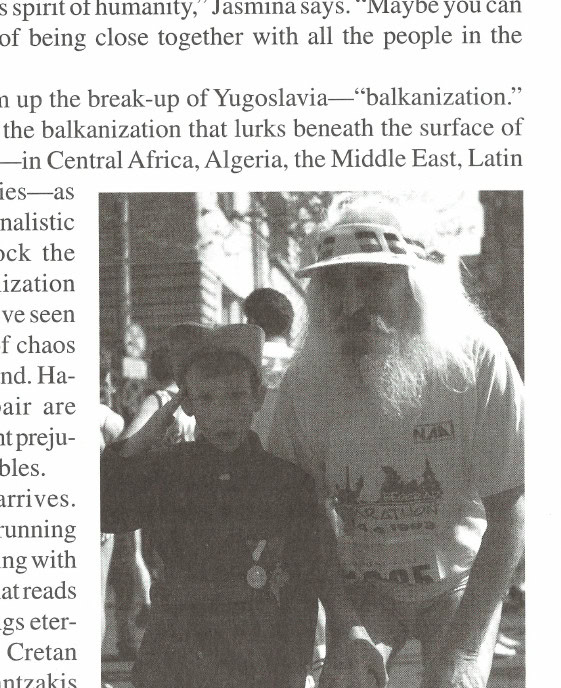
In Belgrade, we see clearly how the marathon is a unifying force opposing the disintegration of the
cosmos, an ordering force against the “balkinazation,” the breaking apart, not just of Yugoslavia, but of the world. We see clearly that the marathon sometimes is indeed more than a race, that it is part of the emerging new world myth Campbell wrote about, a myth that has as its symbol the blue Earth, as seen from outer space, floating in the cold, dark void.
The marathon aids in the heroic struggle to put Humpty Dumpty back together again by transcending differences of race, religion, and politics, making us aware that we are all not just runners, but human beings.
I tell this to my new friends and ask them: How can it be that running along with people you cannot speak with, you feel closer to them than those “strange apothecary souls” you know well in your own cities? I ask whether the demonstrators read Nietzsche to the police guards.
“Yes.”
I rewrote one of Nietzsche’s aphorisms from The Wanderer and his Shadow, I tell her. It is called “The Way to Equality” and maybe explains what I mean. It now reads like this: “A few hours of marathon running turn a villain and a saint into two rather equal creatures. Long-distance running is the shortest way to equality, fraternity, and understanding—and friendship is added eventually by sleep.”
ROCK THE NIGHT AWAY
That night many of the marathoners show up for a rock concert outside of city hall in the center of Belgrade. On the way over, we stop at the fortress. High atop the Kalemagdan, we watch the comet Hale-Bopp, looking like a large firefly above the western horizon as a full moon jogs slowly across the night sky.
Looking out over the buildings of “new” Belgrade across the Sava River, the centuries slip back into the shadows. The plains are empty wilderness once again. The first humans come and camp, build fires, and hunt the wild beasts. The Celts, Romans, Huns, Slavs, Turks, and Serbs reappear, chasing each other across the plains. And now it is runners chasing, not each other, but. . . but what?
Earlier in the day, thousands of marathoners had run over the ghosts of all the blood and battles that had preceded them in the previous two millennia, through the same streets the demonstrators had marched. With that history in mind, each footstep in the marathon takes on a sacred mission.
All marathons represent their city. Some represent a people and a country. And a few marathons, like Belgrade, represent something more: a new idea. And this evening on the Kalemagdan, the idea is as clear as the stars shining in the night sky—the triumph of order and reunification over the balkanizing forces of disorder and chaos.
I tell this to my Serbian friend, and she replies, “Perhaps. Do you know Karadjordje?”
“Who?”
“Karadjordje. You mean you don’t know ‘Black George’?”
“No,” I reply, a bit ashamed.
“He was a famous Serbian national hero from the war against Turkey, between 1809 and 1813. You see, we are no longer fighting against an occupier, but there are different enemies. What did our beloved Kazantzakis call it? The ‘inner Turk’? Do you understand?”
I wasn’t sure. We walked down to the chapel of St. Petka, the holiest Belgrade saint. The walls of the small side chapel are covered with soot from the countless candles lit to ask for favors, beneath icons of St. Michael and St. George.
The candles are in a five-foot, two-tiered round holder, filled with sand. “You light candles for the living and put them upstairs. Then you make a wish,” Jasmina says. “Candles for the deceased are put below. We believe the church is a sainted place.”
Watching the churchgoers come and go, I ask, “Do you agree with Nietzsche when he wrote that God is dead?”
“No, I cannot believe that—”
“Why not?” I ask, as we spar like runners in the lead pack.
THE NEED TO BELIEVE
She shakes her head. “I have to believe. That is the most important thing. Belief. Nietzsche had some good ideas in the Birth of Tragedy, about the symbiosis of comedy and tragedy. He knew Socrates, Plato, Aristotle. I think he had the most successful symbiosis of those two principles. In all things you have to have balance.”
We watch women bringing jugs to fill with water from the church, said to effect miraculous cures.
“Our world is an image of the ideal world, the world of ideas,” she adds, “but we are just reflections, so we are not that good. I think Nietzsche was a good philosopher, but his philosophy is not good.”
“Why not?”
“He was writing for the elite, for the ubemensch. What of the rest of the world that are not superpeople but are only trying to survive? What would he say to them?”
What could I tell her? That they are destined to live their lives in the herd?
“That’s just it; there has to be an ideal of the ideal woman and man, even if we know there isn’t one,” I tell her.
“No,” she says, “I prefer Fromm.”
“Why is that?” I ask, sensing her gaining an edge in our discussion.
“He was very humanistic. The first thing is that he was very interesting. The second thing is that he was very good. He made the perfect symbiosis of Freud and Marx. He is not your typical psychologist. He took the good things from both sides, Freud and Marx. He added thought to their emotions.”
“You like him better than Hegel?”
Jasmina replies, “The best thing about Hegel, Marx said, is his final idea that the dialectic is an evolutionary process. Marx didn’t believe in another world. He believed God was opium for the people. . . . Maybe it is, but I still have to believe.”
After a pause, she adds: “And even you have to believe. Maybe the marathon is opium for other people.”
I start to protest, then stop, thinking of something the vice-mayor said yesterday: “The marathon here is more than sports. It is part of the city. The marathon continues the policy of hope.”
Sitting atop the Kalemagdan, watching the comet continue its 30,000,000-mile marathon journey and the moon its endless circling of the trans-earthly track, I think about the human struggle endlessly circling over the centuries. You feel blessed to be a foot soldier in order’s battle against chaos and disintegration—the disintegration not just of empires, nations, and city-states, but of the old world order that is crumbling before our eyes.
My friend has had enough of this, and we go to the concert, then to a nightclub. It is packed, even at 4:00 A.M. Our conversation continues over the music. “What of eternal recurrence?” I prod.
“No. There has to be an end. I can’t imagine the universe being endless. It has to go somewhere.”
“Maybe the universe will expand endlessly.”
“Where is it proved that the universe is expanding? Where does it go? Where does life go? If it is expanding, it is expanding within limits, which means it’s limited in space. That proves it has an end.”
Night turns to day in Belgrade. We come into the hotel and head for the steamroom to cleanse. I recall what Bubka said the day before when we met for a swim. After small talk, he was asked if he would try a marathon.
“I like sprinting and power,” he had replied. “I’m not a marathoner, but, why not? I will think about it. After all, if you believe in yourself, anything is possible. Even a marathon.”
Yes, Bubka, you are correct. As the Belgrade Marathon continues to show, anything is possible, as long as you have faith.
CHARL MATTHEUS (pronounced “Charl,” as in Charles, “Ma-TAY-us”), the dedicated, driven champion of the 1997 Comrades Marathon, the world’s largest ultramarathon, fled the comfortable climate of his South African homeland where he enjoys the celebrity of a national hero to train in the frigid winter altitude of a tiny, remote North American town at 10,124 feet above sea level. He endures the loneliness of his 150-mile training weeks in this austere setting for his single-focused goal: to set the course record at Comrades in 1998. On a break in April between his twice-daily workouts, Marathon & Beyond’s Theresa Daus-Weber, a past winner of the famed Leadville Trail 100, met with Charl to talk altitude.
M&B: Over 75 years of existence, now attracting more than 14,000 runners willing to race a grueling 90K (56.25 miles), the Comrades Marathon is the oldest, largest, most popular ultra by far—and the most competitive road ultra in the world. What brings a runner from the competitive environment of South Africa to the wilds of Leadville, Colorado?
Charl Mattheus: In 1996, after I placed fourth in my eighth attempt at the Comrades Marathon, I wanted to figure out why I was missing the win. I analyzed what the missing element was and determined that it was high-altitude training. Then I looked all over the world to find a training location that was high—about 3,000 meters—and in a location where English was spoken.
Russia had some possible locations, but language was a problem for me. I have trained in Russia before, so I know what it is like there. Language is also a problem for me in the very remote locations of Europe that have high enough elevations for my needs. So, I considered high-altitude locations in America. I had raced in the U.S. before and liked the culture there. Alamosa and Buena Vista, Colorado, were possibilities, but they were not quite high enough, and they were too windy. Vail was the right altitude but too expensive, so I chose Leadville.

This article originally appeared in Marathon & Beyond, Vol. 2, No. 5 (1998).
← Browse the full M&B ArchiveMore like this
1,000+ stories from 19 years of Marathon & Beyond
The complete archive of the legendary long-distance journal — digitized and free to read.
