

Where Eagles Dwell
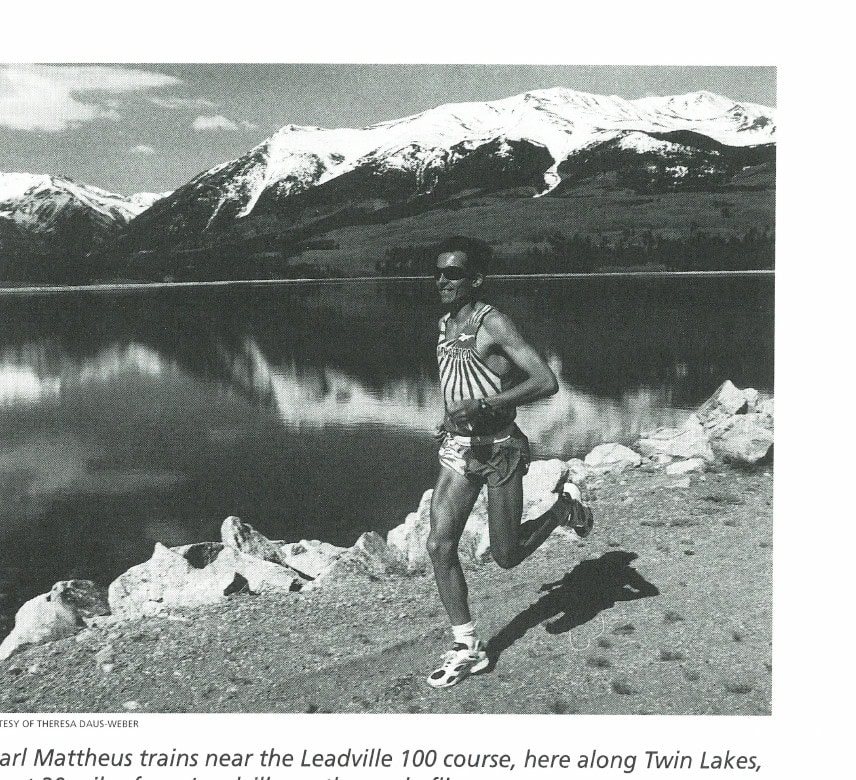
M&B: You have selected an extreme environment in which to train to reach your goal. Tell us about your high-altitude training program.
Charl: Although the weather can be quite harsh in Leadville in the winter [midday temperatures average about 15 degrees Fahrenheit, and snow covers the ground from November through April], I run outdoors twice a day: in the mid-morning and in the late afternoon. I run whether it is snowing or a blizzard. I have run when I could not even see my hand stretched in front of my face. I also use a treadmill in my house sometimes.
I have several phases of training I want to accomplish while at high altitude, including a weight loss phase [Charl weighed in at the beginning of 1998 at 130 pounds on a 5’8″ frame] and a tapering phase. As I prepare to leave Leadville for Comrades, I will weigh 120 pounds and taper from my 150 to 175 miles per week to 100 miles per week during that [taper] period.
To accomplish some of my mileage and to keep sharp and competitive, I race various races in the U.S. while I am training in Leadville. I set a Colorado 50K record at the Frosty Trail 50K down in the Denver area early in the season. I also raced the Las Vegas, Shamrock, and Los Angeles marathons. I plan to race the Mile High Ultra Trio near Denver again this year in May [1998].
M&B: American ultrarunners compete in an essentially unknown sport here in the United States. When their ultrarunning “hobby” becomes known, they have to listen to clichéd responses like: “You run 100 miles in 17 hours on a trail? Do you do that without sleeping? Do you go to the bathroom?” Ultrarunning is a nationally known and very popular sport in South Africa. Why do you think ultrarunning is so popular in your country and so obscure in the States?
Charl: The Comrades Marathon is a very popular, well-sponsored event. It is a 77-year-old national tradition in South Africa and has produced some of the country’s best-known national icons. The race is televised the entire day and viewed by adults as well as the children. There is much advertisement, sponsorship, and excitement for the race each year. Over 14,000 runners participate, many of them year after year. It is not uncommon for a runner to have 20 Comrades finisher’s medals. Our President, Nelson Mandela, is at the finish line to greet the winners, and the awards ceremony is televised live on national television.
The main sports in South Africa are rugby, soccer, and cricket—all sports that require running. South Africans are familiar with running; it’s part of their athletic culture.
In America, the most popular ultra events are trail races, and these often have the number of racers restricted by the Forest Service. A race that has restricted entry cannot grow and become more widely known by sponsors, nor can more runners participate.
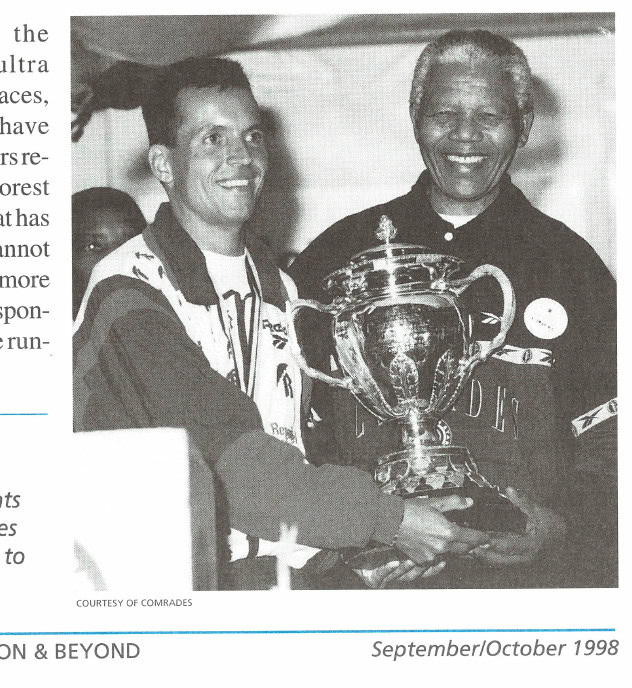
M&B: How does it feel to be a national hero to 50 million people in a country that is about the size of Texas?
Charl: I worked very hard to achieve my 1997 win at Comrades. It is an honor for a South African. I like to represent the Comrades Marathon and this prestigious international South African athletic event to the people in my country and the world. Success at Comrades is an important career and lifetime opportunity for me. I like representing the successful aspects of South Africa to South Africa and to the world.
I have received many requests to give motivational speeches and make appearances at sports and public events. I will attend to such things in the six months after Comrades, but I feel that I must concentrate on my training here in Leadville the six months before Comrades.
M&B: Tell us about your life as a professional ultrarunner and one of Cosmopolitan magazine’s 10 most eligible bachelors.
Charl: Like other professional athletes, I am able to train full-time and to travel to races with the support of my sponsors [Reebok, Seiko, a Mercedes dealer, Powerāde, Ray Ban, a South African insurance company, and a German pharmaceutical company that produces sports products]. I get invited to interesting races and meet great athletes and people all over the world.
The Cosmopolitan Most Eligible Bachelor title? Yes, that is a funny thing. I am an eligible bachelor, but I cannot even get a girlfriend. That just makes you think that I might run too hard and play too little. I was honored with this title because it opened up doors to be a judge at many beauty contests, and it attracts a lot of attention from the single women. However, my training is very important to me because without it, I will not perform in running.
M&B: What would it take to make ultrarunning popular in the United States?
Charl: A big, international, showcased event with large prize money. Prize money produces good performances and attracts good athletes, sponsorship, and spectators. It must also be a 100K event, the distance that is recognized as the IAAF 100K championship. There must be an extra prize money incentive for setting a world record at the event. This incentive prize money should be insured as we insure incentive prize money in South Africa. The insurance guarantees payment of the incentive in case a runner breaks the record. The sponsor offering the prize money does not have to advance the money unless the record is broken.
M&B: Do you have any advice for U.S. ultrarunners?
Charl: Ann Trason, the 1997 Comrades Marathon women’s champion, is one of the best ultrarunners on this planet, ever—men and women. She is an American ultrarunner, which shows that this country has strong-minded, genetically gifted athletes who can perform at world-class levels. The U.S. needs younger, faster athletes to move into ultradistance running on the roads. You’ve got the [trail running] athletes. They just have to move over [to road racing]. Trail running is good for base training and for the pleasure of running and strength training, but you loose your speed in trail running. Speed is the only way to record fast times in road ultras. You must have two fast road ultras a year in the U.S., a 50K to get the younger athletes [involved] and a 100K to be able to enter and be competitive at the World 100K Championship race. The fast marathoners will move to the 50K and later attempt the 100K, using trail running as training. You are so lucky to have such beautiful trail runs in this country.
M&B: Is there anything you want to tell us about yourself or your sport that we haven’t covered?
Charl: I ran my first marathon in 2:48 when I was only 13 years old, with very little training. So, I started very young. But I want to encourage young athletes to develop their speed at the shorter distances first before moving on to the marathons and ultras. Then you can be the best at these distances.
M&B: Tell us something about Charl Mattheus, the 1997 Comrades champion, that no one else knows.
Charl: I set five alarm clocks to 4:00 A.M. the evening before Comrades because I am worried about being late for the race on raceday morning. I have prerace anxiety dreams about going to the starting line in my bare feet without my racing flats!
M&B: Everyone thinks there’s something magic that ultrarunners eat to make them run long distances. So tell us, what do you eat that makes you run so fast at Comrades?
Charl: My traditional prerace meal the evening before the race consists of the following items eaten separately: two pounds of marshmallows, aged honey, and corn.
[Note: No, this is not information garbled in translation from Afrikaans. Charl is fluid in English, his second language, and he spoke very distinct, accurate English during the interview.]
Although not part of my prerace dinner, or my raceday nutrition, I will enjoy a few “jelly babies” [gummie bears] for carbohydrates in my otherwise very nutritious diet of thick, pureed fruit juice, healthy soups with a little meat, and lots of vegetables.
M&B: Racing Comrades is a dream for many U.S. ultrarunners. It was kind of a mystery before 1994 when American Alberto Salazar won the race. Tell us about the race.
Charl: The Comrades Marathon is held in the South African province of KwaZulu Natal, the “Garden Province.” The race began in 1921, but there were several years during World War II when the race was not held. Thirty-four men ran the first 89K [approximately 54 miles] race from Pietermaritzburg to
Durban; now there are nearly 15,000 racers. An interesting aspect of the race is that the course changes directions each year. The “up” course starts at sea level in Durban and climbs 755 meters [nearly 3,000 feet] to Pietermaritzburg, where the Comrades Marathon Museum is located. Handlers, or “crew” as you call them here in America, are called “seconds” at Comrades. In addition to our seconds, there are 60 aid stations along the hilly “up” and “down” course.
The race is run in June, our early winter. The climate in South Africa is always sunny, and raceday temperatures in Durban, a coastal city, are around 24 degrees Celsius [roughly 80 degrees Fahrenheit]. The race starts at 6:00 A.M. The first 10 men and the first 6 women to finish the race win prize money and gold medals. Silver medals go to runners who finish under 7:30:00. To earn a bronze medal, a runner must complete the course within the 11-hour cutoff time. Runners who complete 10 Comrades Marathons are assigned special green bib numbers to distinguish them from other runners. When you have completed 20 Comrades Marathons, you are assigned a “double green” number to identify your accomplishment.
M&B: Let’s run through each of your Comrades Marathons with the year, your finish time, and your finish position, and ask you to comment on each. 1987, 6:10:30, 21st place.
Charl: My first attempt at Comrades. I was 21 years old.
M&B: 1988, 5:49:47, 7th place.
Charl: One of my greatest runs. My first gold medal.
M&B: 1989, 5:48:57, 9th place.
Charl: I did not prepare my legs with weight training as I should have, and for a “down” course year, the legs must be right.
M&B: 1990, 6:12:31, 32nd place.
Charl: Due to a 12-hour-a-day work schedule, I did not have the appropriate rest in my preparation for the race.
M&B: 1991, 5:47:31, 6th place.
Charl: I ran a bad tactical race, and that is why I lost.
M&B: 1994, 5:56:10, 11th place.
Charl: I was injured during my base training the year that Alberto Salazar won Comrades.
M&B: 1995, 5:35:01, 2nd place.
Charl: I was working 10 hours every day and decided to become a [running] pro.
M&B: 1996, 5:34:56, 4th place.
Charl: This year the Russians came in and were very strong.
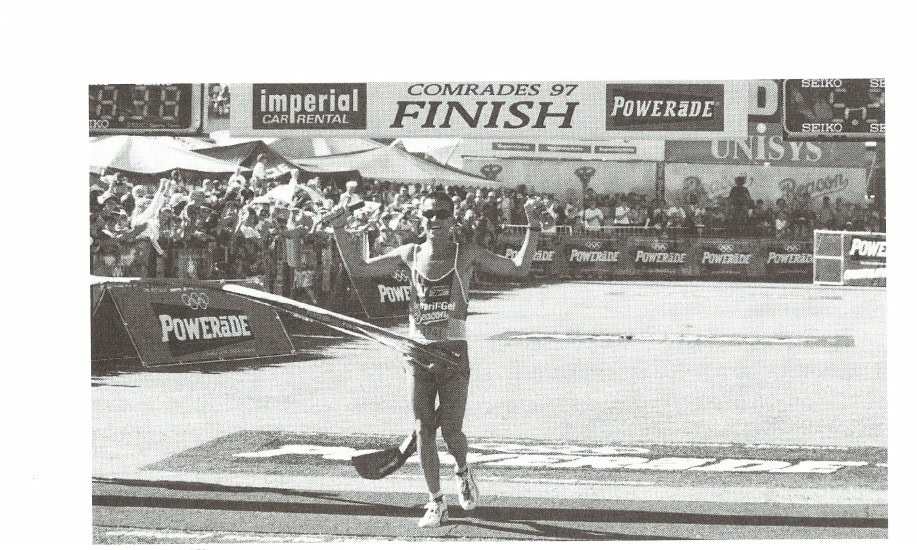
M&B: 1997, 5:28:37, 1st place.
Charl: This race produced the second-fastest pace per kilometer in the 77-year history of Comrades.
M&B: 1998. You’re going after Bruce Fordyce’s “up” record of 5:27:42.
Charl: My sponsors and running club have offered me a big bonus incentive if I break this record.
Postscript: Sandwiched between a strong field of Russians, Charl finished second after a dramatic and gallant duel at the 1998 Comrades Marathon. After battling most of the race with victor Dmitri Grishine, who broke the “up” course record by a minute and 17 seconds in a time of 5:26:25, Charl finished in 5:31:32. This heated race was dubbed as “one of the greatest Comrades Marathons of all times.” Stating that he was pleased with the race, Charl did not use an injury that he entered the race with to detract from Grishine’s win. Charl returns to the 1999 Comrades Marathon as the defending “down” course champion and as the top South African finisher in the 1998 race.
This article originally appeared in Marathon & Beyond, Vol. 2, No. 5 (1998).
← Browse the full M&B ArchiveMore like this
1,000+ stories from 19 years of Marathon & Beyond
The complete archive of the legendary long-distance journal — digitized and free to read.
