

Learning to Run on the Wind
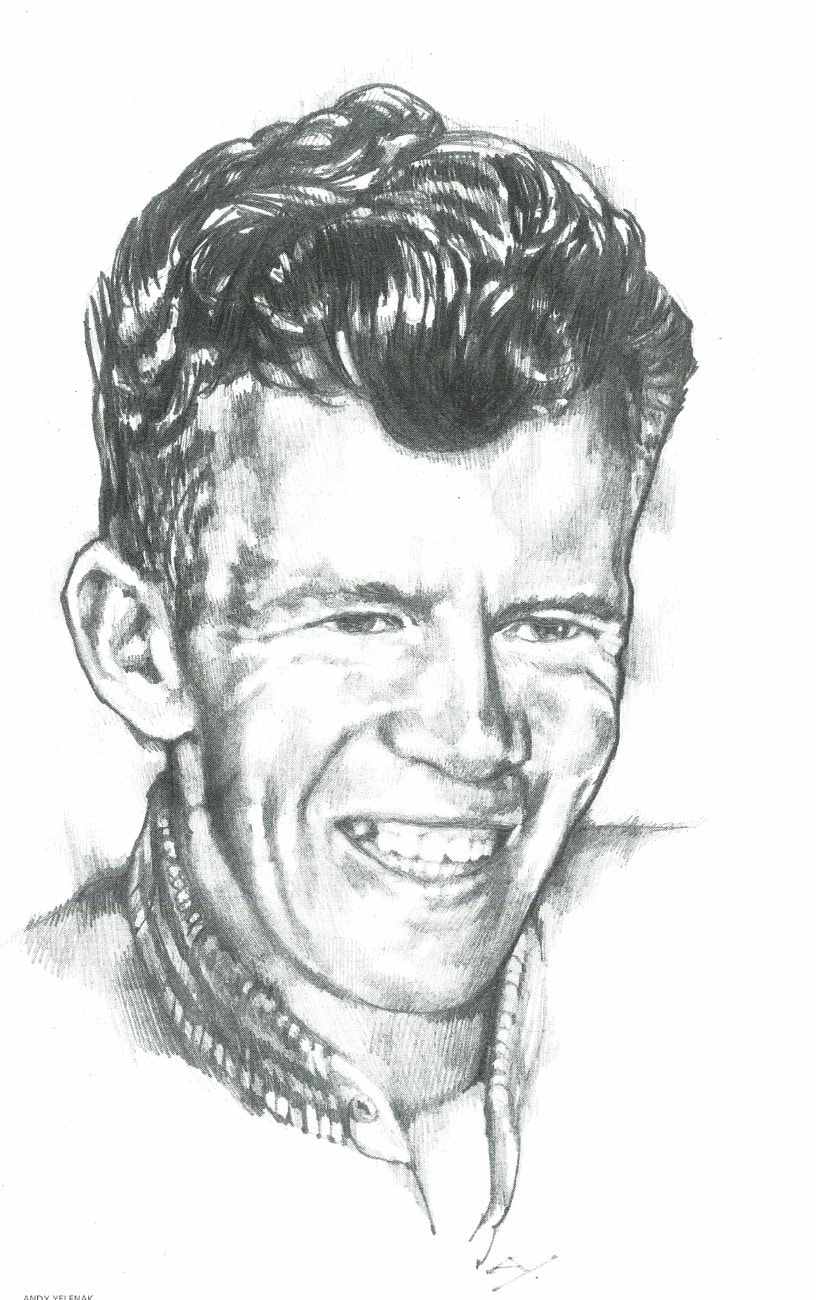
through the day OK, though, with his trusty flask, the easy sprinkling of Sunday PM customers, and his rub-the-world’s-face-in-it attitude.
“He-e-ey, Johnny,” he yells. “What’re ya gonna do, boy?”
“Hey, Pete. Whataya mean, what’m I gonna do?”
“Papa Joe’s dead,” Pete says. “Ka-poot! Now ya gotta beat them Rooskies in the marathon.”
“Oh jeeze, Pete. No ‘Rooskies in the marathon,'” I say.
Pete steals a swig before flipping his ham hash. “Then who ya gonna beat, boy?”
“Beat? Pete. I just gotta finish. That’s the goal,” I dodge, knotting on my counterhop’s apron.
“Ain’t the way I hear it, Johnny-boy. I see in today’s paper, you’re gonna be ‘America’s Only Hope.’ Don’t you read the sports?”
“Ah, you know how that goes, Pete. They got nothing else to write.”
“Could be they got nobody else to run?” Pete shoots back.
Damn flask. I spy a couple of customers eyeing me suspiciously. Pete keeps his needle working. “Boy, ya gotta beat them Japs! Ya gotta beat them Finns! Ya gotta beat some Swede, by yumpin’ yiminy!”
I’ve half turned to confront the needler when I’m spun around by an unamused voice. “I won’t eat my hash burned to a crisp,” it informs me.
“He knows where he can put it, then,” Pete growls as he slams the man’s plate on the divider. Placing it gingerly on the irate customer’s tray and forcing a smile, I think, jeeze, only six hours, and I get to enjoy my two-mile jog home.
* * *
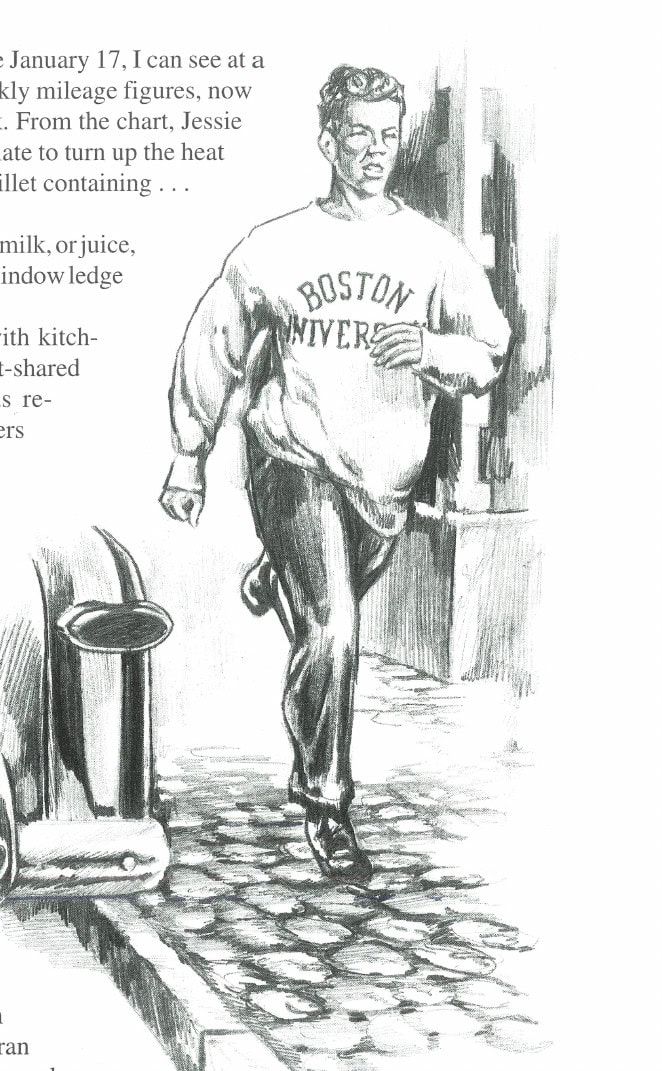
The rain has stopped by 9:15, when I hit the streets again. A keen northwest wind makes me wish I’d worn a jacket, but by Central Square I feel perfectly comfortable; and sweat rivers my face as I top the stairs to our third-floor apartment.
It’s only a way station, both Jessie and I know, and there will, there must, be better to come. Still, it has been home to us since our marriage on January 17. Despite a few considerable drawbacks, it has become a focal point in the story of our joined lives.
Jessie has taken a break from her Boston University music studies to enter into her wife’s role. She greets me with a kiss and the standard question: “How many miles today?”
“Umm . . . 12 this morning . . . plus the 2 and 2 to work and back, so, 16, total,” I report.
The diminutive lady walks to a wall chart bearing the felt-tipped heading, “Jessie Kelley-o-Graph” and writes “16” on the March dateline. The chart’s wide date spaces reach bottom at Monday, April 20.
For the weeks since January 17, I can see at a glance my circled weekly mileage figures, now averaging 72 per week. From the chart, Jessie steps over to our hot plate to turn up the heat under a small black skillet containing . . . ham hash!
The accompanying milk, or juice, will come in from our window ledge “fridge.”
The single room with kitchenette alcove and tenant-shared hallway bathroom has replaced dormitory quarters for both of us. It has also given some of our old dorm pals a place to hang out, safe from the university guardians’ prying eyes.
On this particular night, one of Jessie’s Charlesgate East Dormitory friends, Pat Condit, curls catlike in the room’s one stuffed chair.
“Johnny!” Pat adds her greeting from the shadows. “I bet you ran all the way here from Harvard Square. C’mon now, ‘fess up.”
Pat draws deeply on her Pall Mall and narrows her eyes like an earth scientist studying a Martian.
“Oh, hi Pat. . . . Yeah . . . Well, you know,” I fluff my answer.
“Of course, I know,” Pat says. “You ran all the way here from Harvard Square . . . after having run all the way up there in the first place. My God, man! I mean, I remember having had to go up there one day and taking about an hour connecting.”
“Well, sure. . . . You were on the MTA. It’s actually faster if you run,” I say.
Pat sips her port. “You’re not suggesting that I run to Harvard Square? Johnny, I assure you the thought would never cross my mind.”
“Ah, jeeze, of course not, Pat. This running thing isn’t for everybody, for sure.”
Here Pat takes a still deeper drag, narrowing her eyes to mere slits.
“Johnny, I’m really beginning to believe you’re planning to do this thing. And I know they have it, it exists. I mean, you can’t live where I’ve lived for the past three years and see that parade of indecently dressed men passing almost under your window without believing it happens, but . . . God! It seems so basically unthinkable. Why on earth would anybody in their right mind. . . ?
“. . . want to run a marathon?” I ease her through. “Well, look, Pat—couldn’t it be like the mountain? ‘Because it’s there . . .’?”
“Johnny,” Pat says emphatically, “there are a lot of ‘things there’ that I have absolutely no wish to be there with. I mean, the Atlantic Ocean is there, but I don’t have any desire to be there swimming it.”
Jessie cuts in with, “Johnny’s hash is hot.” She places a plateful on the tiny drop-end table, along with knife, fork, two slices of bread, a dollop of margarine, and a glass of orange juice.
As I dig in, Jessie asks, “What’s going on tomorrow?”
“Class at nine, class at eleven, work by three. Home by 9:30,” I chomp.
“What about running?”
“Nope. No running on Mondays. Monday’s always off,” I say.
“Oh, that’s right. I wasn’t thinking Monday,” Jessie says.
At this, Pat gulps her wine, stubs out her cigarette, and starts for the door. “Oh slazack! Another Monday,” she says, rallying briefly with “Hey, Joe Stalin died! Maybe there’ll be a bit of peace in the world now. But I doubt it. Know what I think? They should turn the whole shooting match over to the English. They’d get it right. They don’t run marathons in England, do they?”
“Sure do,” I set her straight. “In fact, except for possibly Emil Zatopek of Czechoslovakia, Jim Peters of England is the world’s best marathoner.”
“My God! You can only hope it’s a case of the exception proving the rule,” Pat says.
* * *
“Jeepers crow, Jackrabbit. I could have had a great bunch of quarters lined up for you today,” Coach Doug Raymond grouses.
Now, both Doug and I know we’ve agreed to let Monday be my official rest day during this three-month buildup toward the marathon. Doug is just unable
to hide his displeasure with the arrangement. But, facing him in his digs at BU’s Braves Field, without being suited up for his workout, I know I have to play things cool because I’m still a full-time BU student by virtue of a “Leadership Scholarship,” the terms of which I’ve violated in several ways:
- By pulling out of Kenmore Square’s Myles Standish Dormitory, and its dining hall, to get married.
- By bucking Doug’s authority in determining to race in the marathon, thereby doing myself—and my school—out of several university track meets, especially the ballyhooed BU Relays, held each year on Marathon Day.
On the credit side, I’ve won a couple of New England cross-country titles, and, while too often crumbling in showdown meets, have given Doug some slim reason to hope I might at least partially make things up to him as I head into my senior year.
Still, I know that my ex-track champion, ex-Navy commander coach is seriously smarting from what he can’t help but view as a case of insubordination.
I wish I hadn’t even stopped in at the field this afternoon. I might better have gone straight from the 11:00 AM class to work and piled on some overtime. Now Doug’s got me.
“Jackrabbit,” he says portentously, “I’d like you to step upstairs with me. I want you to tell Buff how things are going.”
Boston U’s “AD,” Aldo “Buff” Donnelli, a peppery football coach as well, waits seated behind his desk for our chat.
Doug opens it up with his goofy trademark grin and appropriate deference. “Buff,” he says, “this young fella is none other than Johnny ‘Jackrabbit’ Kelley. As I think you know, Jackrabbit is going to run in the Boston Marathon in a few weeks.”
For the fact that he’s a body-contact man and a former football star quarterback himself, Mr. Donnelli is a little guy, just a bit beefier than myself. He raises and cups his hands, fingers interlocking behind his head.
“Johnny Jackrabbit,” he repeats Doug’s introduction, drawing out each syllable. “I think I’ve heard of him. So Johnny Jackrabbit is going to run in the marathon.”
The jackrabbit is securely on the spit and is turning slowly as Mr. Donnelli continues, “Maybe, after he runs that race, I’ll understand it.”
He drops a wedge of silence into his expanding thought. Then he develops the thought, “Every year,” he says, “I see these guys, must be at least 200 of them, punishing themselves, strung out along Comm Avenue and Beacon Street.
“And, in all honesty, Johnny Jackrabbit, I just don’t understand it. I don’t understand how a bunch of guys obviously past their athletic prime can willingly beat themselves to a pulp—and for what? A little bowl of beef stew? A slab of Jell-O? Even a laurel wreath?
“Of course I realize a lot of people flock out to watch that race and that the winner gets a day’s worth of headlines—the celebrity of a mayfly, so to speak. But, really, when you think about it, for what good reason?”
On some level, Johnny Jackrabbit does know why he wants to join those guys. Only, when he tries to form an answer, no words come out.
Leaving the former quarterback an opening to race around end, Donnelli continues: “So, I guess what I’m saying is, I wish you luck, Johnny Jackrabbit, though I fail to see why a young man with a gift of speed would want to do something like that with it.”
“That, sir, was my original thought exactly,” Doug says.
“It was? Then why has it changed?” Mr. Donnelli asks.
“Well, sir, I guess the old Jackrabbit is just too stubborn to be talked out of it,” Doug says. “And, as for me, I guess I go along with a saying of my old Scotch-Irish grandfather: ‘What cannot be avoided must be endured.'”
“So you’ve given your marathon blessing?”
“Well, yes, Buff, I have . . . conditionally,” Doug says.
“And the condition?”
“That he wear our BU track jersey, not the BAA unicorn, in the race.”
Mr. Donnelli chews over Doug’s provision for a few seconds before asking yet another question: “You don’t think we might be putting the university’s reputation on the line?”
“Well, we could be, we just could be, sir,” Doug concedes, quickly adding, “But I think the old Jackrabbit knows that too, and he won’t let us down.”
The old Jackrabbit strains to nod his assent.
“Wearing our jersey,” Mr. Donnelli bears down on him. “You won’t want to look like one of those . . .”
“I call ’em ‘ham-and-eggers,'” Doug offers through his goofy grin.
“A fitting descriptive,” says Mr. Donnelli, with a soft chuckle.
“Well, Buff,” Doug wraps things up. “We sure appreciate your giving us your time today. I think I can promise you a proud airing of our jersey.”
“It could go a long way toward helping me to understand,” Mr. Donnelli says.
* * *
On Sunday, April 5, all Boston’s sportswriters are telling their readers what the Globe’s Jerry Nason knew a month ago: red-hot Japanese and Finnish teams, plus 1949 winner Karl Gosta Leandersson of Sweden, will head the 1953 field.
“Didn’t I tell ya, Johnny,” my Hayes-Bickford workmate, Pete, asks, then answers, “Ya gotta beat them Japs, gotta beat them Finns, gotta beat that Swede, by yumpin’ yiminy! Gotta-gotta-gotta! So, who ya gonna beat, Johnny-boy?”
“Ah, jeeze, Pete, lay off it, will you? I just hafta prove I can finish the thing.”
Pete makes his Bronx cheer face, shoves his cook’s paper hat way back, catches a swig, and charges, “Ya better bring home th’ bacon, or ya’ll get no hashbrowns.”
Jeeze!
Later, down in my BAA “Aye” Jock Semple’s Boston Garden physiotherapy “parlor,” for the “treat” of his free ministrations and the inevitable ego-builder pep talk, I can’t keep from chuckling at the thought of a confrontation between Jock and Pete on the subject of my marathon mission.
Jock opens up with the obligatory dig at Doug Raymond: “All I can say is, he better brush up on his Japanese.”
“Oh no, why so?”
“No offense, Johnny,” my Scottish friend says. “Ye’re goin’ t’ do OK, but I watched those Japanese practicin’ out on the course today, and, cr-ripes, nobody’s goin’ t’ beat them.”
Now this is from the horse’s mouth. Two weekends ago Jock watched me win the time prize at the Cambridge Hyde Shoe 12-Mile Handicap. Last weekend he watched me do it again in the hellish Cathedral Ten in South Boston.
“So what do you truly think, Jock?”
“Ooh . . . let’s see. It’s y’re fir-rst mar-rathon, unless we count th’ one in ’49 y’ didna finish. Now you’re in gr-reat shape. But, besides the Japs, we’ve got the Finns. So-o . . . I’d be pickin’ ye for-r aboot fifth.”
He traces with one expert finger the taut pain line running up my right leg, while I digest his oracular pronouncement.
He picks up the thread of his opening remark: “I see they had t’ pose ye forr a picture wear-rin’ yur BU singlet. No-o, they don’t think much o ‘th marrathon, but they have no qualms aboot milkin’ it for-r a’ the pooblicity it’s worrth, do they?”
“Oooch!” I exclaim, wincing in pain.
“That’s how I know R-Raymond is still pour-rin those terrible quar-rter miles on ye!” Jock says triumphantly. “Well, we’ll toss him his bone this time. Ye can be fir-rst Amer-rican in his pr-recious BU singlet. But . . . the day ye win it, it’ll be wearin’ the BAA unicorn.”
* * *
Marathon Monday dawns cloudy on the wings of a spanking northwest wind that will hold the day’s high temperature below 50 degrees.
I’ve slept reasonably well—better than I expected.
After a breakfast of cereal, one scrambled egg, wheat toast with jelly, half a grapefruit, and coffee, I kiss Jessie goodbye, nervously recheck the contents of my tote bag one final time, and hit the streets for the short mile hike down to Back Bay Station and the BAA’s bus pickup point.
An endless bus ride, followed by an endless wait in Hopkinton, sets my thoughts scurrying down blind alleys of reflection on the subjective nature of time.
But the endless wait passes, as philosophers say all things must.
Jock squires me out of the school’s confusion at 11:25. As we approach the runners’ snow-fence corral, he relieves me of the tote bag with its replacement cargo of street clothes. He will be riding on a press bus, he promises, and therefore available throughout the race—not to worry.
Inside the elbow-jam corral, I spot the always together, always smiling, never standoffish Japanese, amazing little guys (my size) now being mobbed by last-minute autograph hounds and photographers—obligingly scribbling, obligingly posing.
Still no sign of the Finns, or of former winner Leandersson, but I guess that’s how Scandinavians approach these things, almost the mirror opposite of the Japanese.
Body crush or not, I begin to shiver in my skimpy throwaway T-shirt, as the late-morning wind takes its last shot at blowing sense into us. If nothing else, this tiny enclosure is a good place not to have claustrophobia.
High noon. A touch-and-go sun. The gun sends 200 wild ones careening in the direction of the city they have so recently been transported from.
My head swirls. Feet race to locate me a safe distance ahead of the herd, yet not far enough up to win me the dubious “early burner” award.
“Jeeze, Pete,” I want to shout across the miles to Harvard Square. “Look at me now! Johnny-boy is off and running!”
Or, “Hey, Buff, I’m going to show you what we’re all about.”
He’ll know what he can do with his “ham-and-eggers” theory before we get finished with it this afternoon!
Two miles along, entering Ashland. The great wave of collective élan still carries me.
Gray skies and a brisk wind, off the right shoulder . . . curiously, a perfect day for the business at hand. . . .
Feeling good. Feeling sprung. Feeling strong. Finding my niche in the thinning pack.
I think of the feet that have trod these roads. An Abraham Lincoln would certainly call this “hallowed pavement.”
Somewhere not so far ahead, gilding past burgeoning smatterings of spectators, Jock rides his bus.
Certain features of the course, landscape, buildings, remind me of the 1949 effort, begun, like today’s, in a burst of high hope. . . . But I’m another racer today. I have something more than first youth’s enthusiasm going for me now. Today, I know, I have crossed an invisible line demarcating the dreams of boyhood and the deeds of manhood.
Framingham. Still smooth, still strong, clipping along at sensed record speed. Exchanging glances with my Finnish rivals, Japanese rivals, occasional quips with my friend, surprising New Yorker, Austin Scott.
A long, testing climb from Framingham east toward Natick. Concrete road drains the legs. I share the lead with Scott and a tiny Japanese who continually leaps from the road to softer grassy margins. Can he be accelerating with each feathery step?
Natick. Ten-mile checkpoint. Scott labors, fades, and is gone. The Japanese who runs on the wind dictates our pace. For the next four miles we will have the spectator-flecked ribbon of Route 135 to ourselves.
At Wellesley, ecstatic cries of “Yamada! Yamada” explode along with Rising Sun flags from the human chasm of coeds.
But Keizo Yamada looks neither right nor left. And as my legs stiffen on the sharp drop into Newton Lower Falls, the “wind master” begins to take my measure.
Gravity seems to double on the long climb overpassing Route 128. Here Yamada signals Sayonara with a barely noticeable half-turn of his head and a more noticeable quickening of tempo.
But my own race doesn’t come unglued here as it did four years ago. I sense that I can hang on, whatever may come, for a face-saving finish.
If, as my high school science teacher liked to say, “Nature abhors a vacuum,” the marathon must abhor serenity. I haven’t been alone for five minutes when, like the padded clap of Doom, a stern and implacable Finn overtakes me.
Midway through the hills I’m nailed by a second Japanese.
Then it’s ex-champ Leandersson’s turn.
Boston College. Past the curbstone that called me to rest in 1949.
Onward and downward, through “the mysterious mile,” Chestnut Hill. . . .
Cleveland Circle. I walk . . . 50 yards, 100 yards. . . someone shouts, “Get going, Johnny-boy!” I run again.
Beacon Street’s long, crowd-lined vistas. A gigantic Cities Service sign that never gets closer, overhanging Kenmore Square. I think of The Great Gatsby, the eyes of Dr. T. J. Eckelberg. . . .
I’m part of the day’s climaxing pandemonium, shamelessly lurching for proffered sponges, orange slices, Cokes, ice cubes . . . any possible rescusitant.
Kenmore Square. The Cities Service sign passes rearward at last, with the disjointed motion of a silent movie. Pitiful trot east on magnolia-blooming Commonwealth Ave. The crowd’s roar like Niagara, beside which I seem always to have lived.
Onto Exeter Street. The Exeter Street Theater. Alec Guinness starring.
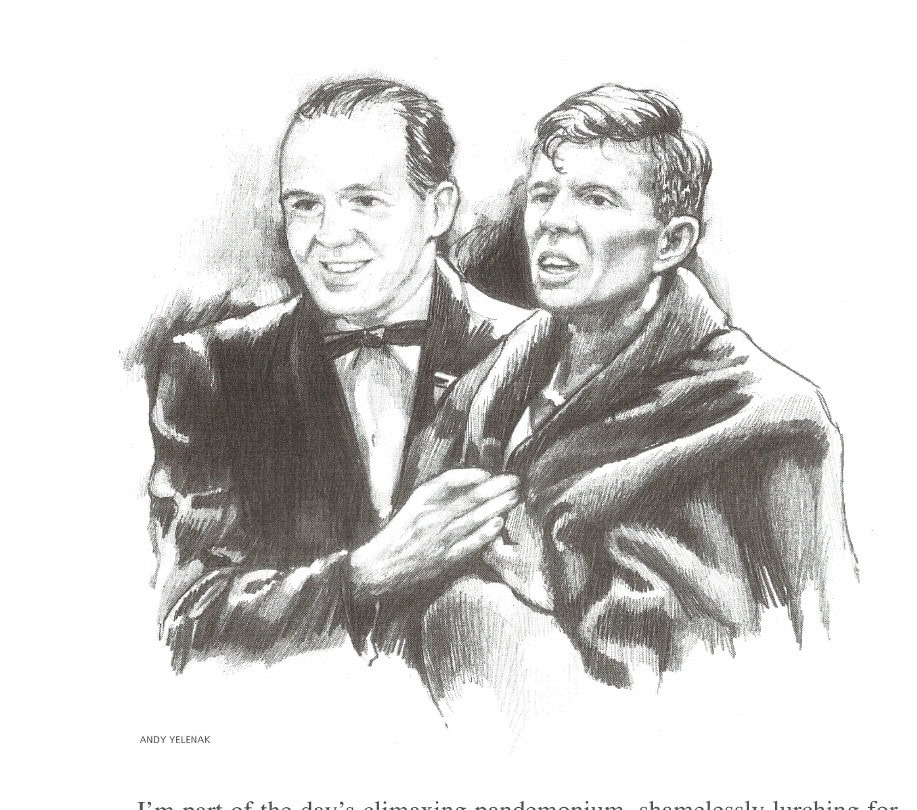
Jock, gleeful, wrapping me in his scratchy Army blanket.
“Joost like I pr-edicted, ye wer-re fifth . . . and fir-rst Amer-rican!” he exults.
Keizo Yamada owns the new course record: 2:18:51. I own my first finished marathon: 2:28:19.
I think I’m learning to run on the wind.
THERE IS something very special, even mystical, about running for 24 hours. Almost everything we do is based on daily rhythms and activities, so it is not surprising that many runners eventually find themselves wondering how far they can run in one day. Even the Western States 100-Mile Endurance Run, which many would consider to be far removed from a typical 24-hour race, gives a special award to runners who finish in under 24 hours: a silver buckle inscribed simply, “100 Miles, One Day.”
After focusing on trail ultramarathons for many years, I recently realized that a 24-hour race offers certain advantages that other races do not. It is an ideal way for a first-time ultrarunner to get a taste of the sport in a distinctly low-pressure situation. If a new ultrarunner enters a 50-mile race, crashes early, and then drops out, the result is a big “Did Not Finish” and probably a feeling of failure on the part of the runner. The beauty of a 24-hour race is that there are no “DNFs.” Runners simply run as many miles as they can run or care to run, and everyone finishes.
A 24-hour race also gives novice ultrarunners more time to reach their goals. Instead of entering a 50-mile race, with its typical 12-hour cut-off time, prospective 50-mile runners who choose a 24-hour venue have effectively doubled the time limit for the attempt. This reduces the time pressure, which will allow the runners to start more slowly, take a long nap if needed, or even go out for pizza and a movie, if they are so inclined. Then they can come back and finish the 50 miles. If they are feeling really good, they might even surpass the original goal and continue to 100 kilometers or some other loftier goal.
Until this year I had dreaded the thought of running a 24-hour race on a track. I had become very accustomed to road and bike path loops ranging from slightly less than a mile to nearly three miles in length, all of which offered a lake in the middle and various types of wildlife to enjoy. But now that I have
This article originally appeared in Marathon & Beyond, Vol. 3, No. 2 (1999).
← Browse the full M&B Archive1,000+ stories from 19 years of Marathon & Beyond
The complete archive of the legendary long-distance journal — digitized and free to read.
