

My Most Unforgettable Marathon
My wife Jessie busies herself making my lunch while I cram in the last of my breakfast—orange juice, wheat toast, a scrambled egg, and coffee. As always, the clock keeps pushing the pace.
I can’t help checking the timepiece in my head: M-Minus-Nine-Days-And-Counting. Three more teaching days before that godsend April vacation. Practically one full week to hide out, to gather my strength, to be as ready as the amateur athlete’s life ever lets one become.
I think of the American over in England who lately has been making New York Times headlines off his brilliant racing against those great British club runners. Leonard “Buddy” Edelen is eight years younger than I. Says he wants to race in Boston. They’re giving him a lot of print, but no money, as yet, to come home to prove himself.
Buddy is a schoolteacher, too. Runs to and from his job, four miles each way, just like me. Does he carry a grocery bag also, I wonder?
At 6:40 our four-year-old, Julie, totters into the kitchen clutching her drawn-up pajama hem. The baby, Kathleen, remains asleep in her crib.
I click on the sinkside radio. The news crackles with unthinkable disaster: a U.S. nuclear submarine, the Thresher, built at Portsmouth, New Hampshire, has disappeared in the Atlantic a few hundred miles off New England, presumed shattered at a depth of one-and-a-half miles.
Jessie and I have time only to exchange glances. She hands me my lunch. I do one last check of the brown bag’s contents. Kisses, and then out into the teeth of the east wind. Plop, plop, plop—south along Pequot Avenue.
Oncoming headlights alert me to possible slush baths from the far side. I have to stay tuned to rearward traffic and remember to cut repeatedly into the grassy margin to avoid dousings.
For the first time in weeks, I welcome visions of the looming 67th Boston Marathon. They refuse to coalesce. In their place are sea-wrapped metal fragments and the eerily blank faces of Thresher’s 129 crewmen, instantly and forever consigned to a watery grave.
Since September, 1956, when I began my teaching career, my wife and I have lived in Groton, now in its Mystic section. With General Dynamics Corporation’s Electric Boat Company as the town’s major employer, and with the nation’s key submarine base located three miles upriver, the business of building and operating submarines is never far from anyone’s thoughts hereabouts. My friend George Terry, like so many thousands of our fellows, works at “EB.”
Despite the economic and emotional dependencies we all share, my own attitude has been shaped by pacifist reading and a lifelong horror of warfare. Today, trudging cold, wet roads and fields toward my classes populated largely by navy and EB kids, I am moved by something more affecting than the most impassioned denunciation of war.
Not until I reach the half-mile stretch of farm abutting Fitch’s soccer field do my preoccupations return to their habitual April rut. Almost gratefully I picture my waiting Ethiopian nemeses, 1960 Olympic champion Abebe Bikila and his understudy, Mamo Wolde.
From them—as if I needed to learn in that dratted Cambridge 12-mile handicap race two weeks ago—there is no personal escape. My only hope—and a great likelihood—is that, in demolishing my 1957 record of 2:20:05, they will hopelessly outclass 200 rivals besides myself.
And what of this Buddy Edelen? How good can the guy be?
Through a swirl of snowflakes, I make out Fitch High School. I hear the 7:20 warning bell.
“GRIZZLED OLD CHOPPING BLOCK”
Three training diary entries. Three solid penultimate workouts:
“Saturday, April 13—6:30 A.M.: From my sister Ellen’s house, New London, ran (through the city and over Gold Star Bridge, into Groton, including Bluff Point and adjacent trails) home to Pequot Ave., Mystic, to finish in 2 hrs., 30 mins. Kept steady 7:00 per mile pace, wearing sneaks & long pants, w/long-sleeved T-shirt, in clear, fine weather: 40–44 degrees, nw breeze. 20 miles.”
“Sunday, April 14—9:43 A.M.: From home, ran 13-mile road course, north through Ledyard and back, to finish in 1 hr., 27 mins. Included pickups of 45 secs., 5:00 mins., 2:30 mins., 1:15 mins., 45 secs., with like recovery intervals after each, from 3–10 miles. Wore long pants and long-sleeved T-shirt in fair, fine weather: 55 degrees, nne breeze.”
“Monday, April 15—9:48 A.M.: Ran as yesterday, adding 3 miles in Ledyard, to finish home in 1:59:30. Kept steady 6:50 per mile pace, wearing flats, long pants, sleeved T-shirt in fair, fine weather: 55 degrees, fresh nne breeze. 16 miles.”
Tuesday, April 16. M-Minus-Three-Days-And-Counting: A day of ill omen. Diary entry: “No running. Have developed a crick in lower back. Walk with Jessie and the girls in Connecticut College Arboretum during afternoon; again, alone, near home, later.”
It’s official. Edelen won’t be coming. My Boston Athletic Association “Aye,” Jock Semple, was rumored to be considering off-setting his expenses, as he did those of Jim Peters in 1954. But, for whatever reason(s), probably bureaucratic, Jock’s beneficence wasn’t tapped.
Belgian champion Aurele Vandendriessche, who finished close to the great Bikila in Europe recently, will be present. And Brian Kilby of England, who thinks he can beat Vandendriessche on a good day. Of course, there’s to be my old scourge, defending champ, Eino Oksanen, going for his fourth win.
Chances are I won’t even miss Buddy.
Now I’ve caught a cold, wouldn’t you know it? These damn things always seem to start with a back muscle strain, just when I’m zeroing in on the big race. Jessie tells me it’s probably “psychosomatic.” She could be right. Even if she isn’t, I can hardly refute her, because, God knows, I’ve beaten her over the head with my pop psychology often enough.
So here I am, 32 years old, beginning to see myself as Jack London described his fictional slugger, Tom King, in the story, “A Piece of Steak”: “…grizzled old chopping block of the ring.”
I’m still doing what I started doing a half-lifetime ago. Chasing my will o’ the wisp. What is there about this running—specifically, racing the killer distance—that keeps bringing some of us back and back for more?
You hear the horror stories. Is it true that “Smilin'” Jimmy Henigan died of a broken heart after being “barred for life” for taking a couple hundred bucks from a cigarette company?
Ah well, I have 72 hours between these reflections and joining the fun in what I think will be my 11th Boston (counting 1949 and 1960 DNFs) and my 27th marathon overall (including seven Yonkers national AAU wins, the ’56 and ’60 Olympic races, the ’59 Chicago Pan-Am, and the ’55 Mexico City Pan-Am DNF, as well as two of Gerard Cote’s Canadian championships).
You’d think I’d get loose. Must be something about the Irish-Canuck mix that prevents freewheelin’ enjoyment of life. Something spooky behind a smiling facade. A guy goes everywhere sneaking paranoid peeks over his shoulder.
Arrgh! Throat feels sore. Please God, not strep! I’ll have to ask Jessie to leave the girls’ room door closed tonight. Early to bed. Thank goodness there’s no school to worry about this week.
Only, there’s my thing about sleeping. What a bugaboo! An athlete can control everything but his sleep. What a waking nightmare that ’58 Boston race was. I actually spent five completely sleepless nights coming down to it. Wanting to repeat so bad. Counted a million sheep. I swore I’d never repeat that folly. Nothing’s worth it.
I remember dust devils whirling in Newton like tiny tornadoes in a desert wind. Staggering on in near delirium. Finishing second, five minutes back of Mihalic, too giddy to answer questions. What would I have done if I had been a soldier facing D-Day? What do big-league pitchers do to calm their nerves? Eino looks like he’s never lost a second of sleep in his life. He’s a detective, isn’t he?
M-MINUS-ONE-DAY-AND-COUNTING
Thursday, April 18—M-Minus-One-Day-And-Counting: I take my final easedown jog through the Pequot Woods behind our Mystic home. I jot “3 miles” in my diary, with a weather note: “Cloudy, mild: 55 d., light sw breeze.”
In early afternoon, Jessie and I leave the girls, along with an undependable car, with my sister in New London and board a train for Boston and Mr. and Mrs. Johnny A. Kelley’s home on the Belmont-Watertown line.
There, over supper, with the phone off the hook, 55-year-old Johnny laughs uneasily as he recounts his 33-year-old friend Dr. Warren Guild’s stories of the latter’s famous Ethiopian house guests, Bikila and Wolde.
“Warren can’t keep enough steak in his freezer,” Johnny says.
“All the boys have to do is eat, sleep, and run. They run twice a day, some days as much as 40 miles. They love American steak, but no potatoes, very few greens. Steak, steak, steak!
“They’re modest, friendly, and thankful for everything the Guilds do for them. Yesterday they jogged over to Lexington Green to read the statue inscriptions. Tomorrow, it’ll be Hopkinton’s Minuteman.
“They even let Warren run with them for a couple of miles sometimes. But when they’ve had enough, they take off like a shot. Guild doesn’t see anybody coming within a half-mile of either of them. He says Bikila will beat Wolde.”
Through Johnny, Guild, one of Boston’s bright young surgeons, discovered running a couple of years ago. True to the popular belief about converts, he can’t seem to get his fill of the activity or its practitioners. Warren has made Johnny his personal guru.
Laura Kelley invisibly whisks our main course plates away and returns with dessert. Spooning into mine, I can’t help marveling over my host’s unique temperament. I have yet to meet another runner of his competitiveness and durability. I know he worries each race as if it were his first, after all these years.
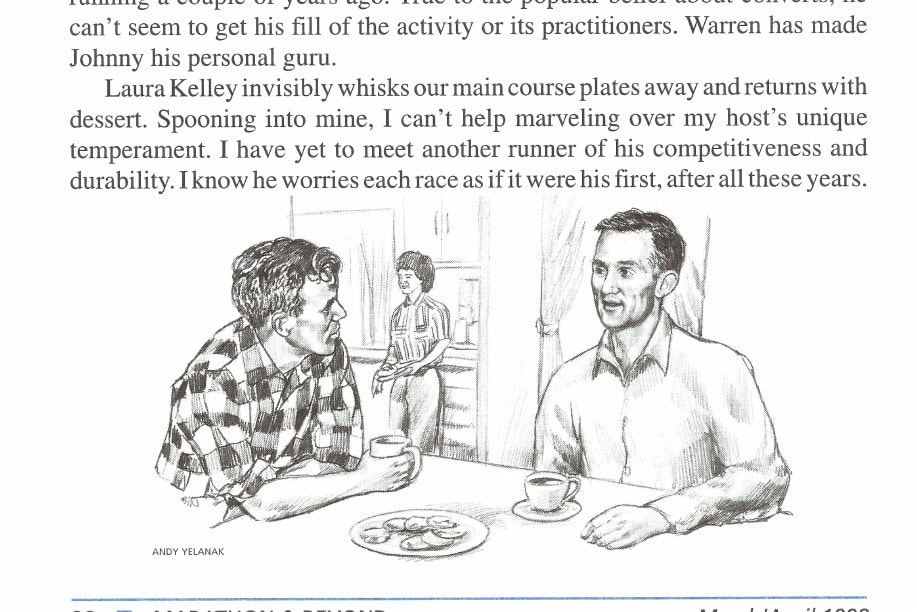
To this extent we are alike. But Johnny Adelbert Kelley possesses an unyielding Celtic toughness that will carry him through hoops of fire, if necessary, to his version of victory. By a quirk of coincidence, we bear the same name (except for the middle one). If only, I think enviously, we bore identical traits.
More to fill a conversational lull than to inform myself, I ask him, “So who do you like tomorrow, Mister Marathon?”
Johnny runs one of his trademark portentous looks my way before declaring, in conspiratorial confidence, “You! It’s your turn again, Kid! In fact, you’re overdue. You should have won all those times you finished second. I know how it is. I’m no stranger to cruel twists of fate in this game, you know.”
I love him for saying it, but the heat is on, and I’m uncomfortable. Time to change the subject.
“Johnny, what do you think about this guy Edelen? Is he as good as they’re saying, or does he just have a super press agent?”
Johnny shakes his head slowly. “It’s hard to tell, Kid,” he says. “I think he’s good, sure. But how good? We won’t know until he gets over here . . . and races against you.”
“I dunno, Johnny. He’s only 24 and racing with that great bunch of Britishers. I’m, . . . well, . . . kind of an old chopping block, I guess.”
Johnny bristles. “Kid,” he says emphatically, “I ran some of my best races after I turned 30. You’ve got terrific races still ahead of you, believe me.”
Then he says, “That Thresher thing was terrible, wasn’t it? It wasn’t built down where you are, was it?”
“No, I don’t think so,” I say.
Johnny grimaces. “You never know in this world, Kid. There are surprises waiting around every corner.”
As quickly as an April sun unburdened by a passing cloud, he brightens. “Laura’s got the bed all made up. Go, get yourselves a good night’s sleep. Tomorrow is a new day.”
He gathers up the last of our plates and follows Laura into the kitchen.
Sitting on the edge of our bed a few minutes later, I force down a tablespoon of the Robitussin Jessie has brought from Mystic.
“I should’ve told Johnny I wasn’t fit to run tomorrow,” I tell her. “My throat is on fire. It’s closing up, I know it is. I’ll kill myself racing with strep, won’t I?”
“If you had strep, maybe,” Jessie says. “But you don’t. You do have a cold, that I’ll admit. But the worst thing you have is a bad case of prerace jitters. Believe me, if I thought you would hurt yourself, I’d be the first one to tell you not to run. You’ve done all the training. You should at least take the starting line. I’ll tell Jock to keep his eye on you.”
“Jock? My God, the man will be out there fighting with everybody in sight, and you think he’ll be able to play my personal physician? He’ll have all he can do to watch out for himself!”
“Trust me,” Jessie says levelly. “He’ll be watching out for you. He always does.”
“You don’t know how badly I want to believe you,” I tell her.
NO TURNING BACK
Jock Semple waits to greet us athwart Hopkinton High School’s teeming main entrance. His oh-so-imitable Scot’s burr overrides the ambient clamor.
“Geeze, wher-re hov y’ beeeeen?”
Laura Kelley deposits our bags on the pavement beside the Opel and tells us, “If Jessie and I don’t get out of town now, we’re not going to get out.”
“Okay, okay, get going then,” her husband replies with stock raceday acerbity. “We’ve got our things to do, too.”
Then, in atonement, he rushes to the Opel’s driver side to kiss her cheek.
Jessie blows her kiss my way and says, “Do your best. And remember, you’re not dying . . . yet.”
The Opel slides efficiently away into Hopkinton’s Marathon Morning Madness.
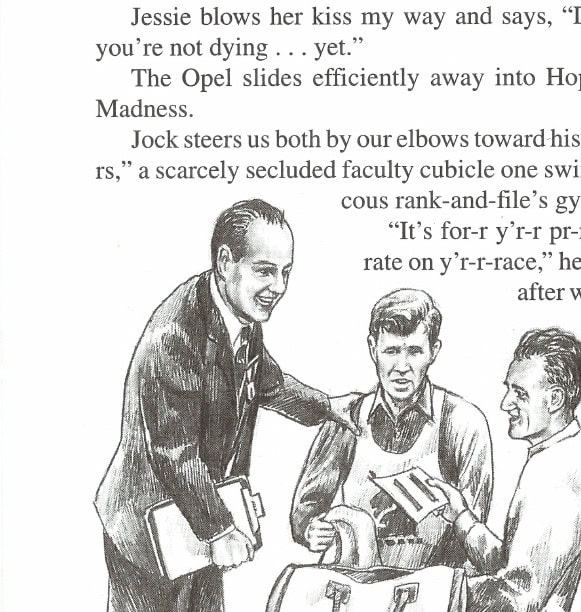
Jock steers us both by our elbows toward his “dr-ressing r-room of the starrs,” a scarcely secluded faculty cubicle one swinging door apart from the raucous rank-and-file’s gym changing quarters.
“It’s for-r y’r-r pr-rotection, so ye can concentr-rate on y’r-r-race,” he invariably explains. A minute after we begin undressing, he’s back, with “just one special r-repor-rter” in tow, for “one quick interrview.”
The quiet, amiable fellow across our aisle turns out to be the Brit, Brian Kilby. A startling camera flash illuminates our handshake.
I feel strangely comforted in the presence of this world-ranked marathoner who appears hardly more girded for our coming ordeal than I—and hardly more physically imposing.
My old pal Eino Oksanen remains conspicuous for his absence from our sanctuary. And we hear that Dr. Guild has driven his famous duo directly to the starting line.
Dressing for today’s weather poses no great challenge. A foggy overcast notwithstanding, the temperature approaching noon nudges 60, while the wind, predicted to be dead in our faces, seems to come from a southerly quarter.
No Olympic champion has ever won the Boston Marathon. So the Boston Globe’s Jerry Nason reminds us as we leave Hopkinton High on foot for the start, half-a-mile down Hayden Row.
“So how is Young John feeling?” Jerry ventures.
Feverish, croupy, probably suffering from strep throat, constricted, half-sleepless. “Not bad, not bad, Jerry, thanks,” I lie.
“Really, Kid, how are you?” my namesake whispers with grim innuendo.
“Feverish, croupy, probably suffering from strep throat, constricted, half-sleepless,” I spill the beans.
Johnny shoots me his terribly concerned look. “Gosh, Kid, that’s awful! But . . . you’ll do okay. You’ll do just fine.”
Over and over, as we walk, voices exclaim, “Johnny Kelley and his son!” “Johnny Kelley and his dad!” Time and again we break stride to scribble “Good luck” on proffered autograph pads. I chuckle to realize that, at this time on a Groton school day, I’d be ordering some troublemaker out of my fourth-period class.
THE 67TH BOSTON MARATHON
The 67th Boston Marathon’s early miles engage my outer self, committing me to the best effort I can make against crippling odds. My inner self has taken refuge in a kind of free-associational reverie.
The outer self keeps pace with a fellow named (I believe) Jesse Eblen. Eblen hails from Seattle, and today’s meeting is our first. We seem well-matched.
Half-hidden by a low ceiling, a TV news helicopter chop-chops overhead. Eino Oksanen, with his incongruous woodsman’s physique, joins us, his stolid countenance allowing no hint of his most reasonable hope.
If there are Ethiopians in the race, our subpack must imagine them. But ample proof of their existence is provided by the overly helpful fans lining our route. “They’re up by 400 yards!” “You’re 600 yards behind!” “Go after ’em! They’re almost to Wellesley!”
In Wellesley at last, we get our first official posting: Bikila and Wolde are striding in tandem a half-mile ahead of us.
So far, I have raced, if that’s the word, tentatively. It’s impossible, after all. Has a fever-wracked marathoner ever hit the jackpot?
Yet, passing through Natick Square a while ago, I think I heard “52-something.” Coincidentally, for the first time, I noticed I was swallowing without feeling I would vomit.
Low expectations and Newton Lower Falls complement each other. But for me today, the course’s lowest point short of its Back Bay finish line exerts an unexpected influence. I actually begin to believe I can finish.
Minutes after our trio tackles the first of those dreaded Newton Hills, Kilby makes us a foursome. As one, we take the 90-degree right onto Commonwealth Avenue, Newton. But the long ascent already behind us, and an ever-edgier wind, now out of the east, are fast escalating our battle to a point of merciless attrition.
Eblen becomes the first to falter. Then we are three. Two miles farther on, Heartbreak Hill takes care of Eino.
Somewhere in the mists ahead, between the solid-money Ethiopians and Kilby and me, a lone Belgian, Aurele Vandendriessche, races in perfect self-control.
How can I be where I am?
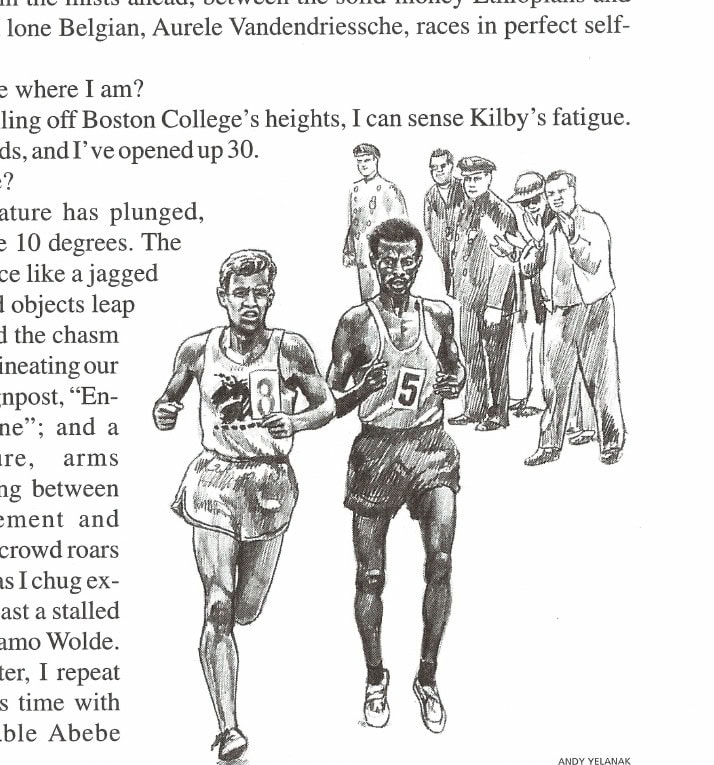
As if free-falling off Boston College’s heights, I can sense Kilby’s fatigue. Another 200 yards, and I’ve opened up 30.
How can this be?
The temperature has plunged, maybe 8, maybe 10 degrees. The wind cuts the face like a jagged knife. Two fixed objects leap from the fog and the chasm of spectators delineating our final miles: a signpost, “Entering Brookline”; and a spectral figure, arms akimbo, teetering between forward movement and inanimacy. The crowd roars its approbation as I chug expressionlessly past a stalled and defeated Mamo Wolde.
One mile later, I repeat the process, this time with the incomparable Abebe Bikila.
Here’s a quick summary of Parts I through VII of The Great Six-Day Races, which appeared in the first seven issues of Marathon & Beyond. — Editor
In 1788 “pedestrian” Englishman Foster Powell travels 100 miles in 22 hours, while fellow countryman Captain Barclay outdoes him by covering 100 miles in 19 hours in 1806. Pedestrianism catches on in the United States, where the best Americans, Edward Payson Weston and Daniel O’Leary, compete in several six-day events in the 1870s. In 1876, the pair travels to England and continues to record impressive long-distance feats. British Parliament member Sir John Astley inaugurates a series of six-day races called the Astley Belt Races. O’Leary wins the first two races in decisive fashion but loses the Belt to Brit Charles Rowell in a gut-wrenching third race. After sitting out the first three events, Weston, whose career was thought to be washed up, competes in the Fourth Astley Belt Race, quieting his detractors with a record-breaking performance. Amidst great controversy, the fifth race takes place in New York City in September 1879. In a hotly-contested competition, complete with illness and violence, Charles Rowell wins the Belt. Six-day race mania sweeps the United States in 1879, and women pedestrians join the action. Charles Rowell captures the sixth and seventh Astley Belt Races to become the absolute owner of the Championship Belt. Charles Rowell sets his sights on a record distance in a six-day event, but he fails dramatically in two attempts.
CHAPTER 11: ROWELL RETURNS
Charles Rowell rested on his farm in England for almost a full year. He spent his time regaining his health and raising stock. Patrick Fitzgerald, likewise,
This article originally appeared in Marathon & Beyond, Vol. 2, No. 2 (1998).
← Browse the full M&B ArchiveMore like this
1,000+ stories from 19 years of Marathon & Beyond
The complete archive of the legendary long-distance journal — digitized and free to read.
