

On the Road with Kathrine Switzer
In one of life’s more validating moments, I am asked back as program director, a position I had with the company from 1978 to 1985. The reality is that Avon and I have been working on the possibility of a return to this program for over a year but keeping it quiet until we could get our events in place, and to maximize the press impact, which today is tremendous. Avon’s sponsorship and system of opportunity and upward mobility played a big role in the development of women’s distance running and was a huge factor in the women’s marathon being included in the Olympic Games. Now the aim is to make running and walking accessible as fitness tools to as many women as possible while still creating that avenue of upward mobility for the talented runner. With a goal of launching in 16 countries in 1998, I see a lot of travel ahead of me.
BUDAPEST, HUNGARY, September
I’ve always wanted to do a women’s race in Hungary, for one big reason: Sarolta Monspart. Sarolta was one of the top-ranked marathoners in the world in the 1970s. But marathoning was her second sport—she actually was a world champion orienteerer. She finished second in the inaugural Avon Marathon in Atlanta in 1978, and we became good friends and have stayed in touch for years after that. Now Avon is doing business in Hungary and wants to do a race there. Twenty years after I met her, Sarolta is now the Director of the National Women’s Sports Institute in Hungary. In 1979, Sarolta was bitten by a tick and was paralyzed for several months. Her competitive career was over, and even today she walks with a limp. But it hasn’t stopped her total immersion in creating opportunities for others. The consequence is that women’s running is not unique in Hungary, and our challenge will be to establish programs in more remote areas that still have corporate impact. Quick! Name three Hungarian cities besides Budapest. See? It’s time to move beyond just the big lights.
BUENOS AIRES, ARGENTINA, October
Talk about big lights. There are 11 million people here. The city looks and feels European, so it’s kind of like New York, only with charm.
Unfortunately, my colleagues in Argentina don’t think women run here and that nobody has ever heard of any woman runner. I feel like I’ve rolled back in time to the old notions of “Women Don’t Like To Run,” yet when I look out at Palermo Park or on the bike trails, I see loads of women runners and joggers. I must wrestle here with what some perceive as sport and some perceive as lifestyle.
In September, the Carrefour 8K race was held in downtown Buenos Aires and attracted 51,000 people, the fourth largest race in the world in 1997. The race director tells me that 20 percent of those runners were women. Check Argentina for a return trip and some re-focusing.
NEW YORK, NEW YORK, November
Thirty thousand registered runners, and after a perfect autumn week, the fog bank and thunder caps begin to roll in the day before the New York City Marathon. In eight hours of television rehearsals, we can’t get a single helicopter up, and that is only indicative of the situation: every single person working every aspect of the race will be challenged.
Frankly, the runners will have the easiest job. They only have to run their hearts out, and there are plenty of heart-tugging stories. Tegla Loroupe heads the favorites list of women, and her touching personal stories only fuel the fact that she also has four minutes on the rest of the field due to her knockout 2:22:07 last April in Rotterdam. People keep talking about course record; Tegla keeps talking about starting conservatively.
German Silva heads the men’s list, and he also never fails to impress with his personal commitment to helping others—this time to donate a portion of his winnings to homeless children in Mexico City. While everybody is handing Tegla the women’s race, German clearly has a tough job against the likes of Domingos Castro, Stephano Baldini, and a flock of Kenyans, not the least of whom is Shem Kororia, who just came within nine seconds of the world half-marathon record by running 59:56 at Kosice two weeks ago.
But there is nothing so certain as the uncertainty of the marathon race. German hangs in with the leaders, and in Central Park with only two miles to go, looks to be a sure contender and is gaining on leader John Kagwe, who is close to a course record despite having to tie his shoes three times. As it often is, the marathon is just a mile too long, and suddenly Silva is not gaining on Kagwe but going backwards. Kagwe wins, in 2:08:12, 11 seconds off the course record, making Kagwe’s the most heartbreaking and expensive pair of Nikes anyone has ever worn. When Silva hits the finish line in fifth place, he passes out and is carted off to the hospital. While he seems OK by the awards ceremony that evening, you have to wonder about the number of times Silva can turn in that magnitude of performance.
For the women, the story is similar. Starting conservatively, Tegla hangs behind a pack of women and makes her traditional move at 19 miles, taking only Colleen De Reuck and Franziska Rochat-Moser with her. Tegla begins surging, and it looks like the other two are just hanging on for places, when poof! Tegla loses her legs at 22 miles, just when Franziska finds hers. It is a neat 2:28:43 victory for the Swiss champion and puts her on the map.
Unfortunately, the race doesn’t have a perfect ending for her. After a complaint by Kim Jones at the postrace press conference, journalists make a tempest-in-a-teacup controversy over women taking water passed to them by men in the race. Along with other runners, Rochat-Moser is wrongly implicated; I was sitting beside her on a motorcycle during the entire race and never saw her take anything from anybody. The next day, race director Allan Steinfeld declared the case closed and no protests filed. The press mostly moved on as if nothing happened, but I felt sad that a tremendous victory from this intelligent and talented woman was tarnished for her. How different would some of our beloved heroes like Grete Waitz or Bill Rodgers be today if something unfair like this happened on their first major victory?
The race also had an unhappy and scary ending for Tegla Loroupe. Finishing seventh, she said she didn’t know what had happened, and she shrugged it off to menstrual cramps. But several days later, after being examined by a sports medicine specialist in New York, Loroupe was found to have two serious stress fractures in her spine. It is a serious condition, where the bone is broken but not separated. Separation could cause injury to the spinal cord and even paralysis, so her mobility must be restricted. Tegla will have to wear a back brace 23 hours a day and cannot run for four months. She cannot run the marathon distance for at least eight months.
I suppose all these stories that pull at the heartstrings are minimized, however, by a man named Donald Arthur, who ran the race with a transplanted heart. Mostly unsung, totally unnoticed, perhaps Donald Arthur puts the race into perspective best.
Editor’s Note: Due to Kathrine’s increasingly busy schedule in launching the Avon Running series, this will be her last “On The Road With … Kathrine Switzer” column. Kathrine will continue to contribute to Marathon & Beyond as time permits. We wish her the greatest success in guiding Avon’s return to running. Look for our new “On the Road…” host in the March/April issue of M&B.
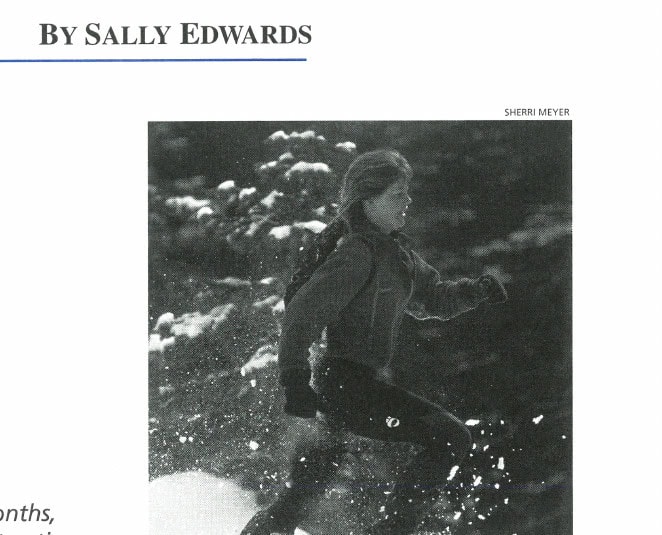
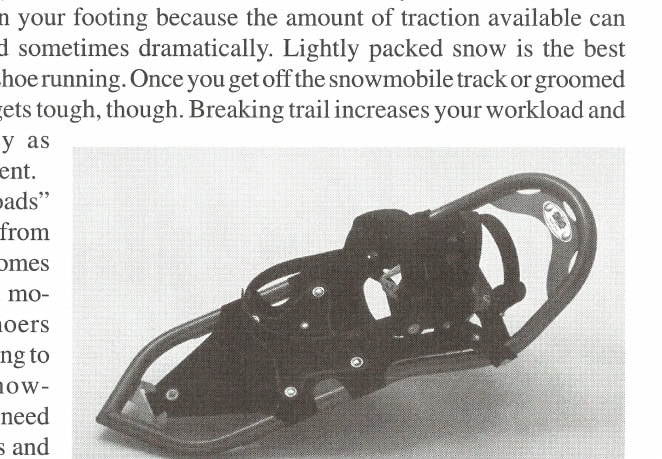
WHEN ARCTIC winds roar in from the north, long-distance runners in northern climes turn to snowshoeing as an attractive alternative to plodding through knee-high snowdrifts or running on treacherous roads. Snowshoes are no longer the bigger-than-a-tennis-racket type used by Sergeant Preston of the Yukon. Today’s snowshoes are smaller, lighter, and more practical.
Running on snowshoes will require a slight technique modification compared to the form you’d use while out running on the roads or trails. The extra weight from the frames of the snowshoes adds to the workload, so you’ve got to lift the legs more. The energy required for lifting and landing shortens your stride length. The outswing gait required to run on symmetrical running snowshoes and the more straddled footplant puts additional stress on the hip flexors, but the softer running surface helps alleviate some of the impact of these biomechanical adjustments. Nicking the inside of the ankles and “drawing blood” is common, so while snowshoeing you’ve got to take a wider stride or wear a pair of hockey-style ankle guards for protection.
If you’re intent on becoming a snowshoer, you’ll need to learn to run smoothly and develop a rhythm in the stride at a constant intensity level. You also need to concentrate on your footing because the amount of traction available can vary quickly and sometimes dramatically. Lightly packed snow is the best surface for snowshoe running. Once you get off the snowmobile track or groomed trails, the going gets tough, though. Breaking trail increases your workload and energy costs by as much as 50 percent.
“Share the roads” is a common cry from runners when it comes to bicyclists and motorists. Snowshoers utter the same thing to skiers and snowmobilers. We all need to share the trails and treat each other with respect. The nordic skiers are protective of their trails, and you’ll need trail passes to snowshoe at a nordic resort. The trail pass gives you the privilege to use the facilities whether you are on or off the trails. It’s best to check in advance if snowshoeing is allowed at a specific nordic area.
GETTING STARTED
Start your snowshoeing adventure by running slowly on a flat trail to learn the balance and coordination required. On a well-packed snow surface, most sub-40-minute 10K runners can snowshoe that distance two minutes per mile slower than their 10K running pace. If you run slower than 40 minutes for the 10K, add three minutes per mile to your time. This translates to a 35 to 45 percent increase in energy used in snowshoeing compared to running.
Economy of movement is as key to successful snowshoeing running as it is for any other type of running. Efficiency lowers the workload and enhances your performance. To become efficient, use the least amount of leg lift practical to raise the shoe out of the snow, and keep your feet as close together as is practical. If you’ve ever run in sand, you’ll remember that the imprints of your feet form a straight line. That’s because when you run, your footplant is directly under your body’s center. Try to accomplish the same pattern when snowshoeing, using as little outswing and as little waddling as possible while running in symmetrically constructed shoes. This bow-legged running style can be awkward at first and requires concentration to pull it off.
You’ll be surprised—and encouraged—at how similar running and snowshoeing are. You don’t need to practice in advance. Many novice snowshoe racers, for example, simply rent or buy a pair of snowshoes and enter their first race without ever having snowshoed before.
You’ll notice that there are different stress points involved. When running uphill, the calf muscle is shortened because the heel doesn’t land and the same muscle drives the leg into the hill for stability and footplant. Most runners develop tremendous hamstring strength because this muscle group drives the leg forward in the running gait. In contrast, in snowshoeing, the quads and hamstrings are used about equally. The quads work to lift the added weight of the snowshoe out of the snow.
Runners-turned-“shoers” love the convenience and safety of sport snowshoeing. If you live in snow country, it’s incredibly easy to slip into your bindings and go for a workout right from your back door. You can run and hike your favorite running trails in the winter and experience entirely different scenery. You can even snowshoe after dark by using a head-mounted lamp. There is nothing quite like snowshoeing under a full moon. Take your training partner along. Put some drinks and a snack in a daypack and take off.
SNOWSHOE RACING IS DIFFERENT
For those runners who love to race, snowshoe racing is a little different than you’re used to. Distances often aren’t accurate, and like many wilderness tales, the lore and legend is exaggerated. Take, for instance, the Iditashoe. Race management acknowledges that the event is “an Alaskan 100-miler,” which means that they don’t know the distance of the course, they haven’t measured it, and they don’t really care to since it ends at a trapper’s cabin and they aren’t about to move the cabin to accommodate a little thing like an accurate measurement. Some racers in the Iditabike used their cycle computers to measure the course, and they felt it was 85 to 90 miles.
This article originally appeared in Marathon & Beyond, Vol. 2, No. 1 (1998).
← Browse the full M&B ArchiveMore like this
1,000+ stories from 19 years of Marathon & Beyond
The complete archive of the legendary long-distance journal — digitized and free to read.
