

My Most Unforgettable Ultramarathon (Vol. 18, No. 5)
ZUMBRO RIVER BOTTOMS, THEILMAN, MINNESOTA, April 12, 2013—There were three running events slated for the second weekend in April in Theilman, Minnesota. The races are held in the hills around the Zumbro
River bottoms in this small southeastern Minnesota town. There was the Zumbro 100-mile, but that was too long for me, and the Zumbro 17-mile, which seemed a little short. So I chose to run the Midnight
50-mile (as the name implies, it starts at midnight!), which seemed just about right. I completed my training with a short run on the Monday before the race. I had heard the weather was going to turn bad and wanted to avoid it. On Tuesday, it was cloudy and a little chilly.
On Wednesday, it got cold, and then it rained. Thursday, it snowed. I went online to look at photos from last year’s race to get an idea of what the weather was like then, and the runners were wearing shorts. It was the same for the year before. Everyone seemed to be smiling and enjoying a beautiful Minnesota spring day. So how come it’s snowing? It was raining again by the time I went to bed.
When I left home on Friday morning, the rain had changed back to snow. Oh, well, I had a 60-mile drive ahead of me. Maybe it will get better as I get closer. Nope. The race started in a campground near the Zumbro River. I arrived about 9:00 a.m. I checked out the snow-covered starting line, just to get a feel for the atmosphere of the race. No runners were around; the 100-mile runners had departed
about an hour earlier. It was pretty quiet, and only a few crew members were sitting around a campfire, trying to keep warm. My dad lives nearby, so I went there to rest until the race. The snow had stopped and the temperature was in the mid-20s when I returned about 11:00 p.m. I’ve run in much colder weather, so I wasn’t too concerned. A party had started since I was there in the morning. I was greeted with a variety of loud music—country, rock, Spanish, polka, pop, and crazy combinations of all. I was excited and ready to go. I couldn’t wait. After months of training, the Midnight 50 was finally here!
Spirits in the night I could see the headlamps of the 100-milers running along the path at the top of the hills that surrounded the starting area. It was an inspiring sight, knowing that I would be up there soon. The tops of those hills were 350 to 400 feet above us, so the view from up there must be incredible!
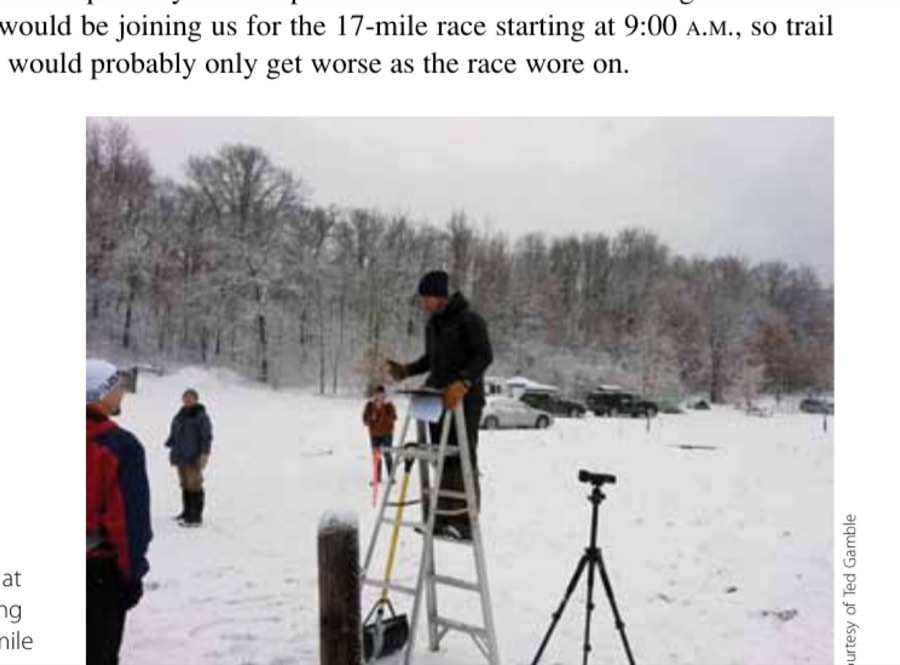
Finally, the race director mounted a stepladder near the starting line and began speaking. The trail conditions were wet, slippery, and muddy. I believe he used the word “atrocious.” What was dry when the trail was marked was now wet, and what was wet was now dry. Take your time and be careful, he said, and we would get through it. We were told that 69 runners had started the 100-mile race in the morning, and 24 had already dropped out. That wasn’t a good sign! I estimated about 80 headlamps ready to attempt 50 miles with me at the starting line. About 100 or so would be joining us for the 17-mile race starting at 9:00 a.m., so trail conditions would probably only get worse as the race wore on.
Courtesy of Ted Gamble
▲
Runners receiving instructions at the beginning of the 100-mile race.
We would be running three laps of 16.7 miles. The 100-milers who started in the morning were about half done by now. The race director said we could recognize them easily because they would likely be limping.
A friend of mine, Hank, had entered the 17-mile race. I figured that I could do two trips around the course by 9:00, and then we could hook up and run together for as long as I could keep up. We started off by running through the campground and then entered the woods. Soon we were climbing a muddy single track up a steep hill. Thankfully, the trail was lined with saplings and small trees, as they provided something to grab to keep from slipping backward. Pretty soon, we made it to the top of the West Scenic Trail, an elevation change of 350 feet in less than a mile. I looked below me and saw a line of headlamps winding through the woods to the bottom of the hill, an amazing sight. After a short while, the trail became very icy. I mentally patted myself on the back for wearing my slip-on ice cleats.
After a couple of miles, a voice behind me shouted, “We’re now one-twentyfifth done! Woohoo!” I replied over my shoulder, “My math ain’t so good now; how far have we come?” “By my reckoning, that’s about two miles or so,” said another.
There were several conversations like that throughout the night. Someone in front of me or behind me would say something, sparking a conversation. Sometimes we would talk like that for a couple of miles, never seeing what the other looked like.
We descended the long, easy Cross Over Trail to aid station number 1. The aid station was lit up like a Christmas tree—literally. Christmas lights decorated the area and hung from trees, bushes, and tables. I filled my water bottle with a little HEED and headed over the concrete bridge that spanned the Zumbro River. From there we followed the single-track Bridge Trail along the river. There were a couple of streams that fed into the river, and log bridges were used to cross these. Thankfully, they were short, easy crossings.
The aid-station layout Including the start/finish area, there were five aid stations on each 16.7-mile loop. The distance between aid station 1 and aid station 2 was the longest of the five at 4.33 miles. Another runner commented that not only was the distance between these two aid stations the longest, but it was also the toughest, hilliest, rockiest, and muddiest stretch in the race. Each time I ran this stretch, I remembered that runner’s words. As hard as I tried, I could not get that out of my head. I don’t know whether it was the hilliest, or the rockiest, or the muddiest stretch, but it was a tough mental obstacle to overcome.
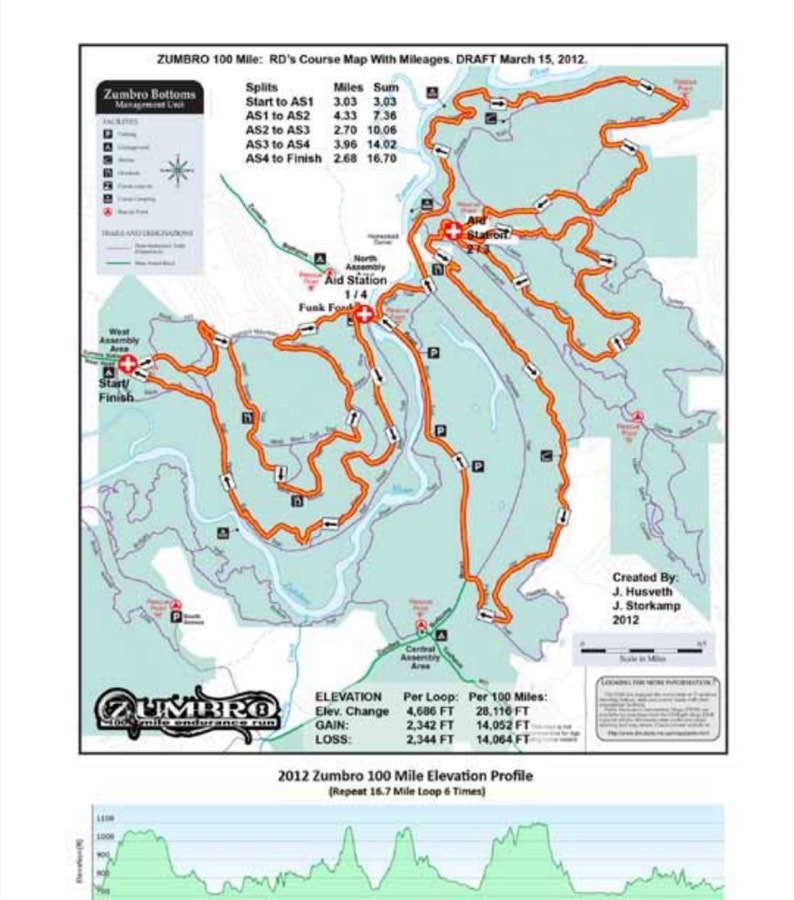
Even though it was dark, I saw a couple of memorable sights in this area. I happened to be leading a few runners down the trail (only because I am slow and they could not pass on the single-track trail) when I noticed a light moving off to my left, near the ground. What’s going on? I envisioned a hurt runner with a twisted ankle or a bad knee. What if there’s blood? How would we get him out? I hoped it wasn’t too serious.
I called out, “Is everything all right?“ “Just marking my territory!” answered a female voice. We all broke out in laughter. I guess I was a little “relieved,” too. It was still early and we were still fairly close together. As we wound through the trees and up and down hills, it was easy to see where I had been and where I would soon be by watching the lights ahead of and behind me. It was another amazing sight. I was really starting to enjoy this.
However, there were several times during the night when I was completely alone. In the weeks leading up to the race, the thought of being alone, deep in the woods, late at night, caused a little anxiety. How would I react? Would I be creeped out by it? As it turned out, I really enjoyed those times when my entire world had shrunk to the five feet in front of me illuminated by my headlamp: just me and my thoughts and an occasional owl hooting in the distance. Otherwise, I was surrounded by a calming silence. It was strangely tranquil. This was the right thing for me to be doing, right now, and very nice.
Finally, arrow-shaped glow sticks on the trail guided me over the last small hill to aid station 2. I grabbed something to chew on, washed it down with a Coke, and continued down the trail. What followed was a short 2.7-mile loop. It began with a steep climb up Picnic Rock and then down the aptly named Sand Coulee Trail. The sand made it nearly impossible to run, like one of those bad dreams where you’re running and not moving, but this was real. I gave up and slowed to a walk, thinking it would be a good way to conserve some energy. Soon I arrived at aid station 3, which was directly behind the second aid station. Funny, I didn’t notice that when I was here before.
I filled my water bottle and headed back out. Almost immediately, the trail began a long, steep climb to the Scenic Overlook Trail. This was a 300-foot ascent up a tough, rocky, and slushy trail. Near the top, I met another runner. He must have been a 100-miler; he seemed beyond exhausted. “
Why do we do this to ourselves?” he asked. “What do you mean?“ I replied. “I mean, put ourselves through this and hurt ourselves so much?” I didn’t know what to say, so I didn’t say anything. I wasn’t yet hurting; I was still having fun. “I think I must deserve this, somehow,” he concluded.
A beautiful view of darkness We parted, and I soon reached the trail at the top of the hill. This part of the trail was worn down into a 12-inch deep groove and lined with mud. The view from up there would have been incredible if we could only see it. It was still very much the middle of the night.
Courtesy of Ted Gamble
The descent back to the river bottoms is called the Ant Hill Trail. Usually, downhills are easier for me than uphills, but not this one. It was just as tough as the uphill climb two miles earlier, only more rocky. The trees along the side of the trail provided some convenient and much-needed handholds that prevented several tumbles. It was here that I came upon a group of 50-mile runners, and I stayed with them for a few miles. It was nice to have some companionship again.
When we got to the bottom, the course took us along a flat gravel road for about a mile and a half to the fourth, and last, aid station before we returned to the starting line. It was nice, easy running for a time, conversation among the group helping carry us along until we came to a spot where the river overflowed the road. It wasn’t too deep, and we were able to splash though it pretty easily. Our feet were already soaked, so it was no big deal.
The fourth aid station was slightly more than two miles from the start/finish line. We started down the gravel road and then turned back onto more single track back to the campground. I separated from the group somewhere in that area and never saw the others again. When I came out of the woods, I was greeted by a pair of snowmen on either side of the trail. I gave the one on the right a high-five. Later on, I saw a family of snowmen (snow people?) cheering me on from the top of a picnic table.
I finished the first lap in a little less than five hours, about an hour slower than I had planned: not good. If I was going to meet up with Hank, I had to run the
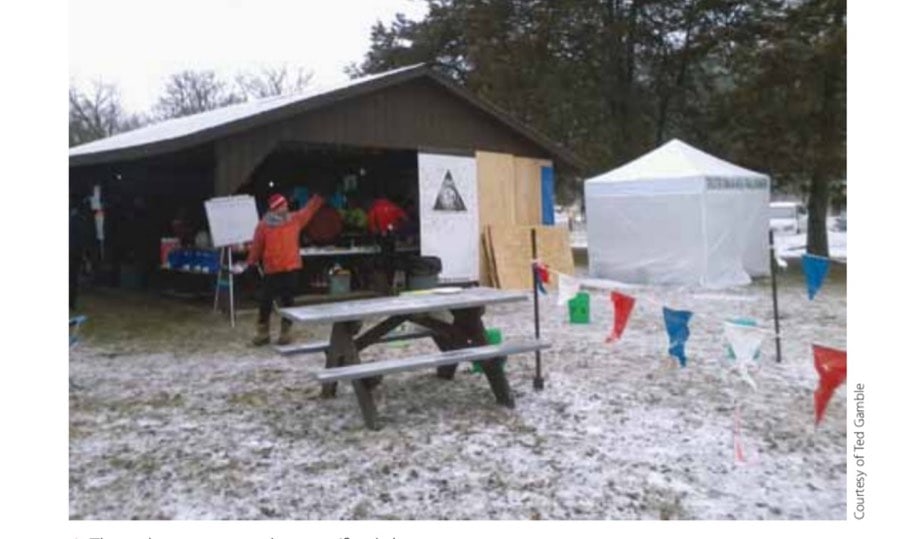
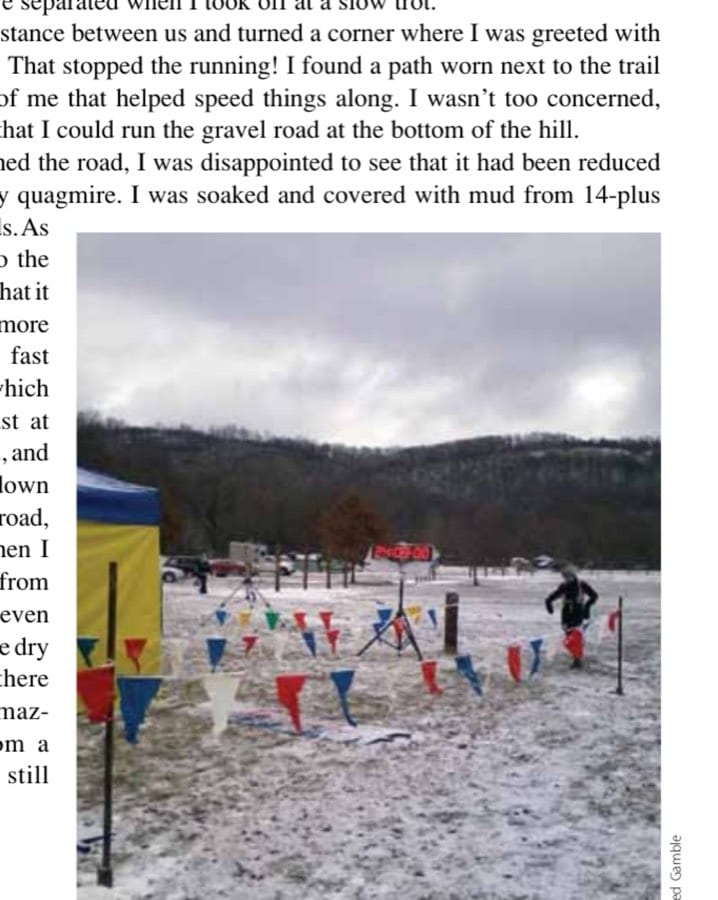
▲ The aid station near the start/finish line.
second lap in less than four hours. That wasn’t going to happen! I had also told my family to meet me between 10 o’clock and 12 o’clock to see me finish. That gave me only seven hours to complete two more laps (33.4 miles). That wasn’t going to happen, either!
I began to think that it was odd how quickly I was able to convert a 16.7-mile hilly run on a muddy, rocky, icy trail to a “lap.” Normally, a lap is something you do on a track that doesn’t take too long. It must be some type of unconscious mental trick to make the distance seem more attainable and realistic. Well, doing one of something is much easier than doing 17, right?
After crossing the start/finish line, I went to my car to change into some dry clothes and changed my socks. It was then that I noticed that I had lost both of my ice cleats. Oh, well, I guess I would have to do without. I also changed the duct tape on my feet (a very effective blister deterrent) and visited the aid station. My hands were starting to get cold, so I filled my handheld water bottle with some warm soup. That worked well, and it was quite tasty!
Finally, lap two I began the second lap, and by the time I got up to the West Scenic Trail, I began to notice the trees lining the trail. Day was beginning to break. The experience gained on the first lap should make the rest of the race easier; I was now somewhat familiar with the terrain and the route. I would now be able to see beyond the illumination of my headlamp, and that should help. I also had decided to be more liberal in my definition of a hill—any upward incline now qualified as a “hill.” I would walk up all hills and run the flats and downhills. I still knew that I wouldn’t make it back in time to meet Hank or my family, but I hoped to pick up the pace a little and make up for my slow start. The new day had given me new hope.
However, as the day brightened, the temperature actually fell. The water that covered the log bridges and the rocks on the trail had turned to ice, making the footing even more treacherous. I really regretted losing my cleats! When I arrived at the top of the Scenic Overlook Trail, I could see the 17-milers congregating near the starting line. There was no way that I could get there in time to meet Hank. I still had eight, maybe nine miles to go! I started to think about meeting my family, too. If they weren’t there when I finished the second lap and I left for my third, they would have to wait five or six more hours for me. Maybe I could leave a note on my car, telling them that I would be later than expected. Yeah, that’s what I would do. I hope they find my car.
I made my way again to the gravel road that wound along the river and came across a younger runner who was recovering from a wrong turn. He and two others had run down the wrong trail for about 45 minutes when they noticed that they were all alone. Sensing that something was wrong, they turned around. That
detour had cost them an extra six miles. That would be really tough to overcome, but he was still determined to finish. I admired his tenacity. Throughout the run, I grazed at all of the aid stations, eating whatever appealed to me. I always ate first what I needed most—gels, electrolyte tablets, water, HEED, and so forth—and then looked for something that simply tasted good. There were quesadillas, fruits, nuts, peanut butter and jelly, candy, pizza, and pop: good stuff. But I noticed at about the halfway point that I was always hungry. There was emptiness in the pit of my stomach that never went away, no matter what I ate. I was sucking down a full water bottle and more between stops. Late in the second lap, the aid stations started supplying hamburgers and hot dogs. Meat! Yes! I devoured a cheese-covered hamburger patty and several hot dogs. No buns for me! I could feel the energy flow back into my body, rejuvenating it. I must need protein for long runs like this: lesson learned.
As I approached the start/finish area for the second time, I saw my wife, Linda, and daughter, Katey, waiting for me. Cool! I was happy and relieved to see them. Being so far behind my goal, I was sure that I was going to miss them. They probably thought they were going to see me finish the race; instead, they saw me finish my second lap.
I had covered just 33.4 miles in 10.5 hours. There were 16.7 hilly miles left to go. Physically, I still felt pretty good. Mentally, I was thoroughly enjoying this. What an experience! I was a little disappointed in my speed, but I have never pretended to be fast. However, the trails were in very poor condition due to the horrible weather, and the course was incredibly challenging. But I knew that I was going to finish this thing. There was only one lap to go!
Again, I planned on running the flats and the downhills and walking the uphills. The plan worked very well until I reached the first aid station. With the additional runners and the now gradually warming weather, the trails were in the worst condition of the race. Even the flat areas were dangerously muddy and slippery. It was hard to walk in many places, and there were several times where I did the double-arm pinwheels and almost fell. I must have been a ridiculous sight to anyone who saw me.
Walk? Run? What’s the perfect combination? I knew that I was going to finish well under the cutoff time of 18 hours, so there were no worries on that front. With the muddy trails, I decided to walk to aid station 3 from the second aid station, about 10 miles in, and then walk up to the Scenic Overlook Trail, and I should be able to run the flat areas at the top of the hill. There was simply no way to run down Ant Hill, so I would have to walk that part of the trail. With all the walking, I shouldn’t have any trouble running the gravel road to the fourth aid station. From there, it was only a little over two
Courtesy of Ted Gamble
miles to the finish. I would run as much of that as possible. No matter what, I would cross the finish line running. I must have been going too slowly to catch anyone, because I didn’t see another runner on the course until I made it to the third aid station. Was I that far behind everyone else? I hoped not. I was getting kind of lonely.
I asked the aid-station workers if they had seen anyone lately. Yes, they said, I should be catching up to someone soon. And there were still several who had not yet checked in; they could be behind me, or they could have dropped. Eventually, I caught up to a couple who were also walking due to the trail conditions. We walked together until we reached the Scenic Overlook Trail. The trail looked a little better, so we separated when I took off at a slow trot.
I put some distance between us and turned a corner where I was greeted with ankle-deep mud. That stopped the running! I found a path worn next to the trail by those ahead of me that helped speed things along. I wasn’t too concerned, because I knew that I could run the gravel road at the bottom of the hill.
When I reached the road, I was disappointed to see that it had been reduced to a long, muddy quagmire. I was soaked and covered with mud from 14-plus hours in the woods. As close as I was to the finish, I decided that it didn’t matter anymore and took off as fast as I could go, which really wasn’t fast at all! I slipped, slid, and splashed right down the middle of the road, slowing only when I had to, to keep from falling. I didn’t even attempt to find the dry spots, because there weren’t any. Amazingly, aside from a little fatigue, I still felt OK.
▲
A runner approaches the finish line.
The last 2.5-mile stretch to the finish was as muddy and perilous as the previous 14. It didn’t matter; I could smell the finish. I ended up walking most of it anyway—well, except the last 100 yards or so. I had told myself earlier that no matter what, I would finish this thing running, and I did.
It took me more than 16 hours to finish. I was the 45th runner out of 51 who crossed the finish line, but I had finished, and I guess that is an accomplishment. Thirty runners who started the race didn’t finish and 20 others who signed up didn’t even start. Surprisingly, I didn’t feel the elation when I finished that I had thought I would. I was just “done,” and that felt good.
As I write this about two weeks after the race, I’m still a little sore. I’ve thought about the runner I met on the Scenic Overlook Trail who asked, “Why do we do this?” I think Dean Karnazes puts it best:
Western culture has it a little backwards right now. We think that if we had every comfort available to us, we’d be happy. We equate comfort with happiness. And now we’re so comfortable, we’re miserable. There’s no
struggle in our lives. No sense of adventure. We get in a car. We get in an elevator. It all comes so easy. What I’ve found is that I’m never more alive than when I’m pushing, and I’m in pain, and I’m struggling for high achievement, and in that struggle, I think there’s a magic.
And what I learned from it Eat often, drink often. I’ve heard it said that an ultramarathon is a lot of eating with a little running thrown in. Figure out what foods work best for you, and have fun experimenting! I learned that I needed meat
during runs like this. Trees are not just pretty to look at. They can save you from long, painful falls down steep hills. Thank the aid-station volunteers. They’re out there all night in the woods, in the cold, in the mud—for you, for free.
Break your race into small, bite-size pieces. Fifty miles is a long way to run. Three 17-mile laps is a little better, but even that can seem a little long. At Zumbro, the first aid station was three miles away, and that
wasn’t too hard. From there, the second aid station was only four miles away. The next one was less than three miles from there, and so forth. Before you know it, you’ve covered 17 miles; I mean, you’ve finished the first lap. And there are only two more to go.
This article originally appeared in Marathon & Beyond, Vol. 18, No. 5 (2014).
← Browse the full M&B ArchiveMore like this
1,000+ stories from 19 years of Marathon & Beyond
The complete archive of the legendary long-distance journal — digitized and free to read.
