

Small Is Beautiful
I’M NOT sure at which point a small marathon becomes a large one, much less a megamarathon, but my guess is that the change has not so much to do with the number of participants as it does with the character and atmosphere of the race. Keep in mind that in its early years the New York City Marathon was run inside Central Park as a club race and boasted only a few hundred runners. It wasn’t until the race left the park that it “mega-sized.”
I’ve run a few big marathons in my time. I’ve hunted for parking in the slave gangs of traffic, stood in registration lines that would make Russian housewives balk, been buffeted like a dinghy in a stormy sea of 20,000 runners, and the best way I can think to describe the experience is to say I felt devalued, like a peso.
I’ve run in my share of small marathons, too. I’ve searched desperately for out-in-the-boondocks starting areas, gone without elapsed times, mile splits, the support of spectators, and the free samples of Tylenol, Ultra Fuel, PowerBars, Breathe Right strips, and carbonated, cantaloupe-flavored water, and the best way to describe those marathon experiences is. . .unplugged.
There are hundreds of marathons to choose from, and they come in all sizes. After all, this is the United States, the land of options and choices. Megamarathons are great for runners in search of flat expanses of blacktop and fast times. And large marathons are perfect for those seeking less stimulation and more elbow room. But for those who like open air, breathtaking scenery, and a more laid-back, casual atmosphere, the small marathon beckons like a neon “Eat at Joe’s” sign in a lonely desert night.
SADDLEBACK MOUNTAIN TRAIL MARATHON
Baz Hawley, director of California’s Saddleback Mountain Trail Marathon, is one of those people. “Last year the Saddleback Trail Marathon had 127 starters and 119 finishers,” says Hawley. “In a race this size there is less pressure on the runners. It’s great for those intimidated by large groups.”
The Saddleback Trail Marathon, held in late November in the Cleveland National Forest, near San Juan Capistrano, California, attracts runners from as far away as New York and Boston.
“Predominately, these people have all run in big marathons, and they’re tired of the hoopla,” says Hawley. “They’ve found that in a marathon like the Saddleback it doesn’t matter how fast or slow you are. You can set your own pace. Small marathons are not about keeping track of times, competition, mileage, or PRs. They’re about remembering why you run.”
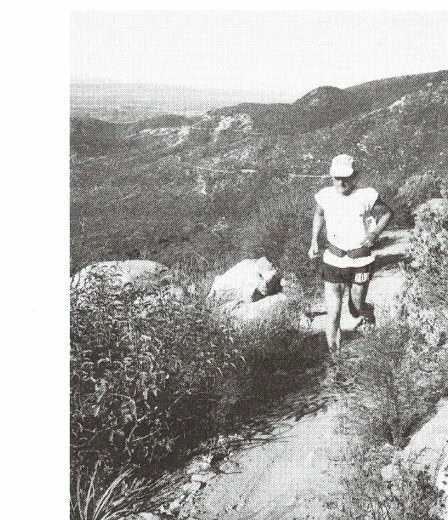
Saddleback is a special event, explains Hawley. For many of the runners who come back year after year, the race has become something of a necessity. Why? Because at Saddleback, runners are not treated like cattle or rental cars at a NASCAR drivers’ convention. The event is well-organized, well-directed, and all problems are addressed quickly and without fail.
“We’re the same as any other marathon,” says Hawley. “If I make a mistake, the runners give me hell.
“Not everyone wants a PR or a course record,” adds Hawley. “It pleases a lot of people just to finish a marathon. The winner in this year’s race finished in 3:18. Last place cruised in in a casual 9 hours. I knew both of the runners.”
Hawley, himself a veteran of over 100 marathons and ultras, appreciates the thick, visceral camaraderie found only in small events. “Small races are more casual and less competitive,” notes Hawley. “In the ’96 event, Rob McNair, of Huntington Beach, California, was leading the race. He saw a trail-marking ribbon in the wrong place, so he stopped and put it in the correct spot. In that same race, four or five competitors stopped to help a fallen runner. Each runner is aware of the other runners and is very supportive. More and more people are coming back to small marathons for just that reason.”
SMOKY MOUNTAIN MARATHON
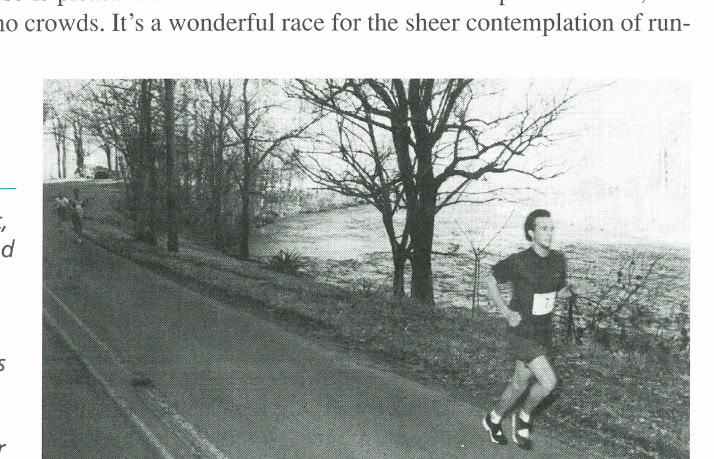
Another advantage of the small marathon is its cost. With the entry fees of big-name races approaching $100, it’s nice to know there are still marathons open to even the most financially challenged. Sherman Ames, director of the Smoky Mountain Marathon, held in February in Knoxville, Tennessee, is hoping to keep it that way. With an entry fee ranging from $20 to $25, the Smoky Mountain Marathon is described in The Ultimate Guide to Marathoning as one of marathoning’s best deals. As an additional bonus, the race is held on the cusp of the Great Smoky Mountains—a breathtaking wilderness that grabs you by the ankles and pulls you into its vortex.
“We get a lot of the same people year after year,” says Ames. “It’s an intimate affair. A lot of people enjoy seeing each other, even if it’s just once a year. One fellow sent me a fax after the last race that said, ‘Sorry I had to miss the annual gathering of the tribes.’ The marathoners feel an affinity for each other. A smaller race leads to that much more exclusively.”
According to Ames, small, rural races like the Smoky Mountain Marathon are a great place to get away from it all. They provide many runners with a great sense of normalcy in a busy world. In a small marathon there is less pressure and expectation (self-imposed or otherwise) and more time to enjoy running. When the starting gun sounds in a small race, spectators vanish, the field thins, and thoughts turn inward. The mind becomes serene, meditative. Stress fades away. Doubts vanish like conquered ghosts.
“We don’t hold out our marathon to be a flat, fast qualifier,” says Ames. “The course is pleasant and scenic and runs beside an unpolluted river, and there are no crowds. It’s a wonderful race for the sheer contemplation of running.”
NORTHERN CENTRAL TRAIL MARATHON
Beautiful scenery also plays a leading role in the Northern Central Trail Marathon in Towson, Maryland. Race director David Cooley describes the course as being so exquisite, his description makes you want to sing some primal song of celebration.
“The Northern Central Trail Marathon is a beautiful race,” says Cooley. “The runners are thrilled with the whole concept of it. The course is run on a former railroad bed. It’s very historic—Lincoln’s train rode over it when he went to Gettysburg to give his address. The running surface is flat, hard-packed dirt, so it’s easy on the legs. And the scenery is absolutely incredible.”
The out-and-back marathon, which is held in Gunpowder Falls State Park (15 miles north of Baltimore) at the end of November is in no danger of growing into a larger event.
“The Maryland Department of Natural Resources limits the race to 300 runners,” says Cooley. “It is very rural and attracts very little spectator involvement.
AVENUE OF THE GIANTS
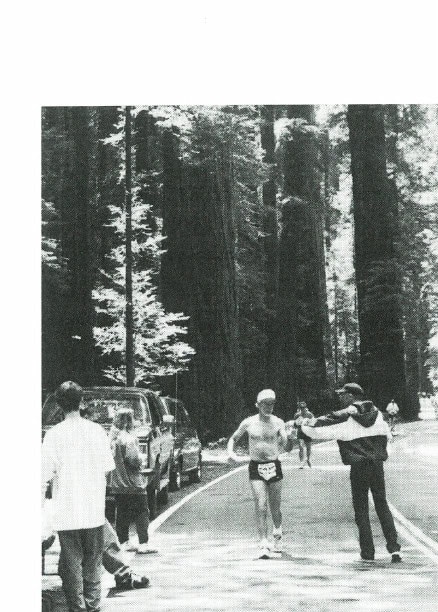
Rich Gilchrist, a veteran race director for the Avenue of the Giants Marathon, held in Weott, California, in early May has a similar no-frills philosophy when it comes to hosting races. A self-described traditionalist and advocate of clean amateur athletics, Gilchrist does not offer appearance money, travel assistance, free lodging, or prize money to top runners. He believes in competing for what he calls “the thrill of competition,” an interesting variation on the traditional thrill-of-victory maxim.
Gilchrist has hosted and directed the Avenue of the Giants Marathon for 25 years and lives by the old-school runners’ philosophy: run for the enjoyment and not for the bucks.
“Small marathons keep running pure,” says Gilchrist. “You’re supposed to learn something from a sport and not expect to be paid for doing it. Big races offer money and awards. Small marathons, like The Avenue, offer the satisfaction of running 26.2 miles.”
Gilchrist states that small marathons also offer a wide range of flexibility that larger events are unable to provide. “We can tolerate early starts,” notes Gilchrist. “And the volunteers can stay later, so we can handle walkers. We like to help the athletes in other ways, too. When they call and ask about the race, we help them find hotels, motels, and the best places to eat.” The first Avenue of the Giants Marathon, held in the early ’70s, had 35 participants. Today the race attracts over 400 runners.
Gilchrist describes the race as “an apocalyptic 26.2-mile run through the heart of redwood country.” The course, a double out-and-back, takes runners through redwood forests, over gently rolling hills, around blithe, fern-shaded meadows, and beside a chattering river—so many landscapes, running Avenue is like crossing a whole uninhabited continent.
“It’s probably still the word of mouth that gets runners up here,” says Gilchrist. “One runner talking to another. They love the scenery. The Avenue would have probably become a large race because of its beauty, but the numbers are limited because of the [California State] park [restrictions].” “I want running to stand on its own merits,” adds Gilchrist. “In a race like The Avenue, I think it does just that.”
WINEGLASS MARATHON
What if you’re a runner who craves the peace and tranquillity of a small marathon, but can’t resist the amenities of a big race? What do you do? Mark Landin, race director for the Wineglass Marathon (see page 108 for a profile of the race), in Corning, New York, may have the answer.
“I call the race a large-town, small marathon,” says Landin. “The runners get a little more attention in a race like this.”
According to Landin, any runner—from the most laid-back guy with the mongrel ensemble of dorky T-shirt, ripped shorts, and dog-chewed shoes to the jaded, Lexus-driving, junk-bond trading, cell-phone-talking yuppie—would feel comfortable at the Wineglass Marathon.
“It’s not a crowded race,” says Landin. “There’s a lot of open area for running. And we offer all kinds of gifts and prizes. We have long-sleeve T-shirts, crystal trophies, commemorative glass medallions, finishers’ certificates, wine, champagne, and $4,500 in prize money.”
Wineglass, which finishes in the town of Corning (population 12,000) and attracts fewer than 800 runners (including relay team members), is now in its 16th year.
“We also offer free lodging and race entry to elite runners [generally those with times under the current course record],” adds Landin, “and we try to keep our cost down. Our entry fee is only $25.”
Not all race directors agree that less is better, but they do agree on one important point: Small marathons offer an unparalleled opportunity to enjoy the adventure, the challenge, the beauty, and the solitude of an event. Inexpensively. And without crowds. Who needs big when you’ve got races that are big on intimate?
This article originally appeared in Marathon & Beyond, Vol. 1, No. 3 (1997).
← Browse the full M&B ArchiveMore like this
1,000+ stories from 19 years of Marathon & Beyond
The complete archive of the legendary long-distance journal — digitized and free to read.
