

Going Far, Part 13
Going Far Life, like long-distance running, involves enduring and winning. Part 13. BY JOE HENDERSON
55. The son
MOUNTAIN VIEW, CALIFORNIA, September 1977. Without intervention from doctors, babies arrive on a timetable all their own. They pick the day and the hour. Janet and I appreciated our second child’s timing. Labor began after sunrise (after my run, even) on the Saturday of a short workweek (for the Labor Day holiday, fittingly). Before sunset, Janet delivered a big boy—almost 9 pounds with a head size that mom would never forget.
We named him Eric Joseph. I didn’t want him to be a junior but accepted the middle name because I wasn’t a Joseph, only plain old Joe. Grandma and Grandpa Allardyce brought Sarah to the hospital, and she met her new brother when he was less than an hour old. She was old enough, at almost 4, not to feel threatened by this rival for her parents’ attention that she had had all to herself until now.
Sarah was just a year away from starting school. As my office hours and travel time had grown, I had missed more and more of her early years. Now in preschool, she had started leaving home for part of each day. The time I had lost with her was irreplaceable. I didn’t want to let so much of Eric’s growing up to happen without me.
I couldn’t have guessed while holding him as a newborn how much we would be together in the years ahead. He would be 3 before we learned that he had been born with limited hearing and would need hearing aids and special schooling. He would be 6, and still not voicing many words at a time, when his mother and I separated, and we all agreed that he should live mostly with me.
Eric would learn to speak while talking with me. Later, as he mastered his second language, I would learn to sign while talking with him. We would learn to communicate in ways beyond words.
Update: Success signs This story doesn’t have to do directly with distance running, but it has everything to do with the values that runners hold dear—the enduring and eventual winning. My son, Eric, dabbled in track during high school, and he had gotten pretty good at sprinting (nearly qualifying for the state meet twice at the least and fastest of distances, 100 meters) before leaving the sport. He found bigger races to run as he picked up speed academically and socially.
When his hearing loss was discovered, he was fitted for hearing aids (which so annoyed him at first that he tried to flush one down the toilet and fed the other to the family dog) and was immediately placed into an early-education program. The advice given us at the time was, “Put him in an oral program. This will give him a better chance of learning to speak than if he relied on sign as his first language.”
He hadn’t yet voiced his first word at that time, and without signing he had no access to language. He didn’t speak in sentences until his seventh year, and because of this his now-mainstream classes made little sense to him. He had to repeat an early school year. Eric hit a bigger wall when he started middle school. He joined a new group of strangers at the worst of all ages. He was the only boy like himself at a time when the greatest sin is to be different. Each school day became a lonely, threatening ordeal.
He needed a change and asked to visit the Oregon School for the Deaf. There he saw kids like himself working in their classrooms and said, “I want to go here next year.” We arranged for him to do that. The move seemed like a mistake at first. He traveled to a foreign land where he didn’t speak the language. “It was like I’d been sent away to prison,” Eric said later. “I thought my life was over.” He now felt lost between two worlds—at home with neither the deaf nor the hearing.
Staying at the deaf school depressed him, but going back to his old school terrified him. So that summer he decided to “stay at OSD, try to get along with everybody and improve my life.” He later came to realize that “in regular school I would have always been ‘that deaf kid.’ At OSD I’m just another kid.”
He did there what he would never have tried at a regular school: ran track and played football and was coeditor of the school’s video yearbook and literature magazine. He traveled to an academic competition against other western schools
Courtesy of Joe Henderson
▲
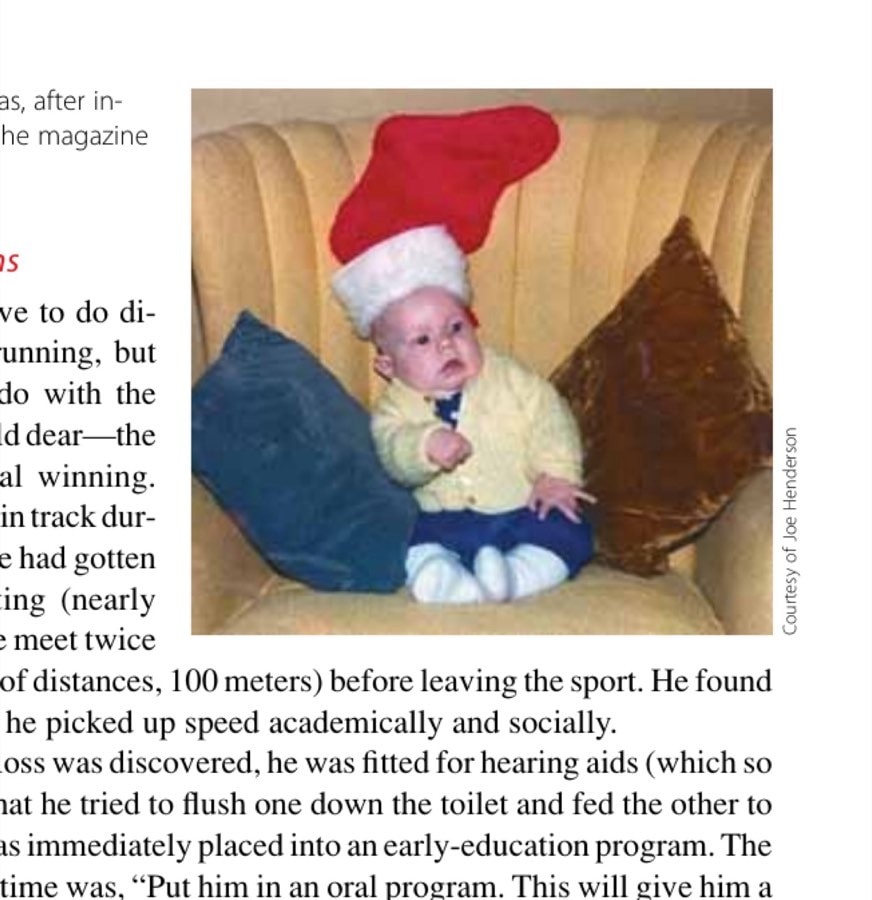
Son Eric’s first Christmas, after inspiring my move out of the magazine office.
for the deaf. He appeared before the state legislature on behalf of a bill to allow out-of-state students to attend his school—and shook hands with the governor at the law’s signing. At graduation he walked to the stage and began with, “I am Eric Joseph Henderson, salutatorian of the class of 1997.” He simultaneously signed and spoke his welcoming remarks. Eric attended regular college classes, not those for the deaf. He took jobs among the hearing and had some friends who could hear and some who couldn’t. The boy who was caught between the worlds of speakers and signers is now equally at home in both. Eric, the nondistance runner, taught his dad new meanings of enduring and winning.
56. The exit MOUNTAIN VIEW, CALIFORNIA, September 1977. According to the business principle espoused by Laurence Peter, employees tend to rise to the level of their own incompetence. A good worker, for instance, might be promoted into a lousy boss.
By late 1977, I had become a boss. My employees would have to rate my competence. All I knew was that I had come to dislike this job because it had separated me from the work I loved. My training was as a writer and editor. Now I did less and less of that work directly—and more and more supervising of those who did. I was spending my days in meetings and on the phone, with little time left over for making up stories of my own and massaging the manuscripts of other writers.
Two negatives combined with two positives this month to point me toward an exit from the Runner’s World offices. The negatives were the twin tensions created by Jim Fixx’s Complete Book of Running (where I seemed to steal credit for RW’s success from its founder-owner, and my boss, Bob Anderson) and the controversy swirling around the magazine’s latest shoe issue (where we were charged with rigging the ratings).
The first positive was that my income from book royalties now exceeded my salary as editor (and I had started earning extra pay as a speaker). The second positive: a replacement editor, Rich Benyo, was already in place as my newly hired assistant (and much later he would become my nominal boss as editor of Marathon & Beyond).
One September morning, my courage buoyed by my son Eric’s recent birth and the latest book-royalty figures, I walked into Bob Anderson’s office and handed him an “I quit” letter. I had cleared out my office early that morning, knowing my welcome here would end as soon as Bob read that note.
Our few moments together were predictably unpleasant. Then I went home to start creating a new office space where I would try to salvage a writing career. To his everlasting credit, Bob did some heavy pride-swallowing. Just a day later
Courtesy of Joe Henderson
▲
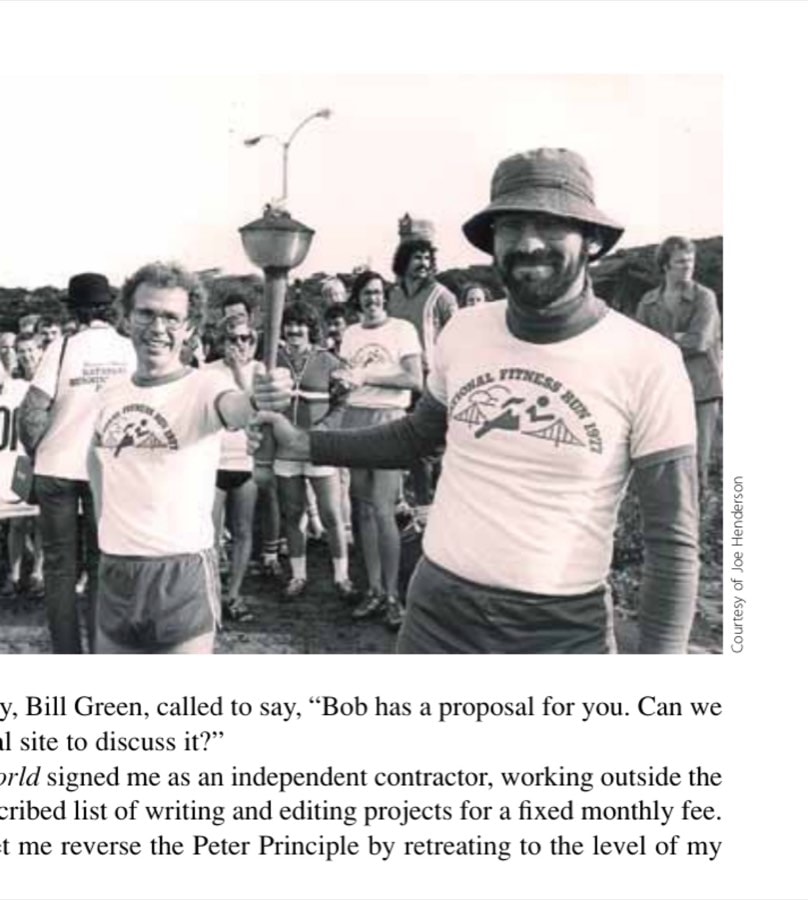
A symbolic handoff to Rich Benyo, who took over from me as Runner’s World editor.
his staff attorney, Bill Green, called to say, “Bob has a proposal for you. Can we meet at a neutral site to discuss it?” Runner’s World signed me as an independent contractor, working outside the office on a prescribed list of writing and editing projects for a fixed monthly fee. This contract let me reverse the Peter Principle by retreating to the level of my competence.
Update: Runner’s highs Runners peak at different ages and levels. So too do writers, though successes with words and phrases aren’t as easily quantified as those with times and distances. We can’t know in advance how high we’ll climb but can only look back later to see when the ascent ended.
In running I took about a decade to learn the game well enough to play it at my highest level. Then I had only a few more years on that high plateau before my body refused to play at that level any longer. Because I started young, I peaked early. My year-round running began at age 15, my best year of racing came at 25, my last personal record of note at 27.
During the peaking years, my days centered on the training runs, my weekends on the races. I had no competing commitments from family or job to keep me from indulging so heavily. I raced whatever and whenever possible, with no thought to what this might mean to my health.
Then, at age 29, I ran myself into a date with a foot surgeon. His repair job worked well enough to let me run again within a few weeks and to race again a
few months after that. But the heel was never again as good as new, and it gave me an excuse to never train as much or race as hard again. My peak clearly had passed, and the time had come to settle for fewer miles and less speed.
Full-time running writing followed a similar decade-long climb to a peak. It started later than my racing but also summited early. This career began at Track & Field News as a 23-year-old; by 26, I had published a book; by 27, I was editing Runner’s World (and not just the magazine but its spinoff books, booklets, and newsletter along with many and varied promotional efforts). By 33, my book sales were lofty enough to let me leave the magazine for life as a gentleman author.
But by then the book sales had already peaked, then crashed downward as quickly as they had soared. By my mid-30s I had to seek another job in magazines but was no longer willing to work as hard to climb as high as before. I had worked too much in the glory days at RW. I had given too little thought to how this might have affected my girlfriend, who became my wife and then the mother of our children. It was time to settle down below peak level.
The sport itself passed through a similar cycle of rapid rise, level off, ease down in those years. They came to be known as the “running boom” (and later the “first boom” to distinguish it from another, bigger one that arrived in the 1990s). This boom lasted about a decade, roughly the 1970s. These were the years when running grew up, and they nearly paralleled my most intense period at Runner’s World.
Those times were heady, but this pace of growth couldn’t last. The boom ran its course after about 10 years. The 1980s became a shaking-out period that determined which runners, events, and businesses would retain their early energy and enthusiasm and which would fizzle.
This book, Going Far, is a personal journal of the boom times, for the sport and for me as I went along on that wild ride. Here I offer a series of snapshots from events attended, people met, experiences had, and ideas formed when we were young and all of this was new.
This peak passed while I was still young, not even 40 and with an equal number of years ahead if I was lucky. I couldn’t, and didn’t, stop writing after the boom years—any more than I could, or would, quit running after setting my last PR. These twin passions had been too much a part of me for too long by then to leave behind.
The running/writing did change, though. I slowed the paces of the runs and the writings so they could keep going. The peaks had been nice places to visit, but I couldn’t have lived indefinitely in that rare air.
The third and last book of this memoir series, titled Running Home, will tell what lay on the far side of the peaks for me. It will show how the settling down can be as challenging and rewarding as the climbing up.
57. The beach
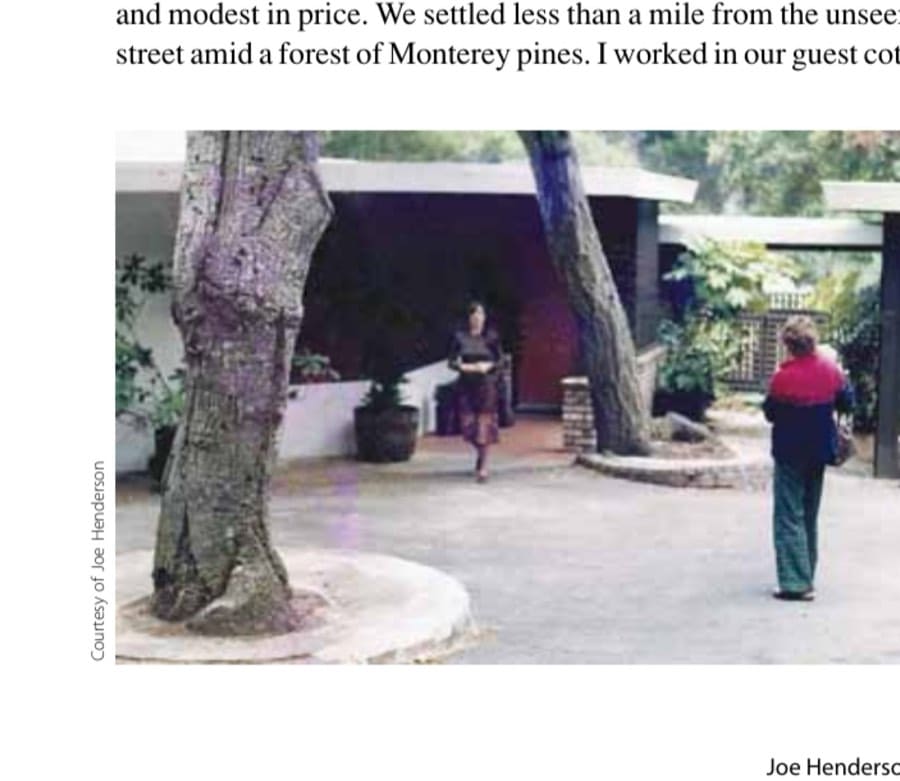
The realtor hands over keys to our home in the woods beside Monterey Bay.
▲
Courtesy of Joe Henderson
PEBBLE BEACH, CALIFORNIA, December 1978. Where would you live if you could live almost anywhere? The likely answer: somewhere other than where you now are and must stay, at least until retirement frees you from the current home-near
job. If you’re young, as I was in this year of turning 35, the dream move is usually a long time from coming true—unless you get lucky, as I did in the late 1970s. I wasn’t retired, but my job was now portable. I could work anywhere with
mail, phone, and airline service. My improved income made resettlement a real and immediate option, and the choice came down to the final one during my now-annual trip to the Boston Marathon. A random assignment of roommates by our tour leader placed me with Bob
Wright, from Monterey, California. I told him this was one of two places my family might move. Our talk about his hometown was exceeded only by our discussion of the race. Bob, a civilian employee of the Army at Fort Ord, said, “I
know you’d love it here. And I know a realtor who can give you a look around.” Within a month we met the real-estate agent named Annie, who spoke with the delightful accent of her native France. In July we moved 80 miles south to the
Monterey Peninsula. The actual address was Pebble Beach, a private development within the gates of the 17-Mile Drive. Visitors weren’t excluded. They just had to pay an entrance fee, as if to a theme park.
This area sounds more posh than it really was. I like to say now, “We lived in the slums of Pebble Beach,” far from the mansions (including Clint Eastwood’s) surrounded by the golf courses that border Carmel. Our house was small in size
and modest in price. We settled less than a mile from the unseen ocean, on a quiet street amid a forest of Monterey pines. I worked in our guest cottage, which would
become such a magnet for visitors that we had to impose a one-night-stay limit except for immediate family. Most of our neighbors were retired, many as ex-military officers. Ours was the only young family within miles. I heard secondhand that the older folks wondered why I never left home for local work but disappeared on mysterious trips for a few days every month. He doesn’t look like a drug dealer or CIA operative, they speculated. So he must be either independently wealthy or a house-husband whose wife supports him.
Janet, the nurse, had found a job right away at Planned Parenthood. Our bright and beautiful daughter, Sarah, had started school in nearby Pacific Grove. Our son, Eric, was healthy and happy. We had made local friends. I could run to my limits and beyond on coastal trails and fire roads through the forest. Life here was dreamlike as 1978 ended. But too soon I would start waking up to hard realities ahead.
Update: Backward glances The stay on the Monterey Peninsula, also known to me as “paradise,” was too brief. It lasted just three years before we moved on to a more family-friendly hometown. I would return to Pebble Beach only as a visitor, and even then only a few times and for quick glances backward.
This time, I was here as Barbara’s tag-along. She had come here for a college reunion. One evening she had a dinner that didn’t involve me, so I decided to drive wherever the car took me into my past. As if reading my wishes, the Subaru went straight to the Country Club Gate of the 17-Mile Drive. This road circles Pebble Beach.
When this was home, a small plate affixed to our cars gave free entry (if paying too much to live here qualified as “free”). Visitors either had to call a homeowner or pay to enter. I had long since lost touch with anyone who lives here, and I debated briefly about paying the toll, which had doubled since I was a resident. I heard Barbara’s thrifty voice say “too much,” but the voice of Joe Past quickly won out. It asked, How much is it worth to you to catch a glimpse of your old self?
As I handed a toll-taker the cash, I said, “This used to be my home.” With only slight interest, he said, “When was that?” I told him, “Probably before you were born. We left here in 1981.” He said, “You’re right,” then waved me through.
I had long said, “My old home is gone. It was leveled because the land was worth more than the house.” I had heard that our lot had been subdivided, that two new mansions had sprung up there and that one had sold recently for 50 times more than our house had cost.
Pelican Road is a U-shaped, single-lane street with twin outlets to the main road. Its total length is about 200 yards. Our house sat at the bottom of the U. On each side during our stay here were two houses, all as modest as ours. The
middle of the U held only a grove of trees. Now crowded into the middle of the U were three megahouses. I drove slowly into the U. Any faster and I would have missed the most surprising and pleasing sight of the weekend. It wasn’t the monstrosity plopped down where our guesthouse (my office) and garage used to sit. The lot had indeed been subdivided and cleared to make room for a mansion.
I barely glanced at the big house and couldn’t tell you now what color it is or whether it’s one story or two. Another sight had grabbed my full attention. Peeking out from the lower left corner of the mansion was my old house. It looked shy now among the hulking newcomers, or embarrassed at what this neighborhood had become and how much its own age now showed.
The house was still dark brown with white trim and looked like no fresh paint had touched it since the 1970s. The roof was still flat and now bore a stubble of weeds. Never was much of this house visible from the road. Now I saw even less—only the front door and the kitchen window. Then as now, the glass-walled family room hid behind a fence, which faced a thickly wooded ravine then and possibly more housing or a new golf course now.
Barbara would have insisted on stopping for a closer look, maybe even knocking on the door and asking whoever answered, “Joe used to live here. Can we have a tour?” I’m not so bold. I didn’t even park the car and walk the U, stopping for a longer look at house number 1126. I feared that current residents might report me as casing their high-priced homes for robberies after nightfall.
I had already seen how much the neighborhood had changed in three decades. As if I hadn’t. Going Far will conclude in the next issue.
This article originally appeared in Marathon & Beyond, Vol. 18, No. 5 (2014).
← Browse the full M&B ArchiveMore like this
1,000+ stories from 19 years of Marathon & Beyond
The complete archive of the legendary long-distance journal — digitized and free to read.
