

Shoeing Away Winter
Some snowshoe racers feel the sport should remain just as it is, sans standardization. These independent individuals believe there are enough rules and regulations in the world of sport without introducing more. There are others, of course, who feel standardization should be applied to equipment, distances, and rules. The Canadians are among the latter group and have set up an organization—the Canadian Snowshoe Union—to see that the sport gets standardized, whether it wants to or not.
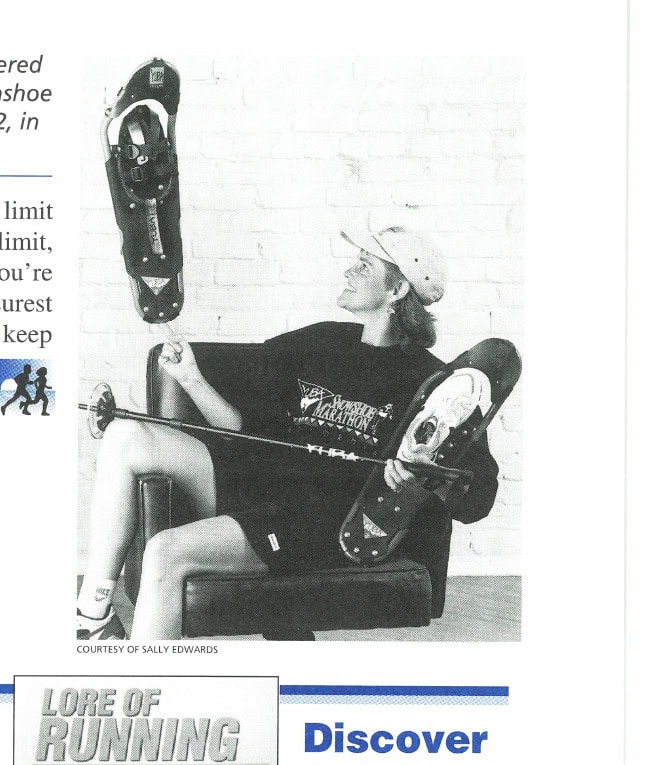
Winter duathlons and triathlons are becoming more popular. Snowshoeing is usually one of the two events in the duathlon. One of these other winter sports—nordic skiing, ice skating, or mountain biking—is typically the other event. For races with more than one event, quick-release snowshoes are a must.
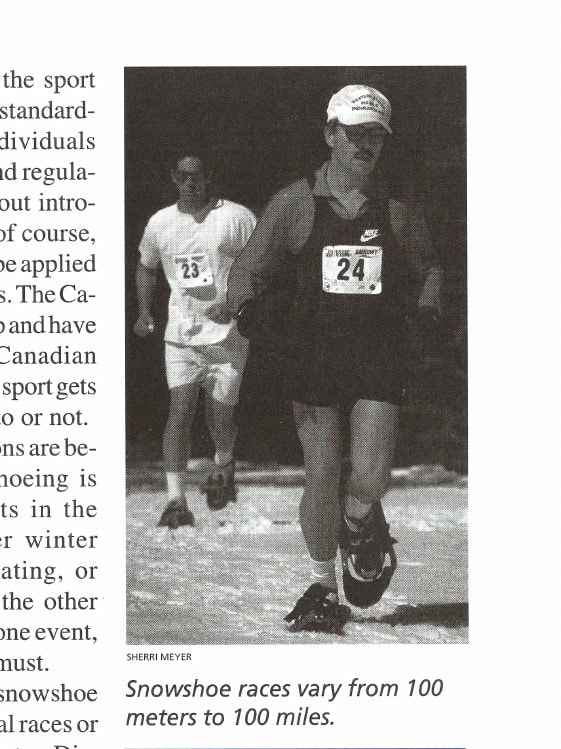
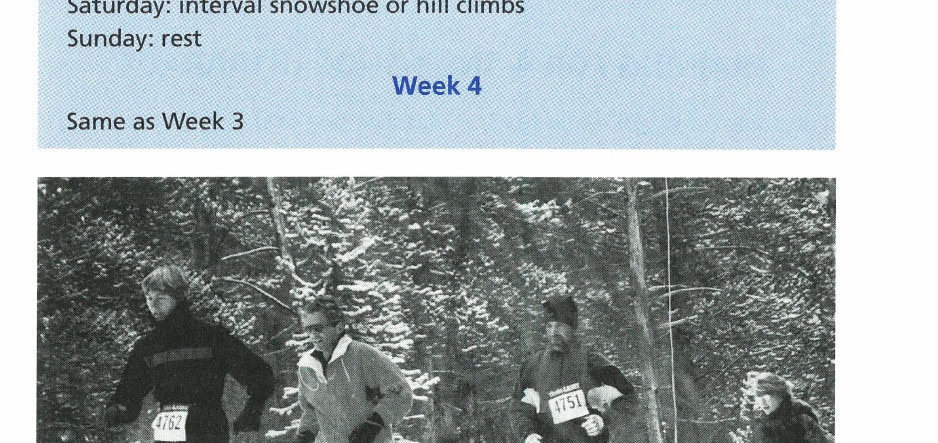
In the United States, several snowshoe manufacturers sponsor individual races or racing series throughout the country. Distances range from 100 meters to 100 miles, and the size of the field varies from half a dozen to several hundred. Snowshoe racing is entirely different from recreational and backcountry snowshoeing and attracts a different type of shoer. In Colorado, the most popular snowshoe races are ascents and descents of mountains, usually with peaks in the 14,000-foot range, and are usually run in or near popular alpine ski resorts. In those races, the snowshoe runner can reach anaerobic threshold within minutes of the starting gun firing. The sport is challenging and exceptionally rewarding.
BASIC TRAINING
What follows is a basic training regimen for runners who have a hankering for snowshoeing. Sport snowshoeing is a great cross-training sport for runners because it incorporates four elements that lead to a successful running program: upper and lower body strength, cardiovascular endurance, flexibility, and coordination.
A successful snowshoe-training program will focus on four areas:
- Cardiovascular endurance: Snowshoeing requires tremendous aerobic stamina that easily elevates the heart rate to 70 to 80 percent of maximum (MaxHR).
- Muscle strength: Sport snowshoeing, when incorporating the use of poles, requires upper and lower body strength. Three primary muscle groups are used for the leg movement: hip flexors (quadriceps), which lift the snowshoe out of the snow; hamstrings (back of the legs), which move the leg forward out of the snow; and calf muscles, for pushing off with your feet or lifting onto your toes.
- Balance: Snowshoeing is demanding kinesthetically. Since snow compacts easily, you travel on an uneven and unstable landing platform, which requires that you learn how to balance on rock-hard ice and stay upright when breaking through firm crust. Each step brings you to an unknown surface, the anticipation of which immediately improves your balance. Snowshoeing requires coordination and balance so you can climb uphill, glide downhill, negotiate a path over rocks, around trees, and across ice.
- Flexibility: Your ability to reach, bend, and relax are all beneficial in negotiating the tasks required to snowshoe effectively. The muscle group that must be truly flexible is the gastrocnemius, or calf, muscle. As you push off the toes on the uphills or balance on the downhills, your calf is stretched.
Specificity and Progression
Your training program must follow the principles of specificity and progression. These two principles state that one must specifically train specific muscles and support systems in the specific manner in which those muscles and support systems are needed, and then progressively add to the workload. This training approach is what exercise scientists refer to as the progression effect: carefully introduced periods of stress improve the level of fitness. Simply stated, to be a good snowshoer, you must slowly increase training volume and quality of snowshoeing.
To reach the minimum fitness threshold and to maintain that level, you must exercise four days a week in a variety of workouts for a minimum of 20 to 30 minutes per session. This translates to roughly two hours of training per week divided over four exercise sessions.
This fits neatly with our four elements of fitness. In the initial conditioning phase, you should work on one of the four elements for an entire workout, whether it’s strength, cardiovascular, balance, or flexibility.
THREE PHASES OF TRAINING
The sport snowshoe training program that follows is presented in three different phases, each with a different training goal. Each of the three phases is progressively more challenging than the one before, and the workout sessions become longer and the type of workout more specific. Before we move into a discussion of Phase 1 Training, let me make several recommendations for how you can be successful in any of the three phases of snowshoe training:
- You can shift around the individual workouts to fit into your daily schedule. For example, the workouts can be back-to-back or can have a day of rest between them. The key is that you set aside a part of your day to train.
- You can change the workouts to fit your preferences. If you would rather take a “spin cycle” class at your fitness club rather than a step class, that’s fine. Just make certain that you work out for the period recommended and for the number of days per week in each of the four regimens.
- If you have not been participating in a running program for an extended period of time, you may wish to stay in Phase I for more than four weeks, or until you begin to feel comfortable at that level. There is no magic in the length of the work periods—the schedule merely follows the principle of progression, which is integral to any exercise/fitness program.
PHASE 1 TRAINING
Phase 1 Training is designed to build a basic fitness foundation and is not specific to the sport of snowshoeing. If you follow this format, you can develop a base at your fitness threshold that you can use for any exercise pursuit, whether it is shoeing or some other cardiovascular-oriented sports activity.
Phase 1, preseason conditioning, is designed to elevate your fitness level to a point where you can exercise four days a week for 20 to 30 minutes each session in the four different fitness areas over a week for at least four weeks. When this level of training is comfortable (or if it is already your minimum training level), you can move to Phase 2 Training.
| PHASE 1. Preseason Conditioning for Sport Snowshoeing | |
|---|---|
| Period covered: | 4 weeks |
| Workout period: | 20 to 30 minutes |
| Purpose: | To develop the four areas of cross-training fitness: cardiovascular, muscle strength, flexibility, balance |
| Number of workouts: | one workout per day, 4 days per week |
|
Week 1 Monday: lift weights for 20 minutes Week 2 Follow the same training as Week 1 Week 3 Monday: weight train for 15 minutes and walk/run for 15 minutes Week 4 Same as Week 2 |
|
PHASE 2 TRAINING
The purpose of Phase 2 Training is to teach the body adaptation so it can train to higher exercise thresholds. This next and progressively more challenging phase is referred to as the adaptation effect. We train in phases to increase the workload in increments. Note that the workouts in Phase 2 are longer in duration than those in Phase 1, and they include more of an aerobic component because in snowshoeing, cardiovascular conditioning is the major requirement.
Phase 2 Notes
A few comments and explanations may clarify some aspects of Phase 2. “Walk/run” means running and walking, alternating between each during the same
workout. For example, walk for three minutes and run for one minute during your 20-minute workout. This serves as a sort of interval training. With time, you can lengthen the running periods and shorten the walking periods as you become fitter. If you’re an experienced marathoner, this may seem extremely basic, but bear in mind that embarking on a snowshoeing program can also be used as a way to ease back into training in the wake of an injury that has caused a lengthy layoff, where returning to training should be done slowly and conservatively, lest you become reinjured.
By “machines” in the workouts, I mean any type of machine at a gym, including but not restricted to steppers, rowers, treadmills, weight machines, or free weights. Machines are challenging and fun, and as you train on the different machines, you specifically strengthen specific muscle groups. Runners who live in regions where snow is readily available for snowshoeing are already likely to be familiar with the inside of a gym, where they can do winter workouts on foul weather days.
References to “step class” are to step aerobics classes. Since snowshoeing makes great demands of the quads, strength training and step aerobics condition the quads wonderfully while also requiring coordination and balance. In a single workout, the runner receives benefits in four areas: strength, endurance, coordination/balance, and flexibility.
The “fitness class of your choice” is a broad term for any type of aerobic workout other than running, and can include swimming, in-line skating, or sustained mountain bike riding.
PHASE 2. Base Training for Sport Snowshoeing
Period covered: 4 to 6 weeks
Workout period: 30 to 40 minutes
Purpose: To build a greater training base
Number of workouts: 5 to 6 days per week
Week 1
Monday: weight train for 20 minutes
Tuesday: rest
Wednesday: run/walk for 30 minutes
Thursday: rest
Friday: snowshoe or step class for 40 minutes
Saturday: stretching 15 minutes, stair climb 10 to 15 minutes
Sunday: rest
Week 2
Same as Week 1
Week 3
Monday: weight train for 15 minutes and run/walk for 15 minutes
Tuesday: stretch for 10 minutes, weight train for 10 minutes, machine for 20 minutes
Wednesday: rest
Thursday: fitness class of your choice
Friday: run/walk for 30 minutes
Saturday: run/walk for 20 to 40 minutes or snowshoe the same length of time
Week 4
Same as Week 3
PHASE 3 TRAINING
Phase 3 Training is the most important training period. Although this phase still incorporates some of the cross-training workouts of phases 1 and 2, other workouts will be specific snowshoe workouts. During this phase, we need to specifically work the upper body muscles that are used for poling and the lower body’s most stressed areas: quads, hip flexors, and calf muscles. Specificity also means doing the specific activity for which you are training: snowshoeing. For those who do not live in an area where snow is available right outside the door, this means traveling to an area where you can “shoe.”
Phase 3 Notes
Notice that the schedule alternates your workouts so that you don’t experience back-to-back workouts that train the same sort of fitness or muscle system. When you train, you need to include variety and challenge in your training program, which means scheduling a diversified program. At Phase 3 Training you are guided through a heavy load or sport specificity: snowshoe training.
“Endurance snowshoeing” on Monday of Week 3 and 4 is your cardiovascular day, when you reach and maintain a steady state heart rate over a long period of time with few rest periods.
“Aerobic snowshoeing” means snowshoeing within your aerobic training zone, which is 70 to 80 percent of your maximum heart rate. This means that your workout is of a slightly higher intensity but for a shorter period of time at a certain percentage of your max heart rate. A heart rate watch is recommended for all three phases of training.
“Interval snowshoeing” training scheduled for your weekend workout means long intervals of 2 to 10 minutes at a higher intensity than your aerobic level for a briefer exercise bout. An example of an interval snowshoe workout would be to run/walk or run at 80 to 95 percent of maximum heart rate for three minutes and then walk for three minutes. This is called a 1:1 work-to-rest ratio.
“Hill climbs” are tough workouts, but they build the strength component of fitness. Run/hike up hills that take you 90 seconds to 5 minutes to climb, progressing from week to week by adding more repeats that are longer. For example, do five repeats (one repeat consists of one up and down or one up with a rest in place) at two minutes up the hill and then walk back down or active rest until your heart rate returns to 40 to 60 beats above your resting heart rate before you begin the next interval. Gradually, build to 10 repeats of 3 to 5 minutes each on the uphill side of the equation.
Phase 3 Training is really designed for those who want to train hard, usually building toward racing. For the fitness-loving sport snowshoer, Phase 3 is not necessary because your training program is designed for preseason and basic conditioning levels.
PHASE 3. Specificity Training for Sport Snowshoeing
Period covered: 4 to 6 weeks
Workout period: 30 to 60 minutes
Purpose: To train specifically for snowshoeing
Workouts: 5 to 7 days per week
Week 1
Monday: snowshoe or run/walk for 30 to 40 minutes, steady heart rate
Tuesday: rest
Wednesday: fitness class of your choice or running
Thursday: snowshoe for 30 to 60 minutes, intervals
Friday: weight train, machines, stretching
Saturday: snowshoe and winter cross-training, 30 to 60 minutes
Sunday: rest
Week 2
Same as Week 1
Week 3
Monday: endurance snowshoe for 3 to 6 miles or about one hour with rest periods if needed
Tuesday: weight train
Wednesday: aerobic snowshoe for 2 to 4 miles at 70 to 75 percent maximum heart rate
Thursday: rest
Friday: fitness class of your choice or running
Saturday: interval snowshoe or hill climbs
Sunday: rest
Week 4
Same as Week 3
WEIGHTY MATTERS
When you are doing weight or machine training, spend extra time on the stations that work the calf muscle, the quadriceps, the pectorals and deltoids, and the hip flexors. For single-station weight lifting, spend a disproportionate number of repeats on these stations, doing several sets each. For free weight users, refer to charts that specify which lift affects these specific muscle groups.
For those who are using symmetrical snowshoes, remember that snowshoeing stresses the hip joint because of the waddling stride that the shoes force
upon you. The quads and the tendon that attaches them to the ball joint in the hip feel the stress the greater and wider your feet are apart. The wider the snowshoe, the greater the strain on the muscles and tendons. Compounding this is the additional lift required to flex the leg high enough to pull the shoe completely out of the snow and over the top of the snow surface as it extends and swings forward. Further compounding this stress are the conditions of the environment: cold weather and unstable footing, which ultimately leads to additional fatigue. Following a specific training program will help prepare you for these conditions.
TRAINING FOR A SNOWSHOE ULTRARACE
In planning for the 100-mile Alaskan Iditashoe race held in February 1992, I did not have this type of training information from anyone who had competed in the event. So I designed a training program with one goal: to finish and if possible to get to the finish line in under 35 hours. Leadville, Colorado’s, Melissa Lee held the women’s record at that time. She also held the distinction of being one of the only women ever to finish the race. Her time was 57 hours. When I asked Melissa (an experienced ultrarunner) about her experience in the Iditashoe, she summed it up with a simple and simultaneously final statement that she would never do the race again—it was that difficult.
Her statement instilled enough fear in me that I began to train harder and smarter. My training plan called for 8 to 10 miles of running on the roads each day (I don’t live in the snow) with two weight workouts, cross-training with swimming and cycling, and progressively longer snowshoe workouts each week beginning with a two-hour continuous snowshoe workout, which gradually progressed to an eight-hour workout. I planned it all out, wrote it down, and followed it. I also kept a log to help me along the way.
I was surprised after finishing the race in a then-course-record of 24 hours and one minute how effective that training plan turned out to be. It just goes to show that writing out a training program, keeping a training log, and using a heart rate watch to keep from training at too high or too low an intensity can pay off in the long run and in the long snowshoe.
Conditioning, whether you are a traditional or a sport snowshoer, has an even higher meaning to each of us: safety. Physical fatigue can result in poor decisions, which can result in potential disasters when you are shoeing on an unmarked trail with a blanket of fresh snow underfoot.
Fatigue can also lead you to making decisions that can result in losing your way or making a grievous error. By getting in shape, you are better tuned in to your limits. Stay within those limits when you are out in the winter season.
But the most important limit you should push is the fun limit, since having fun while you’re snowshoeing is one of the surest ways to succeed at it and to keep at it the rest of your life. Go shoe!
Doing the Old “Soft Shoe”
Going Long on Snowshoes Is an Experience Not to Be Missed.
TAPPED TO GIVE IT A GO
WHENEVER I had a complaint as a child, my father would say that whatever I was complaining about was good for me and that confronting the situation would put hair on my chest. (He used to say the same thing to my sisters.)
So it was my father, and not Friedrich Nietzsche, who introduced me to this philosophy: “That which does not kill me makes me stronger.” While this bit of machismo contains some validity, and applies quite aptly to my early experiences with distance snowshoe racing, I must confess that I have yet to sprout Hair One on my manly chest.
There are two kinds of people in the world—those who learn by doing something correctly over and over and over, and the rest of us, who learn most effectively by our mistakes. Let me share some of my mistakes as a snowshoe competitor to save you the frustrations, humiliations, and unnecessary suffering that await the unwary. I say “unnecessary suffering” because there is always an element of discomfort/suffering inherent in the pursuit of endurance sports, whether you’re running in shoes or on snowshoes. Nevertheless, the following account of my first Turquoise Lake 20-Mile Snowshoe Race—which occurred during the first weekend in 1996 outside famed ultradistance capital Leadville, Colorado—will help you plan successful snowshoe adventures by providing a glimpse of what not to do.
Coming off a relatively successful late-summer and fall running season, I decided to give snowshoe racing a go while the sport was still in its relative toddler stage. My road racing season had included the Telluride Get High, a
Joe Henderson, Runner’s World columnist, says:
“Runners of great distances, would-be runners, former runners, and fans of running all will find much to like about Marathon & Beyond. The articles, in keeping with the events and people they cover, run long and deep.”
Henley F. Gabeau, executive director of the Road Runners Club of America, says:
“Marathon & Beyond has carved its own niche in the world of running publications. I like its size and shape, the excellent writing, and the down-to-earth grassroots focus. If someone had decided to cross FootNotes, Prevention, and The New Yorker, it would have resulted in Marathon & Beyond.”
Running Journal writes:
“I was initially struck by [Marathon & Beyond‘s] overall appearance. More importantly, as I started reading, I found a lot more than just another pretty face. If you are a confirmed marathoner, or a marathon wannabe, I believe that you will enjoy and learn from this new journal.”
Michigan Runner writes:
“This handsome publication looks and feels like a paperback book, and as its name implies, its contents are for folks who believe racing doesn’t start until you’ve run at least two hours. If your forte is the long ones, a subscription to Marathon & Beyond looks like a good investment.”
This article originally appeared in Marathon & Beyond, Vol. 2, No. 1 (1998).
← Browse the full M&B ArchiveMore like this
1,000+ stories from 19 years of Marathon & Beyond
The complete archive of the legendary long-distance journal — digitized and free to read.
