

The Great Six-Day Races
Here’s a quick summary of Parts I through VI of The Great Six-Day Races, which appeared in the first six issues of Marathon & Beyond. — Editor
In 1788 “pedestrian” Englishman Foster Powell travels 100 miles in 22 hours, while fellow countryman Captain Barclay outdoes him by covering 100 miles in 19 hours in 1806. Pedestrianism catches on in the United States, where the best Americans, Edward Payson Weston and Daniel O’Leary, compete in several six-day events in the 1870s. In 1876, the pair travels to England and continues to record impressive long-distance feats. British Parliament member Sir John Astley inaugurates a series of six-day races called the Astley Belt Races. O’Leary wins the first two races in decisive fashion but loses the Belt to Brit Charles Rowell in a gut-wrenching third race. After sitting out the first three events, Weston, whose career was thought to be washed up, competes in the Fourth Astley Belt Race, quieting his detractors with a record-breaking performance. Amidst great controversy, the fifth race takes place in New York City in September 1879. In a hotly-contested competition, complete with illness and violence, Charles Rowell wins the Belt. Six-day race mania sweeps the United States in 1879, and women pedestrians join the action. Charles Rowell captures the sixth and seventh Astley Belt Races, which gives him three victories in a row. He becomes the absolute owner of the Championship Belt.
CHAPTER 10: ROWELL’S MAGNIFICENT FAILURE
Charles Rowell had reached the pinnacle of the pedestrian world. Since his initiation against Edward Payson Weston in 1876, Rowell had decisively won his last four six-day contests. He owned outright the supreme symbol of pedestrian excellence—the Sir John Astley Championship Belt. Along the way Rowell had set two outstanding intermediate marks: 13:57 for 100 miles and 146 miles in 24 hours. He had risen from a lowly boat-boy to an honored, respected, and wealthy athlete.
Attack on the World Record
Rowell was ready to retire at the age of 29, but there remained one challenge—the world record for miles completed in a six-day contest. He wanted to set an unbreakable mark. Several athletes had approached 600 miles, but Rowell wanted to go beyond that mark—to 700 miles, or 166.6 miles a day.
Peter Duryea organized a race for February 27 to March 4, 1882, in Madison Square Garden. It was to be a first-class venture from the start. A $1,000 entry fee was set to discourage all but the most serious competitors. The winner would receive a large trophy, a diamond-studded whip with the figure of Edward Payson Weston in relief on the handle, 100 percent of the entrance money, and 50 percent of the gate after expenses.
Duryea paid Cornelius Vanderbilt $10,000 for the week’s rental of the Garden. Duryea’s out-of-pocket expenses totaled more than $18,000 before the race began. A special nonsmoking section was roped off on the north end of the Garden, and the only spectators that would be admitted were ladies or men accompanying ladies. The American District Telegraph Company set up two offices, one directly to Wall Street. The Western Union Company also established an office.
Rowell kept his plans, but not his training, secret. He was running and walking 40 miles a day at the American Institute Building in Manhattan. He was in the best condition of his life and was ready for the race at the Garden.
Also training at the American Institute was John Hughes, who was backed by The Police Gazette. Trained by ex-pedestrian and champion bicycle rider William Harding, Hughes was confident of victory, even though he was training only 15 miles a day.
The six-day world record-holder, Patrick Fitzgerald, giving himself little time to recover from his outstanding performance in December 1881, was training 25 miles a day at Wood’s Gymnasium in Brooklyn.
The other entrants were Robert Vint; George Noremac from Glasgow, with a previous best of 565 miles; Peter Panchot, the Buffalo mailman trained by “Happy” Jack Smith, with a best of 541 miles; William Scott, a California-based pedestrian with a record of 505 miles, and finally George Hazael of England, with a best of 500 miles.
The days before the start were not without controversy. Robert Vint asked to have his entrance money returned because an injury had not cleared up, and he felt he had no chance of covering the minimum 525 miles to share in the gate money. He presented a letter from his doctor stating that he was suffering from “rheumatism of a stubborn nature” and that it “would be dangerous for him to go on with his preparations for the walking match at present.” The other pedestrians were just as stubborn as his rheumatism and refused his request. Vint would be on the starting line.
Frank Hart had the opposite problem—he asked to be added to the field after the entries had officially closed. Duryea and Rowell argued for his admission. They thought that even though Hart had lost some of his following in 1881, Hart would still serve as a popular drawing card. Hughes and Fitzgerald staunchly refused. Hughes had been told that Hart planned to “stalk” him during the race, and this upset the fiery pedestrian. Fitzgerald was against it for another personal reason. Hart owed him $100 and had made no effort to pay him. After some backroom negotiations, Hamilton Busby gave Fitzgerald $50, and Hart promised to give Fitzgerald the other $50 out of his winnings. Fitzgerald relented, but Hughes still held out. Some more private talks followed, and finally Hughes also gave his consent and Hart was allowed into the race.
The gambling fraternity had received information that the police were going to stop them from setting up their tables within the Garden. Thomas Murphy, an Alabama gambler, was successful in obtaining a court injunction preventing the police from interfering with the bookmakers’ operations. Sunday night, February 26, the bookmakers took up their usual positions alongside the scorers, time-keepers, and newspapermen on the 22nd Street side of the Garden.
Let the Race Begin
Hamilton Busby, wearing a large, sunflower-like badge as a symbol of his position as head referee, called the pedestrians to the line at midnight. A large, but nowhere near record crowd of 7,000 was on hand. Five minutes later, Busby gave the “Go!” and Hughes rocketed to the front. He was not intimidated by Rowell’s awesome training mileage. Hughes charged through 8.625 miles during the first hour. The entire field followed almost right behind his suicidal pace. Hart and Fitzgerald covered 8.375 miles, with Hazael, Rowell, Vint, and Noremac in a line at 8.25 miles. Only Panchot seemed even a bit reasonable with 7.375 miles.
Vint hung on for as long as his sore legs would allow. But by 2:30 A.M., in great pain, he withdrew from the race.
Just after 4 A.M., Hart began to “stalk” Hughes, who had just been passed by both Rowell and Hazael. Disturbed by losing first place and angered by Hart’s tactics, Hughes “entertained [the crowd] by a choice flow of billingsgate.”
Busby once more was called to mediate the dispute. He ordered Hart to cease harassing Hughes or he would be disqualified. Hart left Hughes to himself.
Once Rowell’s name was placed on the top position of the huge scoreboard, he never looked back. He broke his own 100-mile world record by more than a half-hour with an incredible 13:26:30. He went to his tent only a few times during the day, and when he did, he was inside but a couple of minutes. He followed his theory that it was best to “break” the field early with a very hard first two days. He left the track, looking “fine,” at 10:30 P.M. In the first 22.5 hours he had covered a world record and unbelievable 150.125 miles. This record would not be broken for 49 years. Rowell’s 100-mile record would take even longer to be bettered: 71 years!
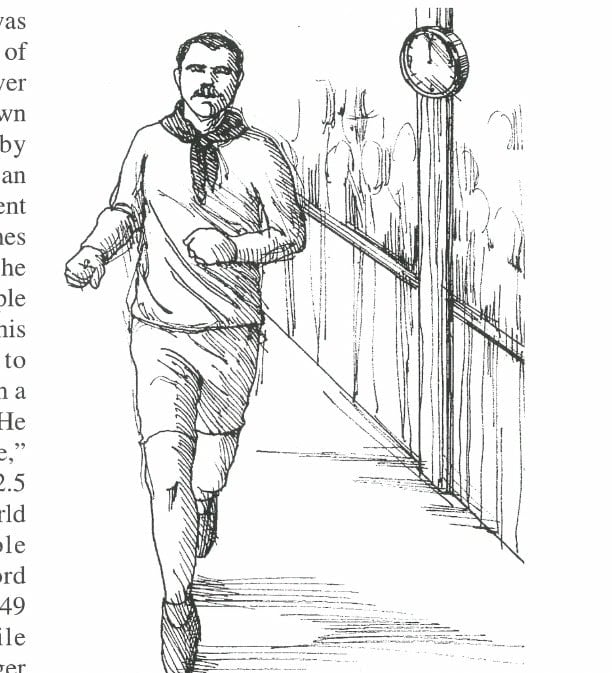
Hart was not drawing the enthusiasm Rowell had expected. The New York Times commented on this: “His [Hart’s] success as a pedestrian and association with sporting characters seems to have made him mischievous, and he is reckoned among the pedestrians as a ‘chronic kicker.’ His once-splendid form has given way to a wasted figure, and he has apparently lost pride in his work.”
Lost pride notwithstanding, Hart finished the first day in fourth place with 124 miles. Hazael was second with 135 miles, and Hughes was third with 134 miles. Another last-minute starter, John Sullivan, was fifth with 120 miles. Sixth through ninth were Noremac with 115 miles; Fitzgerald with a sane 111 miles; Panchot, sick and on the verge of quitting, with 110 miles; and Scott with 86 miles.
Day 2
Scott and Panchot retired for good early the second day. Rowell rested only three hours and continued his “incessant dogtrot.” He, Hazael, and Hughes spent most of the morning and afternoon running together in a line. Rowell’s “light, springy step” was a sharp contrast to Hazael’s “heavy, loggy step.” Hughes “pranced along like a young colt, jumped, and kicked his heels about,” and regained second place. The reason for his newfound energy was “Harding’s Lightning Exhilarator,” a new drink prepared for him by his head trainer, William E. Harding. Hughes’s own evaluation of the drink was, “Begorra, I have something now that would make a dead man walk. It lays over all the stuff I’ve ever tried, and since I began using it, I feel like a new man.”
In all probability, the Exhilarator contained either belladonna or the more potent stimulant, strychnine. The drink would be his undoing in the end, however. But on the second day Hughes was indeed a new man. By late evening he was lapping even Rowell. He completed 121 miles for the day, 11 more than Rowell, and sat comfortably in second place with 251 miles to Rowell’s record 258.375 miles.
Third through seventh were Hazael, 242 miles; Hart, 219 miles; Sullivan, 215 miles; Fitzgerald, 211.5 miles, and Noremac, 200 miles. During the day Rowell had collected another world record of 200 miles in 35:09:28.
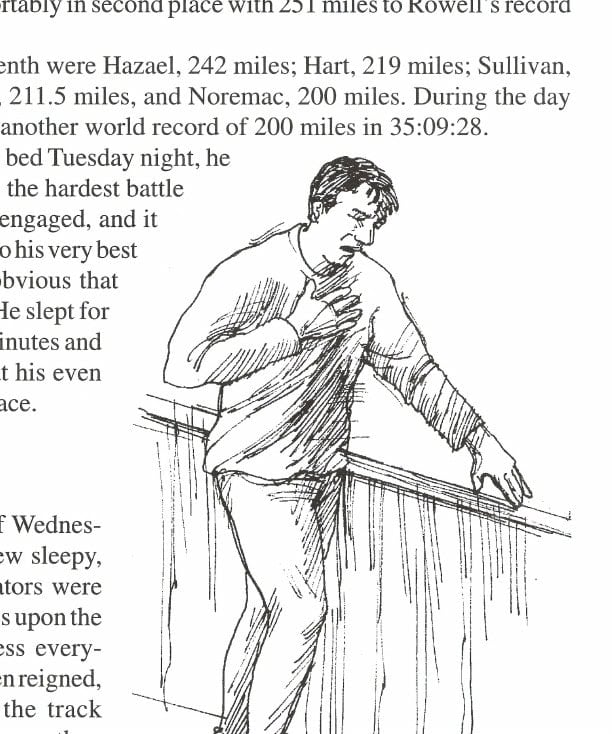
As Rowell went to bed Tuesday night, he said that this race was the hardest battle in which he had ever engaged, and it would compel him to do his very best work to win. It was obvious that Rowell was worried. He slept for only an hour and 40 minutes and started the third day at his even five-miles-per-hour pace.
Day 3
The predawn hours of Wednesday were typical. A few sleepy, dismal-looking spectators were reclining in all attitudes upon the benches, and emptiness everywhere else in the Garden reigned, making the men on the track strangely conspicuous as they plodded along on their weary rounds.
Hughes was feeling the effects of too much Exhilarator and began to falter. He turned pale and “coughed like a man seized with consumption. He limped like a bobtail car horse after a hard day’s tussle with a truck and a wicked driver.”
Hazael moved into second place, and although Hazael’s knee was beginning to bother him, Rowell was unable to gain on him the entire day. In the evening, in an unusual move, Rowell left the track for 2.5 hours. When he returned at 11:25 P.M., his “gait was less nimble,” and his “face had a wan and pinched appearance.” Rowell was beginning to feel the effort of his fifth world record: 300 miles in 58:17:06. In the first 72 hours he had taken only 13 hours and 22 minutes rest.
At the end of the third day, the results were Rowell, 358.125 miles (his sixth world record); Hazael, 342.375 miles; Hughes, 331.5 miles; Sullivan, 314.375 miles; Hart, 313 miles; Fitzgerald, 313 miles, and Noremac, 284 miles.
Day 4
Rowell was in and out of his tent several times during the morning on Thursday. During one such stop, Dr. Taylor was examining a small abrasion on Rowell’s knee, when Rowell called for some beef-tea. In the confusion of cups, vials, bottles, and jugs, his brother-in-law and trainer, Charles Asplan, handed him a cup of warm vinegar that was going to be used to dress the abrasion. Rowell drank it down in one swift gulp, not realizing his mistake until it was too late. At first there appeared to be no difficulty. Rowell left the tent and carried on as he had for the past three-plus days.
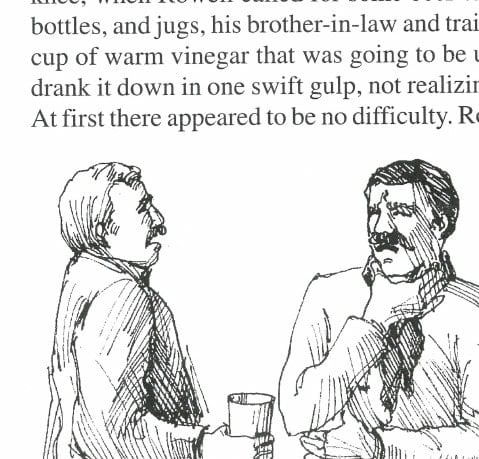
However, within less than an hour, he was back to his tent, vomiting freely. This episode began several hours of periodic vomiting. He was unable to keep anything, food or drink, in his stomach. He realized that this was a situation that could not be tolerated for long. A few minutes after noon, with his lead reduced to five miles, Rowell went to his tent for an extended rest. The hope was that a few hours on his back would settle his stomach and allow him to continue.
An hour later Hazael took over the lead. The press hovered around Rowell’s tent, attempting to pry some information on his condition from his trainers. They sat out in front of the tent, arms folded, “calm and confident.” To all inquiries they said, “He’s all right.”
But Rowell wasn’t. When he returned to the track at 3:45 P.M. his face was “much wasted, and his cheekbones seemed about to burst through his skin.” He left the track once more after less than two hours. It was not until 6:00 P.M., when Fitzgerald passed Rowell, that his trainers admitted that Rowell was seriously ill and told the story of the vinegar.
Hart spent the day walking erect and “with some show of his former greatness.” Fitzgerald was running the most evenly paced race of all the competitors. Only Hazael covered more ground on Thursday. Hughes was suffering and could complete only 50 miles for the day. Still, this was two miles farther than the ailing Englishman.
At the end of the fourth day, the results were Hazael, 433.625 miles; Fitzgerald, 413.375 miles; Sullivan, 409.5 miles; Hart, 409.5 miles; Rowell, 406.375 miles; Noremac, 392.5 miles, and Hughes, 381.125 miles.
Day 5
At 9:50 A.M. Friday the inevitable occurred. As Peter Duryea and Hamilton Busby emerged from Rowell’s tent after a conference with his trainers, they immediately were surrounded by newsmen. They pushed their way through, hurried to the scorers’ table, and officially made the announcement that Charles Rowell had retired from the race. The gamblers were ecstatic. They estimated that more than $100,000 had been lost on Rowell in public and private bets.
Throughout the fifth day Hazael extended his lead over the exhausted field. With a wearied expression, he managed to complete 107 miles on Friday, with the aid of frequent administrations of stimulants, and was almost assured of 600 miles for the entire six days.
Fitzgerald turned in another 100-mile day but, like Hazael, was now depending on the free use of stimulants to keep him going. Hart walked well the whole day.
At the end of the fifth day, the results were Hazael, 540 miles; Fitzgerald, 513.5 miles; Noremac, 498.375 miles, Hart, 490.375 miles; Hughes, 470 miles, and Sullivan 464 miles.
The Final Day
There had never been more than 5,000 spectators in the Garden at any one time since the first night, and Saturday was no different. In fact, during the day a very liberal estimate would say that 500 people were watching the weary and worn
pedestrians struggle through the closing hours. Not only were the spectators few in number, but they were also short on encouragement and enthusiasm. Hazael just didn’t have the charisma of a Charles Rowell.
Four thousand spectators cheered wildly as Hazael and Fitzgerald ran the last 15 minutes together, and Hazael became the first man in history to complete 600 miles in six days. He ran an extra lap and then stopped along with Fitzgerald a little after 9:00 A.M. Sullivan just managed to complete the required 525 miles.
The final standings were Hazael, 600.125 miles; Fitzgerald, 577.125 miles; Noremac, 555 miles; Hart, 542 miles; Hughes, 535 miles, 610 yards; and Sullivan, 525 miles, 170 yards.
The gross receipts for the week totaled about $45,000, $30,000 less that the gate for the fifth Astley Belt Race. Expenses of $18,000 to $20,000 and Duryea’s cut of $6,750 left approximately $20,000 to divide, along with the $9,000 in stake money. Hazael made out well, taking home the third largest purse in the history of pedestrianism: $19,000. The approximate figures for the other peds were Fitzgerald, $5,000; Noremac, $2,400; Hart, $1,600; Hughes, $1,200, and Sullivan, $800.
The Aftermath
The race that was supposed to be the crowning glory of an illustrious career had turned into a devastating defeat for Charles Rowell. What he might have accomplished had he not drunken the vinegar could be speculated upon for hours. Rowell was, without a doubt, quite worn and tired when he left the track on Wednesday night. It seems very improbable that he could have continued on to complete 700 miles in the race.
To understand how extraordinary his performance was that first day, we must remember that no one in the world was able to better his 150.125 miles in 24 hours until the late Arthur Newton ran 152 miles, 540 yards in Hamilton, Canada, in 1931. No one went farther in a U.S. race for 96 years.
Park Barner finally exceeded Rowell’s performance in October of 1978, when he completed 152 miles, 1,599 yards in 24 hours. Had Rowell only been running for 24 hours (instead of 6 days), and had he run the last 1.5 hours of that first day at the same pace he had been running earlier, he would have covered another 10 miles for a total of 160.125 miles. The current 24-hour world record belongs to Yiannis Kouros, who ran 188 miles, 1,038 yards on October 4–5, 1997, in Adelaide, Australia.
Rowell could not retire now. He went home to his farm in England for a brief rest and then more training. He was eager to compete again as soon as possible. Duryea arranged the next match for October 23 to 28, 1882, in Madison Square Garden. The entry fee was reduced to $500, but the field remained almost identical to the one that started the race earlier in the year. Scott and Sullivan did not enter. Daniel Herty, with a previous best of 556 miles, was the only pedestrian who had not competed in the February/March race.
Upgrading the Matches
The Garden went through its usual metamorphosis. The special ladies’ section was improved upon. Doorkeepers were stationed “with positive instructions to keep out men unaccompanied by a lady.” For the first time there would be no bookmakers allowed within the Garden. The exact reason for this was never made clear by the press. However, it was applauded by the papers as a positive step in upgrading the pedestrian matches, and considered no loss at all.
Another change would be that the stake money, $4,500 from the nine starting competitors, would not all go to the winner. He would receive only 70 percent of the money, with second place getting 20 percent, and third 10 percent.
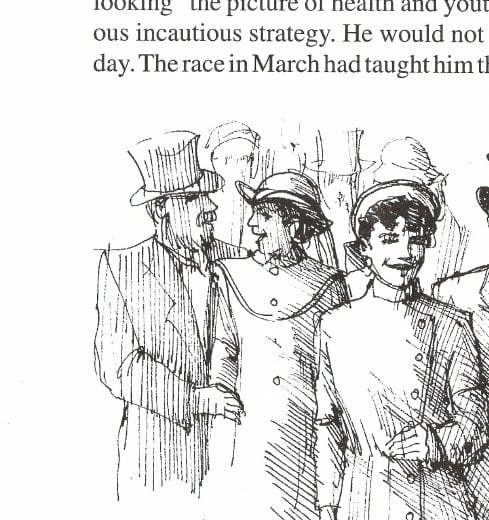
Charles Rowell arrived back in New York City on September 4, 1882, looking “the picture of health and youthful vigor.” He had modified his previous incautious strategy. He would not attempt to destroy the field on the first day. The race in March had taught him that he must temper his recklessness with patience.
At midnight on October 23, 1882, nine eager pedestrians stood in front of Edward Hanlan, the renowned oarsman, and awaited his signal to begin their formidable journey. Every seat in the gallery was taken. The space behind the seats was packed with standing patrons. Seven thousand voices sent the entrants on their way at precisely 12:05 A.M. as the band played “Yankee Doodle Dandy.”
The early miles were a duplicate of the March race except that Rowell was content to remain next to last through the first hour with 8.125 miles to Hart’s, Hughes’s, and Hazael’s 8.625 miles.
This time, however, it was Hughes who continued the maniacal pace. Hazael, though, did not let him go. He followed only 13 minutes behind Hughes’s time of 13:57 for 100 miles. Rowell, showing unusual restraint, glided by 100 miles in 16:08. Hart was next with a 16:40. Fitzgerald, holding himself in check, was the fifth man through 100 miles, in 17:45.
All day long Hughes was running at or near Rowell’s record-setting pace. By 11 P.M. he had completed 149 miles, and it was assumed that he would break the 24-hour record and then go to bed. This assumption was incorrect. At 11:14 Hughes finished his 150th mile and promptly left the track for the night, only one lap short of the world record.
Hart, Hazael, and Rowell were close together in that order with distances of 136.125, 135.125 miles, and 135 miles, respectively. Fifth through ninth place were Noremac, 126 miles; Panchot, 120.125 miles; Fitzgerald, 118.125 miles; Herty, 116 miles, and Vint, 100.275 miles.
While not permitted within the Garden, the bookmakers carried on a thriving business right outside the doors, giving odds of 7-to-10 on Rowell, 6-to-4 on Hazael, and 4-to-1 on Fitzgerald.
Day 2
Hughes lost only a little to record pace through the first 12 hours of the second day. He passed 200 miles just 33 minutes slower than Rowell had in the earlier race. But then Hughes began to slow down. By the end of Tuesday he had lost eight miles to the record, with a distance of 250 miles. The others finished the day in this order: Hazael, 240.125 miles; Rowell, 238.625 miles; Hart, 232.25 miles; Noremac, 224.25 miles; Fitzgerald, 222.25 miles; Herty, 217.375 miles; Panchot, 200 miles, and Vint, 190 miles.
The only real excitement on Tuesday took place when a delegation from the Society for the Reformation of Juvenile Delinquents secured a temporary injunction restraining the management from playing music during the race under the act that prohibited amusements without payment of a license fee. After much haggling, the managers agreed to take out a license for three months and pay the costs of the injunction ($225) in order to settle the matter.
A look around the dreary, deserted Garden the next afternoon quickly demonstrated the general lack of interest in the present competition. There were no more than 300 indifferent spectators witnessing the drama. Hazael closed in on Hughes the entire day and finally, at 3:40 P.M., caught the stiff-legged pedestrian.
Hughes was not finished, however. He tenaciously hung onto the Englishman throughout the evening and at midnight still held a one-mile lead. Interest had picked up a bit during the night and by 9:00 P.M. there were 5,000 spectators in the Garden. Rowell had moved right along with Hazael and finished the day only a lap out of second place. The longest performance of the day was turned in by the durable Fitzgerald. He moved into fourth place, only 10 miles behind Rowell, after completing 109 miles for the day.
The standings at the end of the day were Hughes, 342 miles; Hazael, 341.125 miles; Rowell, 341 miles; Fitzgerald, 331.625 miles; Noremac, 330 miles; Hart, 325 miles; Herty, 309 miles, and Vint, 282 miles. Panchot dropped out before Day 3 ended.
The fourth day was a day filled with drama. Hazael collapsed from exhaustion at 2:00 A.M. His knee, never completely healed from the last race, swelled badly, and he was forced to take frequent rests during the day. Hughes was also “done in,” and took long breaks from his agony on the track. Rowell began to develop symptoms similar to those he suffered in March.
All three moved slower and slower. Only Fitzgerald ran and walked with relative ease. At 3:50 A.M. he passed Hazael. Between 6:00 and 7:00 o’clock in the morning, Fitzgerald fought Rowell for second place and was successful. At 9:25 A.M. he ran into the lead as he passed the faltering Hughes. In nine hours Fitzgerald had taken only 17 minutes of rest and had made up 11 miles on the leader.
Rowell retired from the race for good at 7:15 P.M. Hazael quit at 10:15 P.M. and Vint soon after. Hughes stayed in the race, but he was just trying to survive to cover the minimum distance of 525 miles to share in the gate money.
Rowell was said to be “suffering to such an extent from nervous prostration as to render his further continuance in the race useless.” The true cause for his collapse would not be made public for almost a year. When he returned to England, Rowell was examined by Sir William Gull, the private physician to Queen Victoria. He diagnosed Rowell’s problem as an enlargement of the spleen brought on by a case of malaria he had contracted while training for the race.
The next two days were anticlimactic. The five remaining pedestrians merely went through the motions. The attendance was miserable. Even on the last night no more than a quarter of the Garden was filled. The pedestrians were as worn out as the spectators were. “The appearance of Fitzgerald, Noremac, and Hughes was wretched in the extreme,” wrote the New York Times. “Fitzgerald, with a bad stoop, limped around the track, as if he were treading upon a bed of live coals.”
On the last evening, “an air of gloom, due to the lack of public enthusiasm and empty benches, characterized the closing hours.” Hart, seeing the hopelessness of making any money for his exertion, left the track after finishing 500 miles. Fitzgerald, covering a mere 55.5 miles the last day, easily took first place with 577 miles. Noremac was second with 567.25 miles, Herty was third with
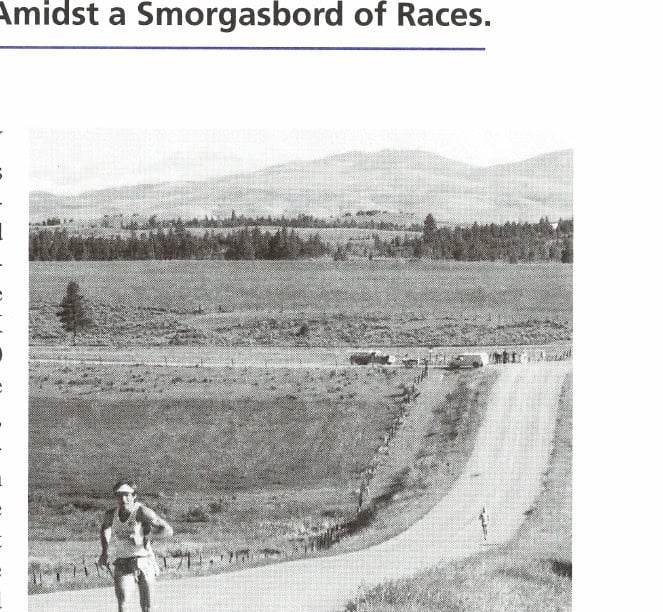
On Saturday of Governor’s Cup weekend in Helena, Montana, road racers have a smorgasbord of races to choose from: the famed 5K (with roughly 4,000 runners, one of the largest in the country), the 10K, a 20K, a marathon relay, a marathon corporate cup, and the Governor’s Cup Ghost Town Marathon, one of the most scenic (and most under-run) marathons in the world.
The marathon runs from the “ghost town” of Marysville in the mountains above the city of Helena to the mass finish line downtown on Park Avenue just behind Last Chance Gulch and boasts fewer than 200 runners, half of whom seem to be using the race just so they can check off Montana in their quest to run marathons in all 50 states and D.C. It’s Montana’s only marathon.
It’s unfortunate that the starting field for the marathon is so small because the course is 90 percent downhill, scenic, well-organized, and drips with history. The course (see page 112 for more details) isn’t exactly easy, although much of it is. If the course has one drawback, it’s that it is located at altitude: the marathon begins in Marysville (the liveliest ghost town we’ve ever visited) at 5,200 feet and finishes in Helena at 4,157 feet (the unliveliest city we’ve ever seen on a perfectly lovely Sunday).
Let’s explain those two statements up front. Marysville is listed as one of Montana’s famed ghost towns, the remnants of the gold-mining boom and bust. In the 1880s and 1890s, Marysville was bursting at the seams with a population of 50,000. The former city has one of those strike-it-rich histories so common to Western mining history. “Irish Tommy” Cruse was a down-on-his-luck prospector who used to sleep on the drug store counter in Helena between hitting up locals for grubstake so he could head back into the mountains in search of gold.
Persistence paid off—big. Tommy struck gold, called his mine Drumlummon after his birthplace in Ireland, and the town of Marysville came into being. There are various legends about how the town got its name. The most romantic is that Tommy named it after the woman in Helena who had been grubstaking him.
Tommy reputedly wrenched $150,000 in gold out of the ground over six years. During the 1880s and 1890s, Drumlummon was Montana’s leading gold producer, to the tune of $50 million. Tommy eventually sold the mine for $1.5 million to an English syndicate, which proceeded to mismanage it into ruin.
THE UNDEAD
Today, Marysville is a burg of roughly 75 people and largely deserted and decrepit buildings. The Marysville House, a funky saloon/restaurant, is one of the liveliest places in Montana the night after the race, and nearly half of the marathoners return to the start to enjoy the good restaurant food. Some of them are even bribed by the waitress with free beers at the bar if they will give up their tables.
In contrast, the charming little city of Helena is nearly deserted Saturday night after the races, and on Sunday it looks as though a neutron bomb had exploded nearby: all the buildings stand, but there isn’t a person to be seen anywhere. One local bookstore operator told us that since Helena is the state’s capital and employs thousands of area residents, they tend not to come back to the city over the weekend.
This is unfortunate. If Last Chance Gulch, the walkabout heart of the city, were in any other locale, the place would be teeming with tourists and locals. Last Chance Gulch is the site where the settlement of Helena started. In the summer of 1864 four dispirited prospectors set up a rough camp at what is now Sixth Street and wandered off after supper to look for gold. Reginald Stanley went up the gulch, dug seven feet to bedrock, and pulled out four gold nuggets. Stanley
This article originally appeared in Marathon & Beyond, Vol. 2, No. 1 (1998).
← Browse the full M&B ArchiveMore like this
1,000+ stories from 19 years of Marathon & Beyond
The complete archive of the legendary long-distance journal — digitized and free to read.
