

The Great Six-Day Races
Here’s a quick summary of Parts I through VIII of The Great Six-Day Races, which appeared in the first eight issues of Marathon & Beyond. — Editor
In 1788 “pedestrian” Englishman Foster Powell travels 100 miles in 22 hours, while fellow countryman Captain Barclay outdoes him by covering 100 miles in 19 hours in 1806. Pedestrianism catches on in the United States, where the best Americans, Edward Payson Weston and Daniel O’Leary, compete in several six-day events in the 1870s. In 1876, the pair travels to England and continues to record impressive long-distance feats. British Parliament member Sir John Astley inaugurates a series of six-day races called the Astley Belt Races. O’Leary wins the first two races in decisive fashion but loses the Belt to Brit Charles Rowell in a gut-wrenching third race. After sitting out the first three events, Weston, whose career was thought to be washed up, competes in the Fourth Astley Belt Race, quieting his detractors with a record-breaking performance. Amidst great controversy, the fifth race takes place in New York City in September 1879. In a hotly-contested competition, complete with illness and violence, Charles Rowell wins. Six-day race mania sweeps the United States in 1879, and women pedestrians join the action. Charles Rowell captures the sixth and seventh Astley Belt Races to become the absolute owner of the Championship Belt. Charles Rowell next sets his sights on a record distance in a six-day event, but he fails dramatically in two attempts. Newcomer Patrick Fitzgerald of Long Island sets a six-day record in 1881 to join the ranks of the top pedestrians. After resting nearly all of 1883 from their arduous racing in 1882, Charles Rowell and Patrick Fitzgerald enter serious training for a rematch in 1884. Competing in a packed Madison Square Garden in New York, the two battle to near death, their trainers using drastic measures to keep the two men on the track. Fitzgerald prevails with a record 610 miles.
CHAPTER 12: THE RECORD ADVANCES—INTEREST DECLINES
Six-day, go-as-you-please pedestrian contests had been dying a slow death since the “hippodromes” of the early 1880s. A race such as the Patrick Fitzgerald–Charles Rowell battle in 1884 could stimulate interest for only a short time.
In 1885 and 1886 there was almost no six-day activity in the United States. In 1887, Philadelphia hosted two six-day races. In February, Robert Vint, the shoemaker from Brooklyn, won $4,000 with a first-place distance of 530 miles. Frank Hart was second with 518.5 miles. Then in November of the same year, Brit George Littlewood made a successful trip to the United States, easily defeating the local favorite, James Albert, 569 miles to 530 miles. Littlewood won $2,200, Albert $1,200. The management made a miniscule $4,000.
Littlewood was now a seasoned veteran. He had achieved personal bests in every six-day race he had entered. He was perfecting his art each time he raced. Albert, at 33, was also approaching his prime. He had competed mostly in small affairs, from his first race in 1879 until the race with Littlewood in 1887. He was now ready for a serious all-out effort.
A race was arranged for February 6 through 11, 1888, in Madison Square Garden. Littlewood was not able to come back to the United States before April so he had to miss the race, but 72 other would-be pedestrians paid the deflated entry fee of $25 to run for glory and fame. Only a handful of the 72 starters had ever completed a six-day race before. The old guard of Frank Hart, Daniel Herty, George Noremac, Robert Vint, and Peter Panchot was there, along with the rising star, James Albert. Several other new names appeared, such as George Cartwright of England, who had a previous best of 570 miles, and Peter Hegelman and Peter Golden, who were just beginning their pedestrian careers.
To reduce the congestion on the eight-lap track, anyone who had not completed 100 miles in the first 24 hours would be disqualified and have to leave the track.
At the end of the first day only 24 of the original 72 entrants had finished the required 100 miles. There had been no great rush that first day. Hart led Albert by one quarter mile with 130.375 miles. Four others had gone over 120 miles. Hart ran into trouble on the second day, and there was little excitement from then on. Albert rolled along, day after day, unchallenged. Interest picked up the last two days when it became clear that Albert had a definite shot at breaking Fitzgerald’s world record of 610 miles in a six-day race.
New World Record Set
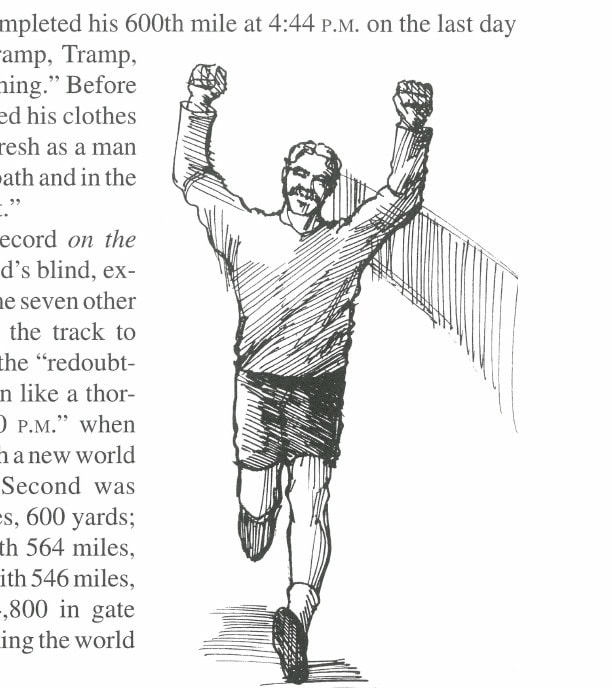
The “natty little Albert” completed his 600th mile at 4:44 P.M. on the last day while the band played “Tramp, Tramp, Tramp, the Boys Are Marching.” Before his 610th mile Albert changed his clothes and came out looking “as fresh as a man who had been in a Russian bath and in the hands of the tonsorial artist.”
He went through the record on the run, in contrast to Fitzgerald’s blind, exhausting stagger of 1884. The seven other remaining pedestrians left the track to Albert after 9:00 P.M., and the “redoubtable and graceful Albert ran like a thoroughbred racer until 10:00 P.M.” when the race officially ended with a new world record of 621.75 miles. Second was Daniel Herty with 582 miles, 600 yards; third was Gus Guerrero with 564 miles, and fourth was Frank Hart with 546 miles, 660 yards. Albert won $4,800 in gate money and $1,000 for breaking the world record.
After the race Albert said that he had had absolutely no problems during the entire six days. He now planned to retire and would resume training only if his record was broken.
Littlewood Arrives
George Littlewood made it back to the United States in April for the second Madison Square Garden six-day event of the year, set for May 7 through 13, 1888. Littlewood had to fight off two serious challenges during the race. The first came from the Irishman John Hughes of New York. Hughes had grown conservative with age and let Littlewood lead the first day, 137 miles to 131 miles. Hughes then moved to the front on Tuesday, while Littlewood suffered a slow-down from an inflamed hip. Hughes pushed too hard, however, and was struck with an attack of rheumatism on the third day. Littlewood regained the lead.
As Hughes was falling back, the Californian Guerrero was moving up. By the fifth day Guerrero had pulled to within 2.5 miles of Littlewood, but he was unable to catch the Englishman. Littlewood held on to win with the second-best performance ever—611.25 miles. Guerrero set a personal best of 590 miles. The ever-present Herty was third with 572.625 miles.
The extent to which Littlewood had suffered during the race was not made known in the press until the day after the race ended. The New York Times of May 4, 1888, described what Littlewood endured for his $3,974.12 in gate money:
It became known yesterday that it was pluck alone that enabled Littlewood, the Englishman, to win the six-day go-as-you-please contest which ended Saturday night. Littlewood’s feet are in a terrible condition. On the second day of the race a huge blister appeared under the ball of his right foot. On the following day another appeared on his left foot. On Wednesday his little toes began to swell, and on Friday they gathered and burst, laying open the flesh so that the bones were visible. His running on Friday and Saturday chafed the broken flesh apart so that it hung in flaps from both of his little toes. In the meantime the skin on the blisters had been worked off, and the man ran for two days on raw flesh. He must have been in excruciating pain during the greater part of the contest. On the third day his hip became swollen and inflamed with rheumatism. At four different times during the race it was thought by his trainers that he would have to abandon the contest, but the plucky fellow determined to go on as long as he could hold the lead.
These two races had been moderate successes for the management of O’Brien and Kelly, and they arranged a third one for November 27 to December 2, 1888. Littlewood returned once more. This time he was to be handled by “Happy” Jack Smith, Patrick Fitzgerald’s old trainer. For four and a half days Littlewood struggled with Daniel Herty, who was competing in his eighth 6-day race. While he had never won a race, Herty had also never finished worse than third. It was not until 4:00 a.m. on the fifth day that Littlewood took over undisputed possession of first place. Even then, Herty did not crumble.
The Record Falls
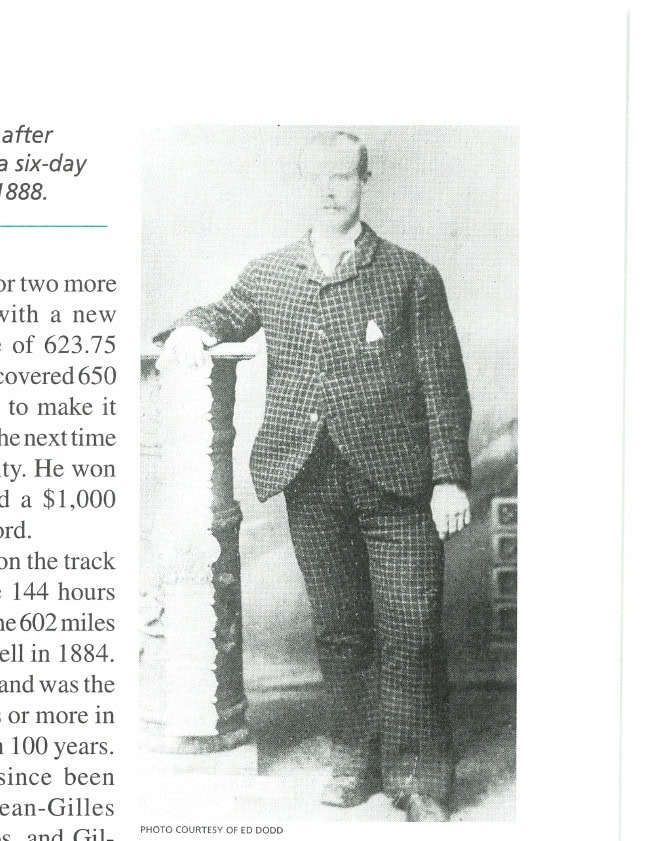
The Sheffield Blond, as Littlewood had been nicknamed because of his reddish blond hair and moustache, reached Albert’s world record distance 621.75 miles at 8:00 p.m. on Saturday. Albert, who had observed the race every evening of the six days, came out of the stands and accompanied Littlewood on his next lap as the band played “Rule Britannia.”
Littlewood walked on for two more miles and then stopped with a new world-record performance of 623.75 miles. He could have easily covered 650 miles, but he did not want to make it difficult to break the record the next time he was given the opportunity. He won $4,400 in gate money and a $1,000 bonus for breaking the record.
Daniel Herty remained on the track until the last minute of the 144 hours expired so he could surpass the 602 miles completed by Charles Rowell in 1884. Herty completed 605 miles and was the last man to cover 600 miles or more in a six-day race for more than 100 years. Littlewood’s record has since been broken by three men—Jean-Gilles Boussiquet, Yiannis Kouros, and Gilbert Mainix. Littlewood’s record of 531 miles, 135 yards for six days of “fair heel and toe” walking, previously set in Great Britain, has never been equaled.
Pedestrianism Is Dying
There was recurrent speculation that Littlewood and Albert would race at the Garden in 1889 for $5,000 a side. The race, however, never took place. In May of 1889, Albert, not able to regain his old form after a layoff of almost a year, managed to scrape by Gus Guerrero 533 miles to 525 miles in a six-day contest conducted in San Francisco.
The same week on the East Coast, in Madison Square Garden, Daniel Herty finally (after nine tries) won a six-day race by covering 550 miles. But because of very light attendance throughout the contest, he won only $1,500. John Hughes was fifth with 515 miles. He took home a paltry $200.
Pedestrianism was just about dead. As one Philadelphia paper said, “After the excitement and interest of bicycle racing, the scene of a motley crowd of quaintly attired athletes slowly ambling around a sawdust path was not an inspiring one.” The wheelman soon gained a position of importance that the pedestrian would never regain.
In March of 1891 another six-day race was attempted at the Garden. The small crowds day after day dealt the final blow. Hughes won the race with 558 miles and made $3,750. No one seemed to care. For the next eight years there were no six-day contests in New York City.
A Short-Lived Revival of Pedestrianism
In the fall of 1898, Captain Alexander Samuells, a New York “sporting gentleman,” proposed a revival of the “great six-day races of the past.” The pedestrians were still around, but on such short notice most of them could not gather the $100 entry fee. They convinced Samuells to postpone the race until June. Samuells enlisted the aid of J. Henry Webb as his business manager and assistant. Webb traveled to England in March with the intention of securing Littlewood’s signature on a contract to compete in the June extravaganza. Webb returned empty-handed. This was to be an omen of things to come.
With the prospect of a full-scale, six-day competition later in the year, Lew Morris of New York arranged two races: a 12-hour race and a 24-hour, go-as-you-please race at the Grand Central Palace in New York City.
At five minutes past noon on February 14, 1899, 35 pedestrians toed the line before starter Al Smith. Peter Hegelman, competing for the first time in eight years, was well prepared. A young Norwegian, Olaf Steen, held the lead for 10 hours. But he had run himself out two hours too soon. Olaf tottered, with feet blistered and swollen. Dazed, his head was hanging forward, and his knees bent under him. His handlers ran alongside “goading him on with threats and shouts.”
Shortly after 10 p.m., Steen collapsed and was carried unconscious to his tent. A short time later he reappeared, supported on either side by a handler. He staggered on in this way until cries of “Shame, take him off!” from the meager crowd forced his handlers to do just that. Somehow he managed to hold on to second place and finished only two miles behind Hegelman’s 70 miles.
The attendance at this 12-hour event was extremely light, and a Philadelphia newspaper, commenting on the fact that this had been the first “long-distance pedestrian contest” held in New York City in eight years, predicted that it would also be the last one for many years to come. The newspaper miscalculated the tenacity of the pedestrians and their promoters.
The February 1899 event was the first race in a four-year renaissance of pedestrianism. Two months later at the same location a 24-hour race was contested. Peter Hegelman was again the victor, with a decent performance of 120 miles. John Glick, a newcomer to the sport from Philadelphia, was second with 113 miles. Eleven of the original 33 starters were still on the track at the conclusion of the race. Two old-timers, George Cartwright and Gus Guerrero, started the race but did not finish. Alfred Olson at 58 years was the oldest finisher, in 10th place with 72 miles.
The long-awaited (by the pedestrians) six-day race began in Madison Square Garden on June 12, 1899, but it was a complete failure. After two days, the gross receipts were a miserable $143. Captain Samuells had already paid out $1,500 in rent for the Garden and was due to pay another $1,000 at the end of the week. It was evident to the competitors, seeing the empty seats throughout the arena, that Samuells would not be able to pay the rent, let alone pay them a percentage of the gate money. They held a quick conference and early on the third day decided to leave the track and go home.
This disappointment did not deter the promotion of a six-day event in Rochester, New York, later that same year. Irish champion Peter Golden covered 352.5 miles for the vertigo-inducing 20-lap-to-the-mile track. Martin Fahey, a 20-year-old youth from Shenandoah, Pennsylvania, was second with 348.4 miles. Third and fourth places were captured by two men from the “Golden Age of Pedestrianism,” 42-year-old Frank Hart, who covered 316.4 miles, and 40-year-old Daniel Herty, who finished a total of 306.6 miles.
New York City was unresponsive to this new wave of pedestrianism. Other cities took over, however. From 1900 to 1903 the cities of Philadelphia, Pottsville, Shenandoah, and Pittsburgh, Pennsylvania; Columbus, Ohio; St. Louis, Missouri; Lynn and Fall River, Massachusetts; and Detroit, Michigan were the sites of various pedestrian competitions.
The most enthusiasm was shown by the City of Brotherly Love. A series of five 6-day races were held in the Industrial Art Hall at the corner of Broad and Vine Streets, Philadelphia, on its tanbark and sawdust 16-lap-to-the-mile track.
Stars of the Renaissance
The “Golden Age” had Edward Payson Weston, Daniel O’Leary, and Charles Rowell. The Renaissance had John Glick of Philadelphia, George Tracy, and the foremost pedestrian of the day, Pat Cavanaugh, a Trenton, New Jersey, Irishman. In one 12-month period, from March of 1901 to March of 1902, Cavanaugh competed in six 6-day races, winning three of them.
His first victory came at the Old City Hall in Pittsburgh in November of 1901. On a tiny 20-lap-to-the-mile track he managed an incredible 506.25 miles to win by 31 miles. In February of 1902 he teamed up with Peter Hegelman in a six-day, two-man relay in Madison Square Garden. They won the race, covering 770.5 miles—the present world record. One month later, back at the Industrial Art Hall in Philadelphia, Cavanaugh won another individual six-day contest with a very fine 532.125 miles to Martin Fahey’s 514 miles.
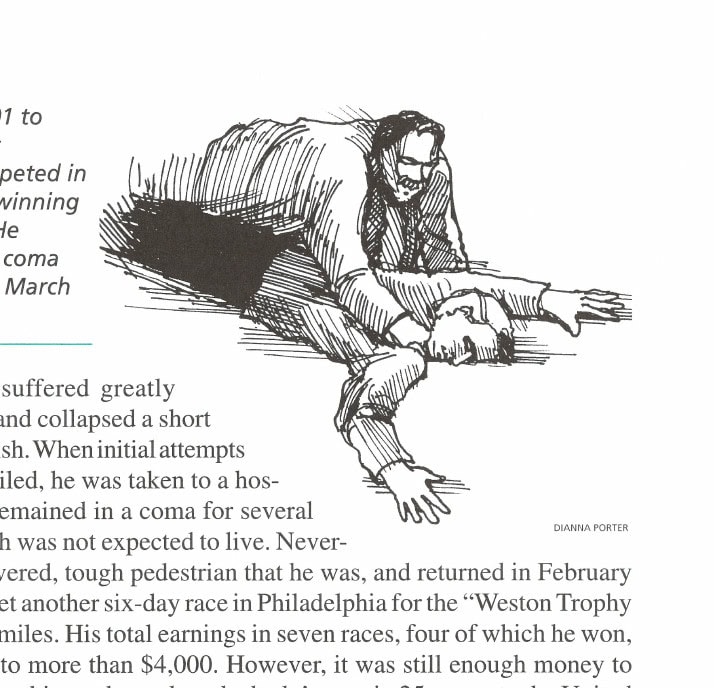
Cavanaugh suffered greatly during the race and collapsed a short time after the finish. When initial attempts to revive him failed, he was taken to a hospital where he remained in a coma for several days. Cavanaugh was not expected to live. Nevertheless, he recovered, tough pedestrian that he was, and returned in February of 1903 to win yet another six-day race in Philadelphia for the “Weston Trophy Belt,” with 524 miles. His total earnings in seven races, four of which he won, did not amount to more than $4,000. However, it was still enough money to allow him to bring his mother, whom he hadn’t seen in 25 years, to the United States from Ireland.
Frank Hart, Daniel Herty, and even Peter Noremac competed in several of these races. Herty turned in the best performance of the old guard in a race in February of 1903, when he finished sixth with 483 miles, for which he won a grand sum of $180.
Death of the Six-Day Race
The contests had changed dramatically from the days of Weston, O’Leary, and Rowell. The tracks were half the size, and while a race in the Garden was no stroll amid pure Alpine splendor, a six-day race at Industrial Hall was a “pretty stiff thing to go up against,” as a reporter for the Philadelphia Record put it. He continued, “the hall is so poorly ventilated as to practically amount to no ventilation at all. . . . One whiff satisfies most people that the sanitary arrangements are not what they should be, for the stench at times is positively sickening.”
In days gone forever, the pedestrians were hailed as national heroes by the sporting press. In 1903 a sports writer for the Philadelphia Journal gave this vivid account of his reaction to a six-day race:
After the first twelve hours the expression go-as-you-please became ridiculous, for no man if he retained his senses pleased to go anywhere.
This article originally appeared in Marathon & Beyond, Vol. 2, No. 3 (1998).
← Browse the full M&B ArchiveMore like this
1,000+ stories from 19 years of Marathon & Beyond
The complete archive of the legendary long-distance journal — digitized and free to read.
