

The Hard Way
Historically, Englishmen have enjoyed a reputation of epitomizing what it is to be a gentleman, and the English in general (apart from a few exceptions) have always been considered honest and fair-minded when it comes to sport, whether as a spectator or a participant. Certainly the Olympics in 2012 confirmed that reputation.
They also love nothing better than to champion the underdog or to show their appreciation and support of anyone, whether a compatriot or not, who achieves something special, particularly when it has been achieved through hard work and individual endeavour, against the odds, rather than as a natural gift or talent. In other words, of all the races in the modern world, it is perhaps the English who still believe most in the traditional meaning of sport and, as such, have produced a society whose individuals like nothing better than to seek out challenges to test their own mettle. Of course I, as an Englishwoman, may be a little biased, and for that I apologize.
However, if I am to represent what I believe to be true of my fellow countryman, I can find no better example to offer the rest of the world than to recount the story of one man whom I have come to know fairly well over the past two years. He is a man whom you will probably never have heard of, yet in 2012, he set a world best for the marathon by running 500 of them in an average finish time of 3 hours, 15 minutes, and 12 seconds.
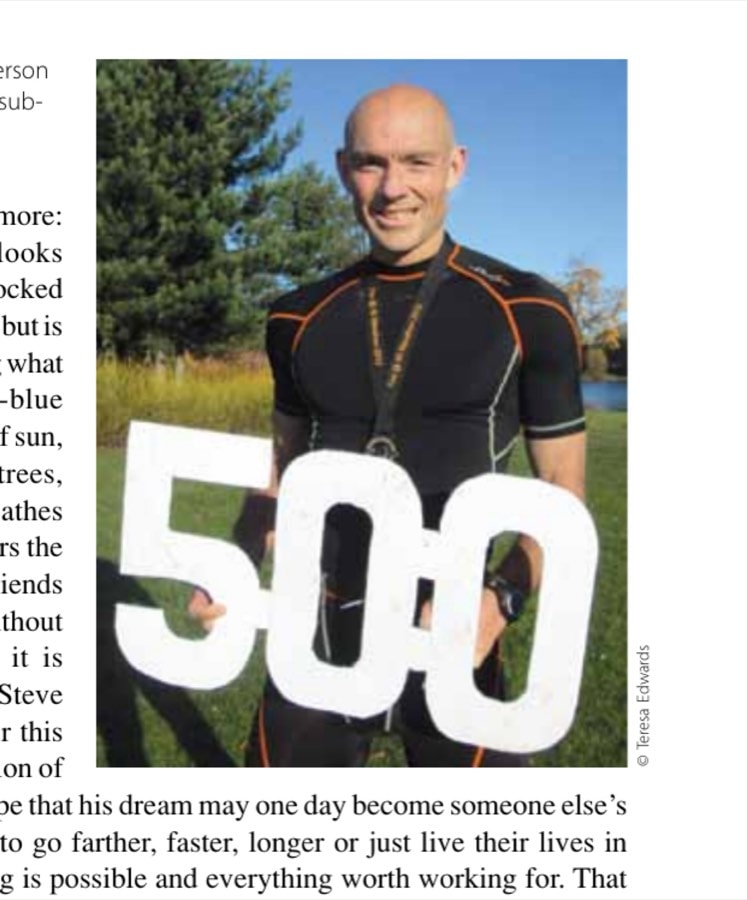
The stats On the way to that record, he set no fewer than five other world records and had run a staggering total of 581 marathons at that time. With finish times ranging from his personal best of 2:51 to his slowest of 3:54, he passed the 500 landmark in April 2010, establishing at that time a world record for 500 marathons run by an individual in the fastest average finish time—3:18. By then, he had already clocked 431 sub-3:30s but had always planned to raise this to 500 by the end of 2012 to coincide not only with the Olympic Games year but also with his 50th birthday.
▲
Steve training near his home in the Cotswolds.
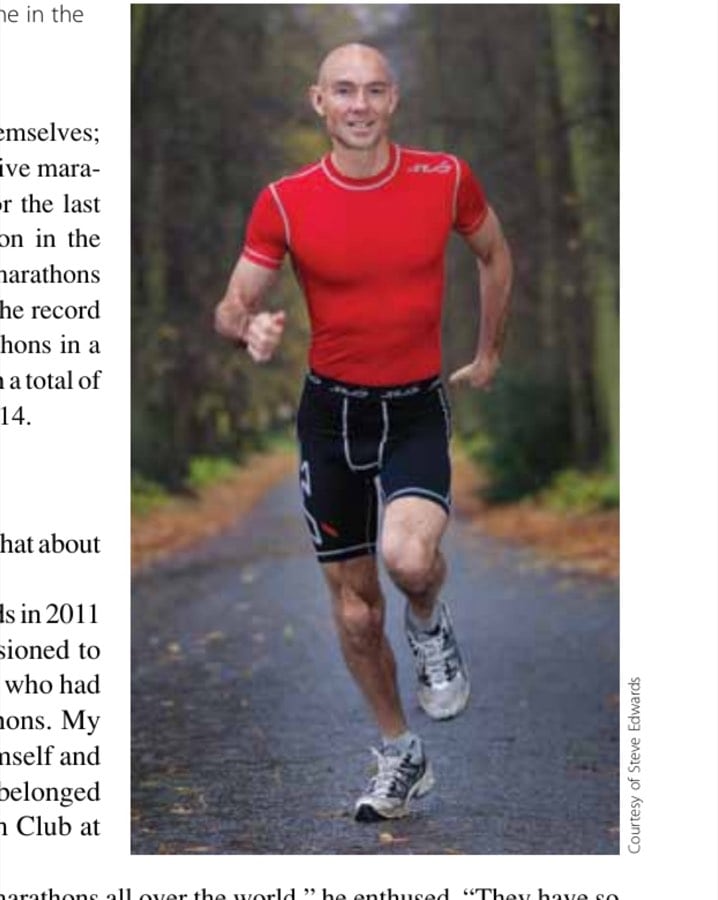
The stats speak for themselves; he has averaged a competitive marathon race every 15 days for the last 24 years, is the only person in the UK to have run over 250 marathons under 3:15, and once held the record for running the most marathons in a one-year period when he ran a total of 87 in an average time of 3:14.
So those are the stats, but what about the man behind them? I first met Steve Edwards in 2011 when I had been commissioned to write a book about people who had run more than 100 marathons. My publisher was a runner himself and had met some guys who belonged to the UK’s 100 Marathon Club at a race in Majorca. “
These guys have run marathons all over the world,” he enthused. “They have so many stories to tell, they’re amazing, there’s a book there!” He was right, on all counts. And so it was that I came to be in Malta in February 2011 for the purpose of meeting members of the 100 Marathon Club who were there to run the marathon that is held every year on the island.
Steve was standing on the corner of the street opposite the pretty waterfront in the early-morning sunshine with his wife, Teresa, the love of his life and his most loyal supporter and mainstay, when I was introduced to him. Sunshine bounced off his bald pate and lightened his blue eyes, and his smile was as welcome as a steaming mug of hot chocolate on an Alaskan winter morning. For more than an hour we blocked the pavement as we stood chatting about the book, Steve’s marathons, and running in general. I left with Steve’s contact details and his promise to help with the book as much as he could. I also left with the feeling that I had just met someone rather special.
True to his word, shortly after his arrival home, Steve duly returned the lengthy questionnaire I had e-mailed to him. Not only had he completed it, he
Courtesy of Steve Edwards
The man
had answered my questions so comprehensively and eloquently that in the end I decided to reproduce it in the book exactly as he had written it. No amendments could improve it, and nothing could be added that wouldn’t detract from the honest, heartfelt answers and explanations he had given.
Despite that, Steve and I still managed to find much to talk about when it came to running. Although I had started in the sport at a much earlier age than Steve, it was quickly apparent that we shared a common view of all things running, from the wonder of its physical aspects and its positive effect on life and health through to the improved mental well-being and respect for our bodies and for the miracle that is nature. Probably one of the things we shared most was our belief that running reflects life and that it is the self-imposed endeavor to achieve, the hard work that takes, and the dedication and commitment required that allow us to fully enjoy the pride, increased self-esteem, and happiness that follow the meeting of such self-set goals.
For Steve Edwards, though, it was something even more than that. It was a means to disprove all the negative beliefs he had about himself, having been the butt of jokes and the victim of bullying throughout his school life due to being born with a disfigured hand. Running a marathon offered Steve the chance to prove himself not only to others but perhaps, more important, to himself; running 500 of them and setting a world record some 24 years after that first one have given him the opportunity to show others that the power to be who we want to be, to achieve what we desire, is not in the hands of the bullies, nor is it in the hands of those we love and who love us in return. It is in our own hands.
That first fateful marathon Steve, who lives in a beautiful part of middle England—an area known as the Cotswolds, where mellow, honey-stone cottages, idyllic wooded valleys, and sparkling streams are commonplace—ran his first marathon back in 1981 at the tender age of 18 as the result of a bet with his mates. Afterwards, able only to crawl down the stairs backwards and unable to walk comfortably for nearly a whole week, he vowed “Never again!”
However, he couldn’t deny that he felt something other than stiff-legged after that first marathon, which he finished in 3:38. He realised how good it felt to feel fit and to run freely without getting out of breath, and he wondered how much more he could achieve if he trained properly for it rather than running five miles every day around a school track in his old football trainers.
Consequently, he joined a club, but when his coach advised him that he didn’t have the necessary biomechanics to run faster than 2:30 and would therefore never become an elite athlete, Steve decided to look for something he could aspire to. He found it when he read about a world record that had been set by an American
© Martin Campbell
▲
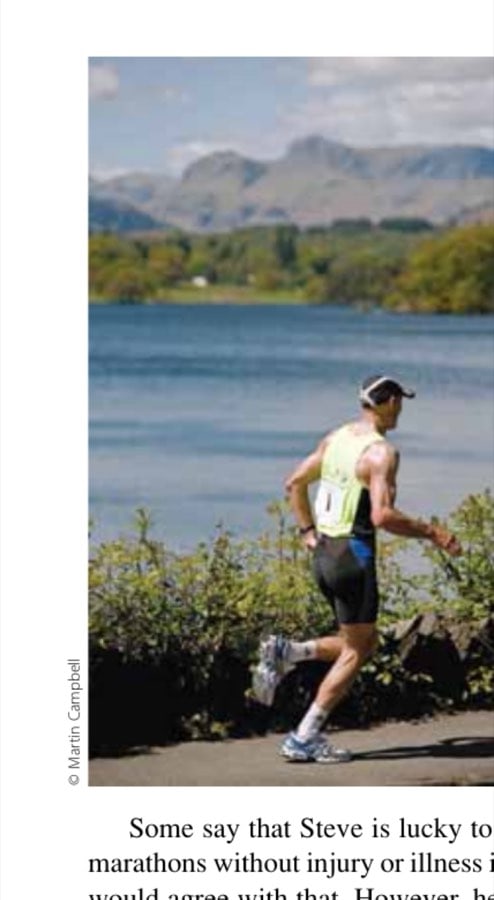
Steve, on his way to running a new vet masters world record for the fastest 10 marathons in 10 days.
of Indian ancestry, Sy Mah, who had completed 500 marathons in an average time of between 3:40 and four hours. “I felt this was something I could potentially achieve, something for me in my world. It wouldn’t be just
about running numerous marathons but running them in reasonable times, digging deep every race, no matter how I felt. That would be the real challenge,” Steve said. That was back in 1988. At that time, Steve had run 12 marathons
with just six under 3:30, but from 1988 he averaged 23 a year, most of them meeting his target. Some say that Steve is lucky to have been able to run so many high-quality marathons without injury or illness interrupting him, and to a certain extent Steve
would agree with that. However, he has never left his desire to become the first man in the world to run 500 sub-3:30 marathons down to chance. He has studied and takes very seriously daily and race-day nutrition, he has a bin in his garden
in which he takes an ice bath after every race, and he heeds the advice of his physiotherapist and masseur. For Steve is a man given to detail: everything is studied, questioned, and checked several times before he will accept and adopt
it. He may well be an amateur in that he is not paid for running marathons, but in every other sense Steve Edwards is a true professional.
Six days before the world record Six days before his world-record attempt, I spoke to Steve over the phone to find out how he was feeling. “I’ve been feeling coldy since yesterday,” he said, sounding slightly nervous, “but I went for a five-mile run today and felt OK once I was outside in the fresh air. The sun was shining and I was thinking how nice it would be if it’s like this on Sunday. I keep trying to visualize the finish and how it will feel. I’m already feeling emotional at the thought. I just want to get that first mile under my belt
and know that everything’s OK. Other people have said to me that it’s just another one, but it’s not. There’s a certain magic about putting a date in the diary and landing on it. I’ve had 24 years of tapering!” he jokes. “
The thing I worry about most is the thought of ‘What after?’ When I reached my 500th, it was great on the day; then I went back to work on Tuesday and everything was normal again. I was quite upset about it and spoke to someone at my running club, and he said, ‘Well, what did you expect to happen?’ “
I like the idea of setting a benchmark. I hope it will inspire someone else to have a go at beating it, like I did when I read about Sy Mah. “I enjoy giving inspirational motivational talks. To try and make the audience appreciate how far a marathon is, I name a local point one mile from where they are so they can imagine that distance and then tell them to multiply that by 26 or to think of somewhere that is 26 miles away from where we are. “
You never know what’s going to happen from one run to the next. I suppose I’ve been lucky with injuries, illness, and life generally not preventing me from continuing. “It’s the mind-set to keep on with it more than anything else. This year has been the most difficult. I’ve had an injury that put me out of a couple of races, but that may have been a good thing as it’s kept me steady and made me change the
ad
date to later in the year, nearer my 50th birthday! And now it will be at a smaller, friendlier event, which I prefer anyway as a general rule.”
World-record day And so it is that on November 11, 2012, Steve Edwards lines up at the start of the little-known Enigma Fox @ 40 Marathon event with just 65 others. The race, organized by Steve’s good friend and fellow 100 Marathon Club member Dave “Foxy” Bayley, takes in 7.5 laps of the picturesque Caldecotte Lake, Milton Keynes, a town just 45 miles northwest of London, erected in the late ’60s to relieve the city’s housing congestion and which is better known for its concrete cows than it is for the setting of world records.
On this day, though, it’s as though the town is aware that it’s about to play host to something rather special, for it has laid on one of those most glorious of English autumn days where the sky is a pure, uninterrupted expanse of blue and the sun a faultless, round-yellow disc from a child’s painting, rusting the amber-gold and ruby leaves of the surrounding woodland. The only movement from the lazy, flat lake is the twinkling wink of its diamond eyes or the occasional frenzy of a clumsily landing swan. You cannot get a more perfect day in England in November.
Three hours, 14 minutes and 17 seconds later, 49-year-old Steve Edwards rounds the final bend, takes his 4-year-old grandson’s hand, and breaks the kitchen-roll finish tape with consummate ease, setting a world record for running 500 marathons in the fastest average finish time—3:15:12. It has taken 24 years of blood, sweat, toil, and tears and the devotion and support of his wife, Teresa, to achieve. The record is likely to outlive Steve and possibly his grandchild, too.
And there is not a TV camera or national newspaper reporter in sight. The decision to set his world record at a good running friend’s low-key event in a beautiful setting in the company of good friends and close family rather than at a highly populated, TV-sponsored event with world-press coverage probably best sums up the man who is Steve Edwards. He is a husband, a father, a grandfather; he gave
© Martin Campbell
▲
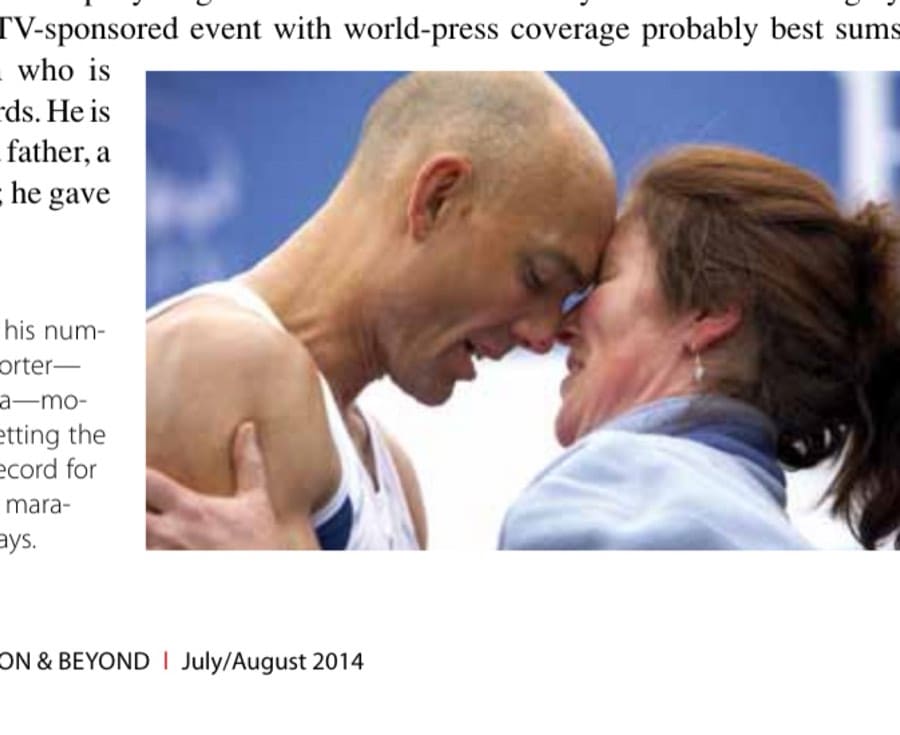
Steve with his number one supporter— his wife, Teresa—moments after setting the initial world record for the fastest 10 marathons in 10 days.
ad
his three grandchildren special medals for them to wear on the day so they would feel included and involved. As he crosses the line, a spinning medal placed around his neck, he sinks to his knees, spreads his arms wide, and bows his head. He is joined by Teresa, who takes his head in her hands and gathers him to her. For a moment they may be alone in the world, no doubt trying to take in and wanting to capture to memory the moment when Steve Edwards became the only man in the world ever to have run 500 sub-3:30 marathons.
But those who have traveled to support him are having none of it. Soon champagne corks are popping, congratulations are offered, hands are shaken, cheeks are kissed in a whirl of joy, friendship, and shared wonder and pride at knowing such a man. In true English-gent style, Steve accepts it all with a gracious smile, a nod of his head, and a twinkle of his blue eyes and asks other runners who have finished how their races went, cheering those who are still running—and there are plenty of them, as Steve finished in third place.
For me, watching from the sidelines, it’s like taking a step back in time to see a man behave with such quiet grace and dignity when achieving something so great. There is no leaping about or shouting, more a quiet pleasure and acceptance that something he has worked so hard for, for so long, has finally come to fruition.
But there is something more: it’s clear in the way he looks around him that he is not locked within his own achievement but is looking outwards and seeing what we see—a glorious clear-blue sky, a yellow glowing ball of sun, amber and russet-leaved trees, shades of autumn. He breathes the fresh, crisp, still air, hears the chatter and laughter of his friends and family, and with or without 500 sub-3:30 marathons, it is clear that all is right with Steve Edwards and his world. For this is not just about the realization of his own dream—it is the hope that his dream may one day become someone else’s dream, may inspire others to go farther, faster, longer or just live their lives in the knowledge that anything is possible and everything worth working for. That is Steve’s hoped-for legacy. He is a one-man London Olympics; he hopes his efforts may inspire if not a whole generation, at least one person. That, he says, would make him really happy.
There is one person, though, without whose support and steadfast loyalty Steve would say he couldn’t have achieved what he has, and that is his wife, Teresa. “It’s been a hell of a journey, with lots of sacrifices, hard work, and commitment, but I’ve loved every minute and made so many good friends,” she says. “I’m very proud of what Steve has achieved.” And so say all of us!
Epilogue Since 2012, Steve has improved his own world-best performances by running a total of 635 official marathons, with an average finish time of 3:18, decreasing his average finish time for 500 marathons to 3:13:48 and setting a world-best average finish time for 600 marathons of 3:16:36. You can read more about Steve and others like him in Helen Summer’s book, Running Crazy, published by John Blake.
© Teresa Edwards
▲
Proud to become the first person in the world to run 500 official sub3:30 marathon races.
This article originally appeared in Marathon & Beyond, Vol. 18, No. 4 (2014).
← Browse the full M&B ArchiveMore like this
1,000+ stories from 19 years of Marathon & Beyond
The complete archive of the legendary long-distance journal — digitized and free to read.
