

Worlds Apart: Women We Love
Two very different women runners, who live in wildly disparate places 10,000 miles apart, share the same dream. One is old enough to be the other’s mother, yet they’ve both been running for the same number of years. One runs competitively, the other collects marathons; one wears rhinestones and pink cowboy boots, the other Nike tights and running shoes. Austrian Ilse Dippmann and American Elaine Doll-Dunn, both as lithe and energetic as teenagers, knock themselves out to provide some of the best organization in women’s running today and give enough heart to keep us going forever.
June: Driving thought the Tyrolean countryside on my way to Vienna for the big race, I found myself humming the tune from The Sound of Music. I know it sounds corny, but the lush rolling meadows dotted with pristine alpine lakes and tiny stone churches looked just like the movie and put me in a happy and anticipatory humor. The soft, green fields and old meandering roads seemed friendlier and more accessible than those in America—I was psyched.
The Austrian Women’s Run (Oesterreichischer Frauenlauf), an 11,200-strong women’s-only event, is held annually in the Prater, a huge park smack in the middle of Vienna, a city of such baroque and rococo intensity that it reminds me of a whipped cream cake. This park is an ideal race location: pancake flat, shady, and on soft asphalt. The one-loop 5K and two-loop 10K races are perfect for fast times, spectators, superb organizational control, and best of all as a venue for the daylong festival that follows.
Ilse Dippmann envisioned all this 14 years ago when she had a dream of organizing the first women’s-only race in Austria and the determination to do it and build it every year. Dippmann, 46, a schoolteacher and 3:15 marathoner, several times ran the Chicago and New York City marathons, but what impressed her the most was the world’s first women’s-only road race, the New York Mini Marathon (earlier, known as Crazylegs, Bonne Bell, L’eggs, Avon, and now Circle of Friends Mini). In 1972, I was one of the founders of that highly spirited 10K race around
Austrian Women’s Run 2005
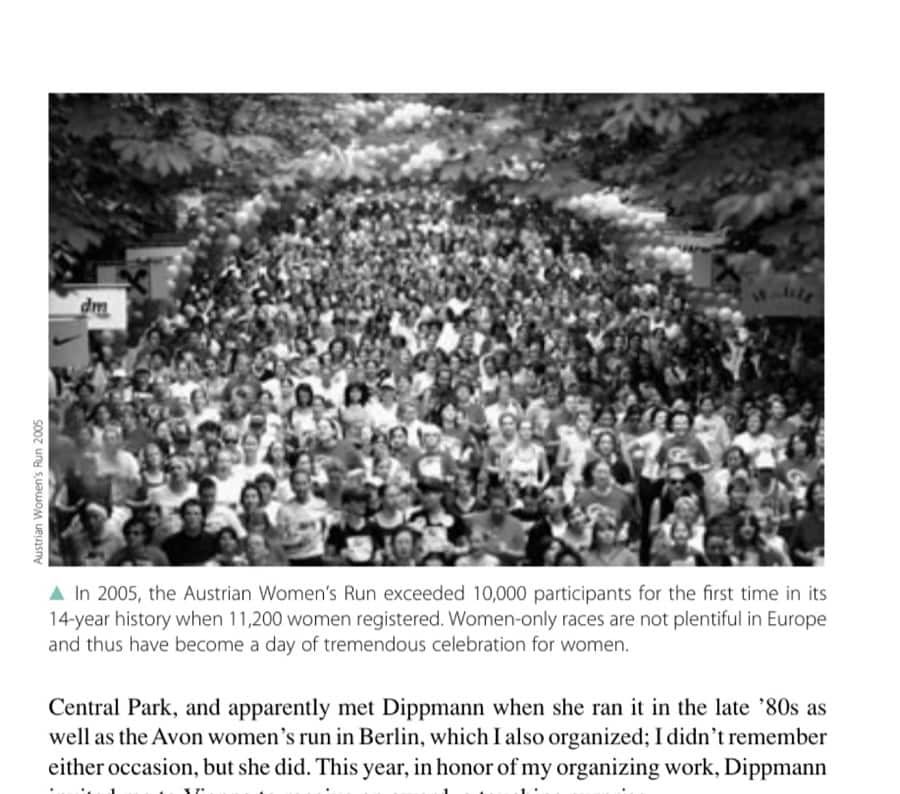
▲ In 2005, the Austrian Women’s Run exceeded 10,000 participants for the first time in its 14-year history when 11,200 women registered. Women-only races are not plentiful in Europe and thus have become a day of tremendous celebration for women.
Central Park, and apparently met Dippmann when she ran it in the late ’80s as well as the Avon women’s run in Berlin, which I also organized; I didn’t remember either occasion, but she did. This year, in honor of my organizing work, Dippmann
invited me to Vienna to receive an award, a touching surprise. With ideas from these events, Dippmann began her first Austrian event with a field of 342 women. Every year she added a new component, building care
fully, keeping quality paramount. A few years ago, boyfriend Andres Schnabel became her business partner as well, and despite their both having full-time jobs, the Austrian Women’s Run now has become a full-time professional effort, with
many layers of sponsorship, political endorsement—the lady mayor of Vienna started the race and then ran in it—entertainment (seven different bands), catering (six different beer stalls!), and technical amenities. Now it is the largest race in
Austria after the Vienna Spring Marathon. “Every year our race has grown hugely, but I was afraid to hope for 10,000,” Dippmann says. “That day has now come, and I’m so happy.” I was too! Dippmann asked me to wear bib number 10,000 in honor of the landmark occasion.
Runners, genetically resistant to rigidity, would delight in this race’s ebullient, laid-back atmosphere that surrounds a Teutonic efficiency. Chip timing and a corral start based on predicted or previous time bring world-class control and the
opportunity to run a best time, unimpeded by a crush of participants. Last year, knowing the race was ready for the next big step, Ilse and Andres recruited an
Austrian Women’s Run 2005
elite international field for the first time. Olympians Sonia O’Sullivan, Ireland; Annemette Jensen, Denmark; Aniko Kalovics, Hungary; and Sabrina Mockenhaupt from Germany rewarded them with global publicity and winner Mockenhaupt with a new course record of 15:42.9. The aspirational aspect of the race was kept, though, as the elites were recruited for the less-intimidating 5K race and not the 10K.
The race is huge and slick, but intensely personal as women from all over Austria came together for their annual rite of racing, jogging, or Nordic walking—a local brand of power walking with two Leki sticks, which is like cross-country skiing without skis or snow. It was brilliant running past banks of wildly cheering men—a sort of reverse of the Boston Marathon’s Wellesley College. These men were also a delightful part of the race volunteer corps and happy beer-drinking partners afterward. “
Many times over the years I wondered if I should give up this race, if all the work is worth it,” says Dippmann. “This year, I knew we were right to persevere. We have moved to the next higher level. Sometimes you get too close to the work to see how wonderful the event is and how significant it is for so many women. In the end, you know you’re changing their lives and they will pass on this vision, too.” While it is this life-enhancing spirit of the event that impassions
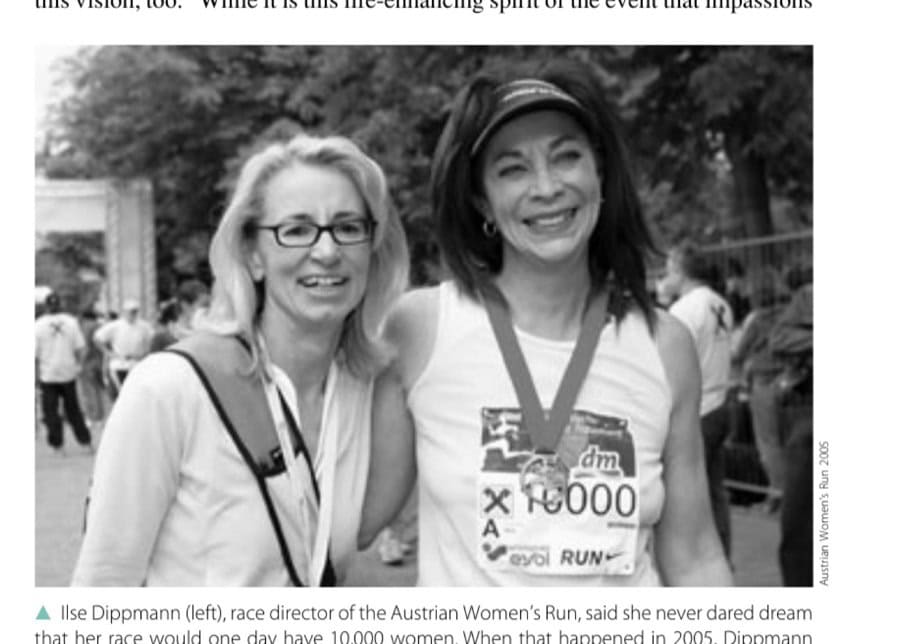
▲ Ilse Dippmann (left), race director of the Austrian Women’s Run, said she never dared dream that her race would one day have 10,000 women. When that happened in 2005, Dippmann asked author Kathrine Switzer (right) to run her race and wear Bib # 10,000.
Kate Axlund
▲
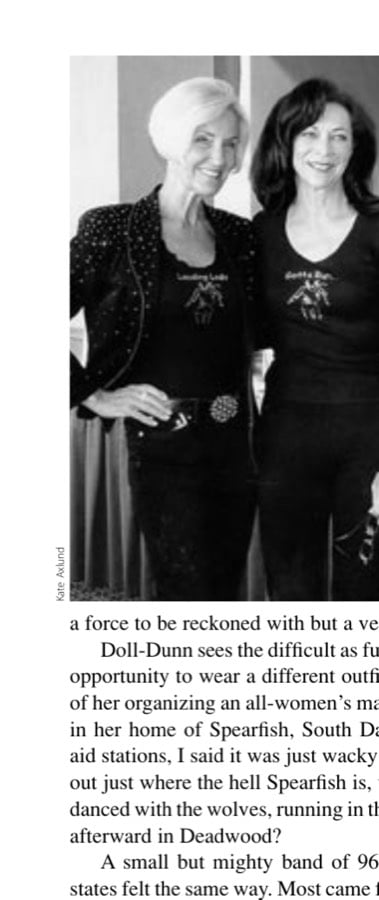
Leading Ladies’ Marathon Race Director and runner of 118 marathons Elaine Doll-Dunn (left) is 68 years old and makes 58-year-old author Kathrine Switzer look like chopped liver.
Dippmann and Schnabel, their event is also ready for world-championship designation—it is that good. * * * August: I first met Elaine DollDunn eight years ago, right after she had run the 60 miles of the Panama Canal from the Atlantic to the Pacific
for her 60th birthday. She had also run 26 marathons in one year, but what really stunned me was her running up and down Mount Kilimanjaro at age 58, wearing a bladder bag, as she is also a cancer survivor. When I heard
she had seven children but had hoped for a dozen, I knew this was not just a force to be reckoned with but a veritable tsunami. Doll-Dunn sees the difficult as fun, the impossible as a challenge, and each an opportunity to wear a different outfit. So when she called to ask what I thought
of her organizing an all-women’s marathon called the Leading Ladies’ Marathon in her home of Spearfish, South Dakota, with chocolates and men-only at the aid stations, I said it was just wacky enough to succeed. I mean, once you figure out just where the hell Spearfish is, who can resist going where Captain Dunbar
danced with the wolves, running in the shadow of Mount Rushmore, and drinking afterward in Deadwood? A small but mighty band of 96 women from an astonishing 27 American states felt the same way. Most came for the pioneering sense of being there “first”
and also for the opportunity to run with a like-minded group of pumped friends in a special all-women’s event. Winner Tracy Stewart came with her mother, Carol Lyndell, who also ran. Two sisters from Colorado and Alaska decided to
meet in South Dakota and ran together; and a few women who met running in the Antarctica Marathon decided Spearfish was even more remote and staged a reunion. One law professor from Philadelphia came alone, but once on the road
she found a buddy and shouted out, “I’ve found a new friend!” Then there was one first-time marathoner who chose this unlikely place for a debut for as good a reason as any: “I came for the chocolate.”
▲
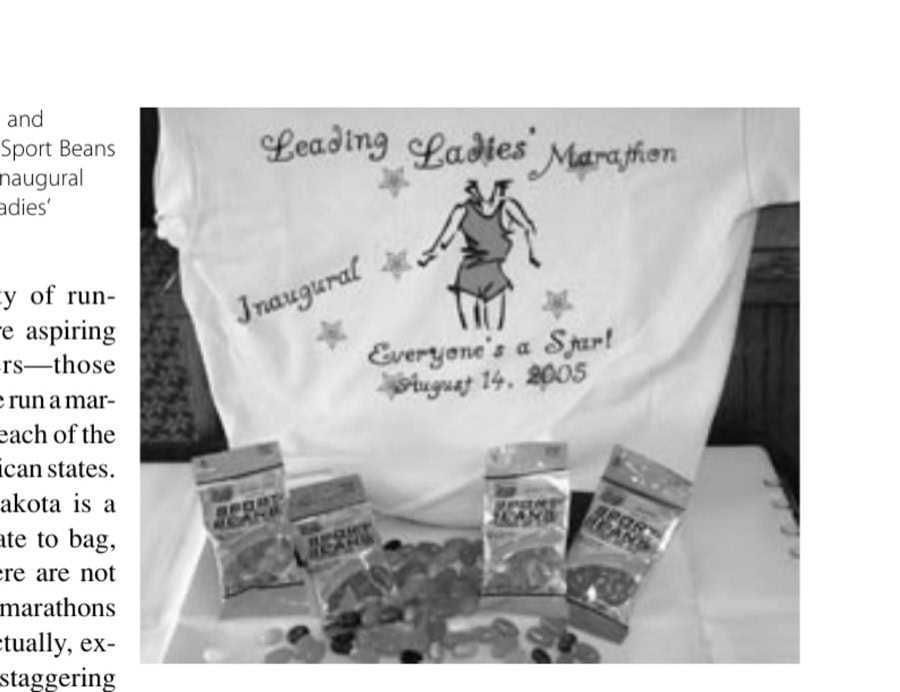
La Shirt and Jelly Belly Sport Beans from the inaugural Leading Ladies’ Marathon.
Plenty of runners were aspiring 50-Staters—those who have run a marathon in each of the 50 American states. South Dakota is a tough state to bag, since there are not a lot of marathons there. Actually, except for staggering scenery, there is not a lot of anything in South Dakota. The entire state has only 700,000 people. That is just fine with Lyn Reibel, who not only got her 50th state but on this day celebrated doing all 50 three times. (Yep, 150 marathons!) Except for one uphill in the first mile, the race ran downhill the length of Spearfish Canyon through the sacred Black Hills. The race has a net drop of 3,000 feet, so sore quads were guaranteed; but if you had the legs for it, so were fast times. Stewart, from Colorado Springs, ran a 2:57. It was her 32nd marathon, and she is only 26 years old. Still, the soaring beauty of the canyon, with waterfalls, streams, bounding deer, and fragrant pine forests, made performances secondary. Many women carried cameras to record the sights, and as we cheered the women out on the course, they answered back, “I’m in heaven!” or “This is the most beautiful place I’ve ever seen!” And, just as the canyon walls and thickening green created a sense of Wild West remoteness, another pink aid station whimsically would appear—“I love pink,” Doll-Dunn deadpans. The finish in the town park had pink medals, roses, breakfast, a deafening cheering section, and a numbingly cold creek in which to plunge sore legs. “I wanted to organize a really unique event for women and amaze them with the beauty we have here,” says Doll-Dunn. “But I had no idea we’d all have so much fun and make so many friends. Everyone wants to reunite next year.”
The proposition is a little scary. A few years ago, a motorcycle enthusiast in the nearby hamlet of Sturgis decided it would be fun to organize a motorcycle festival. Now 100,000 cyclists from all over the world descend on the town each August. South Dakota is really good at wacky, and Doll-Dunn can imagine the unique and never imagine failure. Watch out, world!
This article originally appeared in Marathon & Beyond, Vol. 10, No. 3 (2006).
← Browse the full M&B ArchiveMore like this
1,000+ stories from 19 years of Marathon & Beyond
The complete archive of the legendary long-distance journal — digitized and free to read.
