


ASICS designed the Metaspeed Sky and Metaspeed Edge as the same shoe split into two — same FF Turbo midsole foam, same carbon plate, same outsole pattern, but tuned for two different stride patterns. Most runners pick the wrong one because they assume the more popular Sky is universally better. The real choice is between cadence-dominant runners (Sky) and stride-dominant runners (Edge), and getting this matched right is the difference between a fast race and a frustrating one.
Metaspeed Sky vs Edge: Quick Verdict
Metaspeed Sky is for runners whose pace gain comes from longer strides — the carbon plate sits flat across the midsole, and the midsole geometry rewards a long, ground-contact-heavy stride pattern. Metaspeed Edge is for runners whose pace gain comes from higher cadence — the plate has a more pronounced toe-spring, the midsole is more aggressively tipped forward, and the geometry rewards quicker, shorter steps with faster turnover. Same foam, same plate material, two different stride physiologies.
The Honest Truth: Sky vs Edge Is About Your Stride, Not Your Goal Time
The branding tells you the Sky is for “stride-type runners” and the Edge is for “cadence-type runners” — but that’s actually backwards from what most runners assume the words mean. Here’s what the biomechanics literature says about which platform suits which stride pattern.
1. ASICS’s naming is biomechanically precise — but counter-intuitive
ASICS classifies runners into “stride type” (gain pace by lengthening strides) and “cadence type” (gain pace by quickening turnover). The Sky is built for stride-type runners; the Edge is built for cadence-type runners. The data behind this is real — instrumented treadmill studies show two distinct response patterns when runners increase pace, and the right shoe geometry depends on which pattern you use1Hunter I, McLeod A, Valentine D, Low T, Ward J, Hager R. Running economy, mechanics, and marathon racing shoes. Journal of Sports Sciences. 2019;37(20):2367–2373.. The simplest field test: time yourself running 1 km at 5K pace and at marathon pace. Cadence-type runners increase steps-per-minute by 5–8% between the two paces; stride-type runners increase stride length by ~10% with cadence almost unchanged.
2. Plate position changes which stride phase the shoe rewards
The Sky’s plate sits flatter and more centred under the midsole — the energy return reaches its peak during midstance, rewarding a long ground-contact stride. The Edge’s plate has more aggressive forward curvature with the peak energy return shifted toward toe-off, rewarding the quick push-off that cadence-type runners use2Healey LA, Hoogkamer W. Longitudinal bending stiffness does not affect running economy in Nike Vaporfly Shoes. Journal of Sport and Health Science. 2022;11(3):285–292.. So if you put a stride-type runner in the Edge, the energy return arrives too late for their gait; if you put a cadence-type runner in the Sky, they don’t spend enough time on each foot to extract the midstance return.
3. Stack height and weight — Sky has more cushioning
The Metaspeed Sky Paris sits at 39.5 mm under the heel and weighs ~204 g (men’s 9); the Metaspeed Edge Paris is 39.5 mm but weighs ~218 g — counter-intuitively, the cadence-runner shoe is the heavier of the two, because the plate geometry needed to drive faster turnover requires more material3Worobets J, Wannop JW, Tomaras EK, Stefanyshyn DJ. Softer and more resilient running shoe cushioning properties enhance running economy. Footwear Science. 2014;6(3):147–153.. The 14 g per shoe gap matters most at marathon pace and faster — but only if you’re the right runner for each platform.
4. Foam tuning — both share FF Turbo, but the densities differ
The Sky and Edge both use ASICS’s FF Turbo+ foam, but the durometer (firmness) is tuned slightly differently above and below the plate. The Edge runs a touch firmer overall to support the faster turnover, while the Sky runs slightly softer for the longer ground contact. The energy-return measurements are similar at marathon pace; the difference is in feel and load profile, not raw economy4Hoogkamer W, Kipp S, Frank JH, et al. A comparison of the energetic cost of running in marathon racing shoes. Sports Medicine. 2018;48(4):1009–1019.. So the practical decision rule: pick the shoe whose stride pattern matches yours, not the one whose foam feels softer in the store.
5. The simple field test most runners skip
Get a friend to film you running 800m at 5K pace from the side. Open the video at half-speed and count steps over a 30-second segment. Then film 800m at marathon pace and do the same. If your steps-per-minute increases by 4% or more between the two paces, you’re a cadence-type runner — buy the Edge. If your cadence stays within 2% but your stride length visibly grows, you’re a stride-type runner — buy the Sky. If you’re between the two, lean Sky as the more forgiving platform. ASICS has an official “Find Your Type” tool on their site that uses similar logic. If you’re still figuring out where the Metaspeed line fits into a marathon block, our best marathon running shoes guide works through model-level picks across ASICS and the rest of the field.
Sky vs Edge: Side-by-Side Specs
| Spec | Metaspeed Sky Paris | Metaspeed Edge Paris |
|---|---|---|
| Weight (men’s 9) | ~204 g | ~218 g |
| Stack heel | 39.5 mm | 39.5 mm |
| Heel-toe drop | 5 mm | 5 mm |
| Foam | FF Turbo+ | FF Turbo+ (slightly firmer) |
| Plate position | Flatter, mid-positioned | Curved, toe-shifted |
| Best for | Stride-type runners (long-stride, low-cadence-change) | Cadence-type runners (high-turnover, short-stride) |
Where to Buy
More Shoe Roundups From Marathon Handbook
Sky vs Edge: Pros & Cons
Metaspeed Sky
- ✅ Lighter (~204 g men’s 9)
- ✅ Smoother rocker for stride-type runners
- ✅ Slightly softer foam feel
- ✅ Plate position rewards midstance loading
- ❌ Less rewarding for cadence-type runners
- ❌ Plate doesn’t aid quick toe-off
Metaspeed Edge
- ✅ Plate geometry rewards quick turnover
- ✅ More aggressive forward propulsion
- ✅ Slightly firmer for stable push-off
- ✅ Built specifically for cadence-type runners
- ❌ Heavier (~218 g men’s 9)
- ❌ Less forgiving for stride-type runners
Frequently Asked Questions
Am I a stride-type or cadence-type runner?
Run two timed 800m efforts — one at 5K pace and one at marathon pace — and count your steps over a 30-second window of each (or use a watch with cadence metrics). If your cadence increases by 4% or more between the two paces, you’re a cadence-type runner — pick the Edge. If your cadence stays within 2% but stride length visibly grows, you’re a stride-type runner — pick the Sky. ASICS also runs an official “Find Your Type” tool on their site that uses the same logic.
Is the Metaspeed Sky or Edge faster?
Neither is universally faster. The energy-return measurements at marathon pace are similar between the two; what differs is which stride pattern they reward. The Sky is faster for stride-type runners and the Edge is faster for cadence-type runners. Putting the wrong runner in the wrong shoe usually produces a slower race than wearing the matched one.
How does the Metaspeed compare to Vaporfly?
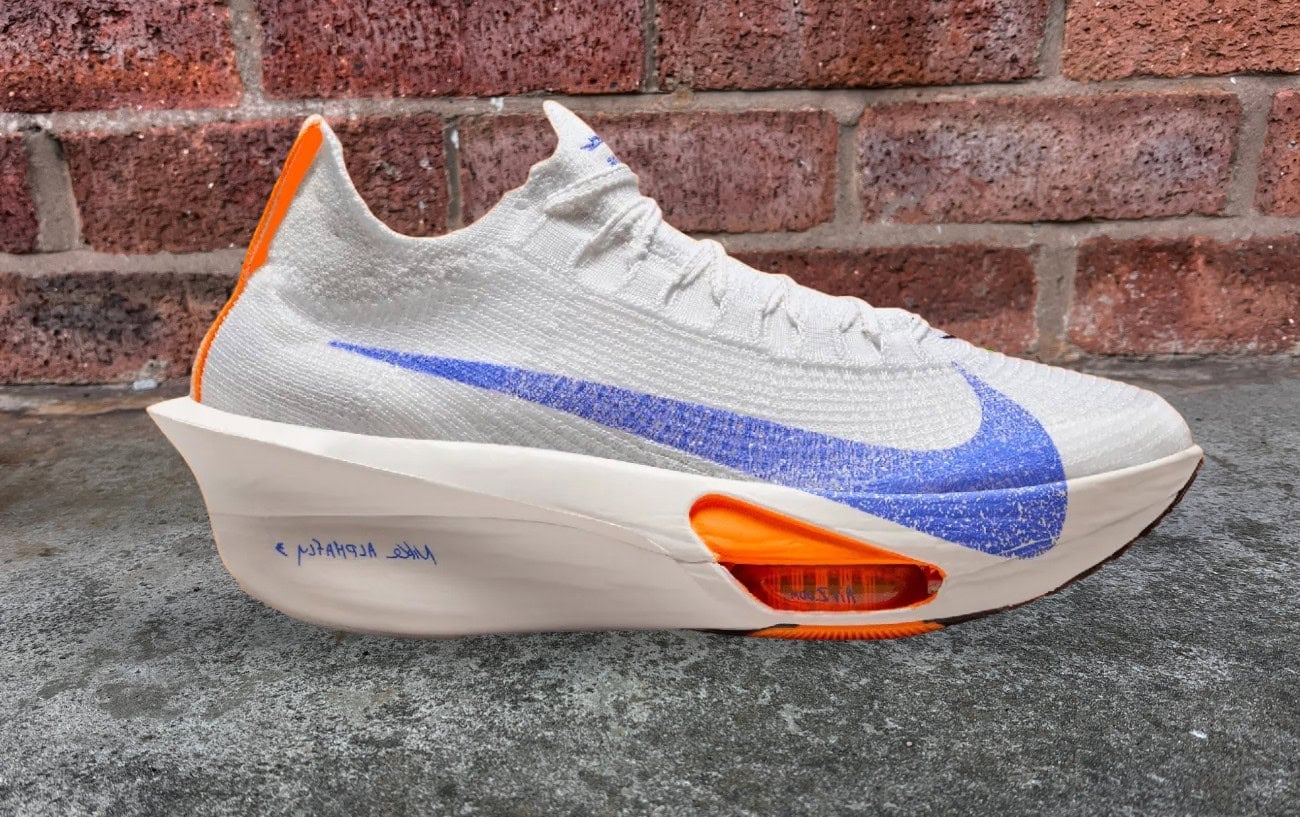
Lab energy-return measurements have the Vaporfly 3, Metaspeed Sky Paris, and Alphafly 3 within 1–2% of each other at marathon pace — much closer than the marketing suggests. The bigger difference is fit and stride match. The Vaporfly’s smoother heel-to-toe rocker rewards rearfoot/midfoot strikers; the Metaspeed Sky rewards stride-type runners; the Alphafly’s twin Air Zoom forefoot rewards forefoot strikers. See our Vaporfly vs Alphafly comparison for that decision.
How long do Metaspeeds last?
FF Turbo+ super-foam, like other PEBA-based super-foams, shows meaningful energy-return degradation after 200–400 km of high-impact use. Reserve them for racing and 1–2 race-pace dress rehearsals per training block. Using them for daily mileage burns through their useful life before goal race day.
Should I size up in the Metaspeed?
The Metaspeed line runs slightly long compared to other ASICS daily trainers and slightly narrow in the forefoot. Most runners should stick with their usual ASICS race size. Wide-footed runners often find the Metaspeed too snug at the forefoot — the wider 2E version isn’t available in the Metaspeed line, so consider the Saucony Endorphin Pro or Nike Alphafly if you have a wide forefoot.
References
RunClub — Free
Join 300,000+ runners in RunClub
Free training plans for every distance, a daily running game, exclusive coaching content, and a real community of runners. Create your free account in 20 seconds — no card.
Already a member? Log in →



Start the conversation