


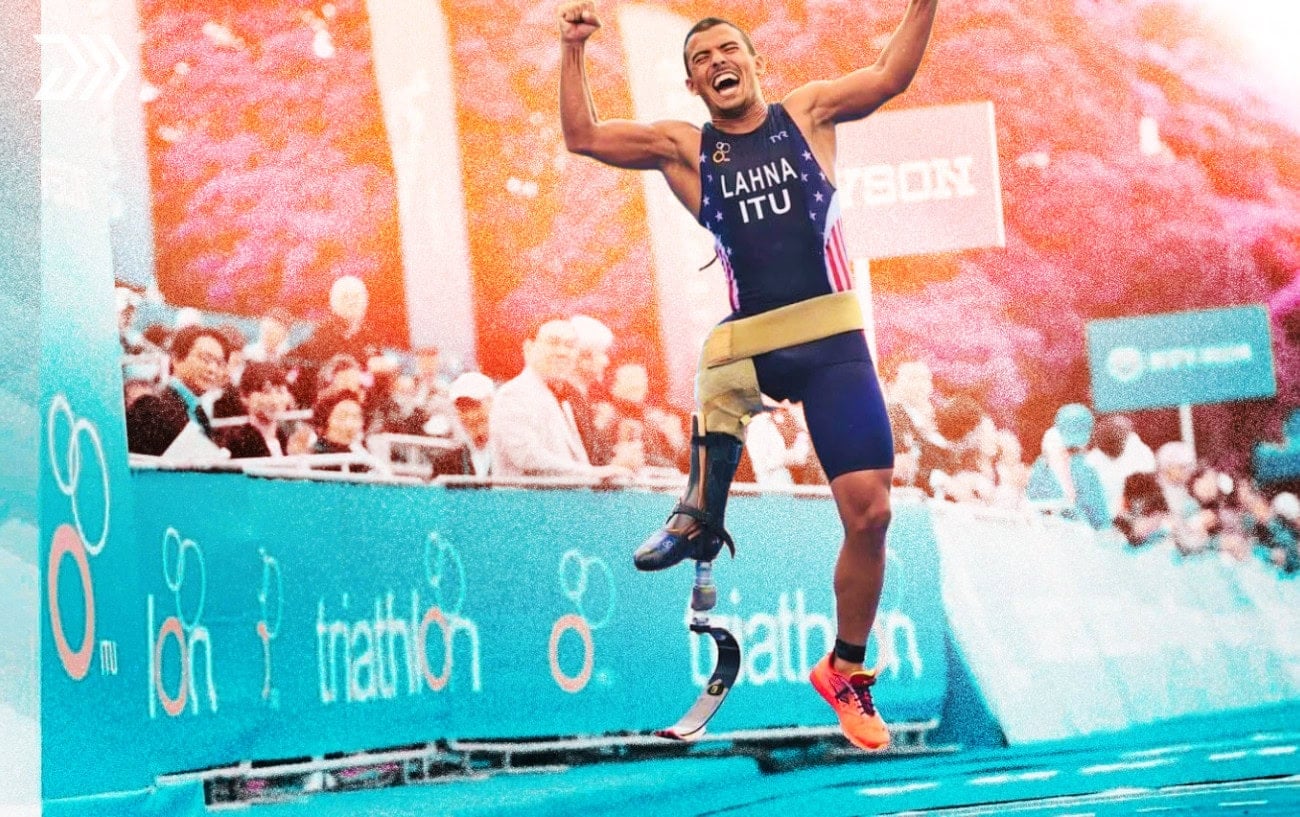
Mohamed Lahna finished the hardest part of his triathlon across America two miles at a time. By the time the Paralympic medalist reached the run, he had already swum around Manhattan and biked roughly 3,000 miles across the country. What was left was a 300-mile run from Las Vegas to Los Angeles on a prosthesis, straight through the Mojave Desert, and it was the stretch that nearly undid everything. Lahna reached Venice Beach just after 1 p.m. on July 29, closing out 47 days and about 3,300 miles of swimming, cycling and running in what is believed to be the first triathlon across the United States completed in this format by an athlete with a prosthetic leg.
The Run Was the Cruelest Stretch
For most runners, the number that matters here is 300 miles across a desert, alone with the heat, on one prosthetic leg. Lahna, who was born without a right femur, told Runner’s World that the run demanded a different kind of caution than the swim or the bike. “Running with a prosthesis is very difficult,” he said. “Blisters can stop the journey, and if you get an infection, it is over.”
So he and his crew broke it into pieces. Roughly every two miles, the support car pulled ahead and stopped, and Lahna cleaned the prosthesis, checked his skin, hydrated and applied BodyGlide before pushing on to the next stop. One section between Nevada and California followed power lines for 116 miles across off-road terrain in extreme heat, a stretch so featureless the route looked endless. He refused to think past the next car. His job was simply to get there, and he said he “repeated that all day.”
Even so, the desert took its toll. “I battled boils and constant pain,” Lahna said. “There were times when we had to stop, treat the wounds, adjust the prosthesis, and find a way to continue.” The heat, the soft sand and the mechanics of running on a prosthetic leg drained energy at a rate the flat mileage never suggested. He crossed the line in Venice Beach in a pair of On racing shoes, having covered the final leg on will as much as fitness.
A 3,300-Mile Triathlon, Coast to Coast
The run was only the last act. Lahna started on June 13 in New York with a 28.5-mile swim around Manhattan Island, which he completed in 7 hours, 44 minutes and 58 seconds. From there he climbed onto the bike and rode roughly 3,000 miles to Las Vegas, moving through 16 states and more than 100,000 feet of climbing before the run to Los Angeles even began. In total, the effort covered about 3,300 miles (5,310 kilometers) over 47 days.
The bike nearly broke his resolve before the run ever could. About two weeks in, Lahna checked the map and realized he was not yet a quarter of the way across the country. “It was daunting and scary,” he said. “I was tired and exhausted, and I still had so far to go.” He stopped thinking about the route as a whole and focused on the day in front of him, and when his pace put him ahead of schedule, his crew talked him out of pressing. “The smart choice was to use the extra time to finish the challenge safely rather than be irresponsible and run too fast,” he said. It is the same discipline that carries runners through a William Goodge-style run across America or the self-supported grind of the Marathon des Sables: protect the body, and let the mileage come.
From No Femur to the Podium
Lahna was born in Morocco with proximal femoral focal deficiency, a rare congenital condition that left him without a right femur, and he did not receive his first functional prosthesis until he was 20. He learned to ride a bike at 25, crossed Morocco’s Atlas Mountains a year later, and finished his first marathon at 27. From that late start he became one of the most accomplished para-triathletes in the world, winning bronze for Morocco at the Rio 2016 Paralympics and silver for Team USA at Paris 2024, with more than 30 World Paratriathlon podium finishes.
His résumé outside the Paralympics is just as long. He has swum the Strait of Gibraltar, finished the Marathon des Sables through the Sahara, raced the Ironman World Championship in Hawaii, and become the first adaptive athlete to complete the Norseman Xtreme Triathlon. The cross-country attempt fits the pattern of a career built at the far edge of endurance, the same territory MH readers know from para-athletes like Hunter Woodhall pushing the limits of adaptive sport.
Running for More Than Himself
The triathlon doubled as a fundraiser. By the time Lahna reached Los Angeles he had raised more than $166,000 for Save the Children and the Challenged Athletes Foundation, against a goal of $250,000. “People will always try to tell you what you cannot do,” he said. “I want children, including my own, to look at this journey and see that their circumstances do not have to define their future.”
He also wanted people to understand what adaptive athletes manage before they ever reach a start line. “For many people, running means putting on a pair of shoes, training, and seeing how far they can go,” he said. “For us, there is much more involved.” Those extra logistics are the reality, he added, but not the whole story, because adaptive athletes are competitors with “ambitions, a competitive side, and the desire to achieve bigger things.” Lahna’s next one is already set: a first Paralympic gold in front of a home crowd at the 2028 Los Angeles Games.
RunClub
Get more running stories — join RunClub
Daily running news, a community of 300,000+ runners, free training plans for every distance, and a daily running game. Free to join — no card.
Already a member? Log in →





Start the conversation