


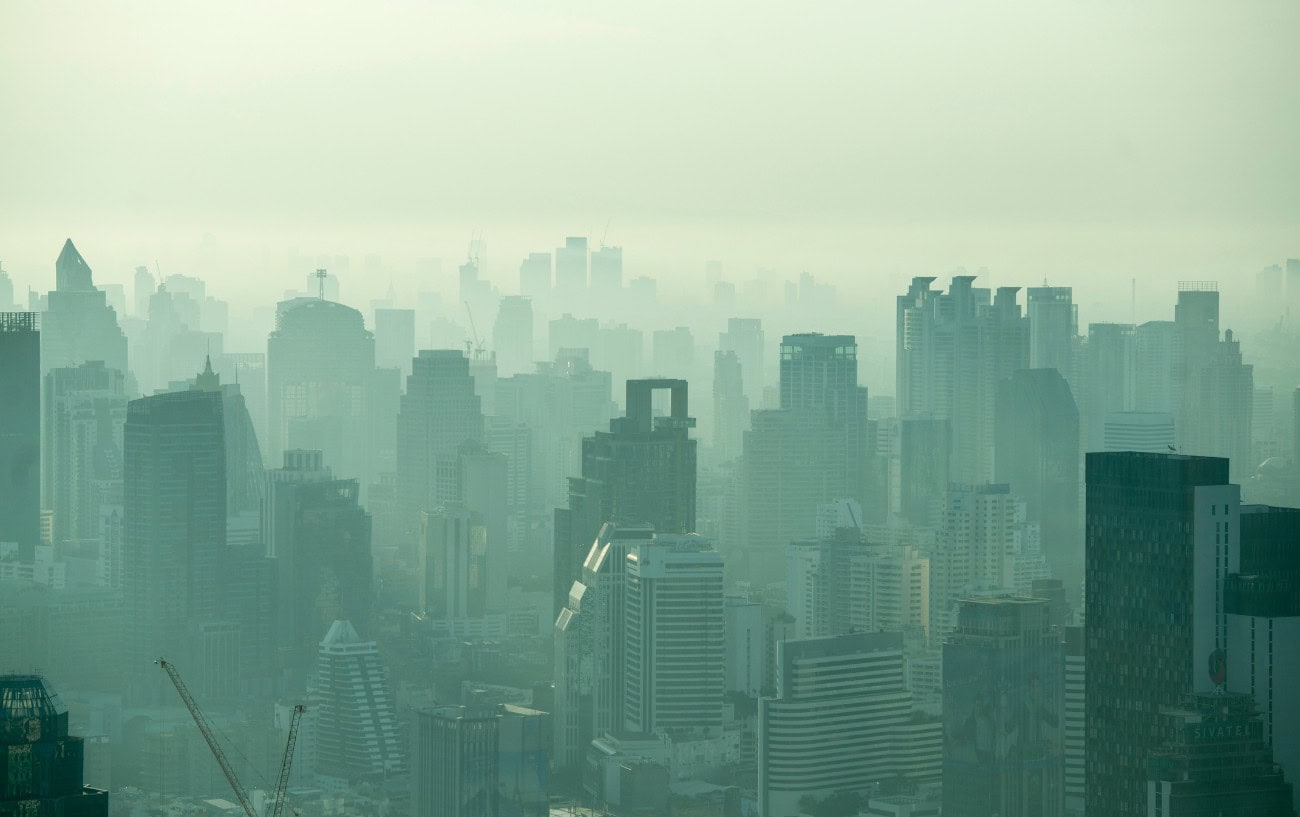
Air pollution is easy to ignore because the workout still feels like a workout. You can’t “see” what the air is doing to your lungs.
Ozone may be especially relevant to endurance athletes because the inhaled dose rises as we breathe more. The harder you exercise, the more air—and potentially more pollutant—you move through your respiratory system.
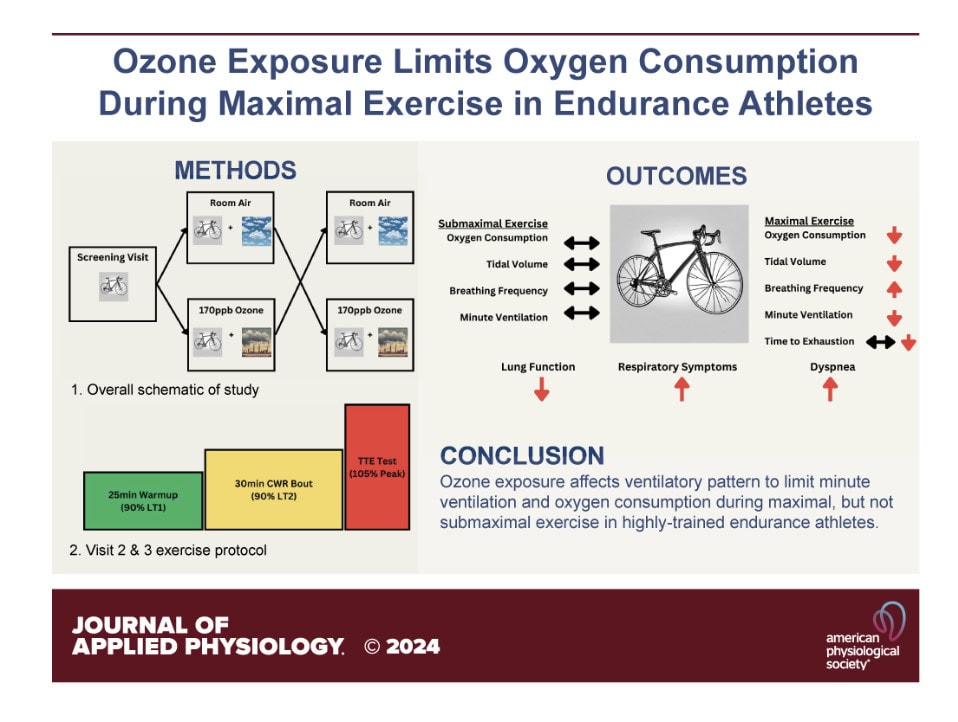
In a new study, researchers recruited 20 highly trained endurance athletes. The athletes completed the same cycling protocol while breathing either room air containing less than 10 parts per billion of ozone or air containing 170 parts per billion, a deliberately high but possible real-world concentration.1Harris, O. D., Gonçalves, P. E. O., Hung, A., Stothers, B., Bougault, V., Sheel, A. W., & Koehle, M. S. (2024). Ozone exposure limits cardiorespiratory function during maximal cycling exercise in endurance athletes. Journal of Applied Physiology, 136(6), 1507–1515. https://doi.org/10.1152/japplphysiol.00085.2024
The protocol included 25 minutes near the first lactate threshold, followed by 30 minutes near the second lactate threshold, and then a time-to-exhaustion test at 105% of peak power.
- During the two submaximal bouts (at LT2 and LT2), ozone did not meaningfully alter oxygen consumption, heart rate, or the other major metabolic measures.
- The clearest differences appeared at maximal exercise. Oxygen consumption at the end of maximal exercise was approximately 3.2% lower with ozone: 58.97 versus 60.92 mL/kg/min.
- Tidal volume and ventilation were also lower, while lung function and respiratory symptoms worsened.
- Athletes reported more chest tightness, breathing discomfort, and fatigue after exercising in ozone.
- Time to exhaustion averaged 209 seconds with ozone and 235 seconds in room air.
What this means for runners
The harder the session, the more attention I would pay to a high-ozone forecast. If ozone (or other pollutant) is unusually elevated, moving intervals or a maximal test to cleaner air—or shifting the session to another time—is a reasonable way to protect workout quality.
This does not mean every run in imperfect air is harmful or unproductive. In this experiment, the metabolic effects were minimal during submaximal work and became clearer at maximal intensity. Session intensity, exposure duration, and pollutant concentration all matter.
References
RunClub — Free
Join 300,000+ runners in RunClub
Free training plans for every distance, a daily running game, exclusive coaching content, and a real community of runners. Create your free account in 20 seconds — no card.
Already a member? Log in →








Start the conversation