


The “should I run on my period?” question is one of the most-searched, least-honestly-answered topics in women’s running. Most published advice oscillates between “no big deal, just run normally” and “rest, take it easy.” The exercise-physiology and menstrual-cycle research is more specific than that — and it’s genuinely useful for runners who want to make smart training and racing decisions across their cycle.
The Honest Truth: How Your Cycle Actually Affects Running
The data on menstrual-cycle effects on running performance is messier than the “track-your-cycle” apps suggest, but the meta-analyses now point to a clear shape. Performance varies modestly across the cycle, individual variation is enormous, and the practical decision-making rules below are what actually matter.
1. Performance variation is real but small (and individual)
The 2020 McNulty et al. meta-analysis pooled 78 studies on menstrual cycle and exercise performance, finding a small but real performance reduction during the early follicular phase (early period) of around 1–3% — but with very wide individual variation that the population-level meta-analysis hides1McNulty KL, Elliott-Sale KJ, Dolan E, et al. The effects of menstrual cycle phase on exercise performance in eumenorrheic women: A systematic review and meta-analysis. Sports Medicine. 2020;50(10):1813–1827.. Some women feel meaningfully slower in the first 2–3 days of their period; others notice no difference. Track your own cycle for 2–3 months before assuming the population data applies.
2. Cramps + bloating: real workarounds
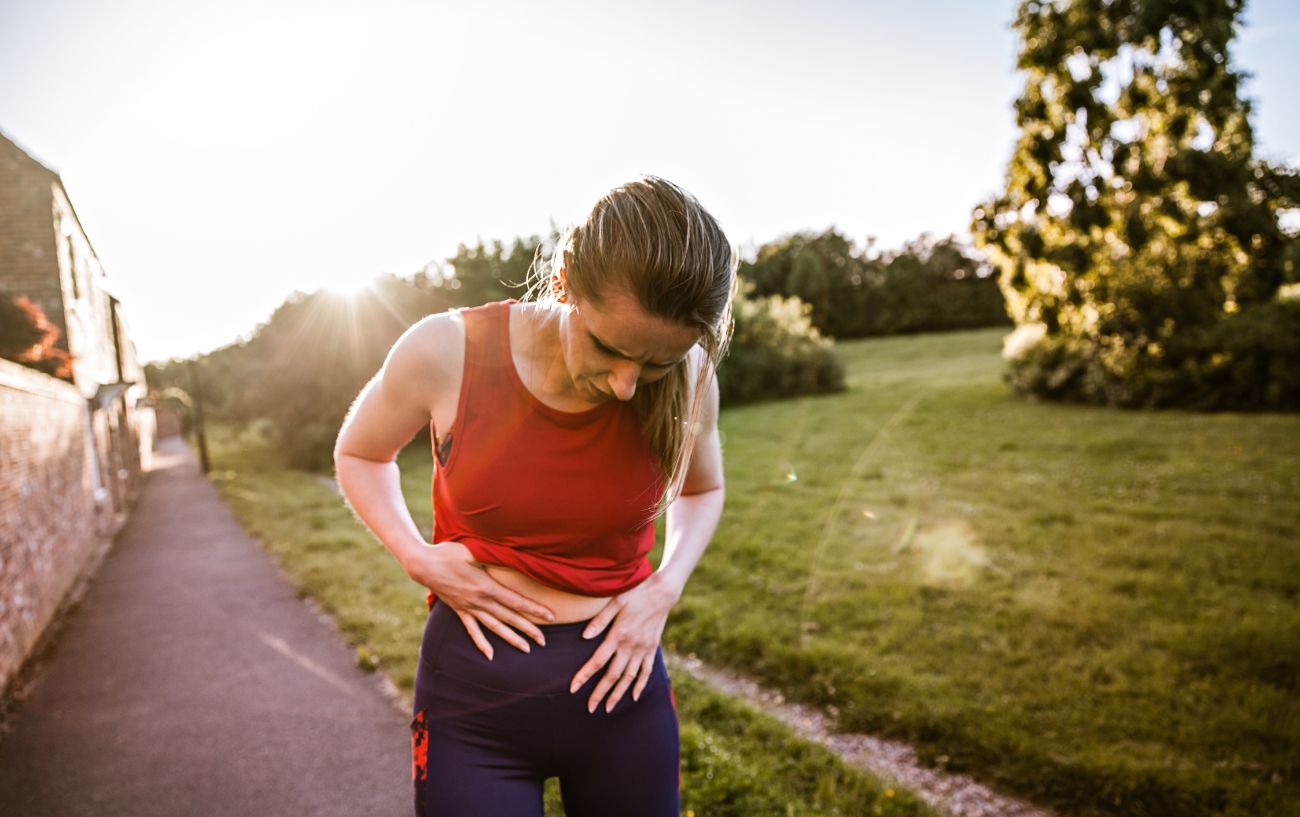
The cramp + bloating mechanism is prostaglandin-mediated uterine contraction. Light running paradoxically helps for many women — endorphin release blunts cramp pain, and the increased blood flow tends to reduce bloating. NSAIDs (ibuprofen 200–400 mg) taken 30 minutes before a run can meaningfully reduce cramp interference if you tolerate them. The runners who feel awful during the first 24–48 hours of period and skip the run rarely regret it; the runners who push through often report feeling better afterwards. Read your own body, don’t apply universal rules.
3. Iron loss + period: female-runner-specific anemia risk
Female distance runners are at meaningfully elevated iron-deficiency risk because of two compounding losses: menstrual blood loss + foot-strike haemolysis from running impacts2Sim M, Garvican-Lewis LA, Cox GR, et al. Iron considerations for the athlete: A narrative review. European Journal of Applied Physiology. 2019;119(7):1463–1478.. The combination produces ferritin levels below the symptomatic threshold (~30 ng/mL) in 30–50% of female endurance runners. If you’re running well during weeks 1–3 of your cycle and noticeably worse in week 4, ferritin testing should be near the top of your list — not training adjustments.
4. Cycle-tracking apps and what to do with them
Apps like Wild.AI, FitrWoman, and Clue are useful for the same reason a training log is — they show you patterns over months, not magical individual predictions. The most actionable use: log perceived exertion + sleep quality + race-day performance against cycle phase for 2–3 months. Some women see strong patterns (consistently slower early follicular, stronger luteal); others see none. Decide based on your data, not the app’s default suggestions.
5. Period-overlap race-day kit
Race-day overlap with your period is going to happen — there’s no value in trying to manipulate cycle timing for goal races. The kit options have improved significantly: period-brief running shorts (Modibodi, Knix, Saalt) handle light-to-medium flow; menstrual cups (DivaCup, Saalt Cup) handle heavy flow without leaks during running better than tampons; combination of both for marathon-distance races. Practise both options on long training runs before race day, exactly as you’d practise nutrition.
Frequently Asked Questions
Should I rest on my period?
Only if your body says so. The literature is clear that running on your period is safe and often helpful. Many women feel better after a light easy run during day 1–2 because of endorphin release. If pain is severe, sleep is poor, and energy is depleted, taking 1–2 easy days is sensible — not because of risk but because you’ll get more from training when you feel ok.
Will running mess up my cycle?
Recreational training volume doesn’t. Heavy training combined with low energy availability does — that’s the RED-S syndrome (relative energy deficiency in sport). If your cycles become irregular or stop entirely while training hard, the issue is almost always under-eating relative to training load, not running itself. See our RED-S guide for the framework.
Should I race on my period?
If your goal race overlaps with your period: race anyway. Olympic medals have been won on day 1 of a period. The performance hit at the population level is small, individual variation is enormous, and the kit options now handle the practical issues. Don’t reschedule a year of training around a 24-hour cycle phase you can’t control.
Are tampons or menstrual cups better for running?
For most runners on heavier flow: menstrual cups. Cups hold 3× more than tampons, don’t shift during running, and don’t need bathroom changes mid-marathon. For lighter flow or as a backup: tampons + period-brief shorts. Period-brief shorts alone work for light-to-medium flow on shorter runs but typically not for marathon distance.
Why is my running so much harder right before my period?
The late luteal phase (days 22–28 of a 28-day cycle) features high progesterone, modest oestrogen, and pre-menstrual symptoms — bloating, fluid retention, fatigue, mood changes. Many women experience their hardest training week of the month here. Treat this as expected and adjust intensity if needed; don’t treat it as a fitness regression.
Related Marathon Handbook Hubs
- Female Runners Body
- Relative Energy Deficiency in Sport (RED-S)
- Menopause and Running
- Running While Pregnant
- Running Postpartum
References
RunClub — Free
Join 300,000+ runners in RunClub
Free training plans for every distance, a daily running game, exclusive coaching content, and a real community of runners. Create your free account in 20 seconds — no card.
Already a member? Log in →





Start the conversation