


Snapshot
In 1954, Roger Bannister broke the four-minute mile, proving the impossible was just a limit waiting to be pushed. Now, seven decades later, we might be on the cusp of another historic breakthrough: a woman running sub-four.
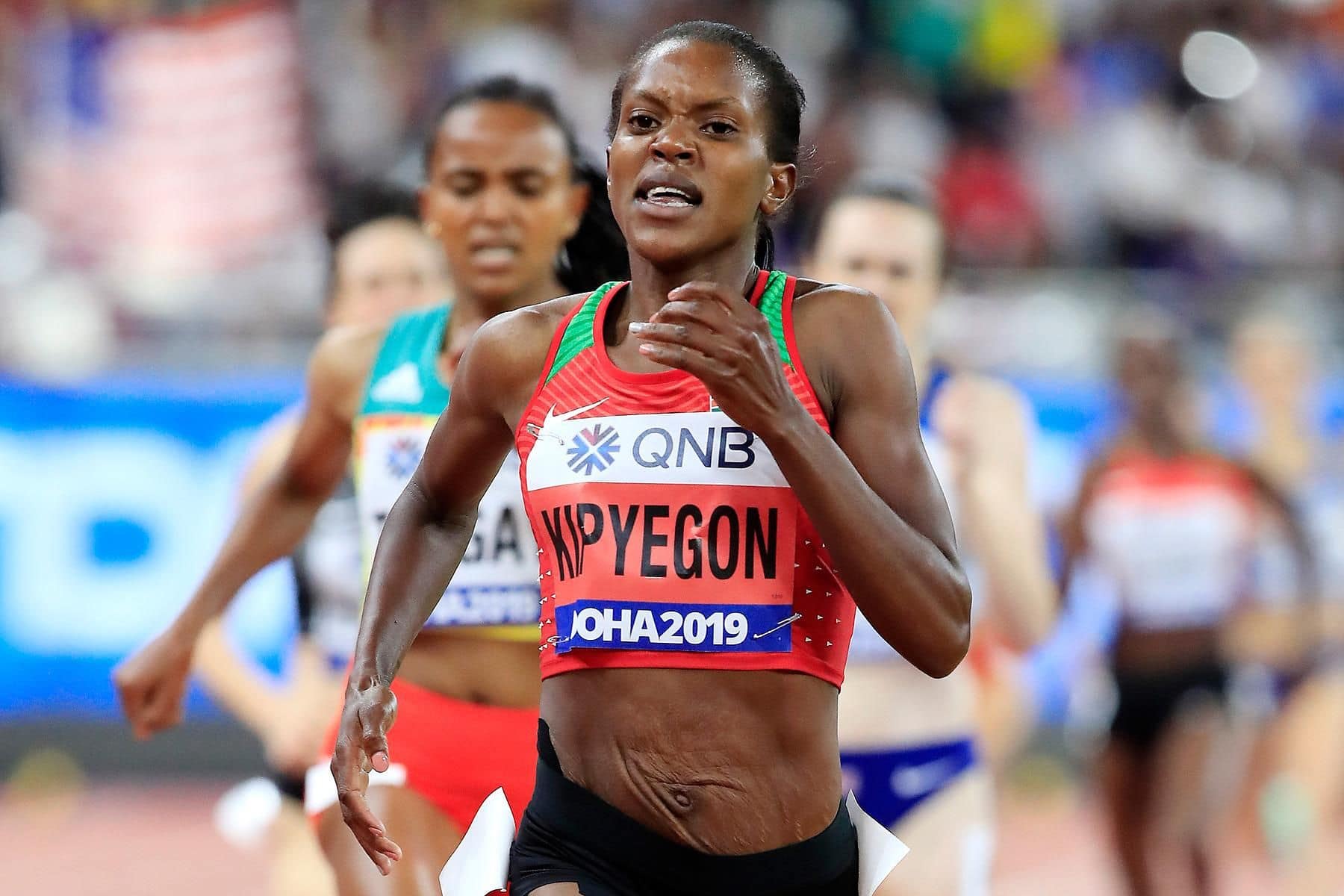
And if there’s anyone who can do it, it’s Faith Kipyegon, according to recent research.
The Kenyan Olympian isn’t just fast—she’s redefining what we thought was possible in women’s athletics. In 2023, she obliterated the women’s mile world record, clocking 4:07.64, just seven seconds off the magic number.
Now, a new study published in Royal Society Open Science suggests that with ideal conditions—namely, strategic drafting—she could realistically hit 3:59.37.
Key Facts
- Study findings: With pacers positioned in front and behind, Kipyegon would reduce air resistance, similar to how cyclists and race cars draft for efficiency.
- Historical precedent: The same principle helped Eliud Kipchoge break the two-hour marathon barrier in the INEOS 1:59 Challenge.
- Drafting effectiveness: Research suggests proper pacing formations could reduce air resistance by up to 76%, translating to a faster time.
- Projected time: With optimized drafting, Kipyegon could potentially clock 3:59.37, equaling Bannister’s legendary time from 1954.

Crucial Quotes
- Shalaya Kipp, co-author of the study: “We found that if everything went right, under a couple of different drafting scenarios, she could break the four-minute barrier.”
- Rodger Kram, a University of Colorado Boulder physiology professor who studies the limits of human endurance and another co-author: “A lot of people said it was physiologically impossible for Bannister or anybody to break four minutes, and I’m sure lots of bros are going to say, ‘No way a woman is ever going to run four minutes; it’s seven seconds away.’ But people have said women can’t do a lot of things, and then they have.”
- Faith Kipyegon: “I appreciate people taking my world record performance as an inspiration to imagine what could be possible in the future.”
- Edson Soares da Silva, lead author of the study: “Anyone from top elite to lower-level runners can benefit from adopting the optimal drafting formation for as much of their race as they can.”
Big Picture
If Kipyegon succeeds, she would shatter one of the last remaining barriers in distance running.
It’s a moment that mirrors Bannister’s achievement—when breaking the four-minute mile was once thought to be beyond the limits of human physiology. Now, we’re having the same conversation about women.
The study’s findings suggest it’s not a matter of if, but when a woman breaks the barrier. The key will be creating the right conditions—similar to how Kipchoge’s INEOS 1:59 event was meticulously planned, down to the pacers, course and shoe technology.
That leads us to Nike.
The sportswear giant is in desperate need of a win right now. Despite being the undisputed king of running for decades, Nike is stumbling.
In 2024, its revenue barely grew, and by early 2025, sales dropped 10% in a single quarter. With longtime CEO John Donahoe stepping down and Nike veteran Elliott Hill taking over, the company is refocusing on performance sports over fashion trends.
A Nike-backed “Breaking4” project featuring Faith Kipyegon could be the perfect move—a way to reclaim dominance in running, generate global buzz and create another iconic moment in sports history.
By the Numbers
- 4:07.64 – Current women’s mile world record, set by Kipyegon in 2023.
- 3:59.37 – Projected time Kipyegon could hit with optimal drafting.
- 76% – Potential reduction in air resistance through strategic pacing formations.
- 2% – The percentage of Kipyegon’s body weight accounted for by aerodynamic drag at 4-minute mile pace.
- 12% – The amount of energy saved if air resistance were completely eliminated.
- 3% – The margin separating Kipyegon’s record from a sub-4 mile, the same percentage that separated Kipchoge from a sub-two-hour marathon before INEOS 1:59.
Key Background
Women were banned from competing in the Olympic 1,500m until 1972—for decades, people wrongly believed women weren’t capable of running longer distances at a high level.
Diane Leather was the first woman to break five minutes in the mile (4:59.6) just 23 days after Bannister’s four-minute mile, but it didn’t receive the same recognition.
Paula Radcliffe’s marathon record (2:15:25 in 2003) was another major moment in shattering misconceptions about women’s endurance abilities. But the current world record in the marathon, set by Kenya’s Ruth Cheptngetich last fall at 2:09:56, was met with skepticism, in part due to rampant doping problems in her native country.
Running is currently grappling with a trust issue.
Enter Faith Kipyegon. She appears to be built for this moment.
Raised in Kenya’s Rift Valley, she’s a very familiar face on the track, and has been a dominant force in middle-distance running for over a decade.
Her credentials speak for themselves:
- Three-time Olympic gold medalist (2016, 2020, 2024)
- Four-time world champion
- World record holder in the mile, 1,500 meters and 5,000 meters
And she isn’t slowing down.
She’s also a long-time Nike athlete, and the company has a track record of creating big moments that attract attention and engender trust. She could become the next Kipchoge at a time when the sport desperately needs a new trust agent.

What’s Next
The biggest obstacle? World Athletics regulations.
Just like Kipchoge’s sub-two-hour marathon, a sub-four women’s mile with rotating pacers wouldn’t qualify as an official world record—it would be considered “assisted.”
However, it would still be a groundbreaking moment, proving that the barrier can be broken.
A controlled event, backed by Nike, featuring top-tier pacers and leveraging cutting-edge shoe technology, could be the ideal setting for this historic feat.
Kipyegon has remained open to the idea but hasn’t formally announced an attempt yet.
Worth Watching
If Nike pulls the trigger on a Breaking4 project, it could:
- Elevate Kipyegon into an even greater global icon.
- Redefine the limits of female distance running.
- Help Nike reassert itself as the leader in running innovation.
Breaking the four-minute mile for women is no longer a fantasy—it’s a question of timing.
With Kipyegon’s talent and Nike’s ability to manufacture moments, a woman running a sub-four mile doesn’t just feel possible.
It feels inevitable.
RunClub
Get more running stories — join RunClub
Daily running news, a community of 300,000+ runners, free training plans for every distance, and a daily running game. Free to join — no card.
Already a member? Log in →









Start the conversation