


Tracksmith launched in 2014 on a premise no running brand had seriously tested: that runners would pay premium prices for gear built around the culture and history of the sport rather than around technology claims. The premise came from cycling. Co-founder Luke Scheybeler had earlier co-founded Rapha, the brand that proved cyclists would pay more for a cultural signal, and Tracksmith was oft referred to as the Rapha of running from its inception. The comparison now carries a warning, because Rapha, for all its influence on cycling, never made the sport’s hardware. Instead, it stayed in its smaller lane, continuing to sell the clothing while other companies sold the bikes.
Tracksmith followed the Rapha model for a decade. But in 2023, the running brand attempted the step its own predecessor in cycling never took: making the hardware.
The premise held, and it inspired a generation of successors: Bandit, Satisfy, Rabbit, Norda, Mount to Coast and others each built a business on some version of the Rapha/Tracksmith model, and several of them now sell running shoes as well. The niche Tracksmith created has become a crowded market, and the company no longer stands out in it simply by being first.
Something else has shifted in the past couple of years: a turn against the brand itself. Tracksmith has not changed what it does, but the reception has cooled, and there is research on why this happens. Consumers who use products as identity signals abandon them when the signal spreads too far, not because the product got worse (in fact, its fair to say Tracksmith’s products have continued to improve) but because it stopped marking them as different. Ten years in, the sash singlet no longer marks an insider. It marks a recognizable type, the older millennial with a marathon PR and disposable income, and the younger crowd has moved on to the newer names on that list, Satisfy, District Vision, and above all Bandit. Tracksmith did not cause this and cannot reverse it by standing still, which is one more reason the company is now reaching for new customers through new categories and new shop walls.
Tracksmith appears to understand this. Within the past year it handed the chief executive job from founder Matt Taylor to Jared Carver, who previously ran Converse, with Taylor sliding over to a new role as chief creative officer. The company has also changed how it sells. For its first decade, Tracksmith sold almost entirely direct to consumer: if you wanted its gear, you bought it from the company’s website or its Boston storefront, sight unseen for most of the country. Now the brand is placing its products in running specialty shops nationwide, where a runner can pick a Ryder off the wall, feel the stitching, and try it on next to a Nike or a Saucony. Carver’s first two tasks follow from those decisions. He needs to get Tracksmith into those shops across the United States, and he needs to convince the buyers and the runners browsing the walls that Tracksmith can make performance running shoes. The Eliot Ryder, a $220 max-cushion super trainer arriving this summer, is the product that will test both.
The most expensive way to make a shoe
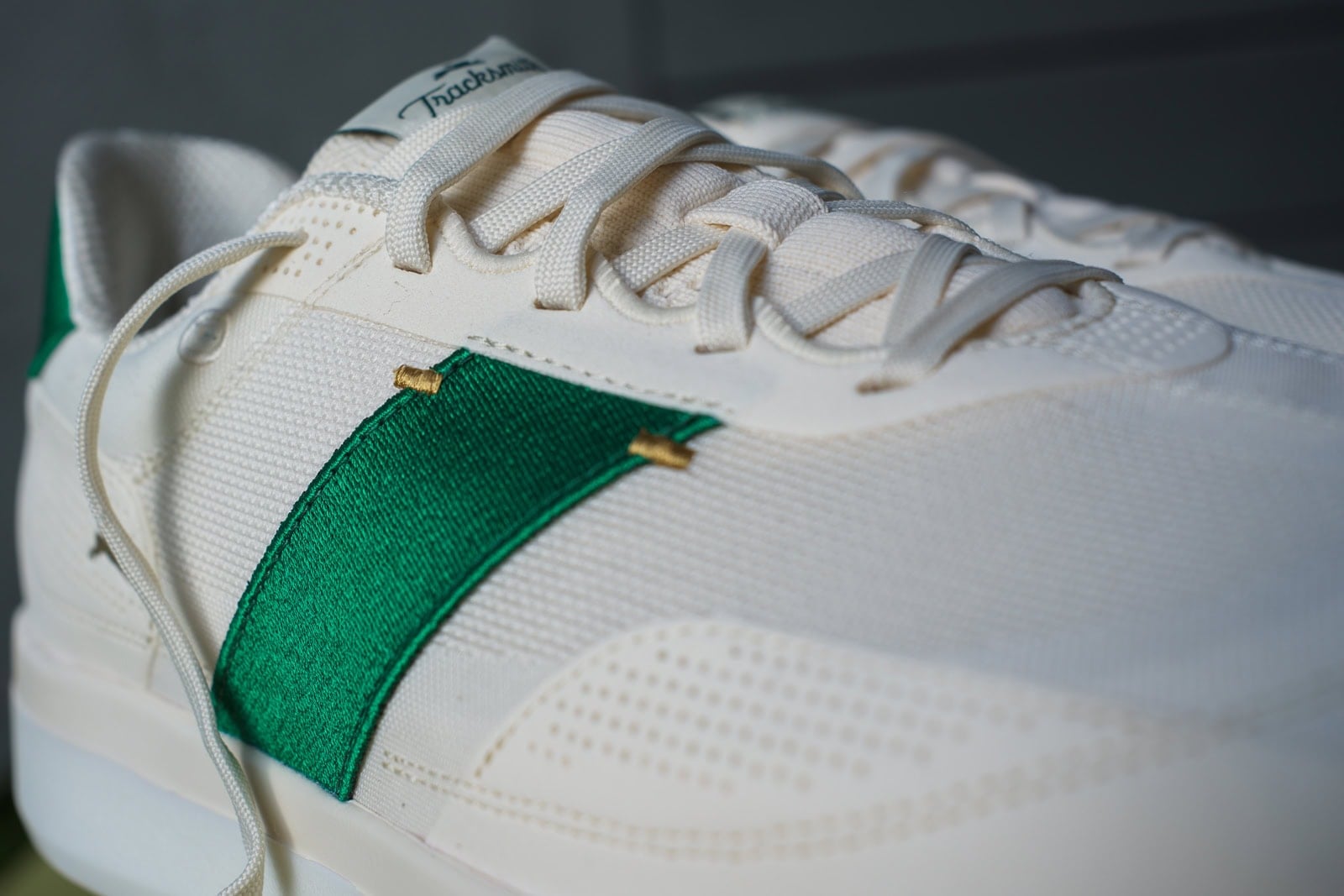
The Ryder does not look like the rest of its category. Max-cushion trainers tend toward sculpted sidewalls and large branding, and Tracksmith’s pitch for the Ryder, max cushion “without the aesthetic baggage,” is a direct comment on that convention. The shoe could pass for a lifestyle sneaker from a fashion house at three times the price, yet the spec sheet describes a training tool: 45 mm of stack at the heel, 37.5 mm at the forefoot, a 7.5 mm drop, and a claimed 9.5 oz, which my scale confirms. That weight is low for a shoe with this much material in it.
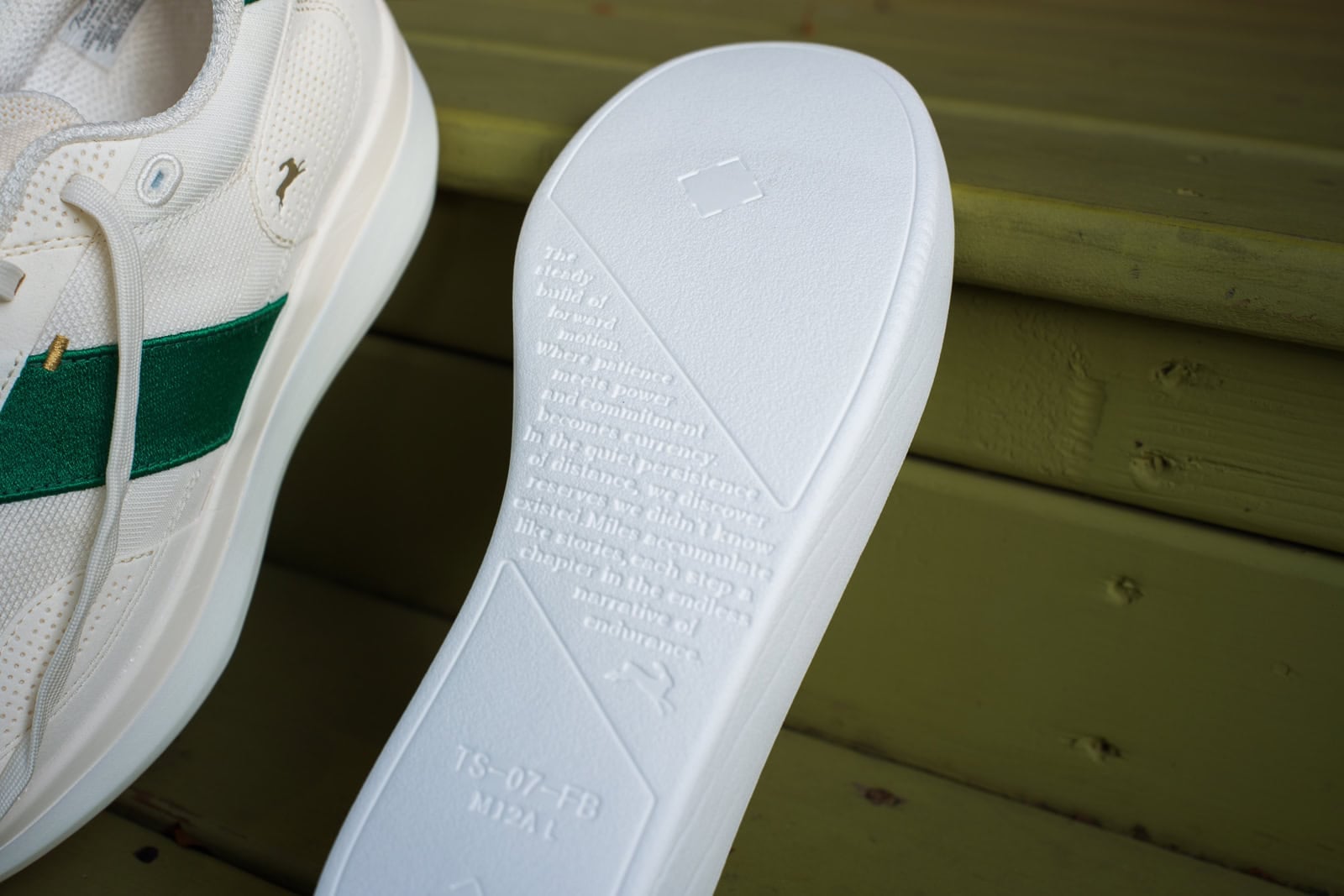
The construction is worth describing in detail. The top eyelets are stitched. The Tracksmith sash on the sidewall and the accent around the heel cup are stitched and woven, where most brands would use a printed synthetic overlay. Suede reinforces the wear points instead of a cheaper poly material. Nothing on the shoe is heat pressed or glued on. There is detailed top stitching throughout, a gold hare logo, a cream-and-red tab at the heel, a knit tongue, and a full gum rubber outsole. The tag on the underside of the tongue reads “Designed in Boston to meet the rigorous demands of runners everywhere.” Each of these choices costs money and slows production, which is why other brands avoid them. No one else in running footwear is currently building to this level of finish.
“Nothing on the shoe is heat pressed or glued on. No one else in running footwear is currently building to this level of finish.”
Taylor may have given up the CEO title, but as chief creative officer he still directs the brand’s identity and creative output, and the Ryder shows it. This is the most Tracksmith shoe the company has made.
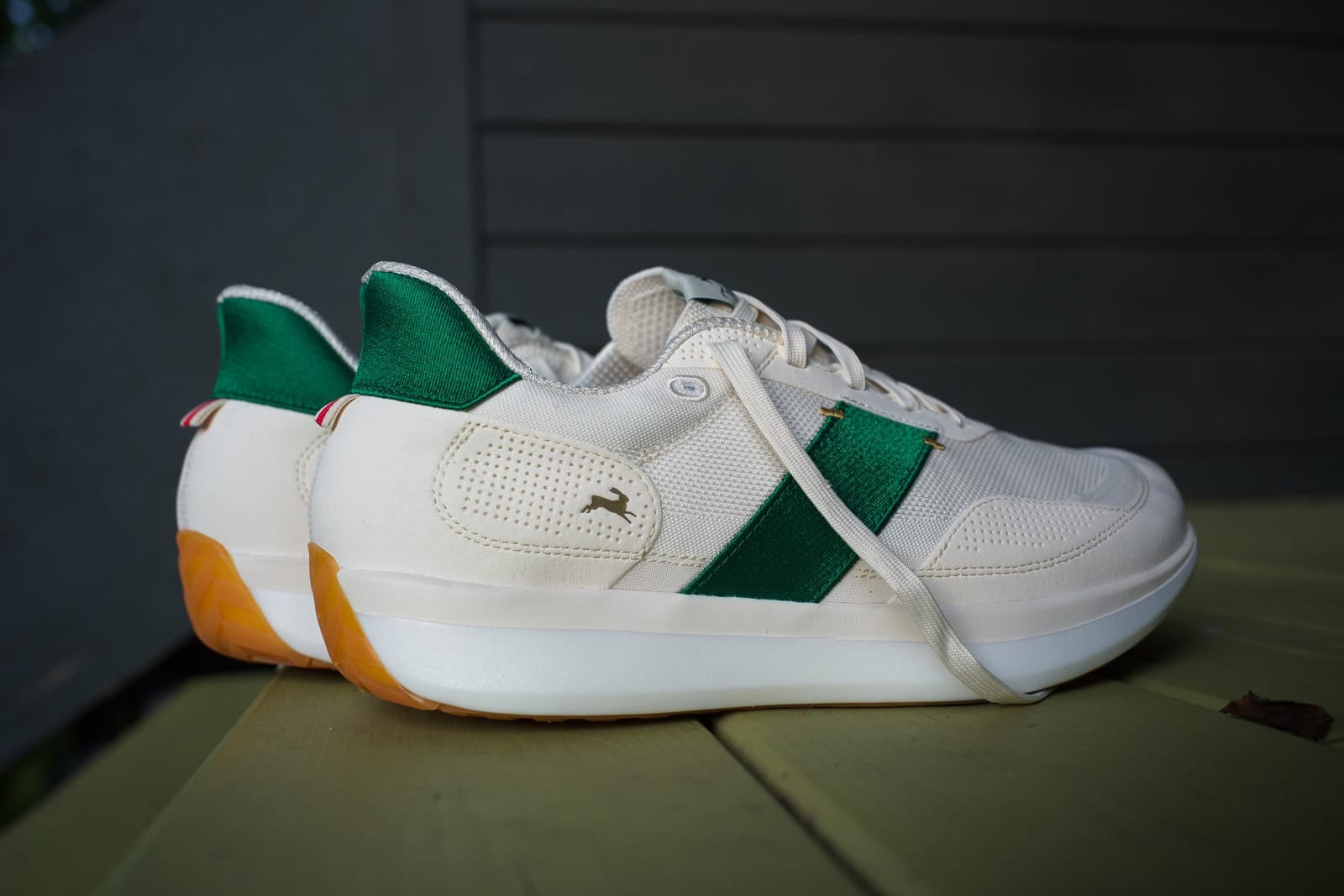
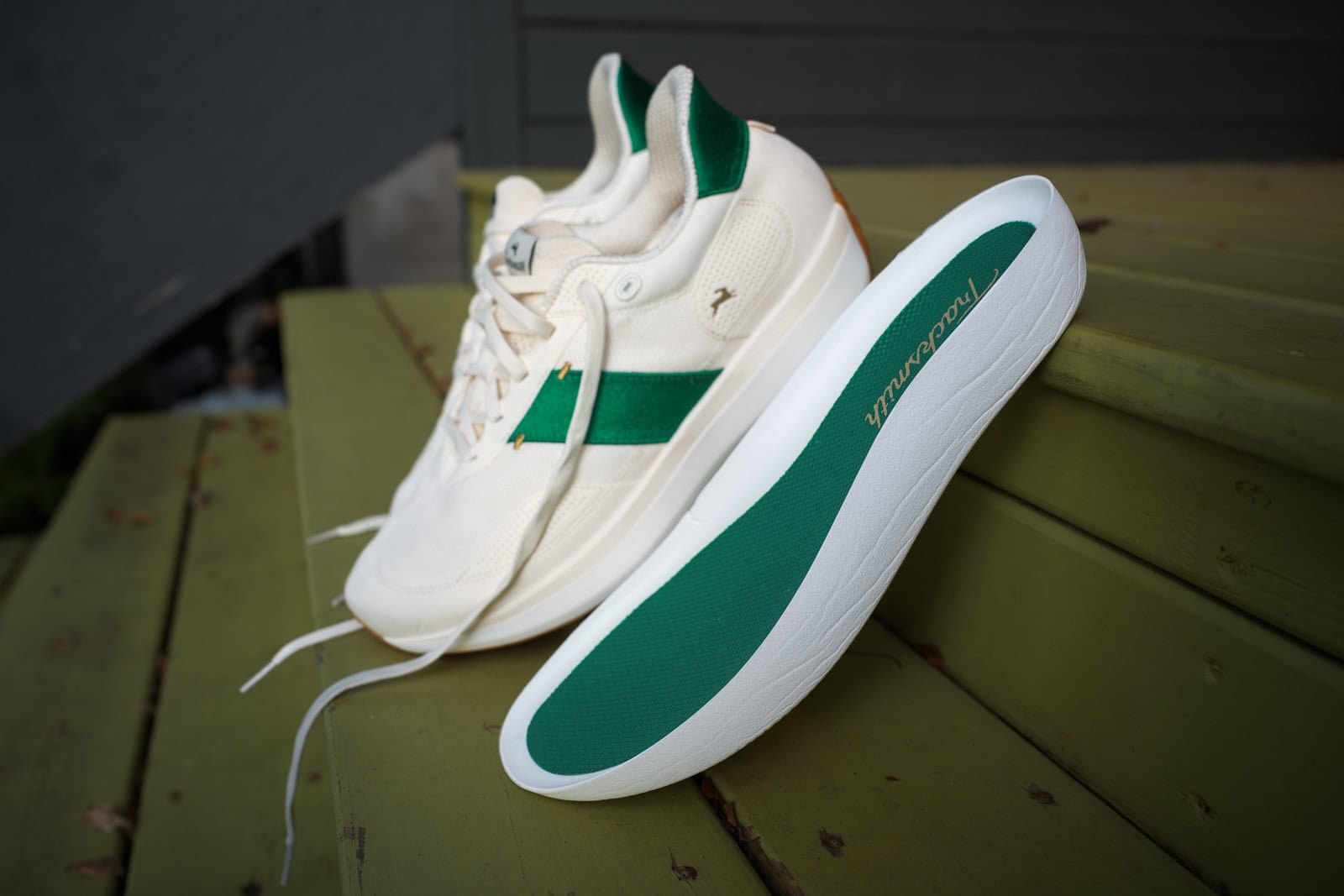
The foam choices run in the same direction. The Ryder’s central feature is a 25 mm drop-in midsole, one of the largest in running: a slab of supercritical ATPU that sits inside the upper, on top of a Pebax foundation in the footbed. The split between those two materials matters. PEBA costs several times more than other midsole polymers, and a senior foam developer at a major shoe brand recently told me that PEBA is still the superior material, but that brands have been experimenting with ATPU and TPEE because they cost much less to buy in bulk. Tracksmith put the cheaper polymer in the replaceable slab, the part designed to degrade and be swapped out, and the more expensive Pebax in the permanent foundation. That is a defensible way to allocate cost, and the two-part construction raises the manufacturing bill on its own. I am not sure consumers will notice or reward any of this. I hope they do.
The closest comparison I can offer comes from cameras, where I have spent my own money on both sides of the question. I should disclose up front that the photographs of the Ryder accompanying this review were taken on a Hasselblad, a camera whose construction, and whose images straight out of the body, I can only describe as satisfying, so you know which side I fall on. I have owned Leicas, and I have owned the Canons and Nikons that were the working standard, a role that now belongs to Sony. The professional on deadline shoots the Sony, because it does more, faster, for less money. A Leica does less on paper, costs three times as much, and is assembled by hand from materials chosen to last decades. Nobody who buys one is confused about the tradeoff. Whether the finer construction justifies the price is a personal decision, and Leica has outlived a century of better-specced competitors because enough people keep deciding it does. Tracksmith is betting that some portion of runners will make the same decision about a shoe.
I should also say, from my own years with one, the part of the Leica argument that spec sheets cannot settle: it takes a better picture. Some of that is engineering, above all the lenses. But some of it is what the camera does to the person holding it, and sports science has documented the effect. Athletes who believe in their equipment measurably outperform athletes who do not, a placebo effect that holds up even when the gear is identical, and psychologists have found the same thing with clothing, where wearing something you associate with competence changes how you perform. They call it enclothed cognition. I shot more, and more carefully, with a Leica in my bag. The same mechanism applies to a running shoe you are excited to lace up on a gray Tuesday in February. Anticipation gets you out the door, confidence changes the quality of the session, and neither shows up in the stack height or the weight. If the Ryder makes a runner feel the way the Leica made me feel, that is not a trick of marketing. It is part of what the shoe does.
The record so far

Tracksmith’s footwear history explains why that bet is not safe. The Eliot Runner, the 2023 debut, was a quiet disaster as a running shoe: an everyday trainer that no one actually wanted to train in. It looked sharp, which let it pivot into what it probably was all along, a lifestyle walking shoe, but it set the company back as a credible shoemaker.
The Eliot Racer recovered some of that ground. The rollout was clever, timed to the 2024 US Olympic Marathon Trials, and the shoe is legitimately good, a strong super shoe from an independent brand, which is hard to do. It is an enjoyable, quick shoe, and it looks better than anything else on a start line. The problem was the market it entered. A super shoe asks a runner to commit, before race day, to a shoe they will never meaningfully test in advance, and to trust it for a performance gain of roughly 4% over a daily trainer. Runners in that position default to shoes with proven records, and a good shoe from a small brand struggles to get picked when the stakes are highest. I admire the Racer, and when my goal marathon comes around I still do not reach for it. Its drop-in midsole also created a friction point in my testing and made the shoe noisy, a small flaw that counts double in a shoe asking for race-day trust. The fit repeated across the line: a touch narrow in the Racer, and narrow enough in the Runner and the Eliot Range trail shoe to rule them out for wider feet.

The Range, Tracksmith’s first trail shoe, arrived last fall to the harshest reception of the three. The hardcore trail community was extremely critical of the shoe and of the trail capsule around it, and some of the criticism landed. It is an odd trail shoe, firm and quite narrow, and at $240 it handed the skeptics an easy argument. But I have worn the full trail lineup, and the apparel is excellent. Several pieces have become my go-to gear for winter running in a Canadian climate. My read is that the loudest criticism said more about the insecurity of trail purists watching a decidedly road and track brand wander into the forest and make boutique, pricey trail gear than it said about the gear itself.
In retrospect, the Ryder is probably the shoe Tracksmith should have launched with. The super trainer category fits the brand without translation: performance, some visible engineering, and identity-based style. A super trainer on your feet signals that you are a dyed-in-the-wool running nerd, and Tracksmith apparel signals the same thing. The category is also more forgiving than the ones Tracksmith chose first. It is full of eccentric designs and cult favorites, it tolerates personality, and a strong first effort there can build an audience.
“In retrospect, the Ryder is probably the shoe Tracksmith should have launched with.”
The case for doing less
The category’s recurring problem is overengineering. Many super trainers are built as detuned race shoes, with aggressive rockers and stiff plates, and end up too demanding for what the shoe is actually for: something to wear a couple of times a week that feels bouncier and livelier than a mileage pig like the Nike Vomero, the Asics Nimbus, or the Brooks Ghost. The Ryder has no plate, and I do not think a proper super trainer needs one. Plates belong in super shoes.
What the Ryder delivers instead is plush, an antiquated and much abused reviewer’s word that happens to be accurate here. There is a tenderness to the touchdown and the toe-off. The drop-in midsole works better than it did in the Racer, quieter and seated more securely in its chassis, though I still want to love the drop-in concept more than I do. The case for it is appealing in theory. Midsole foam degrades before the rest of a shoe does, especially a shoe built like this one, so a replaceable slab means a runner could buy a new insert, run a few hundred more miles on the same upper, and throw away less. It is an altruistic piece of design, and I doubt it will change anyone’s buying behavior in an industry organized around annual models and constant novelty. Tracksmith keeps making choices like this one, correct in principle and expensive in practice, and their fate depends on customers behaving differently than they currently do.
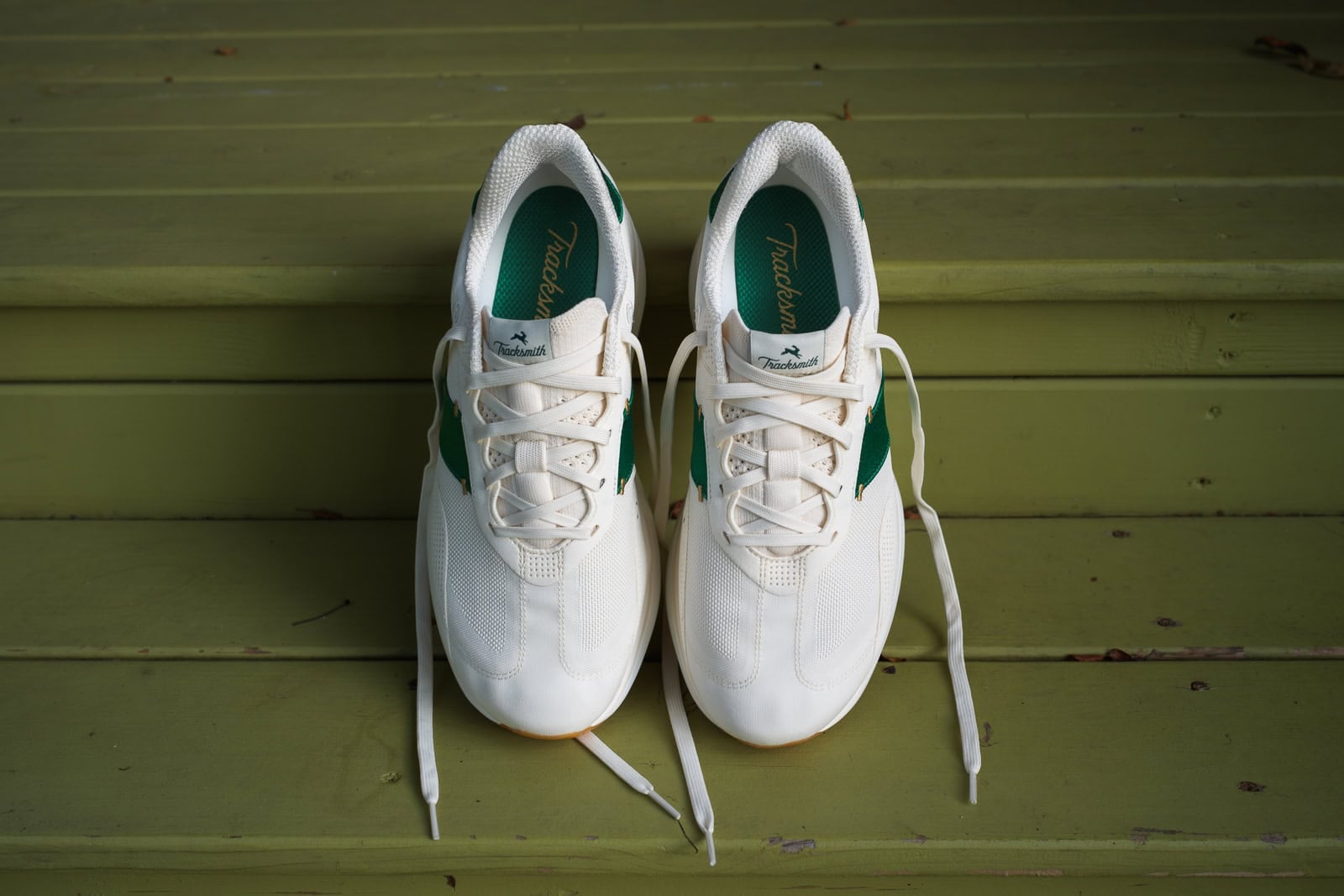
The toe box is the clearest sign that the company is adjusting. After three narrow shoes, the Ryder is generous up front, wide enough for the feet the earlier Eliots ruled out. That suggests the company is listening to feedback, and it lines up with the retail expansion, the trail entry, and the broader lineup. The product decisions and the business strategy now point in the same direction.
Durability is the one question I cannot answer yet. We will not know until we max the shoe out, but based on the construction and the materials, I expect it to wear well. I plan to find out, if I can bear to dirty up a shoe this good looking, and we will report back after a few hundred miles.
The current best answer
One shoe will not settle what Tracksmith is, but it adds evidence. If the Ryder succeeds, Tracksmith becomes more than the brand that started the indie running movement: it becomes a brand that can compete in that movement’s most crowded product category, and the Eliot Runner becomes a footnote. If it fails, the Runner starts to look like a pattern rather than an exception, at the exact moment Carver is asking run shops across the country to believe otherwise. Four shoes in, the record reads as one miss, one good shoe in an unforgiving market, one divisive trail experiment, and now the closest fit yet between the product and the brand that made it. For now, the Ryder is the best answer Tracksmith has given to the question of what it wants to be, and the first of its shoes I would hand to a skeptic.
Running. In Your Inbox, Daily.
Fun and informative running tips, news, hot takes, and shoe reviews — read by 345,000+ runners.
Send Me the Next NewsletterRunClub — Free
Join 300,000+ runners in RunClub
Free training plans for every distance, a daily running game, exclusive coaching content, and a real community of runners. Create your free account in 20 seconds — no card.
Already a member? Log in →



Join the conversation
Thank you for the article. Loved the review. I was an early adopter of Tracksmith, and still almost exclusively wear their running clothes. I am one of those early enthusiasts who is still rooting for Tracksmith. I love what they brought to the sport, and I want them to be around for another decade, and another one after that.
I purchased the first Eliot and it was definitely meh. The shoes are long gone, but I still have the shoe box where I keep all my race medals (even the box had exceptional construction). I really appreciated your observation that not everyone will go for the high design and the small details - I happen to be their target audience, as I will pay more for something that was well designed and executed with minimal shortcuts. I love that nothing is ironed on, I love the stitching and the woven panels, and the shoe laces are pretty amazing. I am a sucker for high end construction and finishes.
One question that comes up - I didn\'t see on Tracksmith\'s website where one can buy replacement cushion inserts. I love the idea of keeping the outer portion while I trade in the inner cushion. Any idea if this will be an option for sale, and how much will it cost? (Like I said, I am their target audience.)
Great article. Thank you.