


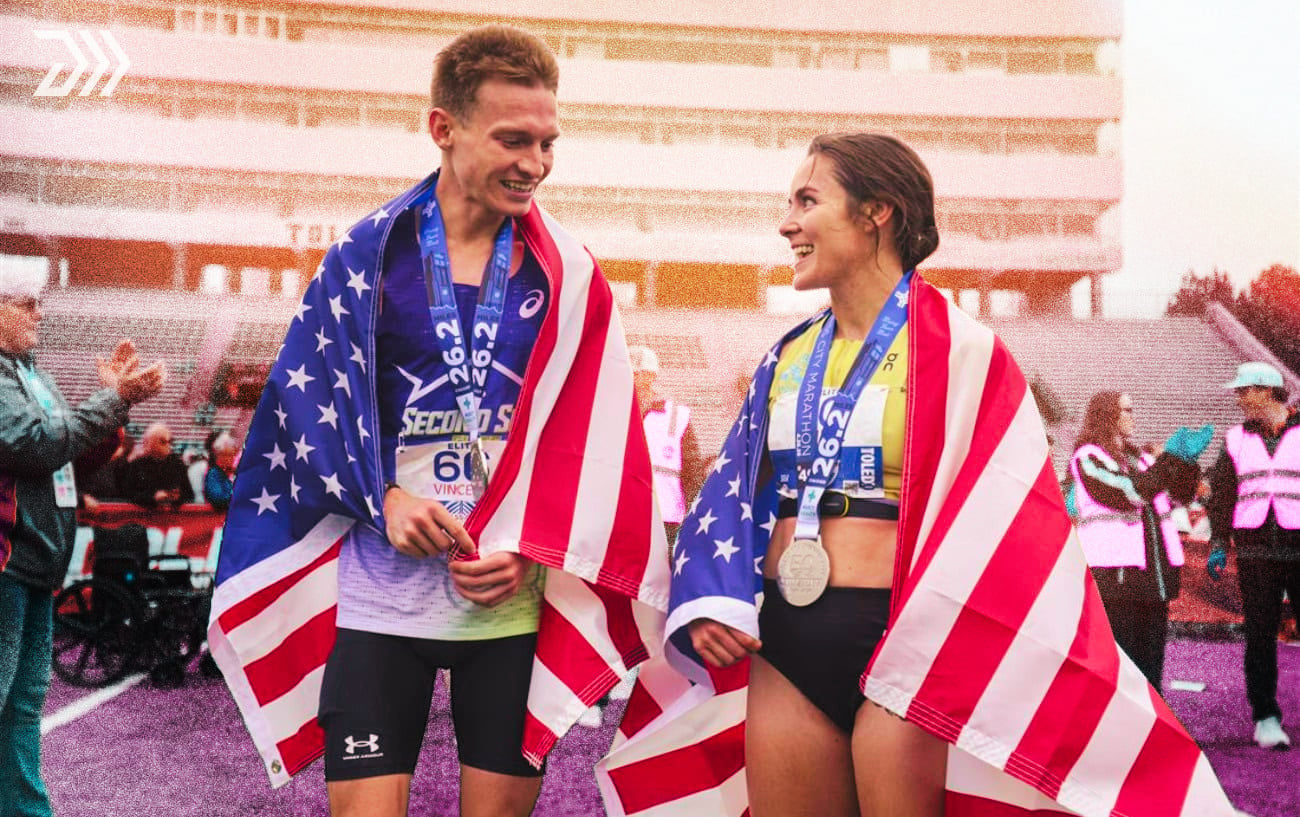
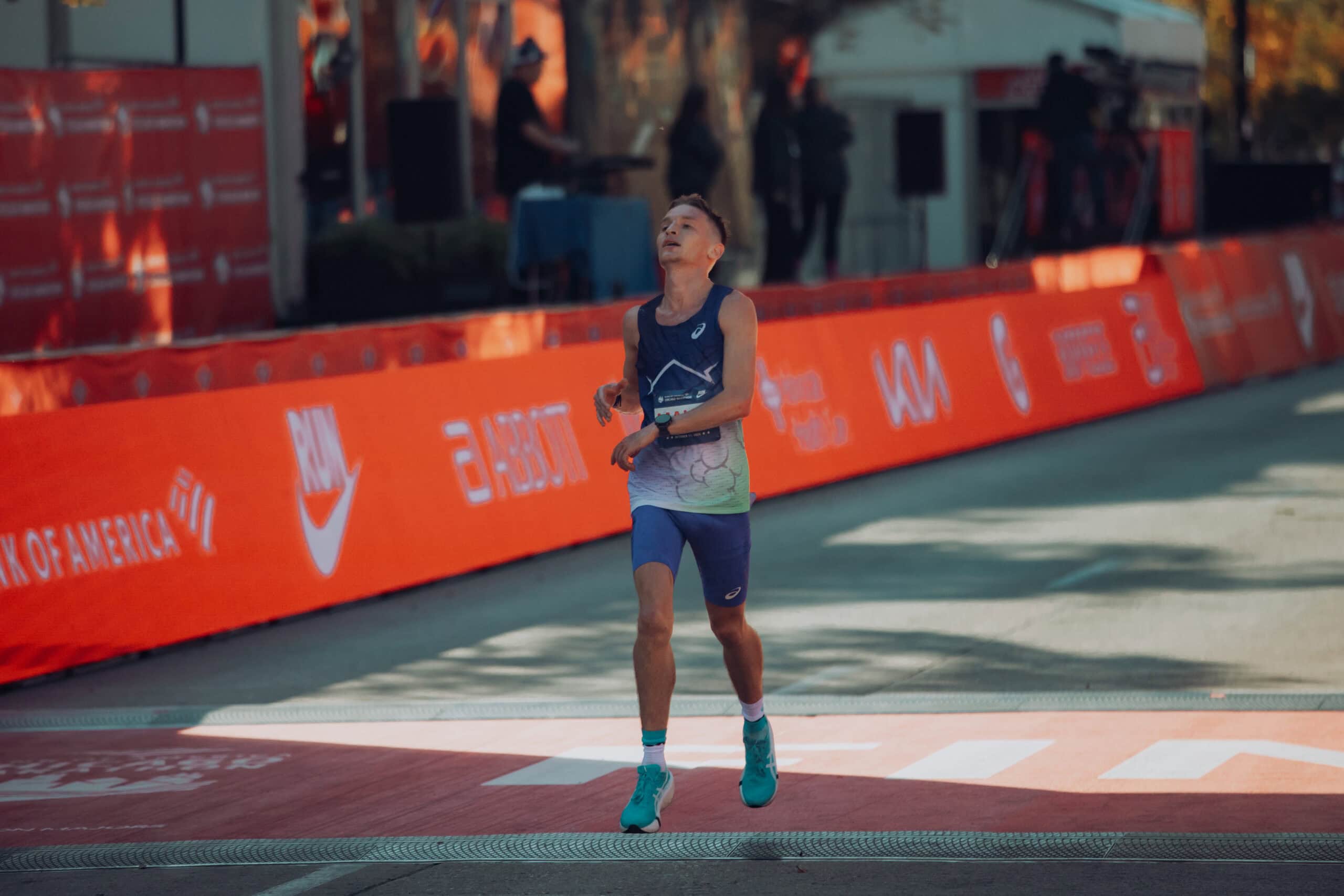
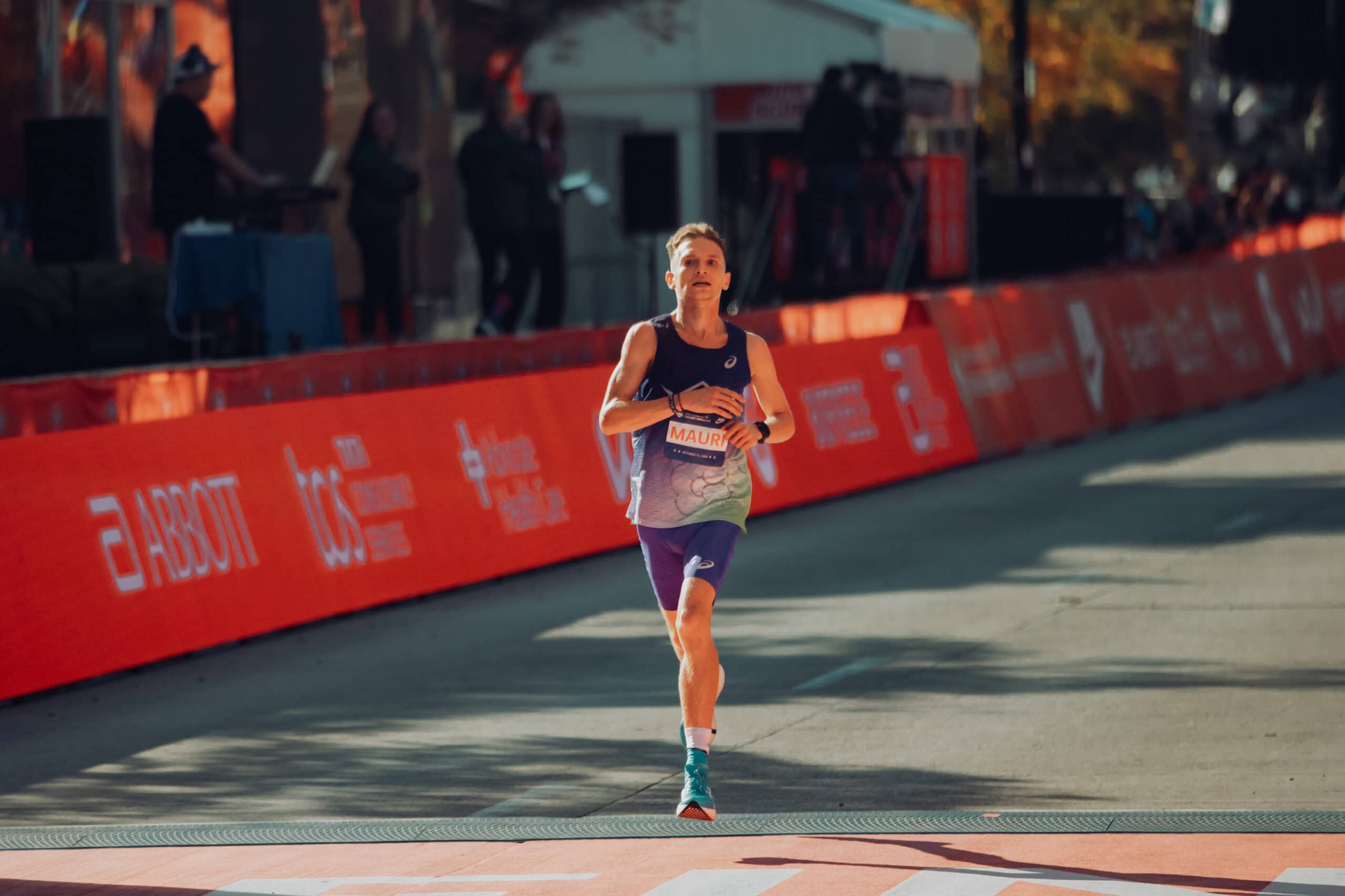
Vinny Mauri lines up for his second marathon in Chicago on Oct. 11 having done most of his training on Planet Fitness treadmills in Ohio. Ten weeks of his Strava log, as tallied by LetsRun’s Jonathan Gault for a profile published Friday, add up to 1,223 miles, with the average mile run in 5:38. Conner Mantz logged 1,182 miles at 6:35 pace in the matching weeks before he set the American record at the 2025 Chicago Marathon.
On Sept. 8 Mauri ran 45 miles, and 36 of them averaged 4:56 per mile, split between 2 x 50 minutes in the morning and 4 x 20 minutes in the afternoon, LetsRun reported. “Volume-wise, I’m doing 10 more miles than a marathon on that one day,” he told the site. In June we wrote up a 26.39-mile treadmill run he finished at 5:18 pace, and the build that carried him to his win at Glass City in April topped out at 110 miles in a week, with 97 a week at 5:54 pace over the comparable 10 weeks, by LetsRun’s count.
The Speeds the Research Has Not Reached
A 2019 meta-analysis in Sports Medicine, which pooled crossover studies of treadmill and overground running, found that at submaximal speeds a runner’s oxygen uptake on a flat belt came out close to identical to running on the ground, with an average gap of about half a milliliter per kilogram per minute. Flat is how Mauri runs most of his sessions, he told LetsRun. Bas Van Hooren, one of the review’s authors, has written that across speeds up to 16 km/h, about 6:02 per mile, the size of that gap stayed much the same.
Researchers who tested 12 national-level male runners for a study in PLOS ONE this year saw a different picture once the effort got hard. They ran the group at 8 to 15 km/h, on the ground and on a treadmill set to the customary 1 percent incline, and the harder the runners worked, the wider the difference between ground and belt became. Close to the second ventilatory threshold, their runners used about 12 percent more energy per meter overground.
Mauri’s 36 fast miles on Sept. 8 averaged 19.6 km/h, and the 4:48 per mile he held for 26.2 miles in Toledo is just over 20 km/h. That is well past the 16 km/h Van Hooren was describing, and about a third faster than the quickest speed anyone ran in the PLOS ONE study.

From Running Alone to Running in a Pack
Mauri finished more than 15 minutes ahead of second place in Toledo, on a course whose record that morning was still 2:19:31, and ran most of his debut with an empty road in front of him. Chicago’s field has seven men with bests under 2:04, plus Charles Hicks and Clayton Young, who both beat his time at Boston in April. Young will race on a torn hamstring tendon. Chicago is the first marathon in which Mauri can tuck in behind other runners, a point we raised when he was added to the field.
A 2025 paper in Sports Medicine Open tried to measure that shelter. Its authors cited earlier work putting the share of a marathoner’s energy spent against air resistance at about 2 percent, then modeled runners at 5.86 meters per second, close to world-record pace. One pacer in front cut the trailing runner’s drag by 19 percent, and two or three cut it by about 42 percent. The V-shaped formation used for Eliud Kipchoge’s INEOS 1:59 Challenge brought it down by 74 percent in their model.
Mantz’s record of 2:04:43 averages 4:45 per mile, 71 seconds quicker than Mauri ran in Toledo. Mauri told LetsRun that sitting in with a record attempt is the plan. “I feel like I’d be stupid not to,” he said. The professional men start in Grant Park at 7:30 a.m. CT, 168 days after Glass City, in his first race as an ASICS athlete.
Marathon Handbook is covering the race live from Chicago on Sunday, Oct. 11, including Mauri’s run at the American record. Follow along in our Chicago Marathon live updates.
RunClub
Get more running stories — join RunClub
Daily running news, a community of 300,000+ runners, free training plans for every distance, and a daily running game. Free to join — no card.
Already a member? Log in →






Start the conversation