


Sabastian Sawe got the headline. He ran 1:59:30 at the 2026 London Marathon and became the first man in history to officially break two hours.
Eleven seconds behind him, a 28-year-old Ethiopian named Yomif Kejelcha crossed the line in 1:59:41.
On any other Sunday in human history, that would have been the marathon world record. The fastest time ever run, by anyone, in any race. Kejelcha didn’t just break two hours on his marathon debut — he ran the second-fastest marathon ever recorded, faster than any human being apart from one had ever done it.
And he did it in his first marathon.
Here is who he is, and how on earth a man whose previous longest race was a half-marathon ran 1:59:41 on his first try.
The Quick Version: Yomif Kejelcha At A Glance
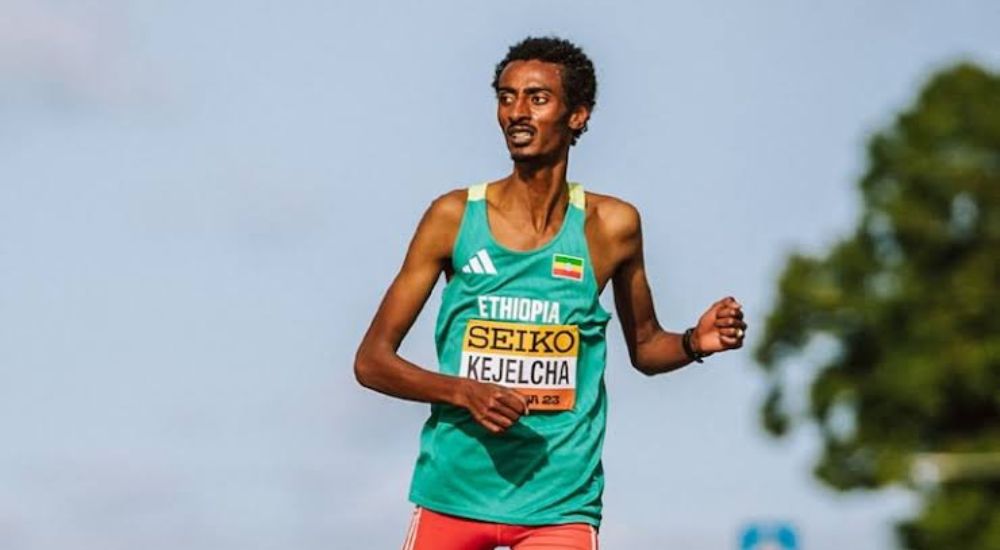
- Full name: Yomif Kejelcha
- Date of birth: 1 August 1997 (age 28)
- Born: Showa, Oromia Region, Ethiopia
- Nationality: Ethiopian
- Sponsor: adidas
- Shoe at London 2026: adidas Adizero Adios Pro Evo 3
- Marathon PB: 1:59:41 (London, 26 April 2026) — fastest marathon debut in history
- Half-marathon PB: 57:30 (former WR, Valencia, October 2024)
- Indoor mile PB: 3:47.01 (former WR, Boston, March 2019)
- 5000m PB: 12:38.95
Who Is Yomif Kejelcha?
Yomif Kejelcha was born on 1 August 1997 in Showa, in the Oromia region of Ethiopia — the fifth youngest of nine siblings. His parents are Kejelcha Atoma and Biritu Negese.
His path into running was, by his own account, far from inevitable. As a teenager, his father wanted him to stay in school. Yomif had other ideas. He dropped out of school in the ninth grade to chase a running career — a decision that, as he’s told the story over the years, got him expelled from the family home.
He joined the Burayu Kenema Club, moved to the outskirts of Addis Ababa to train, and started winning. Quickly.
The Track Prodigy Years
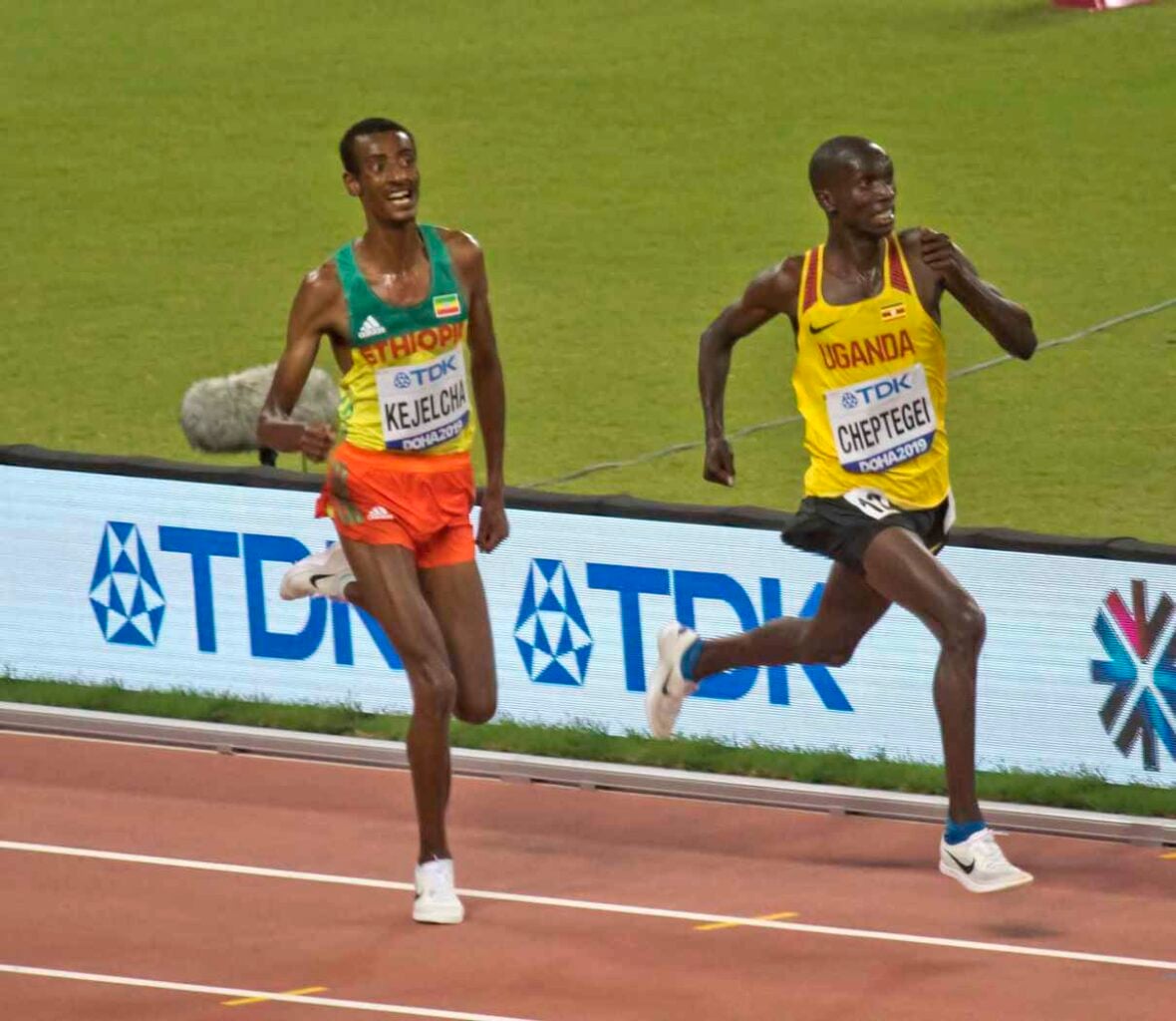
Kejelcha was a phenomenal age-group talent. In 2013, aged 15, he won the World U18 3000m title. In 2014, he doubled up with World U20 5000m gold and Youth Olympic 3000m gold.
Then, in 2016 — still only 18 years old — he won the World Indoor 3000m title in Portland, Oregon. Portland would later become his adopted home.
In 2019, he took silver in the 10,000m at the World Athletics Championships in Doha, behind Joshua Cheptegei. He went on to finish 8th in the 10,000m at the delayed Tokyo 2020 Olympics, and 8th in the 5000m at the 2022 World Championships in Eugene.
A medal cabinet most distance runners would happily retire on. Kejelcha was just getting started.
Nike Oregon Project & The Indoor Mile World Record
From 2018 to 2019, Kejelcha trained as a member of the Nike Oregon Project, working under coach Tim Rowberry. He trained alongside Galen Rupp and Sifan Hassan, with whom he formed an unusually close training partnership — the two of them would go on to set indoor mile world records on the same Boston track within a couple of weeks of each other.
On 3 March 2019, on the 200m banked oval at Boston University’s Track & Tennis Center, Kejelcha ran the indoor mile in 3:47.01 — slicing 1.44 seconds off Hicham El Guerrouj’s 22-year-old world record.
That record stood for nearly six years before American Yared Nuguse broke it in February 2025, running 3:46.63. But Kejelcha’s 3:47 stamped him as one of the fastest pure milers of his generation, and signalled the kind of finishing speed that, on the right day, can swing a marathon.
The Half-Marathon World Record

On 27 October 2024, in the Valencia Half Marathon, Kejelcha ran 57:30 — a new half-marathon world record, beating Jacob Kiplimo’s previous mark by a single second.
The record didn’t last long. Kiplimo took it back in 2025, running an absurd 56:42. But for ten months, Kejelcha was the official fastest half-marathoner in human history — a strong hint that his move up to the full marathon was a question of when, not if.
The Marathon Move
Most distance runners step up to the marathon gradually. They run a 2:05 debut, learn what 26.2 miles really feels like, then take aim at the bigger times.
Kejelcha decided to skip the gradual part.
He committed to a full marathon block in the winter of 2025/26, training between 120 and 140 kilometres per week alongside training partners including Telahun Haile Bekele, Hagos Gebrhiwet and Birhanu Balew. His debut would be the 2026 London Marathon — one of the fastest, deepest fields ever assembled in marathoning.
The Race: London Marathon, 26 April 2026
The pre-race story was supposed to be Sabastian Sawe and Jacob Kiplimo. Sawe — the reigning Berlin champion, second-fastest debut ever, the man most pundits saw as the natural heir to Kelvin Kiptum. Kiplimo — the half-marathon world record holder, finally stepping up to the full distance.
Kejelcha was the third name on the start list. The wildcard. The track guy with no marathon experience, whose half-marathon record had already been broken.
Three hours later, those three were the only men ever to break two hours in an official race — Sawe in 1:59:30, Kejelcha in 1:59:41, Kiplimo in 2:00:28.
Halfway split for the lead group: 59:38.
Kejelcha sat in the lead pack the whole way. Pacers dropped at standard distances. Kiplimo cracked at around 30km. Kejelcha and Sawe ran together through the cobbles past the Tower of London, with Kejelcha looking, if anything, the smoother of the two.
Then, with three miles to go, Sawe pushed. Kejelcha couldn’t quite go with him. But he didn’t fold either — he held on, refused to let the gap balloon, and crossed the line 11 seconds back.
1:59:41 on debut. The fastest first-time marathon in human history, by 24 seconds.
Why This Debut Is Even More Remarkable Than It Looks
Marathon debuts almost always go wrong somewhere. The wall. The cramps. The pacing mistake. The bottle that gets dropped. Even Eliud Kipchoge, on his way to becoming the greatest marathoner in history, ran 2:05:30 on debut — not slow, but a long way off the world record.
Kejelcha’s 1:59:41 is now the fastest marathon debut ever recorded by a margin of 24 seconds. The previous record was held by Sabastian Sawe himself, with the 2:02:05 he ran in Valencia in 2024 — a debut already considered one of the great first-time runs of all time.
Kejelcha’s debut is more than two minutes faster than that.
The closest historical comparison is Kelvin Kiptum’s 2:01:53 in Valencia 2022, which was the fastest debut on record at the time. Kejelcha just took 2:12 off it.
It is, by any reasonable measure, the most extraordinary marathon debut in the history of the sport.
The Shoe: adidas Adizero Adios Pro Evo 3
Kejelcha, like Sawe, is an adidas athlete. He wore the same shoe as Sawe at London 2026 — the brand-new adidas Adizero Adios Pro Evo 3, making its first race appearance.
The numbers are astonishing:
- Weight: ~97 grams (men’s US 9.5)
- Foam: Lightstrike Pro Evo — claimed 50% lighter than the Pro Evo 2 foam
- Running economy: +1.6% over the Pro Evo 2, per adidas
- Upper: ultra-light woven mesh inspired by kitesurfing sails
- Price: $500 / €500
- Availability: Extremely limited release
Both men wore the same shoe. Both men ran under two hours. The shoe, naturally, is now a footnote in the bigger story — but it’s a footnote that will sell out in minutes the moment it hits retail.
What’s Next For Yomif Kejelcha?
Kejelcha has already hinted that he’ll race a fall marathon — either Berlin or Chicago — later in 2026. Berlin would set up a head-to-head with Sawe and an inevitable assault on 1:59:00. Chicago, where the course slightly favours Kejelcha’s downhill-friendly biomechanics, might be where he goes to actually break the world record himself.
Beyond that: LA 2028. The Olympic men’s marathon will be on a hilly, slow course. It won’t produce a fast time. But the man who debuts in 1:59:41 on his first attempt, with a 3:47 mile and a 57:30 half-marathon in his back pocket, is exactly the kind of all-rounder who tends to win Olympic marathons.
Sawe got the headline at London 2026. But Kejelcha may have produced the more frightening performance.
And he’s only just figuring out the marathon.
Read More
- Who Is Sabastian Sawe? The First Man To Run A Sub 2-hr Marathon
- Best Marathon Running Shoes
- Best Carbon Plate Running Shoes
- Fastest Marathon Time: World Records + Top Runners
RunClub
Get more running stories — join RunClub
Daily running news, a community of 300,000+ runners, free training plans for every distance, and a daily running game. Free to join — no card.
Already a member? Log in →









Start the conversation