


A quick note on the spelling: he’s “Sabastian” Sawe (with an A) on his birth certificate and on the World Athletics database, although you’ll see him written up as “Sebastian” all over the internet too. We’re going with Sabastian.
On Sunday, 26 April 2026, on a damp, grey morning in central London, a 31-year-old Kenyan named Sabastian Kimaru Sawe did something that, for as long as humans have been racing 26.2 miles, had been considered slightly mythical. He ran a marathon in 1 hour, 59 minutes and 30 seconds.
Not in a closed-loop pacing experiment. Not in a windless lab. Not on a downhill course with rotating pacers and a laser car projecting the line.
In a real, sanctioned World Marathon Major. With one bib number. Against the best field on the planet.
Sabastian Sawe is now the first man in history to officially run a marathon in under two hours.
This is who he is, where he came from, and how on earth he did it.
The Quick Version: Sabastian Sawe At A Glance
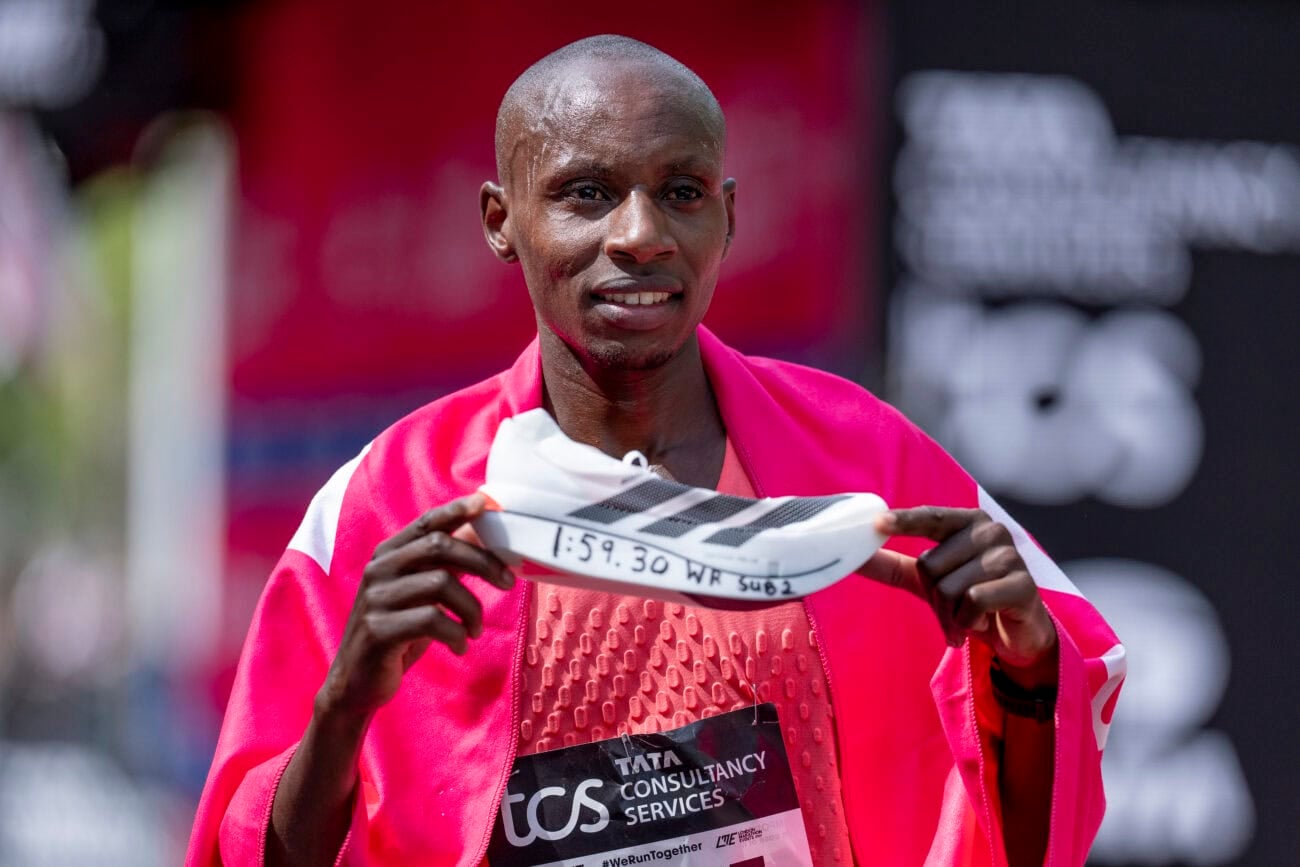
Photo: Bob Martin for London Marathon Events
For further information: media@londonmarathonevents.co.uk
- Full name: Sabastian Kimaru Sawe
- Date of birth: 16 March 1995 (age 31)
- Born: Barsombe, Uasin Gishu County, Kenya
- Nationality: Kenyan
- Coach: Trains within the Kenyan camp system at altitude (Iten / Eldoret region)
- Sponsor: adidas
- Shoe: adidas Adizero Adios Pro Evo 3
- Marathon PB / WR: 1:59:30 (London, 26 April 2026)
- Half-marathon PB: 58:05 (Copenhagen, September 2024)
Who Is Sabastian Sawe?
Sawe was born and raised in Barsombe, a village in Uasin Gishu County in Kenya’s Rift Valley — the same patch of high-altitude farmland that has produced Kelvin Kiptum, Eliud Kipchoge, Faith Kipyegon, and a long list of other Kalenjin distance runners who now occupy most of the men’s and women’s road-running record books.
He is, by the standards of elite Kenyan marathoners, a relatively late convert. While Kiptum was already a 2:00 marathoner in his early twenties and Kipchoge was a teenage 5,000m world champion, Sawe spent most of his early career on the track and on the half-marathon circuit.
In September 2022, at the Memorial Van Damme in Brussels, he set a Kenyan national record in the one-hour run, covering 21,250 metres in 60 minutes — within a whisker of the world record. That run signalled what was coming. A man who can hold sub-2:50/km pace for an hour on a track is, almost by definition, a future marathon star.
In September 2024, he won the Copenhagen Half Marathon in 58:05, one of the fastest half-marathon times ever run.
Then he stepped up to 26.2 miles, and the world started paying very close attention.
A Marathon Debut To Remember: Valencia 2024

Sawe ran his first ever marathon at the 2024 Valencia Marathon in December.
He ran 2:02:05.
For context: that’s the second-fastest marathon debut in history, just 12 seconds behind the late Kelvin Kiptum’s debut on the same Valencia course in 2022. It instantly elevated Sawe from “promising half-marathoner” to “credible threat to the marathon world record.”
He followed that up by winning the 2024 Berlin Marathon, an event so historically associated with world records that several pundits already had him pencilled in as Kiptum’s natural successor.
The Doping Cloud — And How He Answered It
Kenyan marathoning has been hit hard by a wave of doping bans in recent years. When a relatively unknown 29-year-old debuts in 2:02 and follows it up by winning Berlin, the whispers are inevitable.
Sawe answered the whispers in the most direct way possible: he submitted to 25 unannounced out-of-competition drug tests from the Athletics Integrity Unit in the build-up to Berlin — believed to be one of the most extensive testing protocols any marathoner has voluntarily undergone. He passed all of them, and continued to do so in the build-up to London 2026.
Whatever you think about the state of the sport, the testing trail behind Sabastian Sawe is exceptionally well-documented.
The Race That Changed Everything: London Marathon 2026
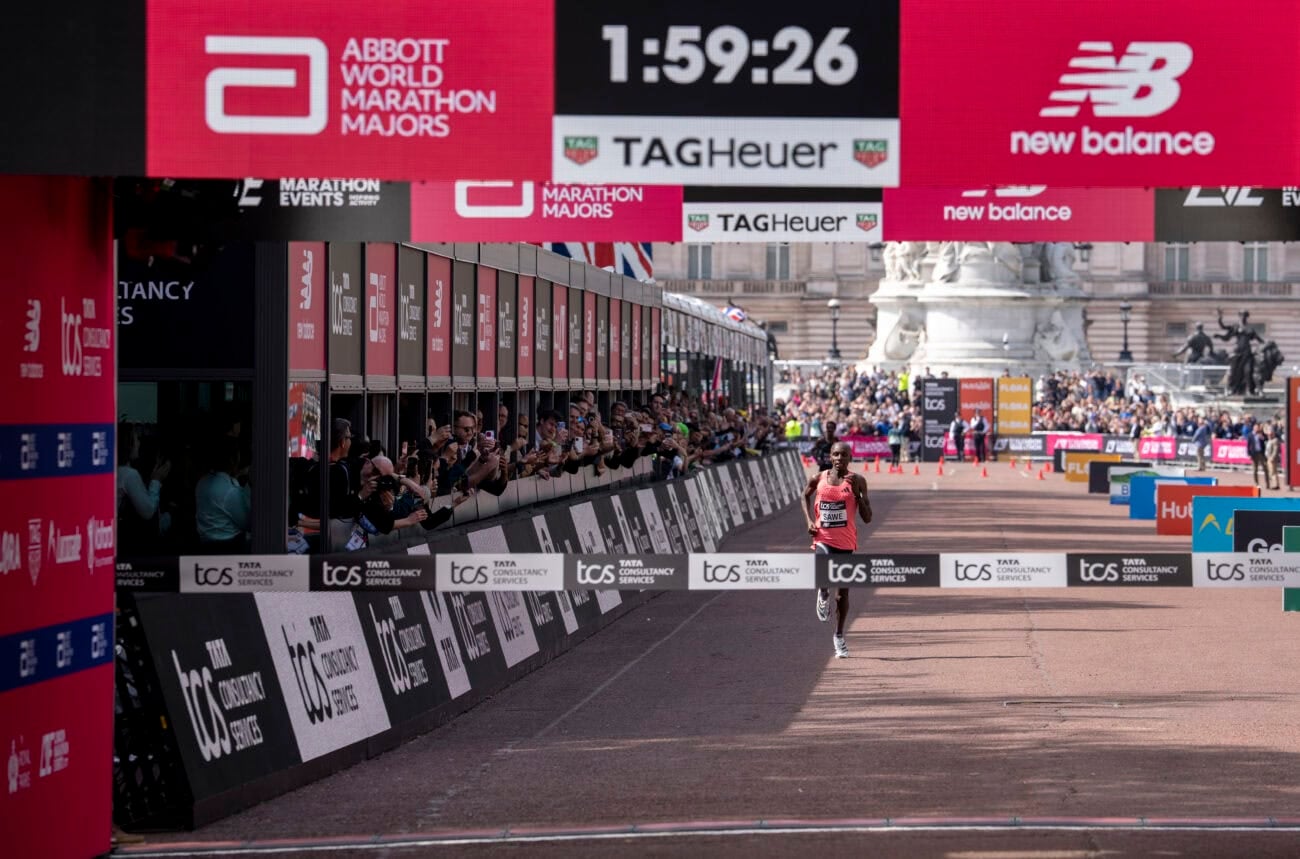
Photo: Andrew Baker for London Marathon Events
For further information: media@londonmarathonevents.co.uk
Sunday, 26 April 2026. Forecast: 11°C, light drizzle, almost no wind. About as close to perfect marathon conditions as London ever offers.
The men’s elite field was the deepest in marathon history. Yomif Kejelcha, the Ethiopian 10,000m and half-marathon star, was making his marathon debut. Jacob Kiplimo of Uganda — the world half-marathon record holder — was lined up alongside him. Several sub-2:03 men filled the rest of the field.
The pacers took the leaders through halfway in 59:38.
For the first time in racing history, a real marathon was on world-record pace and not slowing down.
Kiplimo dropped from the lead group at around 30km. Kejelcha clung on. With three miles to go, only Sawe and Kejelcha were left. Sawe pushed first on the cobbles past the Tower of London, and Kejelcha couldn’t go with him.
Sawe came down The Mall on his own, watching the clock, and crossed the line in 1:59:30 — taking 65 seconds off Kelvin Kiptum’s official world record of 2:00:35.
Kejelcha finished second in 1:59:41 — the fastest marathon debut in history and the second-fastest marathon ever run by anyone.
Kiplimo finished third in 2:00:28 — also under the old world record.
Three men, in one race, ran faster than any human had ever officially run a marathon before. But only one of them broke two hours.
Sabastian Sawe vs. Kipchoge’s INEOS 1:59 Challenge
Most runners reading this will already be asking: what about Kipchoge?
In October 2019, on a closed course in Vienna, Eliud Kipchoge ran 1:59:40.2 in the INEOS 1:59 Challenge. It was a stunning piece of human performance and an iconic moment for the sport — but it was never recognised as a world record, for good reasons:
- It was not an open race (Kipchoge ran alone, not against a field).
- He had a continuous, rotating shield of 41 elite pacemakers in formation.
- A pace car projected a green laser line on the road in front of him to mark optimal pace.
- He was handed bottles in motion by a support cyclist, rather than collecting them from tables.
Sawe’s 1:59:30, by contrast, was run:
- In a World Marathon Major, with mass-start elite competition.
- Without in-and-out pacing or shielding (pacers dropped at standard distances).
- Under standard IAAF/World Athletics record conditions.
- Carrying his own fuel from official aid stations.
In other words: Kipchoge proved a human could run under two hours under heavily optimised conditions. Sawe proved a human could do it in a real race. Both achievements are remarkable, but they are different categories of remarkable.
The Shoe: adidas Adizero Adios Pro Evo 3

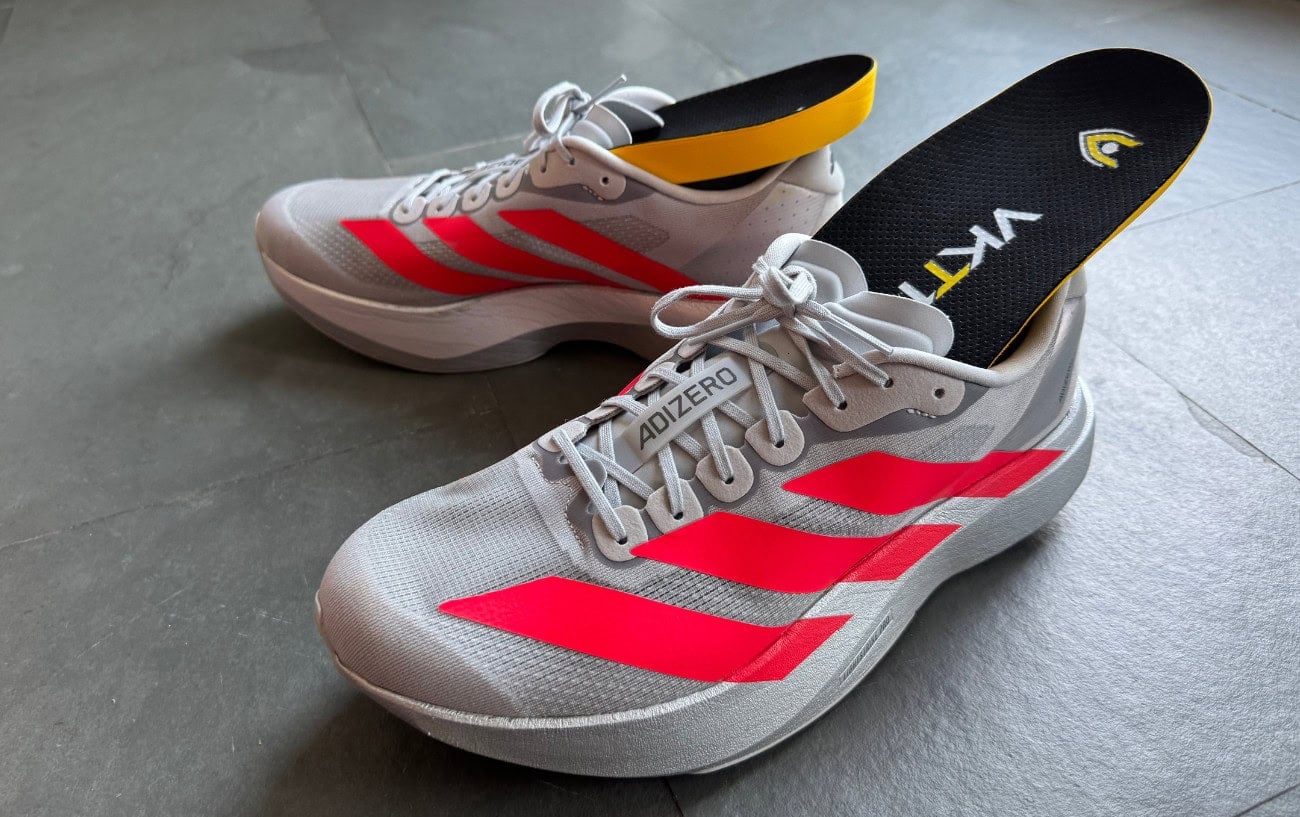
Sawe was wearing the brand-new adidas Adizero Adios Pro Evo 3 — making its global race debut at London 2026.
Some quick numbers:
- Weight: ~97 grams in a men’s US 9.5 (a typical road-racing flat is 200g+; even most super-shoes weigh 180–220g)
- Foam: new Lightstrike Pro Evo compound, claimed to be 50% lighter than the foam in the Pro Evo 2
- Upper: ultra-light woven mesh, with structural inspiration drawn from kitesurfing sails
- Running economy: adidas claims a 1.6% improvement over the Pro Evo 2
- Price: $500 / €500 (approx. £433)
- Availability: Extremely limited release, single-race intended use
To be clear: nobody is pretending the shoe ran the race. Sabastian Sawe did. But the marginal-gains story of the modern marathon is impossible to ignore — and the Pro Evo 3 is the lightest, most foam-rich super-shoe adidas has ever sold to the public.
What This Means For The Sport
There are a few honest things to say about Sawe’s 1:59:30.
The first is that the marathon will never look the same again. The two-hour barrier was a psychological wall as much as a physical one. Roger Bannister’s four-minute mile got broken by a guy named John Landy 46 days after Bannister did it, then by 16 more men in the next two years. Walls fall in clusters. Yomif Kejelcha proved that on Sunday, 11 seconds behind Sawe.
The second is that the bar for what counts as “elite marathoning” has shifted. A 2:02 marathon used to be a world-class result. After London 2026, it might be the cutoff for World Marathon Major podium contention.
The third — and most important if you’re a recreational runner reading this — is that none of this changes what your marathon is. Sub-2 is a story about the bleeding edge of human performance, super-shoes, decades of altitude training, and one extremely fit Kenyan having one extremely good day. The marathon is still 26.2 miles. It still hurts. The clock still tells the truth.
Sabastian Sawe just told a different truth than anyone has told before.
What’s Next For Sabastian Sawe?
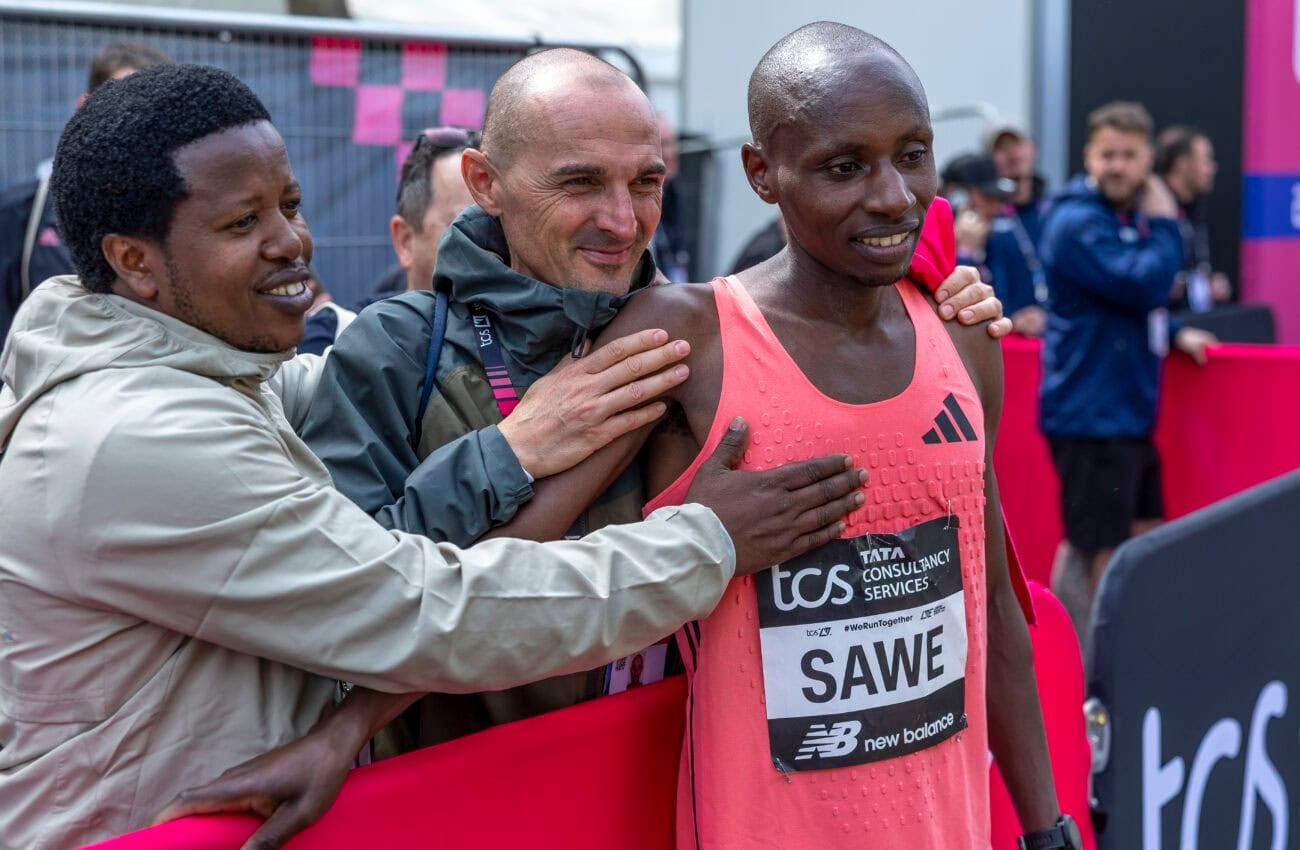
Photo: David Cliff for London Marathon Events
For further information: media@londonmarathonevents.co.uk
Sawe has already confirmed he’ll race the Berlin Marathon in September 2026, where the question won’t be can he break two hours again — it’ll be how much faster can he go?
Beyond that, the LA 2028 Olympic Games loom large. The men’s marathon at LA28 is set to be staged on a tough, hilly course that will not produce fast times. But it will produce a story. And Sabastian Sawe — who, two years ago, hadn’t even run an official marathon — is now the man everyone else is racing.
Read More
- Best Marathon Running Shoes
- Best Carbon Plate Running Shoes
- Fastest Marathon Time: World Records + Top Runners
RunClub — Free
Join 300,000+ runners in RunClub
Free training plans for every distance, a daily running game, exclusive coaching content, and a real community of runners. Create your free account in 20 seconds — no card.
Already a member? Log in →








Start the conversation