


For most runners, the idea of racing a marathon on every continent is the sort of bucket-list project you tackle gradually, over years or even decades. But there’s a small, determined corner of the endurance world that doesn’t believe in waiting.
Their goal is more audacious: seven marathons, on seven continents, in seven days. I’d call that something of a physically punishing, financially eye-watering, logistically fragile circumnavigation of the planet, and one of the most extreme “runcations” you could think of.
Enter: The Great World Race.

The Great World Race is a relatively new entrant in the ultra-niche space of multi-continent marathon expeditions.
The event is organised by Ice Cap Adventures Ltd. and its global network of local race partners. And while the price tag, €49,500 (around $57,350 USD) per participant for 2025, is a headline in itself, the cost only tells half the story.
The rest is the sprawling, brutally compressed itinerary that pushes even seasoned marathoners well past their comfort zone.
But exactly what is The Great World Race, how does it work, and what are runners getting for that down-payment-sized fee?

What Exactly Is The Great World Race?
When it comes down to it, The Great World Race is a seven-stage marathon race.
But, each marathon takes place on a different continent, flown to each day over the course of one week. A half-marathon option exists, but the full marathon is the marquee event.
While multi-continent challenges aren’t entirely new (the World Marathon Challenge created this category in the mid-2010s), The Great World Race distinguishes itself with a slightly different route, a larger logistical footprint, and higher-end travel accommodations.
Its foundational principle, however, is essentially the same: complete all seven marathons in 168 hours or less. The races are official, measured by AIMS/World Athletics course measurers, sanctioned through national federations, and even recognised by the Antarctica Athletics Federation.
The weather in Antarctica is the single uncontrollable factor. Organisers are explicit that the entire race hinges on conditions at Wolf’s Fang runway, which is where the first race takes place. Until the first flight departs Cape Town, nothing is guaranteed. And once that first marathon begins in Antartica, the clock starts ticking.
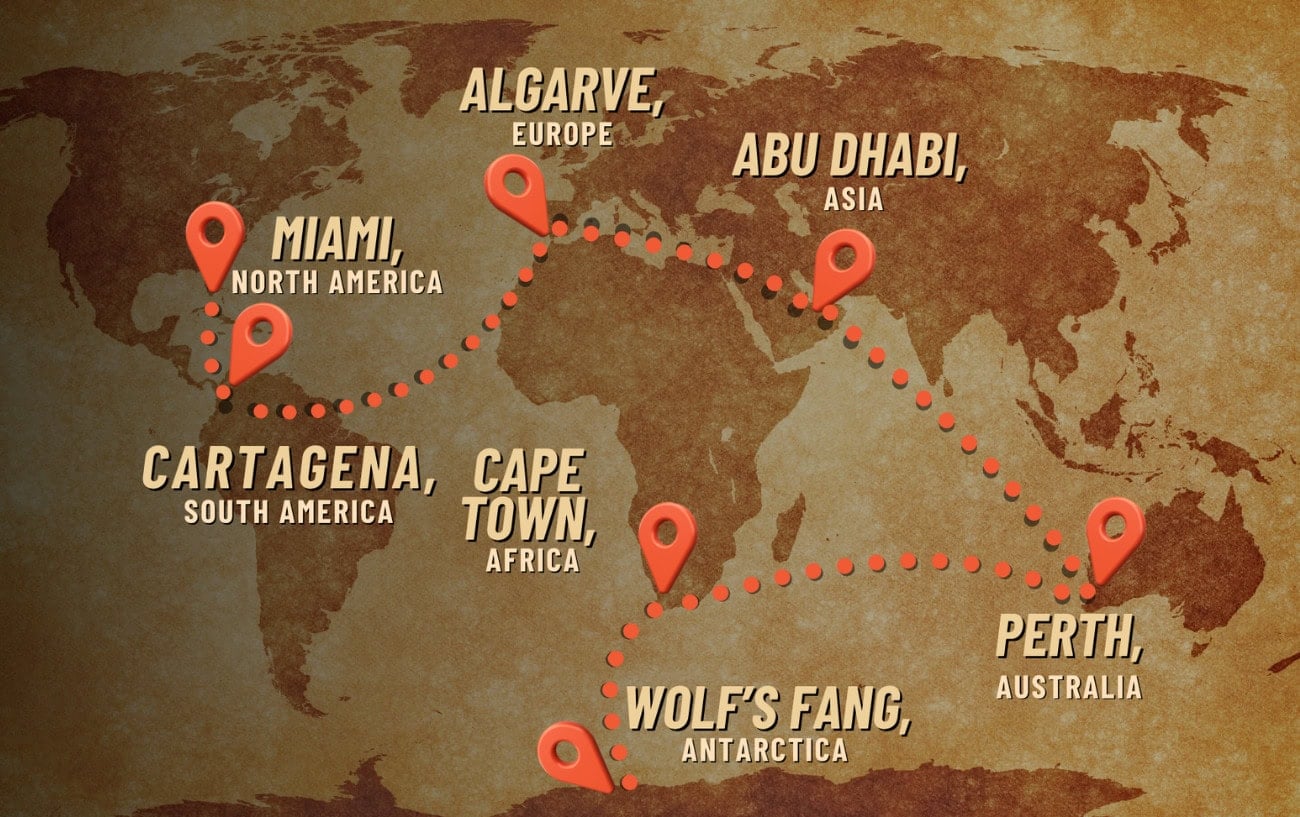
How the Route Works: Seven Continents, One Week
The Great World Race begins in Cape Town, which serves as the staging point for all Antarctica operations.
From there, competitors board a private jet to Wolf’s Fang, a blue-ice runway in Queen Maud Land operated by White Desert. The camp sits at roughly 71° South and is primarily used for scientific and expedition logistics. The marathon course is a groomed 10.55 km loop run four times.
From Antarctica, the event moves eastward around the globe:
1. Wolf’s Fang, Antarctica
A remote, non-technical loop course near the ice runway. Temperatures can fall below –20°C, though summer conditions vary. Emergency evacuation coverage is included.
2. Cape Town, Africa
A paved 7.03 km circuit on the Sea Point Promenade. Six laps make the marathon.
3. Perth, Australia
Hosted in Burswood by the West Australian Marathon Club, typically on a flat riverside circuit.
4. Abu Dhabi, Asia
A stark shift, from Antarctic ice to Gulf heat in under 48 hours. Past editions have used urban waterfront routes with early-morning start times to moderate temperatures.
5. Algarve, Europe (Portugal)
Known for its coastal scenery and rolling historic towns. The European leg blends resort-area logistics with runnable weather in November.
6. Cartagena, South America
A humid, out-and-back coastal course through Colombia’s Caribbean city. Heat management becomes a recurring theme at this stage.
7. Miami, North America
South Beach hosts the final race, typically after roughly 20,000 km of cumulative air travel and near-total sleep fragmentation.
The 2025 schedule runs from 15–21 November, with arrivals and briefings beginning 12–14 November in Cape Town.

The Most Expensive Race In The World
The entry fee will do more than raise eyebrows, it might just fry them off.
But when you pull apart the itinerary, the cost reflects a very specific economic reality: transporting a small group of runners, staff, medical personnel, photographers, and equipment across seven marathons and six international charter flights in under one week is not what we would call a normal commercial enterprise.
Here’s what the registration fee includes:
- Round-trip private jet flights to Antarctica, the most expensive component by far
- Business-class charter flights for the remaining continents (Cape Town → Perth → Abu Dhabi → Algarve → Cartagena → Miami)
- Meals and drinks on charter flights
- Trip-cancellation coverage (2025), plus Antarctica medical evacuation insurance
- Ground transport at every stop, including shower and changing facilities
- Accommodation in Istanbul during years when the Asia and Europe races are held there consecutively
- Race entries for all seven marathons with official timing, aid, and medical support
- Professional race photography
- Medals for every marathon plus a completion medal
- Digital certificate and branded apparel
- Inclusion in the Global Marathon Club, which recognises athletes who complete 7 marathons or half-marathons on 7 continents within 7 days
What’s not included: your travel to Cape Town, lodging before departure, meals outside flights, and your travel home from Miami.
To put the cost into context: an independent expedition to Antarctica alone, without six additional continents, commonly runs between €15,000 and €35,000 for tourists, and more for rare athletic events.
Chartering a jet suitable for an ice runway landing pushes costs even higher. In other words, most of the fee is absorbed before the first marathon even begins.

An Ultra-Marathon of Logistics
The compression of time is what makes events like this so difficult, not just physically for athletes but operationally for organisers.
The Great World Race involves:
- Six time zones crossed in one week
- Two polar flights, including one to a blue-ice runway with narrow weather windows
- Seven courses that must be measured, sanctioned, staffed, and secured
- Medical teams monitoring for cold injuries, heat exhaustion, dehydration, and cumulative fatigue
- Contingency plans for weather delays, reroutes, and shifting start times
Antarctica remains the hinge point. If the flight cannot safely depart Cape Town, the entire race is delayed.
Once the Antarctica marathon is completed, organisers work aggressively to maintain momentum; each consecutive start time is planned but flexible. All races have an eight-hour cutoff, but the event director can adjust as needed.
Athletes must also accept that sleep will be fragmented.
Most rest happens on flights, often in business-class seats rather than lie-flat beds, depending on the aircraft. Many past multi-continent marathon competitors cite sleep deprivation, not the mileage itself, as the true test of the week.
So, Is It a Race or a Runcation?
It’s both.
Each marathon is an individual race, but there is an overall champion who is determined by the fastest average time across all seven events.
But the majority of entrants treat it as a personal challenge rather than a performance race.
Historically, at similar multi-continent events, finish times vary dramatically, from elite runners using the format as a competitive proving ground to recreational athletes posting 6–7 hour marathons but still completing the full series successfully.
The event’s guiding philosophy is simple: help everyone finish, provided it’s medically safe to do so.
RunClub
Get more running stories — join RunClub
Daily running news, a community of 300,000+ runners, free training plans for every distance, and a daily running game. Free to join — no card.
Already a member? Log in →












Start the conversation