


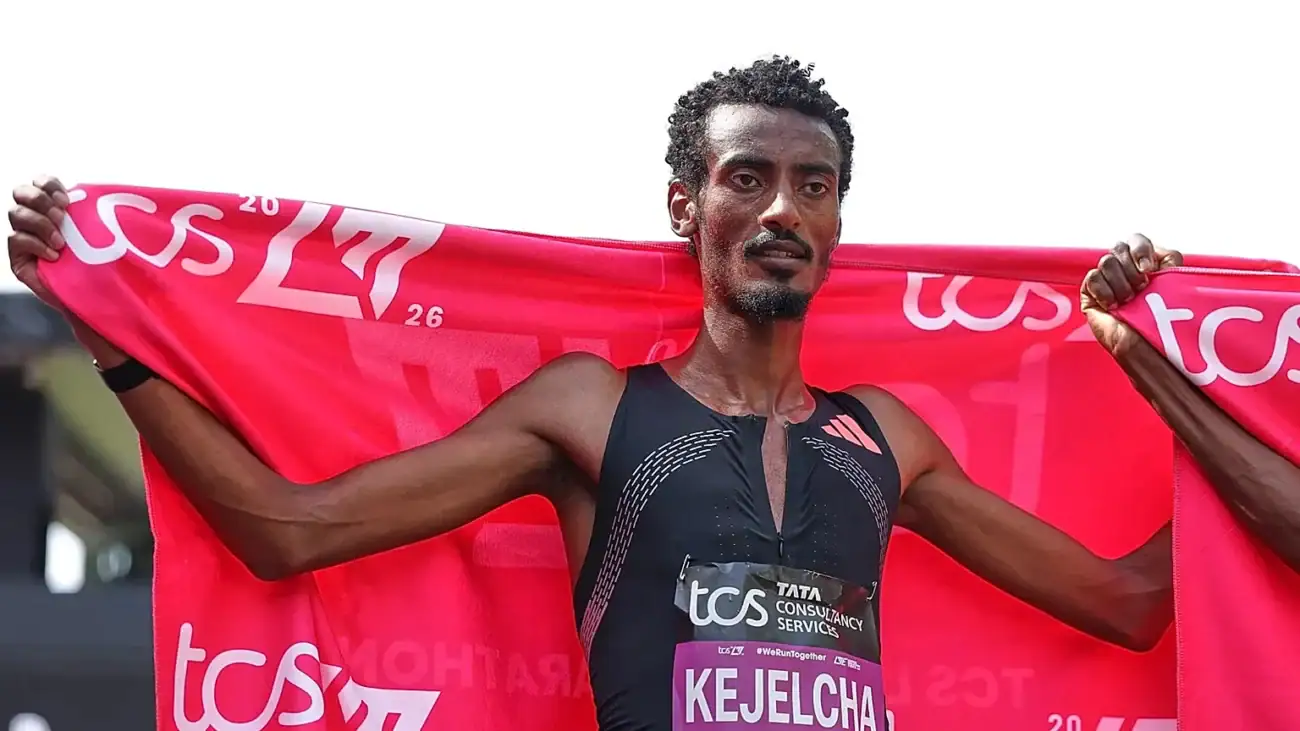
Yomif Kejelcha is going to Buenos Aires. The Ñandú Association, which puts on Argentina’s biggest half marathon, confirmed this week that the 28-year-old Ethiopian will line up for the 21K on Sunday, August 23. He arrives with the road 10K world record of 26:31, a 1:59:41 marathon from London this past spring (the fastest debut in history, and the second-fastest marathon ever clocked), and a half marathon best of 57:30 that puts him within striking distance of the world record.
It would be hard to ask for a bigger headliner, and Buenos Aires is starting to expect them. Last year Uganda’s Jacob Kiplimo, the current world record holder (pending ratification) over the half marathon, ran 58:29 here. That stands as the fastest half marathon ever run in the Americas.
For runners who haven’t paid much attention to this one, the appeal is mostly the course. Buenos Aires has quietly built one of the fastest 21Ks anywhere. The loop is certified, almost entirely flat with roughly 100 meters of total elevation gain across the whole distance, and the city itself does a lot of the work of dragging you forward. Start and finish are in the Bosques de Palermo, the big northern green space, at the corner of Avenida Figueroa Alcorta and Dorrego. The gun goes off at 8 a.m.
From the woods, the field heads south through the wide tree-lined avenues that Porteños take for granted. The route tracks down Avenida 9 de Julio, sixteen lanes across at its widest, then carries on past the Obelisco, the Teatro Colón and the pink walls of the Casa Rosada in Plaza de Mayo. It brushes the cobblestoned edges of San Telmo, runs out along the Río de la Plata waterfront, and then loops back north to Palermo to finish near where it started. By the second half, you have the river on one side and the city skyline on the other, which is the kind of stretch that makes a fast course feel fast.
That mix of geography and pace is what has been pulling the world’s best down to Argentina. The Ñandú Association has already taken more than 20,000 entries this year. Most of the international field comes from Brazil, with strong groups from Uruguay and Chile, and runners from every continent showing up on the start list.
RunClub
Get more running stories — join RunClub
Daily running news, a community of 300,000+ runners, free training plans for every distance, and a daily running game. Free to join — no card.
Already a member? Log in →


Start the conversation