


Heel-toe drop is one of those shoe features that gets discussed constantly, but it is hard to isolate in real-world shoes among all of the other fancy foams and plates.
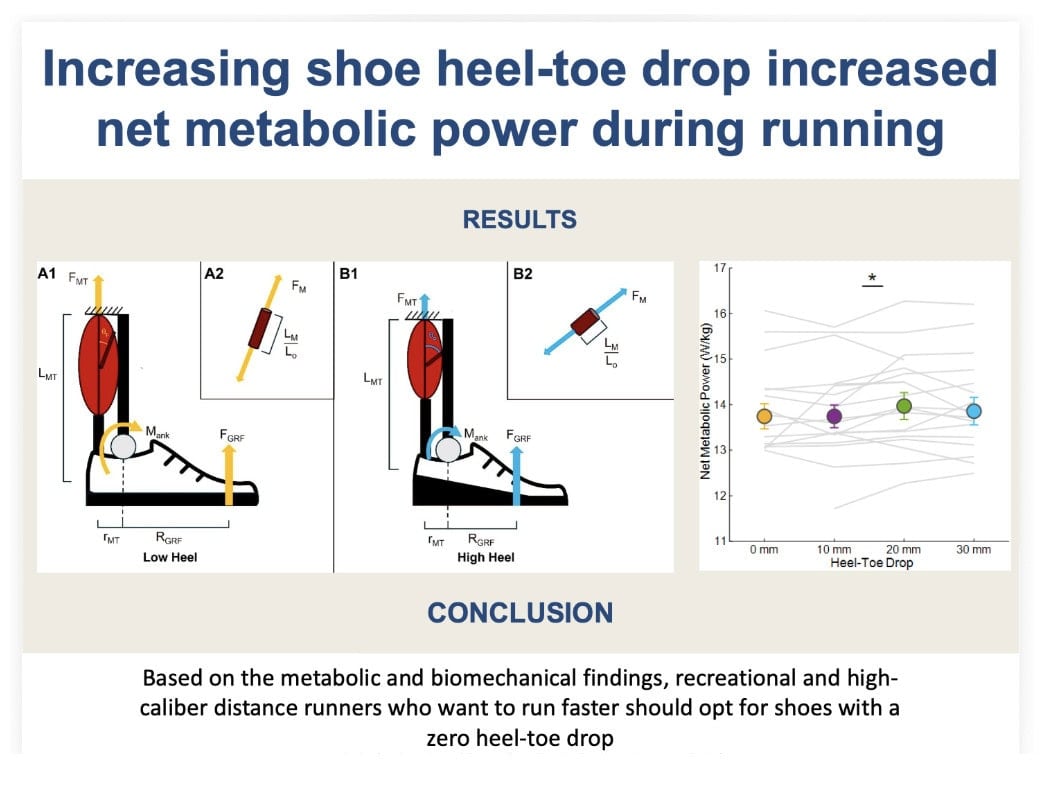
So a new study did something clever to specifically test how heel-to-toe drop influences running economy: it built custom shoes with heel-to-toe drops of 0, 10, 20, and 30 mm—while keeping the shoe model and mass fixed.

Twenty runners ran at ~8 mph in each shoe condition while researchers measured metabolic cost of running (i.e., running economy), ground reaction forces, joint mechanics, and leg muscle behavior using ultrasound.
- A higher heel-to-toe drop increased net metabolic power during running. Reducing the drop from 20 mm to 0 mm reduced net metabolic power (i.e., the energy cost of running) by 1.6%.
- In performance terms, that is not nothing. The authors note that a 1.6% improvement in the economy could theoretically translate into roughly 1–3 minutes saved in a marathon, though that extrapolation should be treated with caution.
- Higher-drop shoes increased ankle plantarflexion and shortened the calf muscle length during ground contact. The researchers propose lower-drop shoes allowed the calf muscles to operate at longer, more economical lengths.
- Higher-drop shoes also increased peak and average knee movements, suggesting a shift in mechanical demand up the leg.
The authors recommend zero-drop shoes for recreational and high-caliber runners who want better economy. I would soften that recommendation.
The study is well-designed to isolate heel-to-toe drop, but it is still a lab study at a single speed in custom shoes. The shoes were also created by adding cushioning to adjust the drop, which may have affected underfoot stiffness. And, importantly, running economy is not the only thing that matters. Injury risk, comfort, calf/Achilles tolerance, terrain, fatigue, and shoe-superfoam interactions all matter too. The authors themselves note that the effect of heel-toe drop on injury risk remains unsettled.
What this means for runners
If you already tolerate lower-drop shoes well, this study gives a plausible reason they might feel efficient. If you have always run in 8–12 mm shoes, I would not suddenly switch all your mileage to zero drop because of one study. The more useful approach is gradual experimentation: try a slightly lower-drop shoe for short easy runs or controlled workouts, watch how your calves and Achilles respond, and judge the shoe by the combination of economy, comfort, and durability in your own body.
RunClub — Free
Join 300,000+ runners in RunClub
Free training plans for every distance, a daily running game, exclusive coaching content, and a real community of runners. Create your free account in 20 seconds — no card.
Already a member? Log in →











Start the conversation