


Running-form advice has a habit of turning observations into rules.
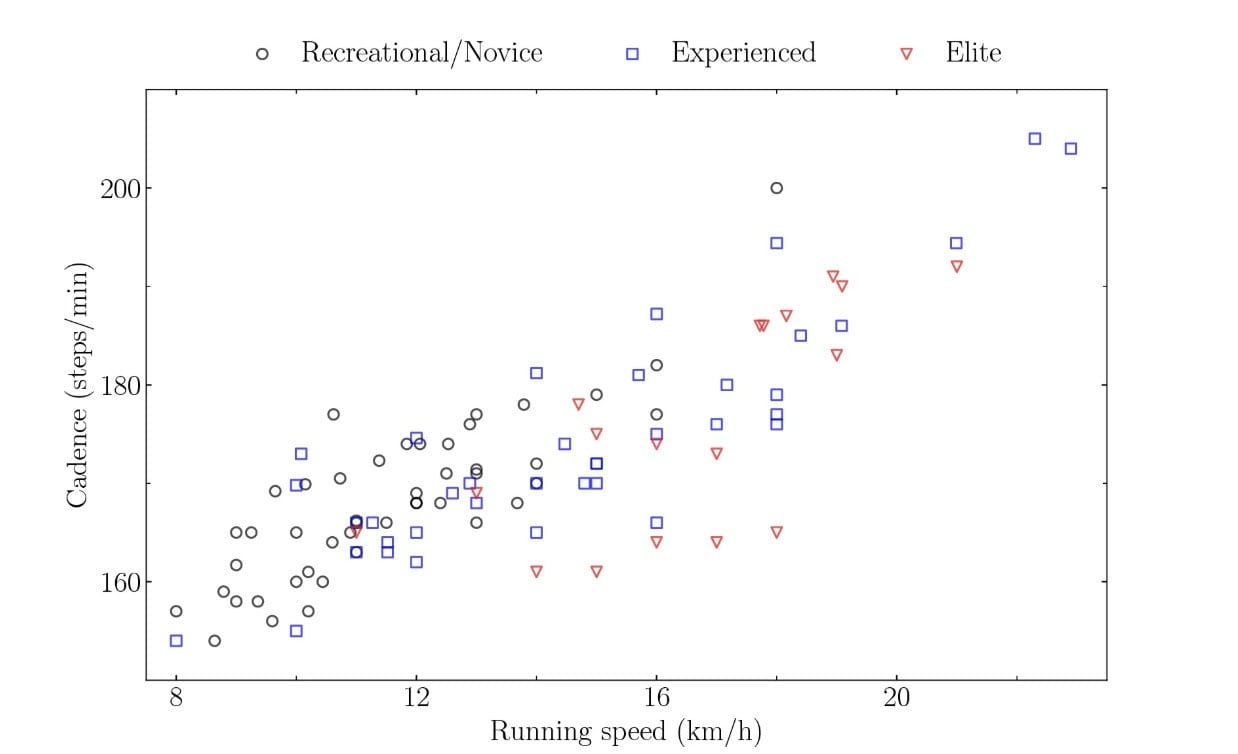
Many elite runners land somewhere other than the heel, so heel striking must be bad. Some successful runners average around 180 steps per minute, so everyone should aim for 180. Increasing cadence changes certain forces measured in a laboratory, so raising cadence must prevent injuries.

A new narrative review examined these three beliefs and found that the evidence is much less tidy.1Patoz, A., Gindre, C., Lussiana, T., & Breine, B. (2026). The Heel-Strike Fallacy and Cadence Beliefs in Distance Running: A Narrative Review. Sports Medicine – Open, 12(1). https://doi.org/10.1186/s40798-026-01120-y
- Rearfoot striking was not consistently associated with greater impact-related loading or a higher risk of overuse injury. Changing foot strike may reduce load in one location while increasing it somewhere else.
- Cadence was similarly individual. Across studies of recreational, experienced, and elite runners, typical values ranged from roughly 150 to 210 steps per minute. Cadence changed with speed, leg length, body mass, maturation, footwear, and running surface. Laboratory studies also suggest that runners tend to settle near an individually economical cadence—not one universal number.
- Increasing cadence can acutely alter stride length, joint angles, loading rates, and other biomechanical measures. But responses vary among runners.
- Long-term studies showing that cadence manipulation reliably reduces injury risk or improves performance remain sparse.
What this means for runners
If you are healthy, comfortable, and performing well, a heel strike or cadence below 180 is not automatically a problem that needs correcting.
Form changes make more sense when they address a specific issue: a tissue you are trying to unload, a recurring symptom, an obvious functional limitation, or a performance goal. Even then, introduce the change gradually and judge it by pain, tolerance, function, and performance—not whether your watch displays an approved number.
References
RunClub — Free
Join 300,000+ runners in RunClub
Free training plans for every distance, a daily running game, exclusive coaching content, and a real community of runners. Create your free account in 20 seconds — no card.
Already a member? Log in →










Start the conversation