


Endurance performance isn’t limited to the heart, lungs, and muscles. The brain helps regulate effort, discomfort, pacing, and decisions about when to slow down or stop.
That has made transcranial direct current stimulation, or tDCS, an appealing idea. The technique applies a weak electrical current through scalp electrodes. Stimulating regions involved in effort perception and self-regulation could, in theory, make hard exercise feel easier or allow an athlete to tolerate it longer.

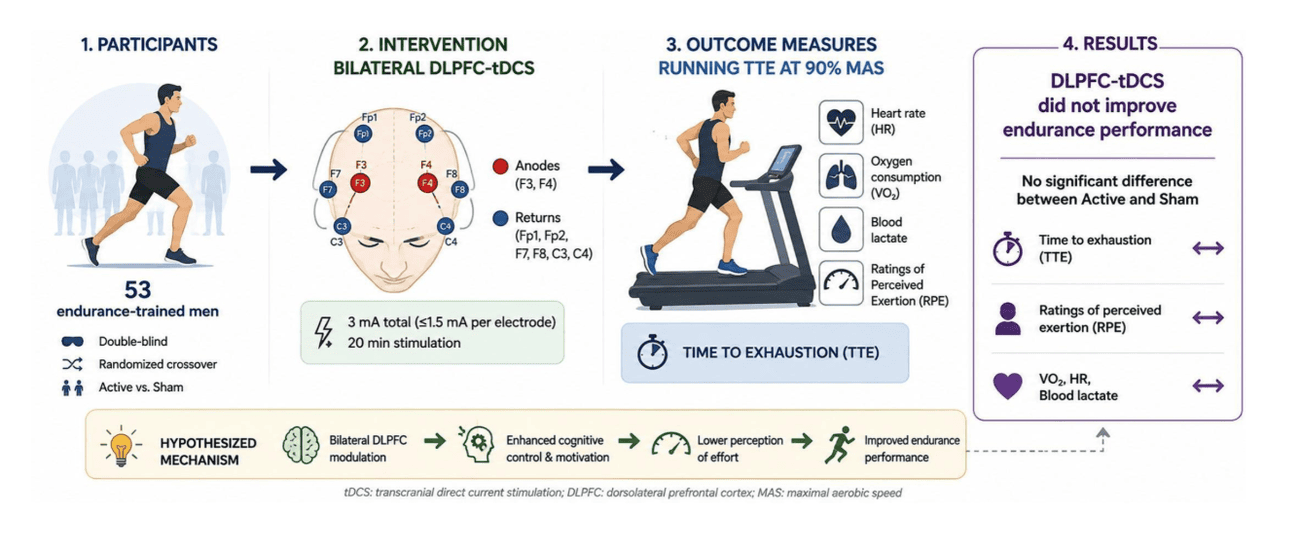
A recent experiment tested that possibility in 53 endurance-trained men. Before running, the participants received 20 minutes of either active or “fake” stimulation targeting the prefrontal cortex. They then ran at 90% of maximal aerobic speed until exhaustion.
The active stimulation did not extend time to exhaustion. It also did not change perceived effort, oxygen consumption, heart rate, or blood lactate.
That is a fairly comprehensive null result. If stimulation had increased endurance without changing physiology, we might expect runners to tolerate a given level of effort longer. If it had altered physiological strain, we might see a difference in oxygen consumption, heart rate, or lactate. Neither pattern appeared.
The researchers also included a separate no-stimulation comparison involving 40 participants, which supported the same overall conclusion. The study was larger than many exercise-tDCS experiments and used both sham and no-stimulation comparisons, making the absence of an effect more informative than a small, uncontrolled null result.
Still, this was one acute stimulation session in trained men followed by a laboratory time-to-exhaustion test. It cannot answer whether repeated use, another electrode arrangement, a different stimulation dose, women, less-trained runners, or a self-paced race would produce the same result.
What this means for runners
This study offers no practical reason to pursue prefrontal brain stimulation as an endurance aid. Under the tested protocol, it did not make trained runners last longer or make the effort feel easier.
That does not prove every form of tDCS is ineffective in every setting. It does put the current promise in perspective. Training, pacing, fueling, sleep, and heat or altitude preparation remain far stronger—and far better supported—ways to influence endurance performance.
RunClub — Free
Join 300,000+ runners in RunClub
Free training plans for every distance, a daily running game, exclusive coaching content, and a real community of runners. Create your free account in 20 seconds — no card.
Already a member? Log in →









Start the conversation