


People often describe running performance as a contest between the heart, lungs, and muscles. But the brain helps set pace, interpret effort, recruit muscle, and decide how much discomfort is tolerable. If you could temporarily increase activity in brain regions involved in motor output and cognitive control, could you run faster? That’s the question a new study set out to answer.1Sierra, I., Chen, Y., Fernandes, G. A., Lajeunesse, H., Clouette, J., Potvin-Desrochers, A., Gibbs, J. C., Côté, J. N., Basset, F. A., & Paquette, C. (2026). The Effect of Non-Invasive Brain Stimulation on Running Performance and Inertial Measurement Unit-Derived Spatiotemporal Parameters in Endurance-Trained Runners. In Sensors (Basel, Switzerland) (Vol. 26, Issue 17, p. 5390). PubMed. https://doi.org/10.3390/s26175390
Ten endurance-trained runners—seven men and three women—completed four 3,000-meter time trials on a 200-meter indoor track. Before each trial, they received one of four intermittent brain stimulation conditions: stimulation of the primary motor cortex, stimulation of the left dorsolateral prefrontal cortex, stimulation of both regions, or sham stimulation. The order was randomized, the runners were blinded, and sessions were separated by at least 72 hours.
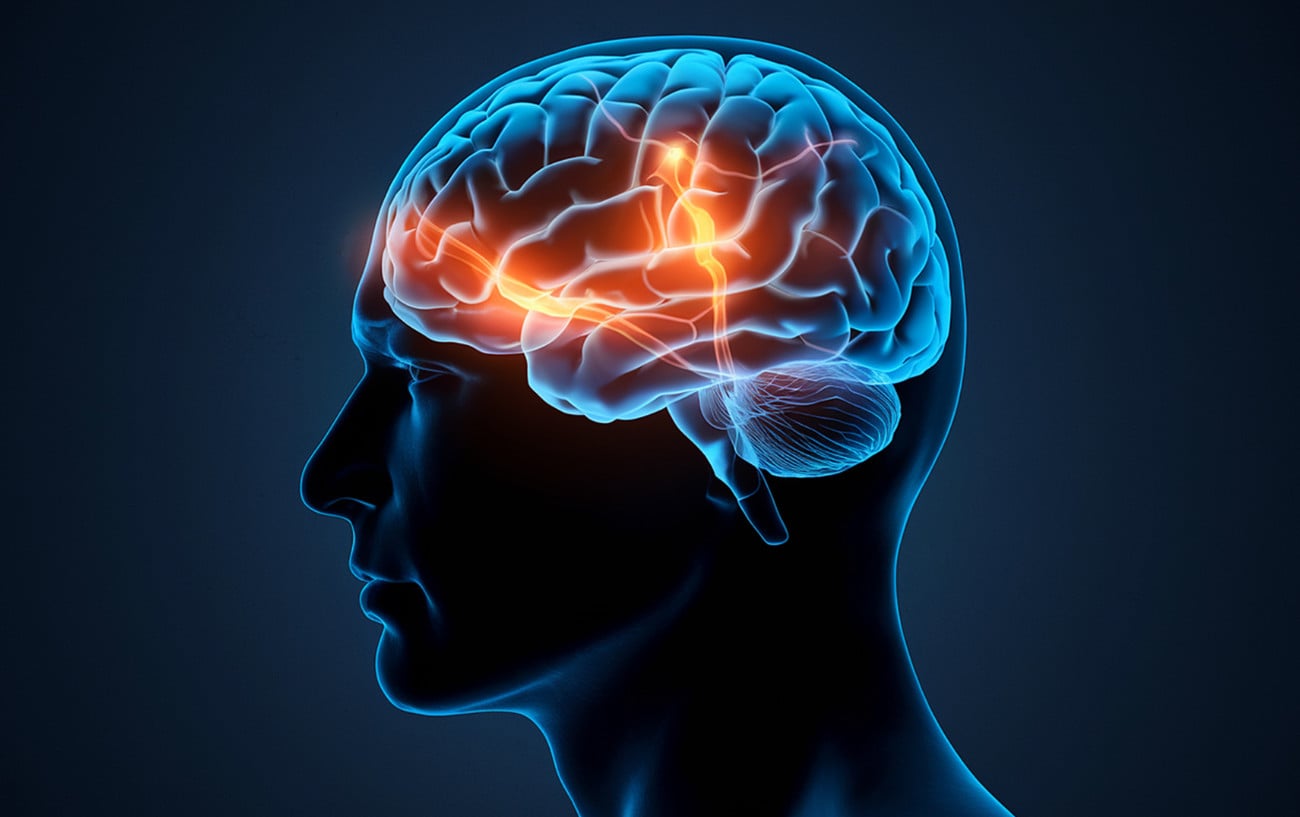
The motor cortex helps drive movement. The prefrontal cortex contributes to pacing, motivation, cognitive control, and interpreting effort. The combined condition was designed to influence both sides of that equation.
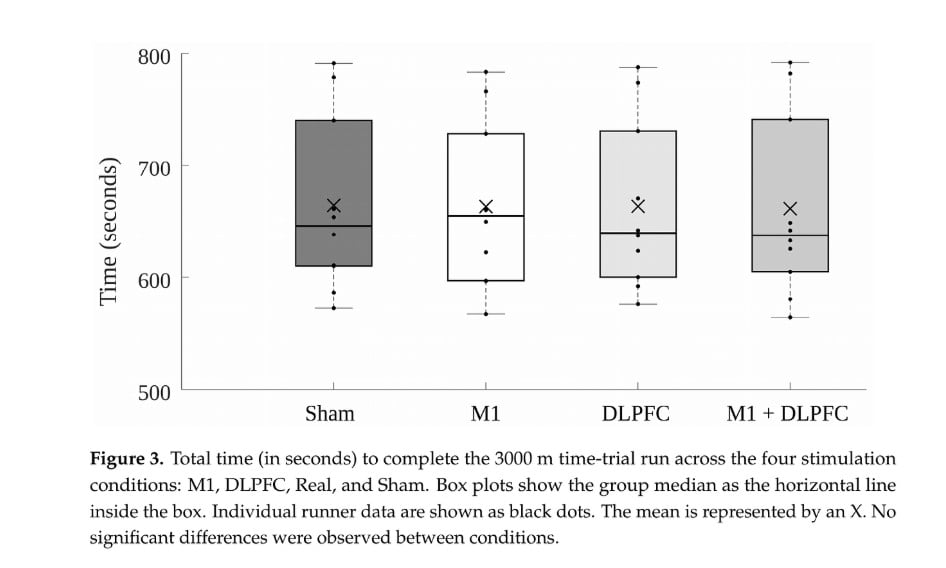
Brain stimulation did not produce a statistically significant improvement in total time.
- Average finishing times were 11:04 after sham, 11:03 after motor-cortex stimulation, 11:03 after prefrontal stimulation, and 11:01 after combined stimulation.
- Seven of 10 runners were faster after the combined condition than after their own sham trial.
The pacing data were more interesting. After combined stimulation, runners were faster on the first lap than after prefrontal stimulation alone. They also began with a shorter stride time and a higher step frequency (cadence) than after motor-cortex stimulation alone. Seven of 10 runners showed both of those early gait changes relative to sham.
But the early speed came with a possible trade-off. The combined condition had the largest slowing through the opening and steady-state phases, and the sham condition was actually faster in the final lap. Ratings of perceived exertion were virtually identical among conditions and rose to about 19.5 out of 20 by the finish.
What this means for runners
This is a fascinating mechanism study, not a reason to book a brain-stimulation session before your next race. The main performance outcome didn’t improve, and the clearest effect may have been a pacing change rather than increased capacity.
Feeling no harder does not always mean you are pacing better. A tool that lets you start faster—whether it is stimulation, music, caffeine, or race-day adrenaline—can simply move effort earlier in the race.
References
RunClub — Free
Join 300,000+ runners in RunClub
Free training plans for every distance, a daily running game, exclusive coaching content, and a real community of runners. Create your free account in 20 seconds — no card.
Already a member? Log in →










Start the conversation