


A decade ago, telling a marathoner to consume 90 grams of carbohydrate per hour sounded aggressive. For many runners, even 60 grams per hour felt like a lot (maybe it still does).
Now, endurance fueling is moving fast. Elite cyclists are experimenting with 120 grams, 150 grams, and even 200 grams per hour. And runners—especially marathon and ultra runners—are also embracing the wave of high-carb fueling.
That’s the backdrop for a new review article, From Metabolism to Medals, which revisits carbohydrate guidelines for endurance athletes and asks if the old fueling recommendations are still enough.
The short answer… 90 grams per hour should probably no longer be viewed as the universal ceiling.
The authors argue that, for trained athletes, the upper evidence-based range may extend closer to 120 grams per hour, especially when using multiple-transportable carbohydrates like glucose-fructose or maltodextrin-fructose blends.
But they are careful not to turn this into a “more is always better” message. The real goal is not to win the carbohydrate-per-hour contest. It’s to deliver enough usable fuel to support the intensity and duration of your event without overwhelming the gut.
Context is key.

Why Carbohydrates Matter During Long Runs and Races
Carbohydrates are the body’s high-performance fuel.
Fat is incredibly important for endurance, especially over long durations. But carbohydrates can support higher rates of energy production and tend to be more oxygen-efficient (you get more energy per molecule of oxygen when burning carbs vs fat).
During prolonged exercise, carbohydrate intake helps performance in several ways:
- It helps maintain blood glucose.
- It can spare liver glycogen (our body’s stored sugar).
- It supports higher rates of whole-body carbohydrate oxidation.
- It may modestly reduce muscle glycogen use, especially in running.
- It helps preserve the ability to sustain higher intensities late in exercise (enhancing your “durability).
Fueling is not just about avoiding the dramatic “bonk” (“hitting the wall” for those of us on this side of the pond). It is about delaying the slow metabolic drift that happens when carbohydrate availability falls and the body has to rely increasingly on fat oxidation.
That shift is not inherently bad, but when you are trying to race fast, losing access to high-rate carbohydrate metabolism can make goal pace feel progressively less sustainable. You don’t want to be a better “fat burner” when performance is on the line.
The “Crossover” Problem
During prolonged exercise, the body gradually shifts from carbohydrate toward fat as the dominant fuel source. This occurs at something called the “crossover point.”
In easy aerobic running, that is fine. But during a marathon, hard long run, or ultramarathon effort with climbs and surges, maintaining carbohydrate oxidation becomes critical. We want to delay the crossover point for as long as possible (or prevent it altogether).
In cycling studies, consuming 45 or 90 grams of carbohydrate per hour delayed the crossover point. But 120 grams per hour prevented it during a three-hour steady-state ride at a high intensity. The athletes were able to keep carbohydrates as the dominant fuel source for longer.
For runners, this matters because late-race fatigue is often not just muscular. It is metabolic. You may still have the fitness, but if carbohydrate availability drops too far, your ability to express that fitness declines. The same effort produces less speed. In other words, carbs enhance “physiological resilience“.
The effects of carbohydrate ingestion during exercise on the contribution of carbohydrates and fat to substrate metabolism.
What the Running-Specific Research Shows
The most relevant running data in the review come from elite male marathoners, all with personal bests under 2:30. They completed a two-hour treadmill protocol close to marathon intensity while consuming 60, 90, or 120 grams of carbohydrate per hour.
The 120-gram-per-hour condition produced:
- Higher whole-body carbohydrate oxidation.
- Higher exogenous carbohydrate oxidation, meaning more of the ingested fuel was actually being used.
- A roughly 3% improvement in running economy compared with 60 grams per hour.
- Greater carbohydrate contribution to total energy expenditure late in the run.
That running economy finding is especially interesting. A 3% improvement is not trivial in marathon terms (that’s about what you’ll get from a pair of super shoes). It suggests that higher carbohydrate availability may reduce the oxygen cost of running at a given pace, at least in this controlled setting.
But there was one catch: unsurprisingly, GI symptoms were also higher at 120 grams per hour. Nausea, stomach fullness, and cramping were worse in the highest-carbohydrate condition. That really is the central tension of modern fueling when you think about it. More carbohydrate may offer a metabolic advantage, but only if your gut can absorb and tolerate it.
The effects of carbohydrates (60, 90, and 120 grams per hour) during running on whole-body carbohydrate use (A), exogenous carbohydrate use (B), and running economy (C).
Sugar Type Matters
Once runners push beyond about 60 grams per hour, carbohydrate type becomes increasingly important. Here’s why.
Glucose and maltodextrin rely primarily on one transporter inside the gut known as SGLT1. Fructose uses a different transporter known as GLUT5. Combining glucose or maltodextrin with fructose allows the gut to absorb carbohydrate through multiple pathways, which can increase the amount of carbohydrate we absorb and can use during exercise.
This is why many modern high-carb gels and drink mixes use glucose-fructose or maltodextrin-fructose blends. A fructose-to-glucose ratio somewhere between about 0.6 and 1.0 may be optimal for higher carbohydrate intakes. That means blends like 2:1, 1:0.8, or 1:1 are all in the conversation, depending on the product and your individual tolerance.
For lower intakes, this matters less. If you are taking 30–50 grams per hour, a glucose or maltodextrin-based product may work perfectly well. But if you are trying to hit 80, 90, or 100+ grams per hour, a dual-source carbohydrate strategy becomes much more important.
The effects of the fructose-glucose ratio on rates of exogenous carbohydrate oxidation during exercise.
The Gut Is Trainable (But It Has Limits)
For runners, the gut is often the limiter when it comes to increasing carbohydrate intake. Cycling allows for more stable feeding, unlike running, which adds mechanical jostling, reduced gut blood flow, heat stress, and higher rates of GI distress.
The encouraging part is that the gut adapts. This happens through “gut training,” where athletes repeatedly practice carbohydrate intake during training runs and workouts. Across studies using 30–90 grams per hour, gut training generally reduced discomfort. The evidence is less clear that gut training dramatically increases carbohydrate oxidation itself (you may not necessarily be able to train to “use more carbs”), but it does appear to improve tolerance and reduce symptoms of poor carbohydrate absorption.
Practically, this means you should not wait until race day to test high-carb fueling. The long run is for the gut as much as it is for the legs.
A smart progression might look like this:
- Start with your current comfortable intake.
- Increase by 10–15 grams per hour every couple of weeks.
- Practice during long runs and marathon-pace workouts, not just easy runs.
- Use the same products, timing, and fluid strategy you plan to use on race day.
- Back off if symptoms become severe, then rebuild more gradually.
The key is finding the highest effective intake that you can tolerate while still running well.
Bigger Is Not Always Better
Body size, exercise intensity, training status, and individual gut physiology may all influence how much carbohydrate an athlete can use. Larger athletes may use more exogenous glucose than smaller athletes, but body size does not explain everything. There is still meaningful individual variation.
One proof-of-concept study showed that when researchers measured individual exogenous glucose oxidation and then prescribed a personalized dose, athletes could consume less carbohydrate while achieving similar oxidation rates. The average personalized intake was about 65 grams per hour, roughly 28% lower than 90 grams per hour, yet it produced similar peak exogenous glucose oxidation.
For some runners, 90–120 grams per hour may be useful. For others, 60–75 grams per hour may be enough. And for many recreational runners, the biggest win is simply moving from underfueling to consistently fueling at all.
Practical Recommendations for Runners
Here is how I would translate this review into real-world fueling targets.
Runs Under 60 Minutes
Most runners do not need carbohydrates during these runs, assuming you’re starting reasonably fueled. Water may be enough, and for easy runs, even that depends on heat, duration, and sweat rate. Of course, if you enjoy fueling and think it helps, be my guest.
Good target:
- Consider carbs only if the run is very intense, done after fasting, or part of a two-a-day setup.
Runs of 60–90 Minutes
Fueling becomes more context-dependent. For easy runs, you may not need much. For workouts, progression runs, or long marathon-pace segments, some carbohydrate can help preserve quality.
Good target:
- 0–30 grams per hour for easy aerobic runs.
- 30–45 grams per hour for harder sessions (e.g., intervals or tempo runs) or race-specific work.
Runs of 90 Minutes to 2.5 Hours
This is where many runners should start taking fueling more seriously. Underfueling here can compromise workout quality, recovery, and the ability to practice race-day nutrition.
Good target:
- 30–60 grams per hour for most runners.
- 60–75 grams per hour for harder long runs or marathon-specific workouts.
- Practice with the same products you might use in racing.
Marathons
For marathoners, especially those racing hard, 30 grams per hour is probably too low. Many runners would benefit from building toward 60–90 grams per hour. Advanced or well-trained athletes may experiment with 90–120 grams per hour, but only after practicing it extensively in training first.
Good target:
- 60–90 grams per hour for many marathoners.
- 90–120 grams per hour for well-trained, gut-trained runners with a clear performance reason.
- Use glucose-fructose or maltodextrin-fructose blends when pushing above 60–70 grams per hour.
Ultramarathons
Ultra fueling is more complicated because intensity, terrain, heat, aid station access, and taste fatigue all matter. The review suggests that many ultra-runners consume less carbohydrate than guidelines recommend, often because of GI distress, logistics, or flavor fatigue. But higher carbohydrate intake is associated with better race completion and performance.
Good target:
- 60–90 grams per hour for many competitive ultra-runners.
- Higher intakes may be useful for some athletes, but they require gut training and careful product selection.
- Use a mixed-format approach: drinks, gels, chews, and some low-fat, low-fiber solid foods.
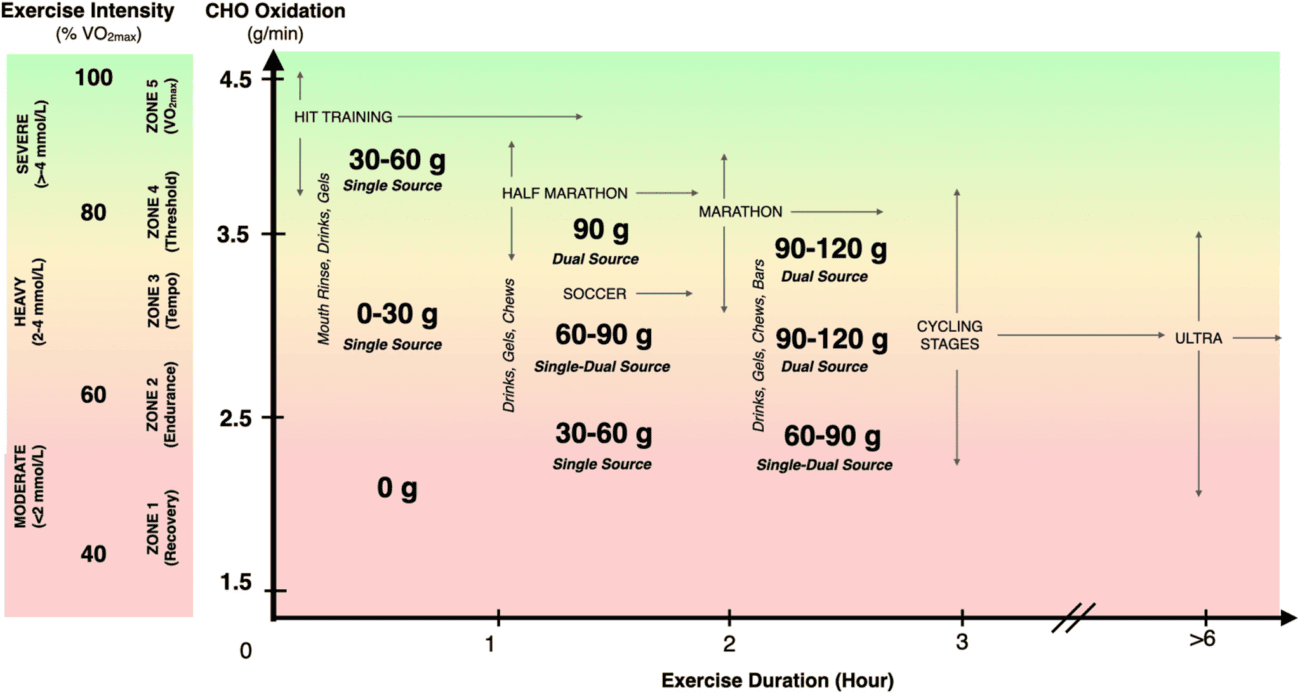
A practical fueling guide for endurance athletes.
What This Means for Runners
Fueling should be treated like a trainable performance skill.
The biggest takeaway from this review is that runners should stop viewing 90 grams per hour as an extreme number and start viewing it as a realistic target for certain long, hard events, especially marathons and ultras, provided the gut has been trained to handle it.
From my vantage point, the discussion around high-carb fueling really is changing in the running world, and that’s exciting for many of us, but the first step is not chasing 120 grams per hour right away (though it’s tempting). It is getting from inconsistent, underplanned fueling to a reliable 45–75 grams per hour in long runs and races.
From there, serious marathoners and ultra-runners can experiment with higher intakes using dual-source carbohydrates, practiced timing, and enough fluid to support absorption.
I would not recommend jumping straight to the high numbers being discussed in elite cycling, but I do think the bigger mistake for runners is usually underfueling out of habit, fear of GI issues, or outdated ideas about “training the body to burn fat.” I’m as guilty of this as anyone.
Train fat oxidation in the right sessions, but on race day, give your body the carbohydrate it needs to actually use the fitness you built. The way I like to phrase it is that high-carb fueling allows you to fully “unlock” your race-day potential.
One critical note…
This review is exciting, but it is not the final word. Much of the high-dose carbohydrate research still comes from cycling, male athletes, and controlled lab settings. Female athletes remain underrepresented, and the authors explicitly highlight the need for more research on elite women and in real-world running conditions.
The future of fueling is better-matched carbs—the right dose, the right blend, the right timing, the right format, and the right gut preparation for the demands of the race. And that’s an experiment each of us has to run (pun intended) for ourselves.
RunClub — Free
Join 300,000+ runners in RunClub
Free training plans for every distance, a daily running game, exclusive coaching content, and a real community of runners. Create your free account in 20 seconds — no card.
Already a member? Log in →












Start the conversation