

Going Far, Part 10
Going Far When a visit to Pre’s Rock really means something. Part 10. BY JOE HENDERSON
M41. The performer
OUNTAIN VIEW, CALIFORNIA, May 1975. Distance runners tend toward undemonstrative introspection—a shy wave to accept cheers, a self-effacing comment to reporters. Steve Prefontaine wasn’t typical, which is why he would be remembered so well for so long after his last race. Prefontaine was a performer.
There had been and would be faster runners, but none so skilled at exciting crowds. A performer needs a stage and a crowd the way an artist needs paint and canvas, and Prefontaine had the ideal place and people in Eugene. Nowhere in this country is our sport as major as here.
Janet Newman Heinonen’s early career as a Eugene-based writer paralleled Prefontaine’s as a runner. She knew him better than other writers and could penetrate his brash shield. One of her articles about him started this way: “The image-makers have been hard at work on Steve Prefontaine, as they are on all athletes needing simplifying and classifying. The picture they paint of Steve is one of a cocky kid running around with a large chip on his shoulder, daring anyone to knock it off.”
This interview showed a quieter and more thoughtful Prefontaine. He talked of himself as a stage performer: “I think I have rapport with the people here in Eugene because being out there by myself, I’m an actor in my own way. If I make a good performance and the people appreciate it, I appreciate their support. It’s a two-way thing. If someone likes a painting on the wall, they smile. If someone likes what I did, they’re going to smile or clap or respond.”
The Eugene crowds responded to him with near mania, but the people there also knew him as a fallible individual. “I like to talk with people and have them accept me as Steve Prefontaine, the human being who lives in Eugene, Oregon—as compared to Pre the athlete, the person who runs.”
▲
No American track runner, then or since, played better to an audience than Steve Prefontaine.
Update: Pre views Much was expected of Steve Prefontaine between the 1972 Olympics, where a medal barely escaped him, and 1976, when he would be so much more mature and experienced. But by the Montreal Trials we were left to wonder what might have been. And by then an informal shrine to Pre occupied the spot where his sports car had crashed.
Pre’s Rock later became the smallest city park in Eugene, a 20-foot strip protected from developers. Street signs, a target for souvenir hunters, point the way there between thefts. A metal monument, created by prisoners at the Oregon State Pen, marks the point of impact. On the rock itself is a hand-painted “PRE, 5-30-75, RIP.”
Pilgrims leave memorabilia ranging from race numbers to racing shoes. Pre worship is amazingly enduring. It hasn’t waned over the years but grown, egged on by Nike plus two theatrical movies and a documentary (“Fire on the Track,” which is better to me than either of the full-length films). Adults who never knew of the living Pre now visit the spot where he breathed his last. Kids who weren’t born when he died have elevated him to running sainthood.
A University of Oregon professor, a runner himself, examined the Pre phenomenon for an academic paper. Dan Wojcik’s focus was Pre’s Rock and what draws the faithful there. Dan asked for my thoughts about that spot. My reply: “I’m happy it’s there but don’t feel compelled to visit except when out-of-town guests ask to see it. Making a pilgrimage to the spot where he died strikes me as slightly maudlin. I’d rather celebrate at the spot where he lived to his fullest. That, of course, is Hayward Field [less than two miles from Pre’s Rock]. I’d like to see a Prefontaine statue there, perhaps alongside Bill Bowerman’s.”
Courtesy of Joe Henderson
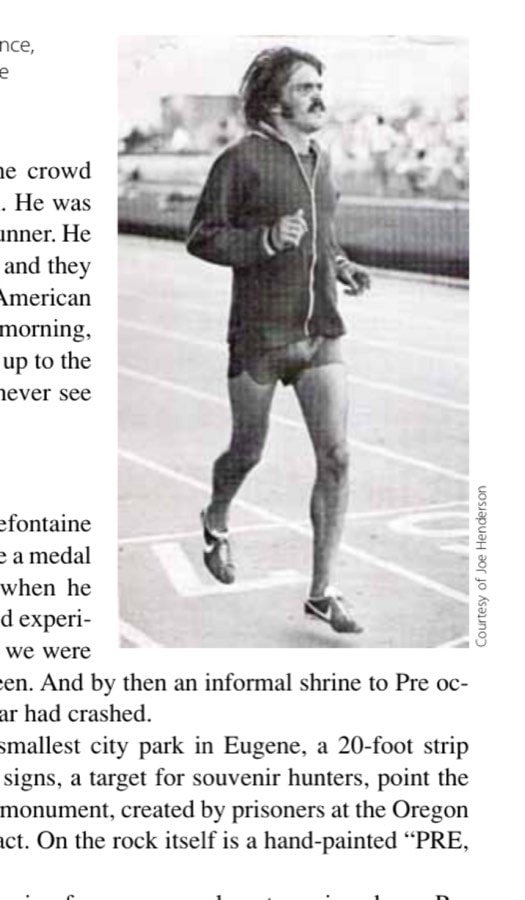
On May 29, 1975, the Eugene crowd came to watch him perform again. He was 24 years old, still not peaked as a runner. He brought out the best in the crowd, and they from him, by coming close to his American record for 5,000 meters. The next morning, his people and the rest of us woke up to the news that he was gone. We may never see another runner like him.
This is my Pre view. Another, better one comes from someone who knew well this runner I never met. At the time when Dan Wojcik asked me about Prefontaine, I was paying my annual visit to Jeff Galloway’s running camp near Lake Tahoe. Jeff has come there every summer since the mid-1970s, first to train himself and later to direct his camps.
He and Prefontaine had been teammates on the 1972 Olympic team, running different distances. “We planned to train at altitude together in the summer of 1975,” Jeff told me. “I was already at Tahoe when I heard about his death.” He drove immediately to Eugene. Once there he was drawn to the Rock, much as runners have been ever since. “There I picked up a broken piece of headlight from his car,” said Jeff. “I kept it in my own car for a long time, then forgot to remove it when we sold the car for junk. I’ve always regretted that.”
Jeff had something else from Pre that he thought was gone. Recently he unearthed Prefontaine’s business card from Nike. “He gave me this card the last time we saw each other, two weeks before he died,” Jeff said. “He was very proud of his new title, National Director of Public Affairs.”
Jeff now handed me a photocopy of the card. On the same page were two photos of these runners and others. The inscription above Jeff’s signature read, “Great memories, with friends.” He asked, “Would you leave this at Pre’s Rock for me?” I did. This was my first visit to that shrine in more than a year. And it was the most significant, since it delivered a message from someone who knew Steve Prefontaine as he really was.
42. The highest MANITOU SPRINGS, COLORADO, August 1975. High points in a runner’s life take many forms: the fastest time, the longest distance, the races won, the records set. I had already gone as high as I could in those ways that runners usually judge success. But I could still go higher—literally. The chance came when Don McMahill invited me to his Camp Crockett in the Colorado Rockies.
While walking out of the Colorado Springs airport, Don motioned toward the highest point on the horizon and said off-handedly, “That’s Pikes Peak. Runners will be climbing it on Sunday.” I hadn’t planned to be among them, which was fine with him. “If you write anything about our camp,” he said, “please don’t give the impression that it’s a Pikes Peak training center. Runners come to Crockett for lots of other reasons.”
The camp brought together high school runners, college men, women, masters, fitness runners. But the camp remained intimately linked to Pikes Peak, both for the nearby location and its same-week timing. Some campers came specifically for this climb. Others ended up on the mountain in spite of themselves. I came to camp only as a speaker but caught the “mountain fever” that was going around.
My entry came too late for any training on the mountain or at this altitude. The ascent started almost as high as I had raced before, then went up almost 8,000 more feet to peak at 14,115. Joan Ullyot, a veteran of this course, oriented me by saying, “The trail near the top alternates between loose gravel and boulders. Almost everyone walks at this level, and 30-minute miles are not uncommon. Expect to take as long to do the half-marathon to the top as you’d normally need to finish a marathon.”
Rick Trujillo, the king of this mountain, had won here the past two years and would again this time. He told the campers, “The secret for me is that I try to maintain my equilibrium at all times. I try to keep my breathing normal. If I get tired, I slow down. Near the top I may walk for 20 or 30 steps until I feel like running again. And I stop and drink every chance I get. I don’t try to keep an even pace. On the mountain every step is different from every other.”
I learned that my breathing wouldn’t be normal here even if I lay down. Near the top I ran 20 to 30 steps, if that, between long walks. The last mile took most of the half hour that Joan Ullyot had promised, and the 13-mile climb took full marathon time plus a little more.
After finishing I sat down on a rock, looking down on Manitou Springs and out toward Kansas while trying not to be sick. (That would come later, on the car ride down the switchback road.) I felt little sense of triumph over this mountain. It had granted temporary visiting privileges, which I gratefully accepted.
The view was spectacular from the peak. But I knew after so hard a climb that I wouldn’t be back soon (or ever, as it turned out). And I knew that I couldn’t stay very long in air so rare. All the hard-to-reach peaks are that way.
Update: Running high No official times were taken at a 1991 race in Utah, and its distance was a guesstimate. But I know I had never run slower for any distance. True, a long-ago climb up Pike’s Peak was slower, but it doesn’t count because oxygen starvation above the tree line slowed me to anaerobic walking. In the Utah race my running never stopped but was slower than anyone else’s that day.
So if this run seemed to go so poorly, why did I feel so good about it? Because I chose not to dwell on how low I had sunk but to revel in how high I had climbed, in elevation. I was spending a long weekend at Brian Head, a ski resort in southern Utah. Tom Miller’s running camp based here ended with a small race called the “Anaerobic 10K.” It used to be known, through a clever juggling of letters, as the “Brain Dead Run.” But the image-sensitive management of the ski area protested that name.
The 10K applied more accurately to elevation—entirely above 10,000 feet— than to the distance. No certifier had ever laid a wheel on this course, and none ever would if camp director Tom Miller could stop it. He urged runners to leave
their watches behind. “Times don’t mean anything if you don’t know the exact distance.” He added that “the idea here is to take your attention away from the end result and focus on every step of the run.”
Not that we had much choice. Our immediate concern was sucking in enough air going uphill (a thousand-foot climb in the first half, with one-third less oxygen per gulp of air than at sea level), then stepping lightly over rocks and ruts on the way down.
Afterward Tom Miller observed, “Look how different this is than the usual finish-line scene. No one is asking how fast anyone else ran or moaning about not running fast enough. Everyone thinks they ran as well as they could have today.”
The mountain reduced running and runners to their simplest terms. It made us focus on the run itself instead of the end point. Then it let us celebrate a natural act well done instead of letting a numerical result brand us as “too slow.”
43. The talk-doc MOUNTAIN VIEW, CALIFORNIA, October 1975. Life doesn’t necessarily begin at 40. It can begin again whenever we come to a major turning point and choose to take a new course—or courses. That happened for George Sheehan at 44 when he returned to running and soon began racing as a master . . . again at 48 when he began writing a newspaper column . . . again at 51 when he began contributing to Runner’s World . . . again at 55 when he began speaking on the running circuit.
He became fast enough in running to set a world mile record for men 50 and older. He became good enough at writing to lead Larry Merchant of the New York Post to say, “The best practicing athlete-journalist may be George Sheehan.” His columns led in 1975 to his first book, Dr. Sheehan on Running. What follows is my foreword to that book:
George Sheehan is a physician, and his patients think he’s one of the best. Yet “doctor” is one of the last things I think of when I picture George. Runner, yes. Writer, absolutely. Practicing eccentric, to be sure. Dressed in long johns and ski mask, he once ran past a family moving into his neighborhood. They stared at him. He shouted, “Go back! Everyone in this town is crazy!”
He doesn’t fit the white-coat image of a doctor. He shuns the title, language, appearance, and conventions of his profession—dealing, Larry Merchant wrote, “as much with the metaphysical as the physical.” In a field that trains its people in scientific reasoning and laboratory-tested fact, George ventures guesses and trusts what he learns in his “experiment of one.” More cautious doctors who read what he writes sometimes criticize him for this. That’s OK, he says, because he has criticism for them in return. “The doctor is educated in the treatment of disease,” he says, “not in health.”
George Sheehan was meant to write, and we were fated to get together. I was the new editor of Runner’s World in 1970, and George was fairly new to writing. When I asked him to write for RW, he said, “Ask for readers’ medical questions and I’ll answer them. Print some of the better ones.” His “Medical Advice” column appeared in the first issue I edited.
Letters eventually arrived by the dozens each week, and George answered them all personally . . . plus writing a weekly column for a newspaper (the Red Bank Register) in the New Jersey town where he practiced medicine. The best of these found a second home in Runner’s World, and most of the essays in the On Running book originally ran in RW.
George lives across the country from me, and I hear from him by letter or phone almost every workday. But only twice had we gotten together to talk in recent years. Both times he was speaking at sports-medicine seminars. At the first, he said, “I’m not here as a doctor but as an athletes’ representative.” And he talked athlete-to-athlete and athlete-to-doctor, not doctor-to-doctor.
I noticed then how little importance he gave to appearances. He wore a faded blue shirt with a frayed collar. A paper clip held his narrow tie in place. Later his speaking uniform became even less formal. He wrote, “I now wear skin-tight Levis, over-the-calf hose, old running shoes, and a cotton turtleneck shirt. Anything added to this is simply for concealment.”
The second time I heard him speak, he had lost his reading glasses ($2 Woolworth’s specials), and so he spoke without notes. The talk was to be on heart abnormalities of athletes, but he barely brushed that subject. Instead he spun out the Sheehan Philosophy: the same thoughtful, personal messages that filled his new book. The audience, numbed by a day and a half of clinical lectures, loved what George had to say.
No one’s views carry more weight with the current generation of runners than George Sheehan’s. Frank Shorter, the Olympic Marathon champion, paid George a backhanded compliment when he complained about his own conversations with runners. He said, “I don’t want to talk about Dr. Sheehan all the time.”
Courtesy of Joe Henderson
▲
George Sheehan spoke with wisdom and humor, and he sometimes bared his soles to make a point.
George isn’t for everyone, but his writing does have wide appeal. He phrased what might have been an answer to Shorter and a statement to his own readers: “For every runner who tours the world running marathons, there are thousands who run to hear the leaves and listen to the rain, and look to the day when it all is suddenly as easy as a bird in flight. For them sport is not a test but a therapy, not a trial but a reward, not a question but an answer.”
Update: By George Early in his On Running book George Sheehan explained his penchant for quoting the master thinkers of history—from Socrates to Santayana—in his own writing and speaking. “My family rarely gives me any credit for original thought,” he wrote. “When a topic comes under discussion at the dinner table, someone is likely to turn to me and ask, ‘What would Bucky Fuller say about that?’ ”
He continued, “I am living proof that you can go through the world on borrowed words. Whatever happens, there seems to be someone who has already expressed my reaction to the event much better than I could. So I find it difficult to speak without giving voice to someone else’s words. I quote them because they said so well what I was thinking. They described my experience, my personal truth, in miraculously right words.”
In the process of becoming the best-loved writer and speaker in running, George himself became a valued source of quotable quotes. He gave voice to what other runners thought or felt or sensed but couldn’t find the words to express as well as he did. Name any subject related to the running experiences—and many subjects far removed from sports—and this master thinker had found just the right words to describe it. His friends and fans would ask themselves, “What would George Sheehan say about that?”
To a wordsmith the ultimate form of flattery isn’t imitation of his style. It’s repetition of his words.
44. The eccentric MOUNTAIN VIEW, CALIFORNIA, November 1975. To make a break from traditional training methods is to invite controversy. Australian coach Percy Cerutty so relished the role that he named one of his books Mr. Controversial. He courted his iconoclastic image to the end.
I first met him near that end, long after he had coached Herb Elliott to world records and Olympic gold. That training had featured sandhills and barbells and a diet centering on raw oats and raisins. At least that’s what I thought Elliott did while I read tantalizing snippets about him from half a world away.
Cerutty (pronounced like “sincerity,” without the “sin”) had lost none of his combativeness at nearly 80. He acted more like a former prizefighter than a
longtime long-distance runner. Larry Myers, a freelance coach and writer who had visited Cerutty’s Portsea training center and collaborated with him on a book, now arranged an interview in my office. Myers almost shouted as he introduced us. “Percy, I’d like to have you meet . . .”
The thin little man with white hair, which contrasted sharply with his tanned skin, glared at me. I stuck my hand out and said, “I’m honored . . .” He cut me off with, “Never offer your hand to a man older than you and with a better reputation.” Then he turned as if looking at an invisible partner and spat, “Americans! Hopeless bastards!”
Cerutty paced the room for a few seconds, then exploded with a flurry of gestures. Rage burned from his deep-set eyes as he fixed them on me before proclaiming, “I never touch another man. It nauseates me. Only homosexuals shake hands.” When he sat down, I tried to ask my first question. He put his hand to his ear and ordered, “Speak up. I’m partly deaf. I can’t understand the way you bloody Americans talk. You mutilate the language. Hopeless bastards!”
Deaf or not, it was impossible to converse with Cerutty. He either couldn’t listen or wouldn’t. Talking with him was like trying to communicate with a recording, one littered with all-purpose expletives. I asked no questions as he winged away on his own. He picked up a copy of Runner’s World, leafed through it, then tossed it across a table while proclaiming, “This magazine nauseates me. The pictures. The way all these people run destroys the mind. Better dead than run this way. Hopeless bastards!”
He bolted out of his chair and paced some more, then launched another outburst: “You think I should feel honored to be here. I’m not honored. This place nauseates me. It makes me sick. Your [U.S.] runners make me sick. America makes me sick with its feminine men, garbage food, car fumes. Hopeless bastards! Better dead!”
Cerutty railed on. The office door was closed, but by now his voice filled the building and work had all but stopped as the staff tried to listen in. “America’s a dying country,” he shouted. “There won’t be any more Americans in 40 years.
ad
The men are dying like flies from heart attacks. The men aren’t real men. Hopeless bastards!” Without warning, he launched into a demonstration of running form. “Running isn’t like that,” he said while pointing to a photo on the wall. “It’s like this. Run like a killer. I’m a killer. Aaarrrggh!” (He pounded the wall with both fists, and Bob Anderson in the next room said later, “I thought he was coming right on through.”) “I’m a real man! I’m not going to die!”
This rant embarrassed Larry Myers but didn’t surprise him. As he left with Cerutty, Myers recalled a recent almost equally raucous television interview in which the old man admitted that he might die someday. He said, “I expect to be killed at 105 by a jealous husband.” The supposedly deaf Cerutty heard this and gave his only, ever so slight smile in our time together. I was left to wonder: Was this all an act?
Update: Percy’s obit Percy Cerutty died not long after I wrote this article, from a stroke, at 80. He didn’t live as long as he had expected, go the way he had hoped, or do as much as he had wanted. Few people ever do. But the fighter in him gave him 40 extra years when he did his best work.
Cerutty proudly told—over and over again—how wasted he was in his early 40s. To hear him tell the story, he was just a few steps shy of the grave before deciding to remake himself. He began walking and then running long distances, and lifting weights, and eating naturally.
Exercise itself wasn’t enough, so he competed in ultradistance running, racewalking, and weight lifting. He raced into his 50s, and in his 60s still ran the sand dunes with Herb Elliott and the boys. In his 70s Cerutty could still break seven minutes for a mile.
All along, he read widely, bringing together his knowledge and experience to form a method, a philosophy, a mystique. He wrote rambling but powerful prose and sent samples to Runner’s World, the magazine he claimed to loathe. He hoped to interest RW in publishing the “dollar books” that he intended to write. He wanted to produce 100 of them and was sure he had enough time and material to do that.
Time ran out on him before he had done a fraction of that writing. When I met him, his tough front seemed barely to hide his failing body, mind, and spirit. His fight that day wasn’t with me, with the magazine, or with American men. This was an old man fighting to hang tough for a few more rounds.
45. The week PALO ALTO, CALIFORNIA, January 1976. We run one step at a time, one day at a time. And only at odd moments do we stop, look back, and reflect on how
Courtesy of Joe Henderson
far we’ve traveled. Only then do we gain a sense of all that has happened in the miles and years between then and now. Runner’s World turned 10 years old in 1976. Founder-publisher Bob Anderson’s first idea was to host a one-night celebration with dinner for, talks by, and awards to the people who had most helped him start and continue his magazine. But Bob seldom settled for small ideas. He said in a staff meeting, “It’s self-centered just to get together and pat ourselves on the back. Instead, why don’t we open this up to everyone and celebrate running? Look at all that has happened in the sport since 1966. We should honor the people who’ve been most responsible.”
The planning wasn’t far along before Bob realized that everything he wanted to do wouldn’t fit into a single night. As it turned out, seven nights and days could barely contain it all. He christened this event National Running Week, which now merely ended with the awards dinner that was to have been the whole show.
Running and hearing about the trends and techniques of running filled the previous six days. The final night brought the party, where runners celebrated how far we had come as a sport in these 10 years. Seated with me near the stage was one table of award recipients.
Jim Ryun had set his first world mile record in 1966, at age 19. Peter Snell had lost his world mark the year before and had put running behind him (he thought). George Young, twice an Olympian, was undecided whether to push on for a third. Kenneth Cooper, a military doctor, labored anonymously to learn what type of exercise worked best, and why.
In 1966 and beyond, Ryun lowered the mile record twice. Snell started college as an overaged freshman, earned a doctorate in exercise science—and returned to running. Young made his third Olympic team, then his fourth—in three different events. Dr. Cooper’s Aerobics book helped spark a running revolution.
At a nearby table that night, RW assistant editor Dave Prokop hosted another group. Ten years earlier he had worked for an insurance company in Ontario. With him now sat the sport’s philosopher laureate George Sheehan, runningphysiology pioneer Dr. David Costill, the sport’s senior writer Hal Higdon, and masters promoter David Pain. Each had their own how-far-I’ve-come stories.
▲
A torch relay from San Francisco to Palo Alto opens National Running Week.
In 1966 Bob Anderson, an 18-year-old high school senior, had worked alone in his bedroom on the first issue of his magazine. Seventy-three issues later he hosted this entire event and sat with Nike cofounder Bill Bowerman, ultrarunner Ted Corbitt, Boston’s irascible Jock Semple, and the woman he had inadvertently made famous, Kathrine Switzer. Those two had long since made peace.
In 1966 Kathrine Switzer, a college student, was a year away from “integrating” the Boston Marathon. Switzer then became a lead activist in the women’s running movement. She now was MC of the awards-giving. Her opening statement: “
It’s really incredible how far running has come in the last 10 years. Hundreds of people who wouldn’t have considered jogging a few years ago are now racing. Racers, once considered mysterious athletic phenomena, are now our companions. Women’s distance running has really only been born in the last decade, and that’s an infant which has grown beyond even my brazen hopes. “
It’s almost hard to imagine those times of only a few years ago. Remember running those marathons that were actually 23 to 30 miles in length? Remember eating steak before a race? Remember believing that women who ran over a mile would never have babies? “
Why, how, and that, in fact, running has changed and grown into the sport it is today is why we’re all here tonight. We’re here to meet and honor those people who brought about the changes. But as we do this, let us be aware of how much we have yet to learn, and what Runner’s Night 1986 might be like.”
Update: Home grown Some 5,000 runners took part in one activity or another on the San Francisco peninsula that week. And without any special encouragement from us, National Running Week events sprang up spontaneously in other parts of the country— including one that had figured in my becoming a runner.
In early 1966, I was out of college, just free from Army active duty and new to a newspaper job. Ex-runner friends asked me, “Why are you still running?” Most of them had quit at high school graduation and nearly all of the remaining few on the last day of college. At 22, I already felt old and almost alone while running the streets of Des Moines, Iowa. One reason I left there was to find other runners like me.
Lots of miles passed under my feet in the next 10 years. They led to places I couldn’t have imagined going in 1966. By the Running Week, I didn’t feel old anymore and certainly not alone. No one had to be alone, except by choice.
That week my mom sent a clipping from the Des Moines newspaper where I used to work. It announced “a distance derby at Drake Stadium on Saturday as part of National Running Week activities.” Even the runners in my old hometown weren’t alone anymore. Going Far will continue in our next issue.
This article originally appeared in Marathon & Beyond, Vol. 18, No. 2 (2014).
← Browse the full M&B ArchiveMore like this
1,000+ stories from 19 years of Marathon & Beyond
The complete archive of the legendary long-distance journal — digitized and free to read.
