

Going Far, Part 9
Going Far Some genes take their time showing themselves. Part 9. BY JOE HENDERSON
36. The daughter
SANTA CLARA, CALIFORNIA, November 1973. Some stories are better told in first draft, in words written when the experience was new, before time edits the memories and the lines. This is my first message to my first child, penned in her first days.
Dear Daughter Sarah: You’re barely 2 days old as I sit down to write to you. When or if you read this, you’ll know that we haven’t brought you into the best of worlds and haven’t always brought you up in the best of ways. But remember that we brought you here by choice at a time when some couples of our generation were balking at creating new life. Your mother and I thought you deserved a chance to see life and judge it for yourself.
Your initial timing was great. I biked home from work on a Wednesday, free now for the long Thanksgiving weekend. As I walked into the house, a low moan greeted me from the bathroom. There I found your mother, sitting on the toilet, holding her belly bulge with one arm and leaning on the sink with the other. “
I feel crappy,” she said with a half-smile, half-grimace. “They told me I’d know when the real labor pains start. They’ve started.” My first instinct was to grab the packed suitcase and fire up the car. “Hold on,” said your mom, still thinking like the nurse that she is. “The hospital won’t take me until the pains are a lot closer together.” We timed them with my running watch until she finally said, “I can’t take this much longer. Let’s go.”
It was midnight. You would be born on Thanksgiving Day, and on November 22. On the 10th anniversary of the darkest day in my memory, and the nation’s, I would have my brightest to date—but not immediately. While your mother was
wheeled away to the labor room, I was stuck for the longest hour and a half of my life in a waiting room. There I acted like every expectant father ever portrayed in a movie. I did everything but chain-smoke. I tried to stay seated, but my feet insisted on pacing. “
Mr. Henderson?” a sleepy-eyed clerk finally called at well past two in the morning. I all but sprinted toward her. “You can go into the labor room now.” There I found a nurse releasing the brakes on your mother’s bed. “She’s almost ready,” I was told while being motioned out of the way. “We’re headed for delivery. Get your cap, gown, and booties on, and follow us.”
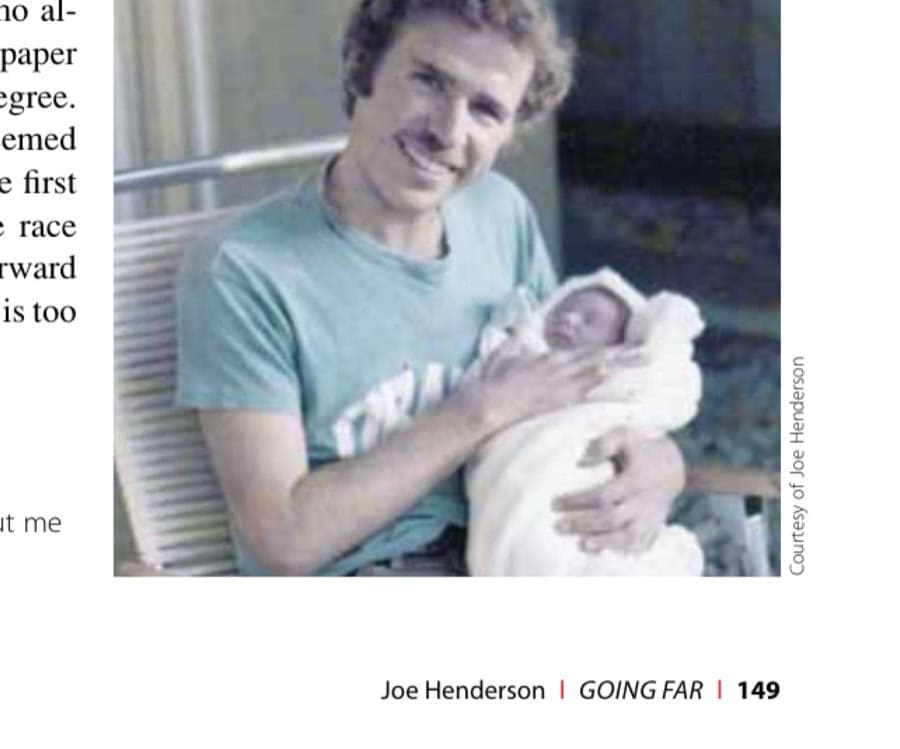
A doctor who had taken little part in the preliminaries now rushed into the delivery room. Five minutes later, as I stood beside your mother’s head, Dr. Hansen announced from down below, “You have a girl.” We hadn’t known until then which you would be. The doctor then held you high for our first look at our first child.
Courtesy of Joe Henderson
Update: My girl I’ve seen many great events at Hayward Field in Eugene: four Olympic Track Trials, two Marathon Trials, a World Veterans Games, many national championships. But none topped what happened one summer Sunday in 1995 at America’s track of tracks. My oldest child made her first and last formal appearance here, with the old covered grandstands filled with spectators.
I took my usual seat at the head of the north turn, farthest from the finish line. The day was gloriously sunny after rain earlier in the weekend had washed the sky clean. We weren’t here for the Prefontaine Classic, which had come to town a week earlier. This later event was even better. Sarah wasn’t here to run but to graduate from the University of Oregon—in journalism.
Sarah inherited the family writing gene. She’s a thirdgeneration journalist who already worked for a newspaper before receiving her degree. But the running gene seemed to have skipped her. The first time she ran a distance race was as a 6-year-old. Afterward she announced, “A mile is too
▲
Infant daughter Sarah put me into training as a dad.
far to run.” She grew up surrounded by running but wanted little to do with it. She never joined a kids’ track club or a school team. When asked if she ran, her stock answer was, “No, I don’t like to sweat.”
Her mind didn’t change until she went to college and saw other young women running. They didn’t run for the reasons her dad did but to battle the dreaded “freshman 15,” named for the pounds commonly added soon after leaving home. Sarah didn’t gain all those pounds and didn’t start to run right away. But she got the idea that sweating wasn’t such a bad idea.
She started quietly, never asking Dad for advice, never talking about her runs unless asked. Two years later she surprised me by saying, “I’ve signed up for a running class at the university.” Soon afterward she announced, “I’ve signed up for a race.” She chose the two-mile at a multirace Valentine’s event.
This was far enough, she said then. But within weeks she had graduated to a 5K and was scanning the schedule for upcoming 10Ks. Her training advanced too quickly, and injuries inevitably followed. Sarah called to say, “My leg is bothering me.” I asked where it hurt. “It’s in my lower calf. I think it’s the Achilles tendon.” My advice wasn’t detailed. I just told her, “Let your teacher know, and take it easy for awhile. The problem should go away in a few days.”
I didn’t tell her congratulations; you’re a real runner now. You become one when you’ve had your first injury. Neither did I say she’s truly my daughter as a runner because we share a weak-Achilles gene. “When you used to take me to running events,” she said, “I thought that all the runners could talk about was their injuries. Now that’s all I seem to talk about.”
Unable to run as she wished, Sarah switched to bicycling for awhile. She had never done much of that as a child either. When I asked what she wanted as a graduation present, she didn’t say a trip to Hawaii or a car of her own. She wanted a better bike. “I’ve fallen in love with bicycling,” she said on graduation weekend. “But I can’t wait to run again.”
Sarah still runs. She’s the mother of ever-active Noah, my first grandson.
37. The first SAN MATEO, CALIFORNIA, February 1974. Everyone with a sense of history gives Kathrine Switzer her due for what she did in the 1967 Boston Marathon and well beyond. But do you remember Nina Kuscsik? You should. Her efforts reach back nearly as far as Switzer’s. Kuscsik was one of the earliest sub-threehour marathoners, with 2:56 in 1971. She was the first Boston women’s winner to be credited as such, in 1972. She led a sit-down strike in favor of women’s running rights at a New York City Marathon, also in 1972, and would lobby for full inclusion of women in marathons until they won an Olympic race.
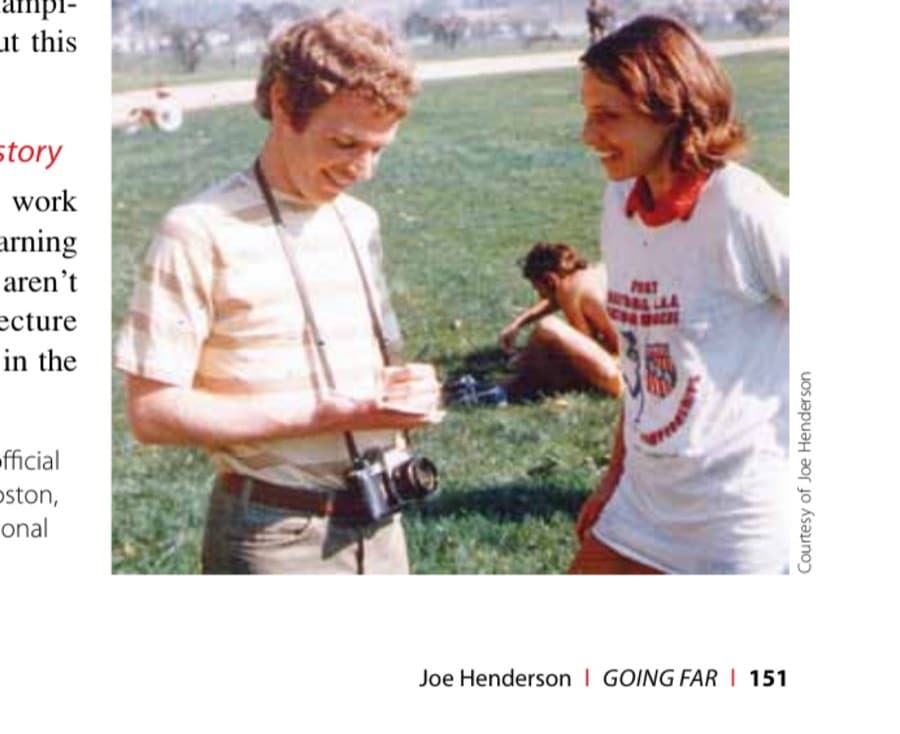
I knew Nina’s racing history already, but the first time I got to know her as more than a name on a results list was at the inaugural women’s national marathon championships. As important a milestone as this was for the sport, the event itself was little more than a regional event. One of the few non-West Coasters to appear was Nina, who flew out from New York City. This wasn’t a good time for her, but she couldn’t miss this moment when women took another step toward equality.
In November, Nina had run a 10K race in Puerto Rico, collapsing on a 90-degree day. That experience, along with family turmoil afterward, had jolted her confidence. She had cut her mileage in half and even doubted her future in running. Now, two days before the national marathon, she said, “I’m still scared of running. The race in Puerto Rico didn’t hurt me so much. It’s just that my head has been mixed up.” I asked if she felt ready for this race. “No,” she said, not in the way that runners usually downplay their chances. This was a sincere, concerned no.
Judy Ikenberry, with the fastest PR coming in, left with the first title. Later she told reporters, “I’ve been running for 18 years, and this is the first time I’ve ever won anything. I guess if a person keeps looking long enough, she can find something she can do.” Then, thinking this sounded too serious, she added, “That’s my sermon for today, folks.”
Nina Kuscsik was in tears as she walked through the chute after finishing fifth, 10 minutes behind Ikenberry’s 2:55:18. This was a relieved cry. “I’m so pleased with today,” she said afterward. “My friends in New York had to badger me to come. I know now that this is what I needed. It gave me back my confidence to know I ran this fast when I was out of shape. I never would have forgiven myself if I hadn’t run here. I would always have wondered what I might have done, whether I might have won. This way I know. I’m so glad I came.”
It wouldn’t have been a true national championship race without this pioneer.
Courtesy of Joe Henderson
Update: Living history Running seminars work the same way as learning in school. Lessons aren’t confined to the lecture halls but continue in the ▲
Nina Kuscsik, first official women’s winner at Boston, at the first official national marathon for women.
hallways, at meals, and on the streets outside. In 1999, I attended a race directors’ conference in Portland, sitting on a couple of panels. As usually happens at events like this, I learned more than I taught—and heard the weekend’s best story outside the classroom. It had both a shocking start and a happy end.
Judy Ikenberry sat beside me for one of the panel discussions. My thought while glancing over at her: She looks too young and lively to be a monument to women’s running history. As Judy Shapiro she began running in the late 1950s and ran as far as the officials at the time would let her go. This was little more than a mile.
Later she married her coach, Dennis Ikenberry, and graduated up in distances as the slowly relaxing rules allowed. In 1974 she won that first US women’s marathon title, setting a PR of 2:55:18 while beating better-known runners such as first official Boston champion Nina Kuscsik.
Later still, the Ikenberrys set up a race-scoring business called Race Central, based in Southern California. This was Judy’s reason for being on the Portland panel, since her company scores the Portland Marathon along with dozens of others each year. After the talk we walked back to our hotel together.
Judy said then what she hadn’t mentioned in her talk: “We’re thinking of cutting back on our business. Dennis is starting to talk about retirement, and I haven’t been well the past year and need to slow down.” She looked as energetic, at age 57, as I had seen her in any of our annual visits. I asked what had gone wrong. She gave a grim story the lightest possible telling. “
I’m happy just to be here,” she said. “I died in June [1999].” There’s a line to capture attention. Judy explained that she had felt symptoms while riding her bicycle and knew what might be happening. “I have a terrible family history of heart disease and high cholesterol,” she said.
During an examination for her condition, Judy’s heart stopped and was electrically jolted back to life. She required immediate bypass surgery, from which she recovered in time for her daughter’s wedding. “She would never have forgiven me if I hadn’t been there,” said Judy.
Tracing a line on her jacket from lower stomach to upper chest, she said, “I now have a nice little scar to remind me to take better care of myself.” She added, “I know I need to stay far away from gambling casinos. I’ve already used up all of my good luck.”
Ten years after her surgery I saw Judy Ikenberry again, back in Portland. She remained healthy and active in the family business at age 67.
38. The master MOUNTAIN VIEW, CALIFORNIA, and ROTORUA, NEW ZEALAND, May 1974. For the most said in the least words, one of the best books ever written about run-
ning was really just booklet length—Jack Foster’s Tale of the Ancient Marathoner. It came together in early 1974, shortly after he ran a marathon for the ages. We worked on this book from opposite ends of the world, without ever meeting or talking by phone.
The Tale’s first words, and far from its best, aren’t his but mine that introduce him to readers: “If a friendship can be measured by the number of letters two people exchange, then I can count Jack Foster among my best friends. On my desk here now is an inch-thick folder of lightweight blue aerogrammes postmarked ‘Rotorua, New Zealand.’ I feel I know Foster about as well as I know any runner.”
Our writing back and forth peaked during his writing of that wonderful little booklet (which I edited). Jack handwrote it in tiny script across almost 100 pages of aerogrammes. He told how running had humbled him at first, which might be why he retained humility about his later successes in the sport. He remembered where he came from.
Jack had competed as a bicyclist, but by his 33rd year he was only biking to work and back and playing some soccer. “Surely a half-hour run would be no trouble,” he said of his first try. After going what seemed to be several miles, Jack arrived back where he had left his wife, Belle. “What’s wrong, have you forgotten something?” she asked. “You’ve only been gone for seven minutes.” Jack recalled, “I was soaked in perspiration and felt tired. Now I was worried. If I felt like this at 33, how would I be when I was 40?”
We now know that by 40 he was an Olympian, with his best marathon time still to come. By 1974 the sport knew him as the world masters marathon record holder. His mark of 2:11:19, set at age 41 while silver-medaling at the 1974 Commonwealth Games, would stand until 1990.
Jack wasn’t like the young superstars who seemed to drop in from another planet, bringing with them apparent immunity to the limitations imposed on us mere mortals. He was more like one of us, one who made very good.
ad
▲
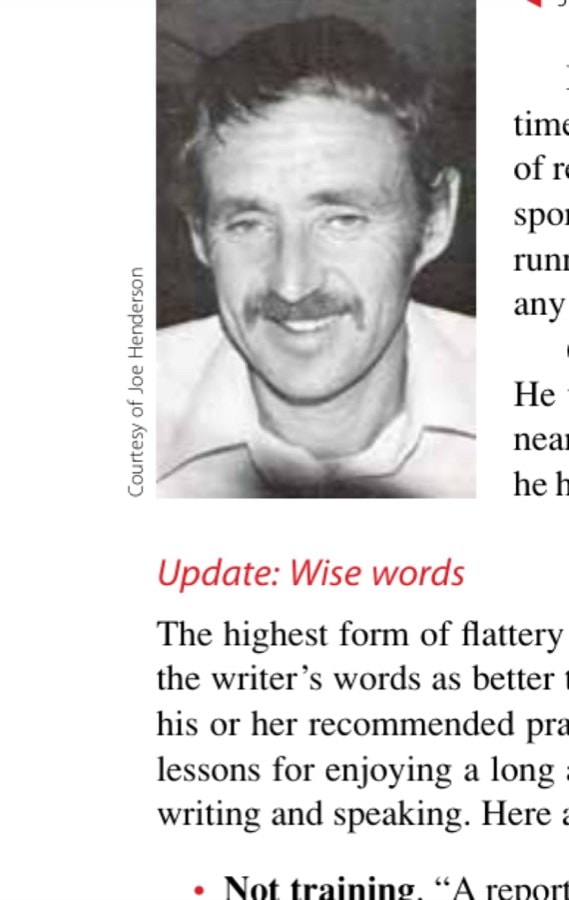
Jack Foster’s masters marathon record stood for 16 years.
Courtesy of Joe Henderson
He ran while raising four children and working full time. He knew the feeling of starting to run as an adult and of recovering from hard runs slower than the kids of the sport did. He wrote for us. We lacked his late-blooming running talent, of course. But he spoke a language that any older, part-time runner could understand. (Bicycling was Jack Foster’s first sport, and his last. He was struck and killed by a car in 2004 while riding near his home in Rotorua, New Zealand—the same place he had started to run almost 40 years earlier. He was 72.)
Update: Wise words The highest form of flattery for a writer isn’t imitation. It’s repetition—quoting the writer’s words as better than any you could make up, or better yet, adopting his or her recommended practices as your own. Jack Foster left us with lasting
lessons for enjoying a long and happy running life. I’ve repeated them often in writing and speaking. Here are two of the most memorable: • Not training. “A reporter once asked about the training I did,” wrote Jack. “
I told him I didn’t train. The word ‘training’ conjures up in my mind grinding out 200- and 400-meter intervals. I refuse to do this.” Nor did he run “the 150 miles a week that some of the top marathoners are
doing. I rarely did more than half that. I believe it is possible to achieve results in a less soul-destroying way.” He concluded, “I don’t train; never have. I don’t think of running as ‘training.’ I just go out and run each day, and let the racing take care of itself. It has
to be a pleasure to go for a run, looked forward to while I’m at work. Otherwise no dice. This fact, that I’m not prepared to let running be anything but one of the pleasures of my life, is the reason I fail by just so much.” •
Timeless racing. Jack added to the paragraph above that “failing” didn’t bother him. Nor did “the prospect of running 2:30 or even 2:50 marathons in the future.” This would have been almost unthinkably slow to him at the time he
penned this line, but “slow” is a relative term. Jack’s times later slipped to levels that were slow only to him—a 2:20 marathon at 50 and to six-minute miles for 10Ks in his 60s. He wrote in the mid-1990s that he didn’t let the old times haunt him: “The
drop-off in racing performances with age manifests itself only on timekeepers’ watches. The running action, the breathing and other experiences of racing, all feel the same. Only the watch shows otherwise.”
Jack chose to define a good race by the effort, not by the numbers of a clock. He said, “All the other experiences of racing that attracted me initially are the same as they have always been, and they still appeal to me.”
39. The review MOUNTAIN VIEW, CALIFORNIA, July 1974. Five years is a long time for a runner, especially for one who spent most of that half-decade in his 20s. Five years was more than one-sixth of my life so far. During that time I had enjoyed my best streak of racing and had endured my worst spell of running. The peaks and valleys weren’t unrelated, and identifying those relationships resulted in my second how-to-run book, published five years after Long Slow Distance.
I introduced the new book with these lines: “Racing success is fleeting. It comes and goes quickly, if at all. A runner must see that trying to hold onto this success is as futile as trying to hold back the water or the wind, the sun or the seasons. Running itself, though, the everyday doing it and feeling good about doing it and wanting to do more of it for thousands of tomorrows, can be as lasting as anything in this life. In this throwaway world we need lasting things. “
This new book is a little about racing success and how to achieve that. But it’s mostly about running longevity and how to last. It talks about the same things I talked about five years ago in LSD: The Humane Way to Train. Yet this is not LSD Revisited. I’m not here to praise the name LSD but to bury it in favor of a new term—one that fills the holes and corrects the wrong ideas left by the first book.”
LSD seemed to give runners permission to go as long as possible, as slowly as possible, and to collect as much weekly distance as possible. Mileage became the gold standard of the sport. Going for big miles squeezed both the fast days and the easy days out of the runner’s weeks, because they contributed so little to the total. As for taking a big zero: unthinkable.
Mile-collecting was the main mistake that LSD encouraged. I didn’t make that one because miles had long since quit counting for me. I ran by time and didn’t even add up the hours at week’s end. If pressed for a guesstimate of weekly mileage, I would say that I averaged 50 or so, before and after LSD caught on.
My mistake was different. While total running didn’t increase, the amount of racing did—dramatically, as more races became available and at longer distances. In my best year, 1968, races accounted for about 5 percent of the running per month. By 1971 that racing rate was averaging 20 percent. It peaked near the end of that year at 40 percent, shortly before my left foot broke down in protest.
I realized during recovery that all the racing had squeezed too many easy days out of my running. Back they came. I vowed never again to let the racing tail wag the running dog as much as it had in recent years, with predictable results. I wouldn’t let short-term goals threaten my long-term health.
▲
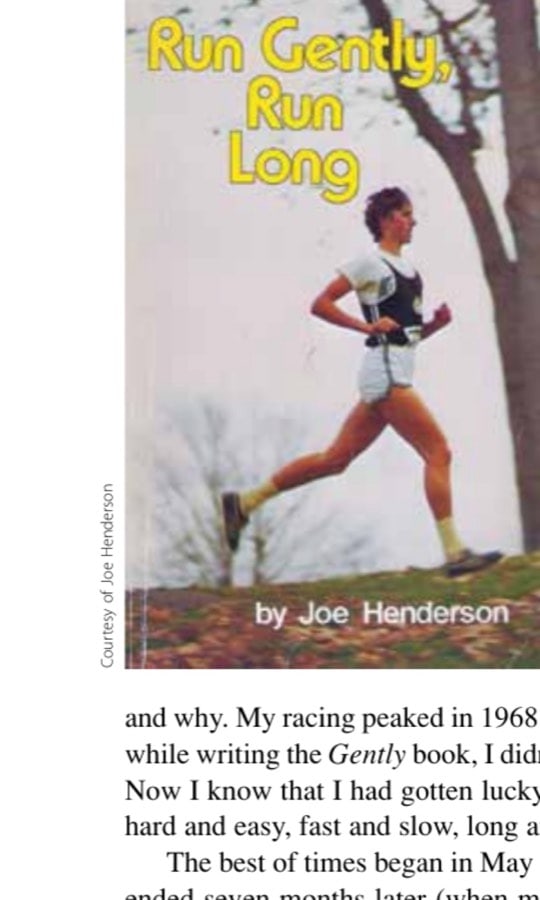
This book grew out of my foot breakdown/repair/rehab episode.
Courtesy of Joe Henderson
From then on, at least 90 percent of running would be modest in pace and distance—in a word, “gentle” (which wasn’t as catchy as the acronym LSD but was more descriptive of how I now ran). Running this way most of the time would better my chances of lasting long as a runner, in years instead of miles or hours. Hence the book’s title: Run Gently, Run Long.
Update: Best times Run Gently, Run Long grew out of what went wrong and reminded me how to keep that from happening again. Now I can look way back and see what went best, when, and why. My racing peaked in 1968, and I descended into injury afterward. Even
while writing the Gently book, I didn’t yet see why I had peaked six years earlier. Now I know that I had gotten lucky and stumbled into the right combination of hard and easy, fast and slow, long and short running at the right time in my life.
The best of times began in May 1968 (after I dropped out of a marathon) and ended seven months later (when marathon training resumed). In between I ran 20 races. Seven resulted in permanent PRs, most others were near misses, and
injuries totaled zero. Only 20/20 hindsight showed me why this was so. That short year featured my most perfect blend of man with method. I was 25 years old—a prime age for runners—and still not deeply into family
and career duties that would have conflicted with running goals. I now know that we’re promised about 10 years of improvement no matter when we start to race, and I had reached my 10th year. My everyday running was purely long slow distance. The longest weekly run
averaged about two hours, and most others were less than half that length. That’s to say that I never trained very hard. This wasn’t so much a training method as a recovery plan between races. Frequent racing, plus going into the races fresh
and healthy and eager, made this system work. I averaged almost a race a week during that seven-month period. Yet most of the races were short (many were one, two and three miles on the track), and they accounted for less than one-tenth of total running.
My magical spell ended in a drift toward longer long runs, fewer easy runs, more long races, less track racing, and a higher percentage of racing. This mix led to more injuries and fewer PRs—and finally to a career-altering breakdown four years later. By the time I figured out what had gone right in 1968, my chance to reclaim that magic had passed. But reflecting now on that best-of-times year is not purely a personal and nostalgic exercise. I can still offer these old lessons to today’s runners who have pages left on their 10-year improvement calendar.
40. The Walk-Doc SAN FRANCISCO, CALIFORNIA, April 1975. A lovely feature of published writing is that you don’t need to read and heed it right away. It’s there, waiting, whenever you’re ready for it.
My introduction to Dr. Ernst van Aaken came in 1960, when he penned the first article for the first issue of a magazine called Track Technique. I skimmed the first paragraph of “Speed or Endurance Training?”—which seemed to have little to do with me—and rushed on to his advice for serious athletes.
Now I’m rereading the introduction by the medical doctor and coach whose last name rhymes with “gone walkin’.” He wrote, “According to my observations children are born long-distance runners. Any healthy boy or girl is able
ad
to run great distances at a moderate pace. The play of children is nothing more than a long-distance run, because in a couple of hours of play they cover many kilometers with several hundred pauses. The play of children is a primal form of interval training.”
In 1960, I thought I had outgrown my childish ways. My running was no longer playful, and I was into serious interval work. I never walked between the fast runs. Fifteen years later I had come around to van Aaken’s way of running, quoting him to support my LSD ideas. I was working on overcoming my own lingering resistance to taking walks during runs when a pair of events aligned perfectly during a single week in 1975.
One was my first meeting with Ernst van Aaken, during his West Coast lecture tour where Dr. Joan Ullyot served as his host and translator. He delivered his talks from a wheelchair, the result of losing both legs after being struck down by a car while running three years earlier.
Van Aaken’s topics ranged widely in his San Francisco lecture and our personal conversations, lasting eight hours in all. He breezed through the subject of run-walk intervals in five minutes, repeating what he had been saying for years but that I had only recently been ready to hear: “Run as a child runs. Run playfully, for 10 kilometers a day, without pain or fatigue. The plan is the same for everyone from competing athletes to people recovering from heart attacks. Only the pace and the amount of walking varies.”
I might have missed Dr. van Aaken’s point yet again if not for an episode that same week. A sore calf, injured in a race earlier that month, stopped me two miles into a Saturday group run. I waved the other runners on, then swore and kicked at the ground for having to quit the highlight run of my week.
Walking sullenly back toward the parking lot, I realized that the pain had eased. I ran again until the muscle threatened to spasm, walked until it loosened, ran a little farther than before, and ran-walked some more while letting the tender leg dictate the mix. This slow-interval session ended up lasting the full two hours that I would have gone with the group. My leg felt better at the end than it had at the start.
I had taken 15 years to appreciate what Ernst van Aaken had written in 1960: if you want to go long, you need to stop once in a while. The pause refreshes. (Dr. van Aaken continued to practice medicine, coach runners, write, and lecture until his death in 1984 at age 73.)
Update: Galloway’s way Want to hear the war of words over walk breaks heat up? Mention Jeff Galloway’s name. His detractors and devotees are equally vocal. Ask purist runners what they think of “Gallowalks,” for which the Olympian-turned-author/coach is best known, and they’ll tell you this is a ploy to let people who aren’t true marathoners
pretend to be. They’ll blame Jeff for slowing down—some critics say “dumbing down”—the sport. I’m sad to see Jeff defamed this way, because there is no more sincere a missionary for running. You can agree or not with his approach. The fact remains that no American has contributed more to the marathon’s growth in recent years. Upward of 100,000 marathoners have come through his training program, centered on walking early (from the first mile onward), often (every mile or even more often), and briefly (seldom more than a minute at a time).
I can’t call myself a true Gallowalker. My use of these breaks predates his teachings, and I’m more a practitioner of van Aaken-walkin’. But I can call Jeff a good friend. While visiting his running camp each summer, I’ve seen his concepts develop and his roster of marathon finishers grow long.
My own run-walk routine was well set by the late 1990s. It was time-based: run nine minutes and walk one. Then came another marathon that I really wanted to enter but was undertrained for. I asked Jeff Galloway for advice. “Walk twice as often,” he said. “Run four minutes and walk one.” But wouldn’t walking an extra 25 minutes add an unacceptable amount of time to my total? “Not really,” said Jeff. “I know a woman who qualified for Boston while doing four-and-ones.”
Still skeptical, I followed Jeff’s plan. This marathon was less than five minutes slower than my previous one, which had employed half as much walking. And I didn’t lose the time to the breaks but only when the training deficit overtook me in the late miles. Jeff knows from tens of thousands of case studies what I had learned only from a study of one: walk breaks cost much less time than you might fear.
Someone who hasn’t run-walked might think that every minute not run would add that minute to the final total. That might be true if you screeched to a dead stop during the breaks. But you’re still moving at about half your running pace. So this cuts the slowdown to about 30 seconds per mile (slightly more for the fastest runners, less for the slowest). But rarely, if ever, does a walk break penalize a runner even by that half-minute. Two reasons: •
Run-walkers tend to go slightly faster in the run segments than by running without pause. They don’t try to speed up the runs; it happens automatically. In races, I notice the people beside me who don’t stop when I take
a break. They usually come back to me again before the next break. • Run-walkers tend to stay stronger, longer, than nonstop runners. Late in a marathon the walk breaks shift from being time-losers to time-savers.
With these breaks I usually slow down less in the late miles than if I had tried to run every step. Here I often see what the run-only purists like least about a run-walker: being passed by one of us for good. Going Far will continue in the next issue.
This article originally appeared in Marathon & Beyond, Vol. 18, No. 1 (2014).
← Browse the full M&B ArchiveMore like this
1,000+ stories from 19 years of Marathon & Beyond
The complete archive of the legendary long-distance journal — digitized and free to read.
