

Going Far, Part 14
Going Far The decline in book sales and an eye toward Oregon. Part 14. BY JOE HENDERSON
58. The descent
HONOLULU, HAWAII, December 1979. The higher your climb, the harder your fall. Even if you settle back to where you had been not long before, the comedown is disappointing. My summit arrived in the final months of 1978 and early 1979. My royalty check peaked out at its heftiest size ever, and I imagined that such amounts would continue indefinitely. Then I accepted a Road Runners Club of America double: a hall of fame induction and a journalism award. The descent came steeply after that.
My spring royalty check from Anderson World, the book-publishing branch of Runner’s World, dropped by half from the last one. The fall check shrank to one-tenth of peak size. Fellow authors Hal Higdon, Joan Ullyot, and I refused to believe that our sales could have sunk so low, so quickly. We suspected underreporting of sales. The three of us demanded an independent audit, which our contract allowed but which also put us in conflict with RW publisher Bob Anderson.
We expected to arm ourselves for a court fight. Instead the accountants found nothing sinister, nothing more than sketchy bookkeeping. We were more likely to have been paid too much before than too little now. There was no lawsuit, but all three of us authors left Runner’s World, at least for a while.
Something bigger was happening then that I didn’t see, or didn’t yet want to admit. I thought what had happened with Jim Fixx and others would keep happening indefinitely. Fixx’s Complete Book of Running topped the bestseller lists, for all topics, for almost a year. At first other books (including mine) tagged along on that wild ride. The big sellers spawned dozens of similar books. In 1977-78 all running books sold, but soon most of them tanked as the market became glutted.
Update: Retiring type In 1979, I had counted on the book Run Farther, Run Faster to refresh my royalty coffers. It would become one of my best books that hardly anyone ever read. Soon after greeting its publication as my only book devoted exclusively to racing, I was no longer a true racer.
In 1979, I thought I would never quit racing. Sure, my times were already slowing. The last PR, I knew even then, had been set that summer—a soft one in the half-marathon, an odd distance then. Didn’t matter if I slowed; the relative effort would stay the same, I thought— always all-out. Racing was too challenging and rewarding ever to give up. Turns out, though, that I was the retiring type.
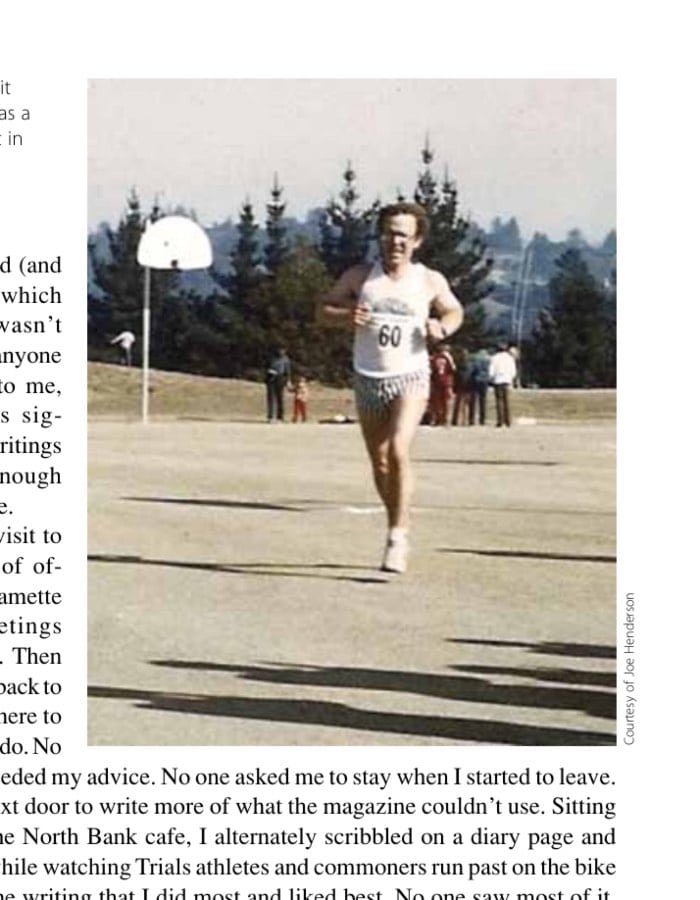
In 1979, I didn’t yet know that I had run my last marathon. Fittingly, this came on the same Boston course as the first, but this latest one didn’t appear at the time to be a graduation exercise from running this distance to run-walking it. A flurry of short races followed over the next year. The last full and honest effort
Courtesy of Joe Henderson
Then I needed to find another way to make a living. Bob Anderson wouldn’t want me back at Runner’s World in any capacity, let alone with added duties, after I had challenged him. So I looked toward Nike, which had declared itself an enemy of RW and was buying a magazine of its own. Ned Frederick and Jack Welch had published a small one called Running that now had visions of going large. Jack arranged a meeting, in Hawaii, to pitch me on working for him.
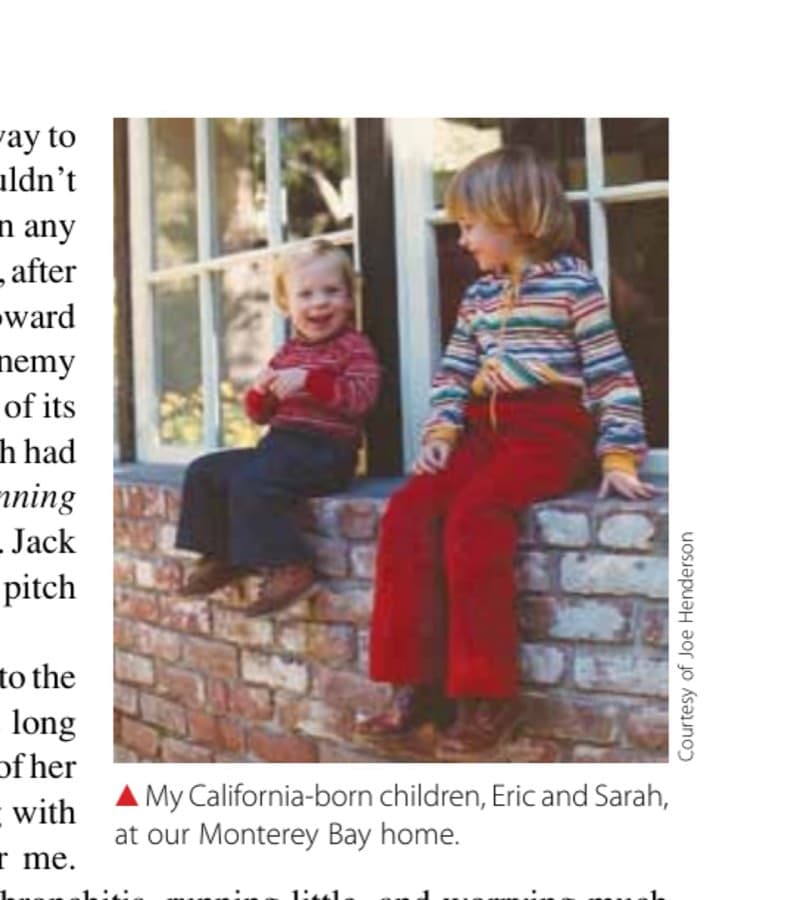
My wife, Janet, and I had come to the Honolulu Marathon. This trip was long planned as a weeklong celebration of her successful cancer treatment, along with ▲ My California-born children, Eric and Sarah,
at our Monterey Bay home. another marathon opportunity for me. But now I was suffering through bronchitis, running little, and worrying much about my suddenly sick career. Jack Welch didn’t need to talk very hard to recruit me to his magazine team. He asked, “Can I assume you are ready to go to work for us?” Yes. “So let’s talk about the terms.” Before I could answer, he said, “This is what I’m thinking. Whatever you were paid at RW, we can raise it. And there’s no need for you to move to Oregon. You can keep writing from home, flying up to Eugene as needed. Though I suspect that once you’ve come here a few times, you’ll want to stay.” I didn’t debate any of this.
seemed like nothing special at the time: September 1980, Artichoke Festival 10K in Castroville, California. I had no clue then that a 10K of 36 minutes would be my finish line for racing the races (as opposed to simply running in them, which continued).
The ability to race fairly fast didn’t suddenly desert me. An injury didn’t settle in for a permanent stay. Life just had other plans for me. I changed hometowns and took a new job. Speaking trips ate up more weekends. Two handicapped children needed extra attention. A marriage ended.
All of this combined to render racing almost irrelevant. I haven’t truly raced for a long time, more than half my running lifetime ago. I tell runners to race until they don’t need it anymore. I quit needing it, or being able to need it, and retired—not from running, of course, and not from the pleasures of going to the races. Sometimes I miss the challenges and rewards of racing, but not enough to earn them.
59. The Swoosh EUGENE, OREGON, July 1980. Ever feel that you’ve made a big mistake by changing jobs? And that it’s too late to turn back? That’s how I felt while visiting the Running magazine office for the first time. There, during the Olympic Trialsto-nowhere, I met the full staff and felt little part of it.
By now I felt as if Nike and Running hadn’t hired me to write but only not to write for its competitor. My writing had gone nowhere since I finished my last book, which itself was going nowhere. My style of writing—sometimes instructional, often personal, always conversational, and built from simple words and short sentences—wasn’t the magazine’s.
The editor, Paul Perry, envisioned this as a literary magazine about running. I can’t fault him for this. It would be a noble effort and an artistic success. Each issue would include at least one major article by a writer from outside the sport: Hunter S. Thompson’s manic take on the Honolulu Marathon, Ken Kesey’s whimsical view of newly opened China. At best these writers offered a fresh take on the sport. But not all of them succeeded. At worst, they lacked insight into running and passion for it.
At the least, Running needed a balance of articles and columns by runnerwriters that the magazine lacked at first. My pieces hid in small, dark corners of each early issue. That was just as well, because I wasn’t proud of what little appeared under my name. The managing editor had come west from Sports Illustrated and tried to bring SI’s ways with her—while seeming to look down on everything that wasn’t New York publishing.
She clearly didn’t like my style or content. Editor Perry required her to accept my byline, but she used my original copy as little more than an outline to
produce a revised (and shorter) piece, which read fine but wasn’t mine. Without anyone ever saying so to me, her heavy edits signaled that my writings weren’t good enough for this magazine. On my first visit to the small suite of offices on the Willamette riverbank, greetings were exchanged. Then the staffers went back to work. I had nowhere to sit and nothing to do. No one wanted or needed my advice. No one asked me to stay when I started to leave.
I retreated next door to write more of what the magazine couldn’t use. Sitting on the deck at the North Bank cafe, I alternately scribbled on a diary page and sipped iced tea while watching Trials athletes and commoners run past on the bike path. This was the writing that I did most and liked best. No one saw most of it, but it was as much worth doing as when tens of thousands read it.
I realized while sitting in the summer sun, looking out on the river, on a weekday, that my (non)job at Running magazine came with good (non)working conditions. I would accept them for now. If I made a mistake in signing on with Running, Nike made one too by agreeing to pay me for doing next to nothing. I decided to ride this gravy train a few stops longer before climbing off to find a real job.
Update: Just wear it Why I wasn’t summarily fired for disloyalty, I’ll never know. By mid-1980, I had accepted six months’ worth of Nike paychecks. I sported the Swoosh most of each day. But I still wasn’t wearing Nike’s signature product, its running shoes, on my runs. My brand of choice was Brooks, the worst choice politically because this was then Nike’s most bitter enemy in the business.
Courtesy of Joe Henderson
▲
The 1980 Summit Marathon, my first as a run-walker and first in Nike shoes.
Understand here that I wasn’t flaunting my footwear. Nearly all runs were by myself, often under cover of darkness. Then I went to the Olympic Trials in Eugene and had nowhere to hide. Running on Pre’s Trail one morning, I came upon a Nike exec. We stopped for a howdy. His gaze went straight to my shoes. His silence and eye-rolling said more than words of censure could have.
Soon I was running in Nikes, and company loyalty came at a price. A foot started hurting almost immediately and kept hurting until I left that company’s employ—and switched to another brand. For almost two decades I ran in Converse, Asics, and New Balance, but never Nike.
I wasn’t anti-Nike-the-company. Its bigness doesn’t disturb me (why pick on the company for being successful?), nor do its alleged labor practices (which probably don’t differ from other companies that manufacture abroad, as most do). I, and we, owe much to Nike for all it has done for me and for the sport. I didn’t wear its shoes for the simple reason that they never worked well enough for me. This reflected the weirdness of my feet and not the quality of the company’s shoes.
My loyalties are two: to my right foot and my left. I wear whatever works, regardless of brand name. For the longest time, to my regret, this wasn’t Nike. Then I was reintroduced to one of its early failures for me: the Pegasus. It had passed through many updates since I worked for that company, and 20 years later the Pegasus 2000 series passed my road test, which is: does the shoe treat me so kindly that I’m hardly aware I’m wearing it? If the shoes “speak” to a runner, it’s usually because they’re causing problems. These Nikes ran so “silently,” as did some later models, that the loyalties to my feet finally matched those to the company nearest to home.
60. The retreat PEBBLE BEACH, CALIFORNIA, April 1981. Retreat isn’t necessarily defeat. Instead of surrender, it can be a pullback to revise strategy. My plan for life as a writer was failing, and to revive it I had to retreat from this bucolic beachhead on the California coast.
Once the book royalties dried up, we couldn’t live in dreamland anymore. We didn’t want to leave but couldn’t afford to stay. We had outgrown our house, where Sarah and Eric couldn’t share a bedroom much longer. We couldn’t add on here and couldn’t buy up in the bullish local real-estate market.
Paul Perry offered a solution. The editor of Running magazine called to say, “Our managing editor is leaving, going back to New York City. Would you like to move north and take her place? Nike can raise your pay and cover your moving costs. Plus you’ll find bargains on houses here.”
The benefits would be professional and financial, even educational. As a gatekeeper on content for the magazine, I could assign and edit my own articles,
reclaiming a voice in the running world. Moving to Eugene, where half the money bought twice the home, would solve the housing squeeze. Sarah was now in second grade at a school that wasn’t great. The older population of this area balked at spending tax money on schools. Eric, at 3, had started to school himself. Our boy was slow to start talking. A pediatrician had tried to ease our concerns by saying, “Don’t worry. He’s a boy and a second child. That combination often leads to delayed speech.”
Finally we visited a specialist at Stanford University Hospital. He told us, “Your boy has been severely hearing impaired since birth. Without hearing aids, he’s essentially deaf.” The doctor outlined a remedial program: hearing aids and an early start at a special preschool. At age 3, he took an hour-long bus ride to Salinas and back each day.
The kids deserved better schools, or at least closer ones, than we could find on the Monterey Peninsula. So we headed north to Eugene, where a job awaited, where better housing was affordable, where the schools were first-rate in this college town. Relocating here was a needed move out of the dream and back to reality, out of a theme park that guests paid to see and into a real town. We would remain in Eugene long after Running magazine’s short life ended, after I resumed writing for Runner’s World, after the marriage broke down and both of us remarried. Eugene, where I came in retreat, would become my longest-time home.
Update: Writing on The highest and lowest points of my writing life both came the same week in December 2003. They would have fallen on the same day if I had picked up phone messages while traveling. The thrill of the high helped ease the pain of the low.
I had picked the right writing hero and visited him at exactly the right time. This is John Steinbeck from Monterey County. I never saw him in life (he died in 1968), but a writer’s good words can reach beyond the grave. Steinbeck’s Grapes of Wrath was the first book I ever read without it being a class assignment or having sports as its subject.
It wasn’t his fiction that moved me the most but his collection of letters and the journals that he kept while writing the novels. From his informal lines I learned what writing can mean to the writer. With Steinbeck it wasn’t a job or ever a career. It was a calling, a passion, even an obsession. He didn’t write because he could but because he must. For every public word he wrote, there were hundreds or thousands that no one ever saw. He felt about writing as I did about running and would come to feel about running writing.
Steinbeck was born and grew up in Salinas, California. The hometown that once vilified him for writing unflatteringly about it now promotes him as its top tourist attraction. There are the Steinbeck House, the Steinbeck Library, the
Steinbeck gravesite, and now the National Steinbeck Center. My 600th race (and one of the last true races) was the Steinbeck Country 10K, in 1980. My wife, Barbara, and I toured Salinas in late 2003, walking where Steinbeck had walked and sitting where he had sat. We ate lunch in his old dining room, where volunteers now serve meals as a fund-raiser to preserve this Victorian house. The narrow, steep stairwell to his room upstairs is closed to the public. But we could see where he had climbed hundreds of times to the room where he wrote his first sentences.
The nearby Steinbeck Center now stands as a memorial to his life’s work. My big thrill there was seeing pages he had handwritten. Most of these were photocopies, all encased in plastic. But the words looked to me exactly as they had to him while going down, and I came as close as possible to touching them—and by extension, him.
I came home from the highest point in my writing life and plunged to the lowest. This dive began with a phone message from the new boss at Runner’s World, a young man I had never met or even heard from before. When I called him back, he said that my column, which had appeared for 250 months in a row, had “run its course.” It didn’t fit into his plans for the “new” RW, so he was dropping it.
I might have listened to his offer to keep writing for his magazine “occasionally.” But then he added an unnecessary (even if true) jab that abruptly ended this conversation and my connection with the magazine: “You’ve been scraping the bottom of the barrel with your column subjects for a while now.” My best answer to him—longest, anyway—is this three-book memoir series, all written after the retirement from RW.
John Steinbeck continues to teach and inspire me. The final National Steinbeck Center exhibit, posted on the wall at the exit, reads, “I nearly always write, just as I nearly always breathe.” I can say with some certainty that as long as I’m consciously breathing I’ll be writing, somewhere.
Preview: Running home Oregon has been my home for more than 30 years now, far longer than either Iowa or California. These years have brought both triumphs and trials, as all lives do. I chronicle them in the final book of this memoir series. Here is its prologue, titled “Home Runs”: EUGENE, OREGON. These days I write as I’ve long written. The first stop for the words is a page in an ongoing journal, and more often than not they go no further. These writings almost always end at a single page. The frequency is daily, with no days off. The setting for this writing is an office at home that doubles as a bedroom for visitors.
© Long Run Pictures/Jay Schwartz
Nothing here has changed much since I started writing these pages in 1959 . . . No, that’s not quite right. I should say that this practice has circled back to how it began—before wordplay became a profession and an obsession, before the reporting took me far from home in search of stories, before I wrote in the offices of several different magazines.
The earliest writings were intended for my eyes only. Each day’s report occupied its own page (which held more white space than pen scratches and carried more numbers than words as I detailed the miles and minutes of that day’s run). I started writing in support of my running hobby, and soon these were twin hobbies of equal standing. I wrote at a desk in a bedroom (except then it was where I also slept).
The habits aren’t much different today, only the setting. Then, as a 16-year-old, it was a small town in Iowa. Now, in my Medicare years, it’s a midsized city in
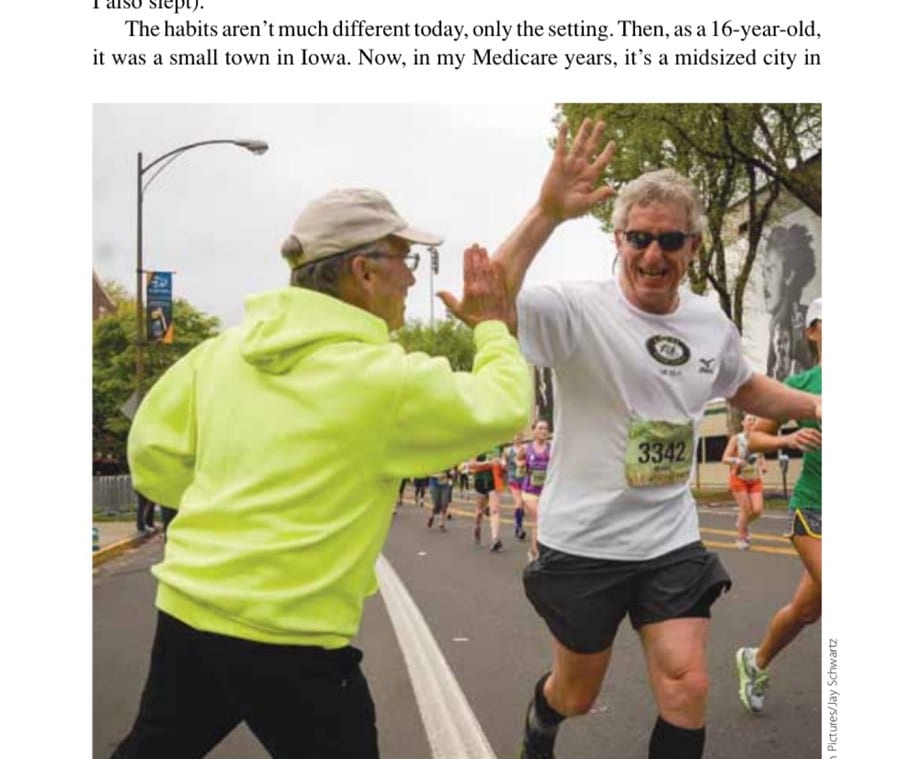
▲ Ken Welker is one among hundreds of runners I’ve coached in recent years.
Oregon. The office in Eugene looks out toward the north and east, and if not for the trees and hills I could see Hayward Field and Pre’s Trail beyond. Immediately outside the window is a space where a retired travel trailer used to rest and where I once wrote. My wife jokingly called it “the world headquarters for Running Commentary” (the one-man show of a newsletter that I still published on paper at the time). When our son moved away, my office took over his bedroom. Then during a home remodel we added the office-slash-bedroom that I now occupy.
I made just one request during the planning of this room: built-in bookshelves. The books I’ve published now fill a cubicle two feet long, and the books I’ve edited occupy another space of similar size. By far the most prominent feature of this wall of shelves, though, is the yearly journals. Their binders number more than 50 and spread across seven of the bookshelf slots.
I’ve long said that if a fire were to break out here and I had just a few minutes to save invaluables and irreplaceables, I would head straight for the journals. They tell the real and full story of my life . . . the one that keeps growing every day I sit down to write again.
This is pure writing. I don’t write it on orders from an editor or publisher. I use no notes. I feel the eyes of no reader peering over my shoulder. All of this might come later, but the vast majority of current writing is unpaid and unseen again. It’s back to being mostly a hobby, as rewarding now as it was in the beginning.
The writing has truly come home again, to a house where I finally feel very much at home. I’ve been here since 1992 but took a long time and a long and winding road to find this home. I had looked for one again ever since leaving my early hometown of Coin, Iowa. Over the next three decades I had lived in four states, eight cities and towns, and 20 different houses (none longer than three years) before settling at the current address.
I’m not a hermit here that I once was. Even this house used to be a place to hide out and hunker down to write between trips. I flew out of Eugene 20 to 25 times a year, to take the stage before running audiences and pretend to be famous. So much was I away, and so busy at home, that I played no role in Eugene’s large and lively running community.
Now I’m all but retired from the road. My travels have shrunk to three or four a year, nearly all of those for family reunions—with my real family and with running friends who feel like family. Meanwhile I get out of my writing cave a lot more often—to teach running classes at the local university, coach marathoners through a local running store, help at several local races, and stand and cheer at many more.
I’m home at last and loving it. This book is the story of how I got here. This concludes Going Far.
This article originally appeared in Marathon & Beyond, Vol. 18, No. 6 (2014).
← Browse the full M&B ArchiveMore like this
1,000+ stories from 19 years of Marathon & Beyond
The complete archive of the legendary long-distance journal — digitized and free to read.
