

The Ergogenic Answer
Some History on Ergogenic Aids
Throughout history endurance athletes have used countless ergogenic aids in attempts to enhance performance. For example, blood doping was popular in the early 1970s, and, most recently, recombinant erythropoietin (rEPO, a hormone drug) has been used effectively to increase red blood cells, maximum oxygen uptake, and endurance performance. However, because such practices may provide an unfair advantage and cause adverse health effects, including death, the International Olympic Committee (IOC) has prohibited the use of such ergogenic drugs, hormones, and methods. Thus, athletes continue their search for effective, yet safe and legal, ergogenic aids—mainly nutrients and various dietary supplements.
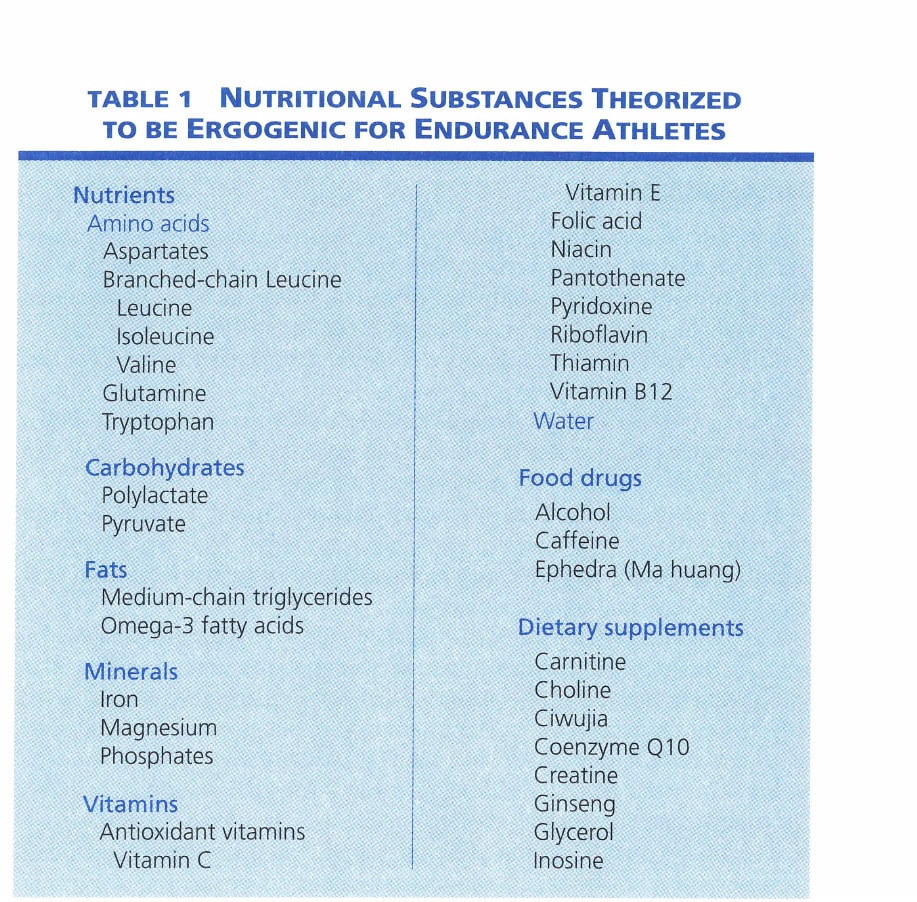
The six major classes of nutrients in the foods we eat—carbohydrate, fat, protein, vitamins, minerals, and water—contain over 40 essential nutrients that are involved in human energy processes in one way or another. We may also consume other products that may influence energy processes during exercise, including food drugs and dietary supplements. Table 1 lists some nutritional substances that have been theorized to be ergogenic for endurance athletes. Although nutritional ergogenic aids may be used in attempts to enhance mental strength or provide a mechanical edge, this brief review will focus on several of those that have been used by endurance athletes in attempts to increase physical power.
Factors Limiting Physical Power
Your car gets its power for high speeds from the oxidation of gas in its engine. Your muscles get their physical power for high-intensity aerobic endurance exercise, such as running a marathon, from the oxidation of carbohydrate, the primary fuel, and fats, a secondary fuel.
One limiting factor to physical power is the ability of your muscles to metabolize appropriate fuels. ATP (adenosinetriphosphate), a high-energy compound, is the only immediate source of energy for all muscle contraction, but muscle ATP supplies are very limited, only lasting a second or so. To sustain high-intensity aerobic exercise, the body needs to replenish its ATP supplies, and the primary means to regenerate ATP rapidly during such endurance events is oxidizing muscle fuels, primarily carbohydrates and fats.
Although proper training will increase the capacity of your muscles to metabolize both carbohydrate and fat, athletes also use various nutritional ergogenics in attempts to optimize fuel usage for improved performance.
Another factor that limits physical power in endurance exercise is your ability to supply and use oxygen. Oxygen supply depends on the ability of your heart, lungs, and blood (cardiovascular-respiratory system) to transport oxygen to your muscles, while oxygen use is dependent on metabolic processes within your muscles. Again, proper training will increase the capacity of your cardiovascular-respiratory system to deliver oxygen and your muscular system to use it, but athletes are also using various nutritional ergogenics in attempts to augment this training effect.
Nutritional Ergogenic Aids to Enhance Fuel Utilization
The foods we eat provide us not only with energy nutrients, but also with nutrients needed to release this energy during exercise. Nutritional ergogenics have been used in attempts to augment premium fuel sources or to exert favorable effects on muscle fuel metabolism during exercise.
Carbohydrate
Carbohydrate is a more efficient fuel than fat, requiring less oxygen to produce ATP. Carbohydrate gives you more miles per gallon, so to speak. Almost all of your dietary carbohydrate, such as bread, cereal, pasta, and fruits, is converted in the body to glucose. Glucose is the carbohydrate form that provides energy needed to form ATP. Excess glucose is stored as glycogen in the liver and muscles.
During exercise, muscle glycogen can break down to glucose for oxidation and subsequent ATP production directly in the muscle, while the liver can release glucose to the blood for delivery to the muscle.
However, muscle and liver glycogen stores are limited, and may become suboptimal within 90 minutes of high-intensity aerobic exercise. Therefore, carbohydrate supplementation may be ergogenic in two ways: increasing your initial fuel stores and refueling as you go.
Carbohydrate-loading (technically called muscle glycogen supercompensation) is designed to increase muscle and liver glycogen stores, possibly 50 to 100 percent or more, prior to exercise. During the tapering week prior to the competitive event, athletes may consume 400 to 600 grams of carbohydrate for several days. In a recent review, John Hawley and his associates from the prestigious Sports Science Institute of South Africa indicated that carbohydrate-loading procedures may elevate muscle and liver glycogen stores, postponing fatigue and improving performance by 2 to 3 percent in endurance events where a set distance (such as a marathon) is covered as quickly as possible. Also, carbohydrate consumption during prolonged exercise is designed to provide additional glucose to the muscle. The optimal amount appears to be about 30 to 60 grams of carbohydrate per hour, an amount provided by consuming 4 to 8 ounces of a typical sports drink, such as Gatorade, every 15 minutes. Numerous studies worldwide have shown that ingesting either solid or liquid carbohydrate during endurance exercise enhances performance.
Carbohydrate By-Products
In the aerobic process of producing ATP, glucose is converted to over 20 metabolic by-products, or metabolites. Several of these by-products have been suggested to be more ergogenic than typical glucose supplements. In a recent review, John Ivy from the University of Texas suggested that supplementation with pyruvate and dihydroxyacetone phosphate (DHAP) could enhance endurance performance in untrained males, possibly by increasing muscle glucose uptake or sparing muscle glycogen. However, all human studies finding an ergogenic effect of DHAP were conducted in the same research facility, so confirming data are needed from other laboratories. Moreover, Ivy also indicated that the effect of DHAP supplementation on trained subjects is unknown.
Research with other glucose metabolites, such as fructose 1,6-diphosphate, and lactate salts (polylactate), has not shown any ergogenic effect beyond that provided by glucose.
Fat-Loading
Our major dietary lipid is fat, which is stored in the body mainly as triglycerides in adipose and muscle tissues. The triglycerides may be catabolized to free fatty acids (FFA), and the FFA are eventually oxidized to produce ATP. Muscle triglycerides provide FFA directly in the muscle, while FFA from the adipose tissue must be mobilized and delivered to the muscle via the blood. Although FFA are an important fuel source for aerobic endurance, they are not as efficient as carbohydrate. Fat use predominates in low- to moderate-intensity aerobic exercise, whereas carbohydrate use predominates in high-intensity aerobic exercise.
Your body supply of fat, and thus triglycerides, to support the energy needs of exercise is almost limitless. So why would you want to supplement your diet with fat to increase your endurance?
Most dietary strategies or supplements attempt to increase FFA oxidation and reduce reliance on your limited carbohydrate stores, sparing muscle glycogen for use during the latter stages of an endurance event.
Because ATP production from fat oxidation is less efficient than carbohydrate oxidation, you would have to slow down your pace if you were low in glycogen and dependent primarily on fat. Sparing muscle glycogen early in the race may help you maintain a faster pace during the latter part.
Fat-loading is a dietary strategy in which you adopt a high-fat, low-carbohydrate diet for several weeks in attempts to shift energy metabolism during exercise to fat instead of carbohydrate. Although several preliminary studies have shown some beneficial effects of fat-loading, most benefits were observed in low- to moderate-intensity, not high-intensity aerobic endurance exercise. A recent review concluded that although the fat-loading hypothesis is intriguing, the current scientific literature is not supportive.
Medium-Chain Triglycerides (MCT)
Most dietary fat we eat is digested and metabolized rather slowly. Medium-chain triglycerides (MCT) are oral water soluble supplements that may enter
the circulation more readily than normal dietary fats and move into the muscle cell mitochondria for oxidation more readily as well.
MCT have been theorized to be a more efficient lipid energy source during exercise. However, recent research has shown that oral MCT do not make any significant contribution to energy metabolism during exercise and actually impaired performance in high-intensity 40K cycling tasks. Oral MCT supplements cannot be recommended at this time.
On the other hand, Lambert and her colleagues from the Sports Science Institute of South Africa indicated that adaptation to a high-fat diet for 10 days, combined with carbohydrate and medium-chain triglyceride (MCT) intake during exercise, could enhance performance in high-intensity exercise bouts. Their procedure involved ingesting 100 milliliters (about 3.3 fluid ounces) every 10 minutes of a solution containing about 2 grams of MCT per 100 milliliters for 60 to 90 minutes prior to exercise, while during exercise consuming the same solution but adding 10 grams of carbohydrate per 100 milliliters. This study suggests that the combination of fat-loading, along with MCT and carbohydrate intake during exercise, may enhance endurance performance. However, Lambert and her colleague recommended that athletes rehearse this strategy during training, as it may cause diarrhea in some individuals. More research is needed to support this preliminary finding.
Caffeine
The drug caffeine, a potent stimulant, is found naturally in certain foods and beverages. For example, one cup of drip coffee contains about 100 to 150 milligrams of caffeine, a therapeutic dose. Caffeine may benefit performance in several ways, and for years it has been a favorite ergogenic aid for endurance athletes.
Caffeine may benefit performance by stimulating neurological functions. For example, recent research has shown that cyclists exercising at a set level of psychological effort can produce more work in 10 minutes when given caffeine. Caffeine supplementation has been shown to improve performance in a 1,500m run, an event that may be benefited by psychological stimulation. Although a 1,500m run is an abbreviated endurance task, caffeine-stimulated improvements in training may lead to enhanced competitive performance.
Caffeine may also benefit metabolic functions during exercise, either directly or indirectly, by stimulating the release of epinephrine (adrenaline), a potent hormone. Many studies have shown that caffeine supplementation can improve performance in prolonged aerobic endurance tasks greater than one hour in duration. One theory suggests caffeine increases the use of FFA for energy, sparing muscle glycogen, but other unresolved mechanisms, including psychological effects, may be responsible for this ergogenic effect.
The IOC has restricted, but not totally prohibited, the use of caffeine. However, legal doses are effective ergogenics. For example, 5 milligrams of caffeine per kilogram (2.3 milligrams per pound) of body weight, the amount of caffeine found in 3 to 4 cups of coffee or 2 Vivarin tablets, is legal and has been shown to be an effective ergogenic.
Carnitine
Carnitine, a vitamin-like compound, may influence energy metabolism in several ways. Of possible ergogenic value for the endurance athlete, carnitine facilitates the transport of fatty acids into the mitochondria for oxidation, a function that might spare the use of muscle glycogen during exercise.
However, there are no scientific data to support a muscle glycogen-sparing effect of carnitine supplementation. Moreover, three recent detailed reviews of the available scientific research concluded that carnitine supplementation does not affect metabolic processes during exercise, nor does it influence actual endurance performance in events such as a marathon or 20K run.
Creatine
Creatine, a substance found naturally in small amounts in animal foods, is currently the hottest-selling dietary supplement for athletes. Creatine supplementation can increase the muscle supply of creatine phosphate, a high-energy compound used in very-high-intensity exercise, such as sprinting. Although creatine is not marketed to endurance athletes, some research suggests it may influence endurance performance, both positively and negatively.
On the positive side, some research has shown improved performance in 300m and 1,000m repeat sprints. If creatine supplementation could increase interval training intensity, you could possibly improve your competitive performance. Well-controlled research is needed to evaluate the effect of chronic creatine supplementation on the training response and subsequent competitive endurance performance.
On the negative side, creatine supplementation has been reported to impair performance in a 6K (3.6-mile) terrain run. One consistent side effect of creatine supplementation is a rapid body weight increase, possibly several pounds in a week. This rapid weight increase is primarily water, a possible mechanical disadvantage to the runner who has to move the additional body weight.
For those who desire to experiment with creatine supplementation in training, a loading-maintenance protocol has been recommended. To load, consume 20 grams of creatine (four doses of five grams) daily for five days; to maintain, consume one five-gram dose daily for eight weeks.
Nutritional Ergogenic Aids to Enhance Oxygen Metabolism
Many nutrients are involved in the transportation and utilization of oxygen in the body. Nutritional ergogenics, including essential nutrients and commercial dietary supplements, have been used in attempts to increase oxygen delivery via the red blood cells or to facilitate oxygen use in the muscles.
Iron
Iron is essential for forming hemoglobin, the compound in the red blood cells (RBC) that transports oxygen to the muscles. Iron deficiency is the most common mineral deficiency among endurance athletes, particularly female athletes on low-calorie diets. Curing an athlete’s iron-deficiency anemia with iron supplementation will increase oxygen uptake and return endurance performance to normal. However, iron supplementation in athletes with normal iron and hemoglobin status has not been shown to enhance performance.
The United States Olympic Committee recommends female athletes undergo blood testing periodically to determine hemoglobin status. If low, iron supplementation under the guidance of a health professional may be recommended.
Phosphorus
Phosphorus is an essential nutrient present in the diet as phosphate salts. Phosphate is part of 2,3-DPG, a compound associated with hemoglobin in the RBC to facilitate oxygen release. An increased 2,3-DPG level and oxygen uptake is the prevalent theory underlying phosphate supplementation to endurance athletes.
Four well-controlled studies have shown that phosphate supplementation (about four grams sodium phosphate per day for three to six days) may increase maximal oxygen uptake (VO2max) by about 10 percent. Several of these studies showed increased endurance performance as well. However, other studies have not shown any ergogenic effects, and a recent review by Mark Tremblay and his colleagues has recommended more research to resolve this issue.
Inosine
Inosine, a nonessential nutrient, is theorized to enhance endurance performance by increasing 2,3-DPG, aiding oxygen delivery to the muscles in a fashion similar to phosphate supplementation. However, two well-controlled studies found that inosine supplementation did not improve oxygen delivery during either submaximal or maximal exercise, nor did it improve performance in a three-mile run. Moreover, both studies found that inosine supplementation actually impaired performance in maximal runs to exhaustion on a treadmill.
Glycerol
Glycerol (glycerin), an alcohol by-product of fat hydrolysis, may be converted to energy in the body, but has been studied as a potential ergogenic for other reasons. When consumed with water (about one gram glycerol diluted in 20 to 25 milliliters of water), glycerol exerts an osmotic effect that helps increase total body water, including an increased plasma volume in the blood—an effect that could increase oxygen delivery to the muscles.
Several studies have shown that glycerol supplementation may improve cycling endurance performance, but other research has shown that carbohydrate supplementation improved cycling endurance as well as glycerol supplementation. Additional research is needed to evaluate the ergogenic effect of glycerol supplementation, particularly in distance running in which the extra body mass (water weight) must be moved as efficiently as possible. Glycerol capsules and a glycerol-containing sports drink, with proper instructions for use, are marketed to endurance athletes.
Coenzyme Q10 (Ubiquinone)
Coenzyme Q10 (CoQ10), a vitamin-like compound also called ubiquinone, is a dietary supplement targeted to endurance athletes. CoQ10 is essential for oxidative energy production in heart and skeletal tissue mitochondria. Theoretically, improved oxygen usage in the heart and skeletal muscles could improve aerobic endurance performance.
However, most studies have shown that CoQ10 supplementation in healthy, physically active individuals did not influence physiological functions during exercise, like heart rate or VO2max, or cycling endurance performance. Actually, one study reported that CoQ10 supplementation was associated with muscle tissue damage and impaired cycling performance.
Ginseng
Ginseng comes in many forms, but Panax ginseng (Chinese or Korean) and Eleutherococcus senticosus (Siberian or Russian) have been most studied for their ergogenic potential. Although the ergogenic effect of ginseng has been attributed to plant extracts called ginsenosides, no actual mechanism has yet been identified. Nevertheless, some investigators hypothesize that ginsenosides may increase cardiovascular capacity during exercise.
Older studies have shown beneficial effects of ginseng supplementation on endurance performance. However, in a recent comprehensive review, Michael
THE FOOT is a complex anatomical structure requiring the coordinated movement of 28 bones, 58 tendons, and 112 ligaments to function properly. Running places on each foot strike a force equal to three times your body’s weight.
Given the foot’s complex anatomy, it is no wonder so many runners experience foot pain and foot problems in the course of their training and racing. Because of the direct pressure the heel absorbs when it hits the ground and the biomechanical stress placed on it during the process of running, the heel region is one of the most frequently injured areas on a runner’s foot.
The heel bone (calcaneus) is the largest foot bone and is a connecting point for the plantar fascia, Achilles tendon, and several other muscles and ligaments. Additionally, various nerves surround the heel on both sides.
The forces acting negatively on the heel as a result of direct trauma, overuse, or faulty biomechanics can lead to injury in one of the largest categories in the lexicon of running injuries, including but not limited to plantar fasciitis (heel spur syndrome), heel bursitis, calcaneal (heel bone) stress fractures, nerve entrapments, retrocalcaneal bursitis, and insertional Achilles tendonitis. Let’s take a look at each injury.
PLANTAR FASCIITIS/HEEL SPUR SYNDROME
Plantar fasciitis may be the most common overuse foot injury encountered by distance runners. The plantar fascia is a thick fibrous band on the bottom of the foot that extends from the heel bone to the base of the toes (see Figure 1) and supports the longitudinal arch and aids in foot propulsion while you run. The plantar fascia is relatively inflexible, and when overstressed, it will pull on the heel bone, causing pain and inflammation, a condition known as plantar fasciitis.
This article originally appeared in Marathon & Beyond, Vol. 2, No. 6 (1998).
← Browse the full M&B ArchiveMore like this
1,000+ stories from 19 years of Marathon & Beyond
The complete archive of the legendary long-distance journal — digitized and free to read.
