

Carbo Science
Enduro automobile races such as the 24 Hours of LeMans have been held since the early days of the auto industry, both as pure competition and as a method of promoting specific brands of cars. Success comes to the focused and well-paced driver who can work in concert with his car against the clock hour after grueling hour and pay attention to details, including the optimum fuel mixture for the distance, speed, and conditions.
Picking the right long-distance fuel is also critical to today’s marathoners and ultramarathoners, and there’s an array of solid and liquid carbohydrates to choose from. Each carbohydrate form (solid and liquid) has advantages and drawbacks. Sports drinks and other liquids are a practical source of carbohydrate because they also replace our fluid losses. High carbohydrate foods, on the other hand, can be easily carried and provide a feeling of satiety that you won’t get from drinking fluids. Marathoners and ultramarathoners use both forms of carbos, so it’s important to know precisely under what conditions each form of the carbohydrate will affect performance.
Muscle and liver glycogen depletion are well-recognized limitations to distance-running performance, and the longer the distance, the more profound the limitations. Eating a high-carbohydrate meal before morning runs helps replenish your liver glycogen stores and improves performance.
Consuming carbohydrates during runs provides glucose for your working muscles when they get low on glycogen. Also, eating an adequate amount of carbohydrate following a long run helps replace muscle and liver glycogen, which is essential for adequate recovery.
The massive body of research on this subject reflects the intense interest in the performance benefits and physiological effects of consuming liquid and solid carbohydrates before, during, and after exercise and provides practical recommendations about whether you should consume liquid or solid carbohydrates before, during, and after runs.
CARBOHYDRATE FORM AND BLOOD GLUCOSE LEVELS
At rest, solid food empties from the stomach more slowly than liquid food does. For this reason, solid carbohydrates may provide a slow, sustained release of blood glucose. In contrast, liquid carbohydrates may raise blood glucose levels more quickly and to a greater extent.
Based on this difference, you’d expect solid carbohydrates to be a better preexercise meal choice than liquid carbohydrates because the solid carbos provide a more continuous supply of glucose during exercise. You’d expect liquid carbohydrates to be a better choice during and after exercise because they elevate blood glucose quickly, thereby enhancing endurance and promoting glycogen replacement. On the other hand, if liquid and solid carbohydrates cause similar blood glucose responses, then you would not expect a difference in performance or glycogen restoration.
Glycemic Index
To scientifically measure such differences, we use the glycemic index (GI), which indicates how much a food increases the blood glucose level relative to glucose, which has a GI value of 100. The glycemic index is influenced by the form of the food (liquid versus solid), its fiber content, the presence of protein and fat, and the food processing and preparation methods. The glycemic index is not simply a function of whether a carbohydrate is a liquid or a solid. For example, an orange has a GI value of 66, while orange juice has a value of 67. The glycemic index is also not a function of whether the food is a starch (e.g., pasta) or simple carbohydrate (e.g., table sugar). For example, a baked potato has a GI of 98, which is close to the value of 100 for glucose.
But the glycemic index concept does have limitations. The numbers that are available are largely based on tests on simple foods. High glycemic foods often don’t affect the glycemic response when they’re combined with other foods in meals. For example, bread has a high GI, but when you add margarine, fruit, and milk to the mix, the GI of the meal is medium to low. Also, the glycemic index is based on equal grams of carbohydrate, not average serving sizes.
EATING ONE HOUR BEFORE RUNNING
Research published in the late 1970s by Carl Foster and colleagues at Ball State University in Muncie, Indiana, suggested that consuming 75 grams of glucose (300 calories) 30 minutes prior to exercise reduced endurance by causing hypoglycemia (low blood sugar) and early fatigue. The result of this study led to the recommendation that endurance athletes avoid consuming carbohydrates (liquid or solid) in the hour before exercise.
Insulin is secreted by the pancreas in response to an increase in blood glucose. Insulin lowers the blood glucose level by promoting the uptake of glucose into cells. When the blood glucose drops, some people begin to show the symptoms of hypoglycemia (weakness, dizziness, nausea, confusion, and partial blackout), or they become exhausted sooner. Fortunately, these insulin and glucose responses are temporary and will not harm performance unless you’re sensitive to having your blood glucose lowered.
Research published in 1991, however, indicated that consuming carbohydrates an hour before exercise may help performance. Michael Sherman and colleagues at The Ohio State University in Columbus found that performance was improved by 12.5 percent when subjects consumed liquid carbohydrate (a glucose polymer drink) an hour before cycling exercise. Eating one gram of carbohydrate per kilogram of body weight helped subjects maintain blood glucose levels during exercise.
Does Carbo Form Matter?
Does the form of the preexercise carbohydrate influence performance? Diane Thomas and colleagues at the University of Sydney in Australia found that athletes consuming one gram of carbohydrate per kilogram of body weight of lentils (yes, lentils!) an hour before cycling improved exercise time by 20 minutes. Compared to an equal amount of carbohydrate from a baked potato or a glucose drink, the lentils (which have a GI of 29) provided a more gradual rise and fall in blood glucose, thereby maintaining blood glucose levels at higher levels during exercise. The Thomas study results suggest that a low-glycemic solid carbohydrate is the preferred preexercise meal. Yet, the Sherman study results indicate that performance is improved following the consumption of a high-glycemic liquid carbohydrate as well. There hasn’t been a lot of research in this area (in fact, the Thomas study is the only one that has examined the GI of preexercise meal), so experiment to find your “best” preexercise meal.
There is also the obvious consideration of whether certain foods (liquid or solid) give you gastrointestinal distress. Some folks can’t eat solid food prior to running without risking a bathroom break and/or gut distress—nausea, cramps, or diarrhea. My advice is that you try different liquid and solid carbohydrates with high and low glycemic indexes to find out what works well for you. The research by Sherman and Thomas suggests that you should consume one gram of carbohydrate per kilogram of body weight an hour before exercise (to get your weight in kilograms, divide your body weight by 2.2).
If you think you are sensitive to having your blood glucose lowered, you have several options. You can consume a low-glycemic carbohydrate, take in a liquid or solid high-glycemic carbohydrate a few minutes before exercise, or wait until you’re exercising to eat a carbohydrate. The rise in the exercise hormones (epinephrine and growth hormone) blocks the release of insulin, thereby countering the insulin’s effect in lowering blood glucose.
EATING TWO TO FOUR HOURS BEFORE RUNNING
Runners are often advised to eat several hours before exercising to allow enough time for the stomach to empty. The rationale is that if any food remains in the stomach when you start running, you can become nauseated when blood is diverted from the stomach to the exercising muscles.
Rather than getting up at the crack of dawn to eat, however, many folks who run in the morning simply forgo eating. This overnight fast lowers your liver glycogen stores (the source of blood glucose) and impairs performance during prolonged runs (over several hours) that rely heavily on blood glucose. During long runs, you rely heavily on your preexisting muscle glycogen and fat stores. Although the preexercise meal doesn’t contribute immediate energy, it starts to provide energy when you run longer than an hour. It can also prevent you from getting hungry, which in itself may impair performance.
Eating a high-carbohydrate meal two to four hours before morning exercise helps restore liver glycogen, which will help during long runs. If your muscle glycogen levels are also low, the meal can also help increase them as well, as long as you eat several hours before your run.
Does the form of the carbohydrate eaten two to four hours before exercise influence performance? Probably not. Sherman and colleagues found that cycling performance was improved by 15 percent when subjects consumed a liquid carbohydrate (a glucose polymer drink) four hours before exercise. Darrell Neufer and colleagues at Ball State University found that cycling performance was improved when subjects consumed a mixed meal (cereal, bread, milk, and fruit juice) four hours before exercise.
Try different liquid and solid carbohydrates two to four hours before running to find out what works best for you. Sherman’s research suggests that you
should consume one to four grams of carbohydrate per kilogram of body weight, one to four hours before exercise. To avoid potential gastrointestinal distress, reduce the size of the meal the closer it is to the exercise. For example, a carbohydrate feeding of one gram per kilogram of weight (four calories per kilogram) is appropriate an hour before your run, whereas four grams per kilogram of weight (16 calories per kilogram) can be consumed four hours before your run.
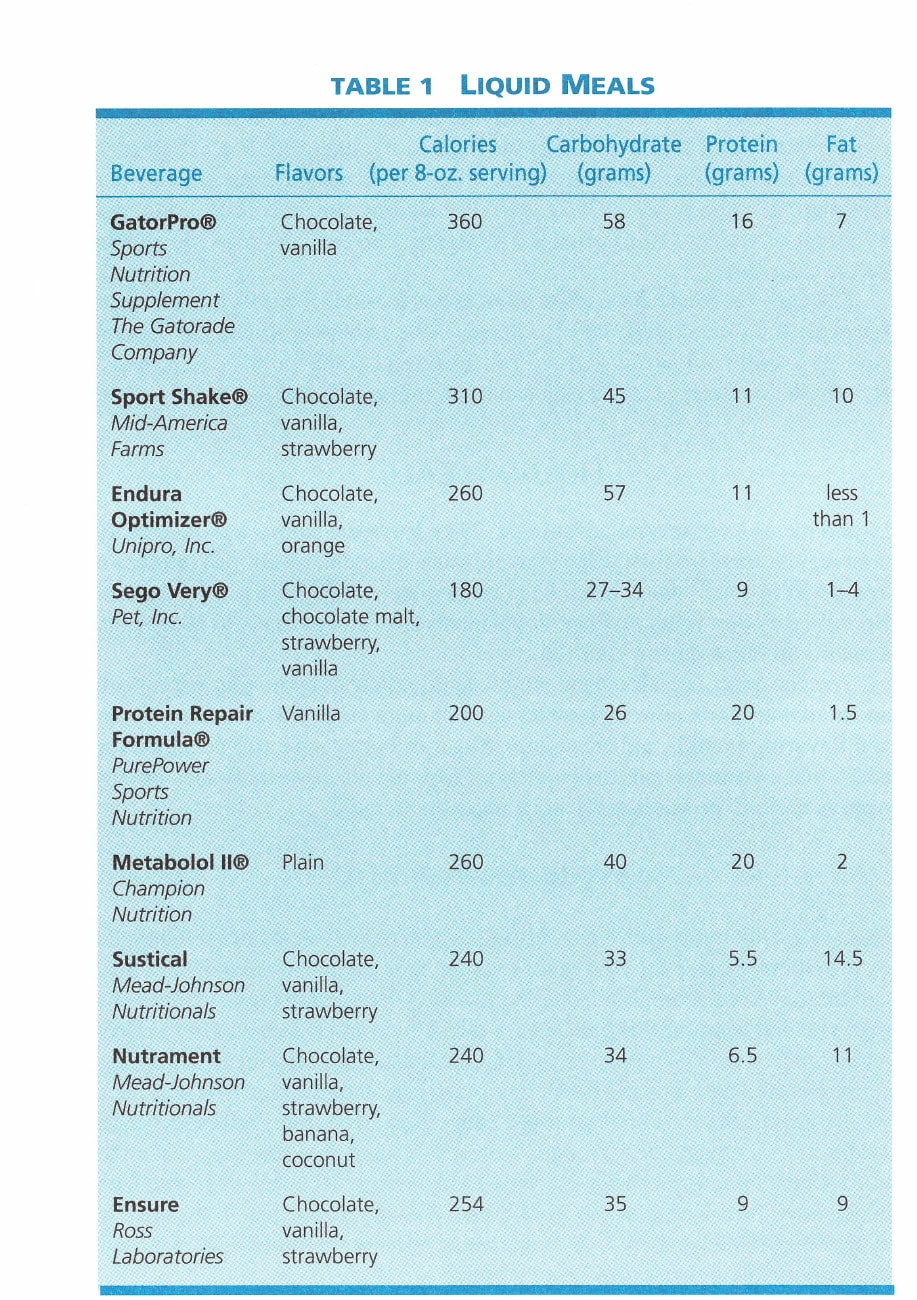
Examples of good high-carbohydrate foods for prerace meals include fruit, bread products (adding jam or jelly increases the carbohydrate content), sports bars, and nonfat or low-fat yogurt. Fruit juices and nonfat milk are good high-carbohydrate beverages. You can also use liquid meals (see Table 1).
LIQUID MEALS
Liquid meals have several advantages. They leave the stomach more rapidly than regular meals, which helps to avoid nausea. Liquid meals also produce a low stool residue, which helps keep immediate weight gain to a minimum. Because they don’t contain fiber, liquid meals are also less likely to necessitate a bathroom break during your run.
You can concoct your own home-made liquid meals by mixing milk, fruit, and nonfat dry milk powder in a blender. For more variety, add cereal, yogurt, and flavoring (vanilla and chocolate). Sugar or honey may also be added for additional sweetness and carbohydrate. There are also several brands of “instant breakfast” powders that can be mixed with milk.
EATING ON THE RUN
Eating carbohydrates during runs lasting an hour or longer enhances endurance by providing glucose for your muscles when they run low on glycogen. Thus, carbohydrate utilization (and, therefore, energy production) can continue at a high rate and endurance is enhanced. Eddie Coyle and colleagues at the University of Texas in Austin have shown that consuming carbohydrates during cycling exercise at 70 percent of V̇O2max can delay fatigue by 30 to 60 minutes.
As the muscles run out of glycogen, they take up more blood glucose, which places a drain on the liver glycogen stores. The longer the run, the greater the utilization of blood glucose by the muscles for energy. When the liver glycogen is depleted, the blood glucose level drops. Though a few people experience symptoms indicative of hypoglycemia, most runners are forced to reduce their exercise intensity due to leg muscle fatigue.
The influence of carbohydrate feedings on running performance has also been evaluated. During a 40-kilometer run in the heat, Melinda Millard-Stafford and colleagues at the Georgia Institute of Technology in Atlanta found that a liquid carbohydrate feeding (55 grams per hour) increased blood glucose levels and enabled runners to finish the last 5 kilometers significantly faster compared to when subjects consumed a drink that didn’t contain carbohydrate. In a treadmill run at 80 percent of V̇O2max, Randall Wilber and Robert Moffatt at Florida State University in Tallahassee found that when subjects consumed a carbohydrate drink (35 grams per hour) the run time was 23 minutes longer (for a total of 115 minutes) compared to the run when subjects consumed a carbohydrate drink (92 minutes).
What Form of Carbs?
Does the form of the carbohydrate consumed during exercise influence performance? No. Manuel Lugo and colleagues at The Ohio State University found that liquid and solid carbohydrate feedings were equally effective in increasing blood glucose levels and improving cycling performance.
Coyle’s research suggests that you should consume 30 to 60 grams of carbohydrate (120 to 240 calories) for every hour of exercise. Try experimenting with both carbohydrate-rich foods and sports drinks. Sports drinks containing 6 to 8 percent carbohydrate are a practical source of carbohydrate. They provide the right proportion of water to carbohydrate to provide energy and replace fluid losses. Drinking 5 to 10 ounces of a sports drink containing 6 to 8 percent carbohydrate (about 56 to 77 calories per 8 ounces) every 15 to 20 minutes supplies the right amount of carbohydrates.
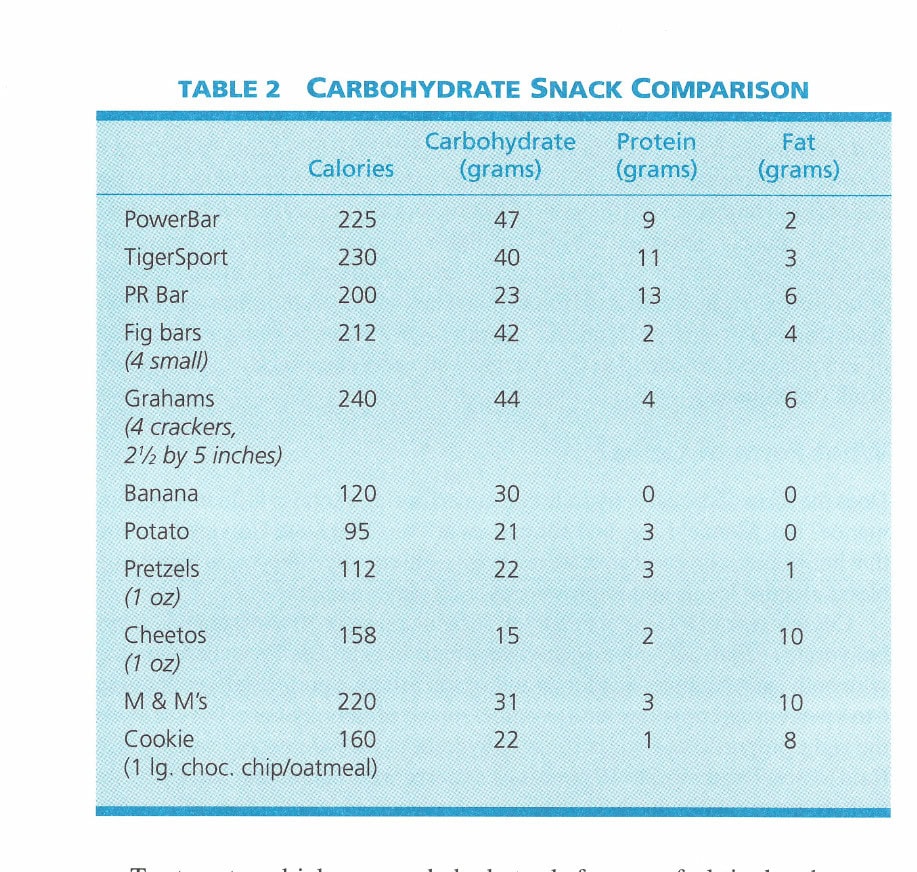
High-carbohydrate foods (see Table 2) provide a feeling of satiety that you won’t get from drinking fluids. Eating one banana or four graham crackers or four fig bars or one sports bar per hour provides the recommended amount of carbohydrates.
Sports bars, fig bars, and cookies have a very low water content so they are compact and easy to carry. By comparison, high-carbohydrate foods that have a high water content, such as fruit, take up more room. For example, to get the amount of carbohydrate supplied by one PowerBar (47 grams), you’d have to eat 1.5 bananas (45 grams).
However, the low water content of some solid high-carbohydrate foods also has a downside. You’d better drink plenty of water when you eat solid food, especially a sports bar. Otherwise the food will settle poorly, and you may feel like there’s a rock in your gut. In addition to aiding your digestion, drinking water while eating solid foods helps keep you adequately hydrated.
Try to eat or drink your carbohydrates before you feel tired or hungry, usually within 30 to 60 minutes into your run. Consuming small amounts at frequent intervals (every 30 to 60 minutes) helps prevent gastrointestinal upset. Your foods and fluids should be easily digestible, familiar (tested in training), and enjoyable (so you’ll want to eat and drink them).
Consuming a high-carbohydrate preexercise meal adds to the benefit you get from consuming carbohydrates during exercise. David Wright and colleagues at The Ohio State University found that cyclists who consumed carbohydrates both before exercise and during exercise were able to exercise longer (for a total of 289 minutes) than those who consumed carbohydrates during exercise (266 minutes) or just before exercise (236 minutes).
However, the improvement in performance when carbohydrates are consumed during exercise was greater than when carbohydrates were consumed before exercise. My advice is that if you want to have a continuous supply of glucose during exercise, take in carbos during exercise.
Consuming carbohydrates immediately after prolonged training and competitions lasting several hours increases muscle glycogen storage and helps you to recover faster. John Ivy and colleagues at the University of Texas in Austin compared glycogen storage when carbohydrate consumption was delayed for two hours after exercise. When the carbohydrate feeding was delayed for two hours, glycogen storage was cut in half when measured four hours after exercise.
Does the form of the carbohydrate influence muscle glycogen syntheses? No. Michael Reed and colleagues at the University of Texas in Austin found that postexercise liquid and solid carbohydrate feedings were equally effective in promoting muscle glycogen repletion following cycling exercise.
Replacing muscle glycogen stores after exercise is particularly beneficial if you train hard several times a day because you will get the most out of your second workout. Ivy’s research suggests that you should consume 1.5 grams of carbohydrate per kilogram of body weight within 30 minutes of completing your run, followed by an additional 1.5 grams per kilogram feeding two hours later.
Many runners aren’t hungry after heavy training. If this is the case, consume a high-carbohydrate drink such as fruit juice or a commercial high-carbohydrate supplement (see Table 3) for your first feeding. This practice also promotes rehydration. Then, your second feeding can be a conventional high-carbohydrate meal.
TABLE 3 High-Carbohydrate Beverages
| Beverage | Flavors | Carbohydrate Ingredient | Carbohydrate % (concentration) 12-oz. serving | Carbohydrate (grams) | Sodium (mg) |
|---|---|---|---|---|---|
| GatorLode® The Gatorade Company | Lemon, citrus, banana | Maltodextrin, glucose | 20 | 70 | 95 |
| Carboplex® Unipro, Inc. | Plain | Maltrodextrin | 24 | 82 | 0 |
| Carbo Power® Nature’s Best Food Supplements | Lemonade, strawberry, fruit punch, orange, grape, tea | Maltrodextrin, high-fructose corn syrup | 18 | 64 | 76 |
| Ultra Fuel® Twin Labs | Lemon, lime, grape, fruit punch, orange | Maltodextrin, glucose, fructose | 21 | 75 | 0 |
| ProOptibol®105 Next Nutrition | Wild berry | Glucose, fructose | 19 | 66 | 0 |
| Cybergenics Cybercharge® L & S Research Corp. | Lemon, lime, grape, | Glucose polymers, fructose | 21 | 75 | 15 |
| Carbo Fire® Weider Health & Fitness | Tropical punch, orange | Glucose polymers, fructose | 24 | 83 | 60 |
From The Ultimate Sports Nutrition Book. Reprinted with permission of Bull Publishing.
Remember that for the endurance athlete, carbohydrates in either liquid or solid form constitute the primary fuel for going the distance, whether it’s the standard 26.2-mile marathon or the 24 Hours of LeMans . . .er . . . a 24-hour track race.
This article originally appeared in Marathon & Beyond, Vol. 1, No. 3 (1997).
← Browse the full M&B ArchiveMore like this
1,000+ stories from 19 years of Marathon & Beyond
The complete archive of the legendary long-distance journal — digitized and free to read.
