

The Infection Connection
Most runners I know have a better-than-average understanding of the human musculoskeletal system, tossing terms such as IT band syndrome, piriformus syndrome, and iliopsoas tendinitis into casual conversation with other runners as though they were confetti at a New Year’s Eve party. Knowledge of the immune system—especially as it relates to exercise—tends to be less encyclopedic, for the layperson at any rate. NK cells, macrophages, salivary IgA . . . ho-hum, when’s your next race?
That is a shame, considering the importance of the immune system. Most of us take for granted that the immune system protects us from disease-causing organisms, but as runners we tend to sit up and take notice only when a whopper cold settles into our heads the day before a marathon or we find ourselves plagued by recurrent sinus infections following races. Running can boost the immune system—but too much can also dampen it.
The immune system’s first lines of defense against invading organisms are barriers: physical barriers, such as the skin and mucous membranes, and chemical barriers, including stomach acids and proteins in tears, saliva, and skin oils. If some intrepid organism manages to penetrate these barriers, specialized cells called phagocytes (including macrophages) engulf, kill, and chew up foreign invaders as well as cancer cells. The aptly named natural killer (NK) cells also destroy infected and cancerous cells. This first line of defense is called the innate immune system.
Then there’s the acquired immune system, the T and B cells (lymphocytes) that respond to specific proteins, or antigens, on invading organisms. Prodded into action by macrophages and other components of the innate immune system, the T and B cells produce chemicals (cytokines and antibodies) that regulate the immune response and help kill the offending organism. It’s the lymphocytes that remember past infections (and immunizations), allowing the immune system to respond faster and more efficiently the next time the same antigen comes along.
Of course, the immune system doesn’t operate in a vacuum; it’s fundamentally interconnected with both the nervous and endocrine systems. It knows whether you’ve been stressed out about losing your job or that you make it a practice of
eating only Pop-Tarts for breakfast every morning. There aren’t any secrets among the three systems: everything is connected.
THE POSITIVE EFFECTS OF MODERATE EXERCISE It’s a commonly held belief that people who exercise regularly get sick less often than couch potatoes: in one survey, over three-quarters of 750 masters athletes (ranging in age from 40 to 81 years) said that they are less vulnerable to viral infections than their sedentary peers. Research backs them up. In a recent yearlong study of over 500 men and women, for example, those who were “moderately active” had a 20 percent reduction in risk for upper respiratory tract infections as compared with physically inactive adults. Women who walked briskly for 35 to 45 minutes, five days a week, for 12 to 15 weeks, were found to have colds half as often as inactive women. And, although immune function naturally declines with age, some studies have shown that highly fit elderly people have better preserved immune systems. Several positive changes occur in the immune system during exercise, and while the immediate effects are transitory, the boost they lend immune cells reduces the risk of infection over the long term.
Jeffrey Woods, associate professor of kinesiology and nutritional science at the University of Illinois, has shown that exercise can have potent stimulatory effects on macrophages, which he describes as “the special forces that come in first and set up the stage for the army.” Woods has also shown that moderate exercise can protect mice from death because of influenza (unpublished data). Even more intriguing is Woods’s recent research showing that exercise—prolonged, intense exercise, “like a mouse marathon,” said Woods—not only delays the growth of tumors but also speeds up the rate of their regression in mice.
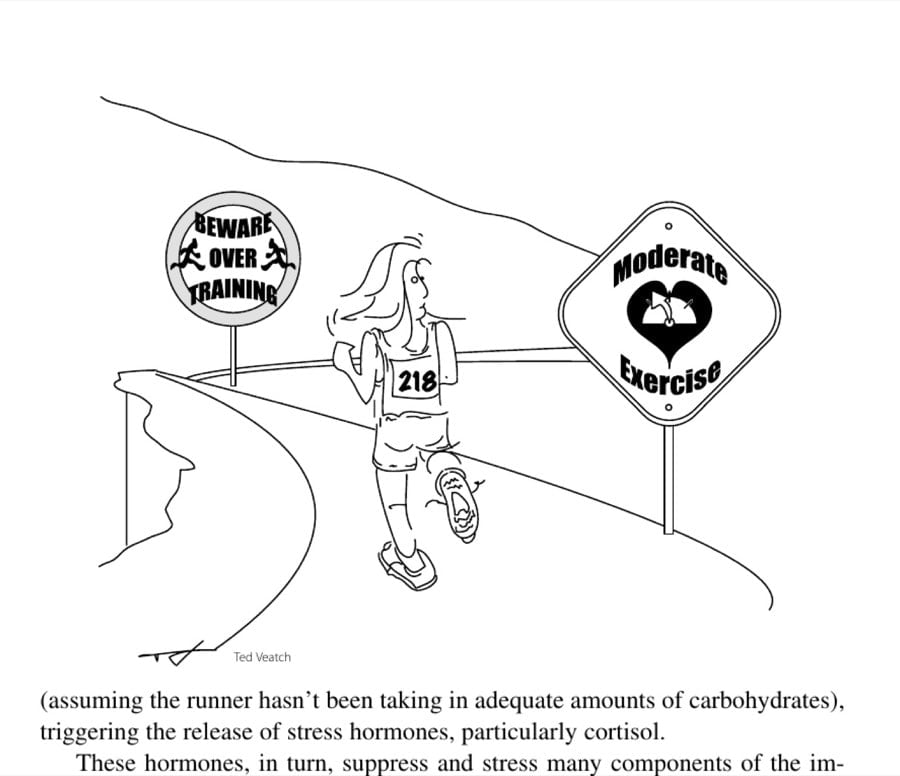
NOW FOR THE BAD NEWS The alert reader will notice that most of the positive benefits to the immune system are associated with “moderate exercise.” Running for miles on end may challenge the spirit, cleanse the mind, and toughen the body, but moderate it’s not. Endurance athletes tend to be an immoderate bunch of folks.
Runners who train hard but avoid overtraining—a term that’s used to describe a decrease in athletic performance resulting from training too hard, for too long—are typically healthy. But there is a common, and well-deserved, perception that overtraining and taking part in long-distance races can lower resistance to disease, especially to colds and other upper respiratory tract infections. “Running a marathon and beyond is a huge stressor,” says David Nieman, professor of health and exercise science at Appalachian State University. “What you put your body through is beyond what’s good for it,” notes Nieman, who has run 58 marathons and ultras. After about 90 minutes of running, blood glucose levels begin to drop
Ted Veatch
(assuming the runner hasn’t been taking in adequate amounts of carbohydrates), triggering the release of stress hormones, particularly cortisol. These hormones, in turn, suppress and stress many components of the immune system, especially the innate system. Phagocytes and NK cells become less efficient at killing microbial invaders; macrophages don’t communicate as well with lymphocytes. The levels of one of the most important antibodies in saliva and the mucous membranes, IgA, drop dramatically. These are just a few stress hormone-induced changes to the immune system.
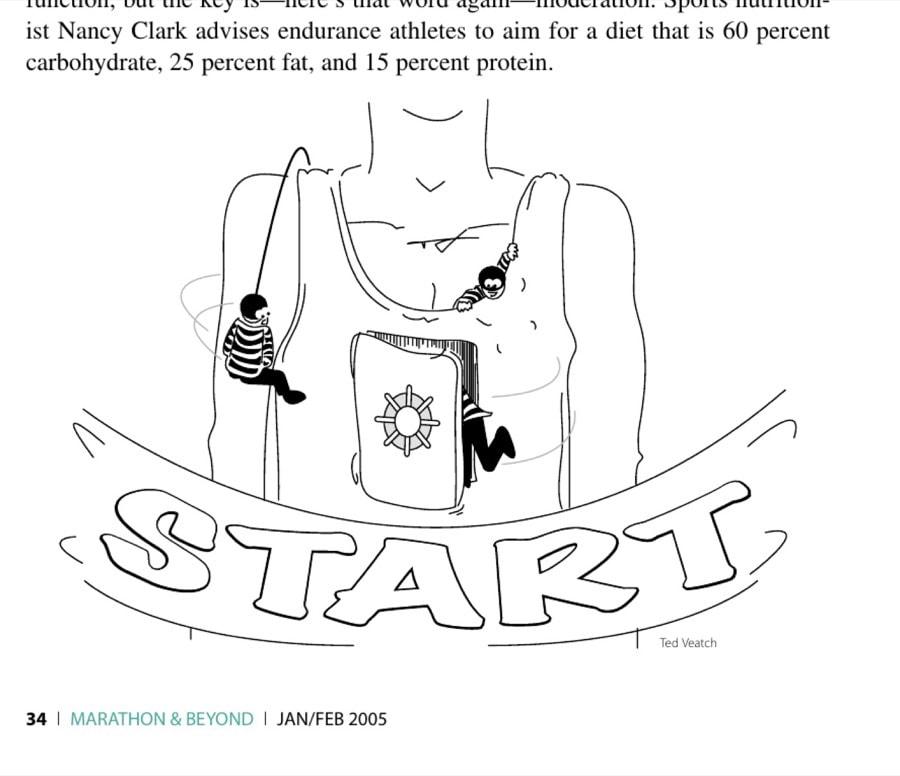
This so-called open window of altered immunity is temporary, lasting from three to 72 hours after an intense, prolonged event. Nevertheless, it presents an ideal opportunity to viruses and other invading pathogens, especially those that enter the body through the respiratory system. As Nieman says, “It doesn’t take much time for a crook to enter a bank and take the money.”
If you think about it, a race situation is an ideal time for viral crooks to crack the vault. At the expo or at the beginning of the race, you’re exposed to hundreds, sometimes thousands, of other runners in fairly close proximity. When the race begins, you’re all breathing hard, inhaling and exhaling microbes with extra gusto. Nieman and others have shown that one in seven runners comes down with an upper respiratory infection after taking part in a marathon—compared with just two out of 100 runners who didn’t compete. Take part in an ultra event such as the 100-mile Western States Endurance Run, and your chances of getting sick are more like one in four.
That said, masters and grand masters can take heart in the finding that their immune response to running a marathon is remarkably similar to that of younger runners. At this level, at any rate, the old dogs are still in the race with the young pups.
NUTRITIONAL COUNTERMEASURES You probably already practice the single most effective method of preventing the immunosuppression associated with marathon or ultra events: eat or drink something with carbohydrates during the race. Low glucose levels trigger the release of cortisol and other stress hormones, which in turn suppresses the immune system.
And, at the risk of stating the obvious, eat a healthy diet. Many runners, aiming for lean body mass, pack in the carbohydrates at the expense of protein and fats. But research has shown that even moderate protein deficiency can result in impaired immune function. Your immune cells can’t mount a decent response to infection if they don’t have the protein building blocks to manufacture the necessary cells, antibodies, and cytokines. Polyunsaturated fats (found in fish, soybean, walnut, and flaxseed oils) in particular are essential to proper immune function.
Not that you should jump onto the Atkins bandwagon to improve immune function, but the key is—here’s that word again—moderation. Sports nutritionist Nancy Clark advises endurance athletes to aim for a diet that is 60 percent carbohydrate, 25 percent fat, and 15 percent protein.
Ted Veatch
When to Rest Should you run when you’re sick? If you have a cold, most clinical experts recommend waiting a day or so after your cold symptoms disappear to resume intensive exercise. Mild to moderate exercise (such as walking) when
you have a cold is fine. If your illness is more serious—fever, fatigue, muscle aches—you should wait two to four weeks before resuming your training regimen. The reasons for doing so go beyond concerns about immediate
recovery. In some cases, exercising while sick can lead to a debilitating state called “postviral fatigue syndrome.” Similar to chronic fatigue syndrome, the symptoms include weakness, fatigue, frequent infections, and depression. Not
much is known about the exact cause of either postviral syndrome or chronic fatigue syndrome, but they can last for months or even years. “I had a friend who ran a fever the night before a race,” Nieman says. “He ran anyway and slipped into a two-year postviral syndrome.”
Several vitamins and minerals, including vitamins A, E, and C, and the minerals zinc and iron, are essential for normal immune function. Vitamins C and E, in particular, are also powerful antioxidants. It has long been known that long-distance running and other endurance events can increase the levels of free radicals—molecules that oxidize and cause damage to cells, including immune cells. The body produces its own antioxidants to counter free radicals and oxidative stress.
Many runners, operating under the theory that more of a good thing is better, take vitamin and mineral supplements. And while moderate amounts may very well be beneficial for the active individual, there is little evidence to support taking megadoses, with the possible exception of vitamin C. Some studies found that taking vitamin C (about 600 milligrams/day) for three weeks before an ultramarathon reduced postrace cold symptoms. Others, including Nieman, have found that vitamin C supplementation made no difference.
In one recent study (not yet published), Nieman found that triathletes who took high doses of vitamin E for two months before Ironman Hawaii actually had greater oxidative stress and inflammatory responses than athletes who didn’t take the supplement. And too much iron and zinc can actually impair immune function. (I can attest to the fact that zinc supplements taste nasty and did little to ward off the cold that hit me as I began writing this article.)
TAKE A CHILL PILL Just as intense, extended physical stress can depress certain immune responses, so too can chronic psychological stress and inadequate sleep. Marital discord,
losing a loved one, caring for aging parents, and taking important academic exams are all associated with suppressed immune function. People undergoing psychological stress have fewer and less-active NK cells and lymphocytes. Students taking exams often have reduced levels of IgA, the antibody found in saliva and mucous membranes. So during periods of intense training and before long races, the take-home message is this: keep other life stresses to a minimum if possible. Get enough sleep, avoid rapid weight loss, and eat a healthy diet. See, Mom really did know best.
REFERENCES Clark, N. (1997). Nancy Clark’s Sports Nutrition Guidebook. Champaign, Ill.: Human Kinetics. Clow, A., and Hucklebridge, F. (2001). “The impact of psychological stress on immune function in the athletic population.” Exercise Immunology Review, 7:5-17. Matthews C.E., et. al. (2002). “Moderate to vigorous physical activity and risk of
upper-respiratory tract infection.” Medicine and Science in Sports and Exercise, 34(8):1242-8. Nieman, D.C. (2001). “Does exercise alter immune function and respiratory infections?” Research Digest, (President’s Council on Physical Fitness and Sports) Series 3, No. 13. Nieman, D.C., et. al. (2003). “Immune and oxidative changes during and following
the Western States Endurance Run.” International Journal of Sports Medicine, 24:541-47. Nieman, D.C., et. al. (1990). “Infectious episodes in runners before and after the Los Angeles Marathon.” Journal of Sports Medicine and Physical Fitness, 30(3): 316-28. Pistilli, E.E., et. al. (2002). “Influence of age on immune changes in runners after a
marathon.” Journal of Aging and Physical Activity, 10:432-42. Shephard, R.J., et. al. (1995). “Personal health benefits of masters athletics competition.” British Journal of Sports Medicine, 29:35-40. Venkatraman, J.T., and Pendergast, D.R. (2002). “Effect of dietary intake on immune
function in athletes.” Sports Medicine, 32(5):323-7. Zielinski, M.R., et. al. (2004). “Exercise delays allogeneic tumor growth and reduces intratumoral inflammation and vascularization.” Journal of Applied Physiology, 96(6):2249-56.
Are You Moving? Please let us know when you move so there is no interruption in your subscription. Send address changes to Marathon & Beyond, 206 N. Randolph St., Suite 502, Champaign, IL 61820; or via e-mail to jan@marathonandbeyond.com. Put “Address Change” in the subject line.
This article originally appeared in Marathon & Beyond, Vol. 9, No. 1 (2005).
← Browse the full M&B ArchiveMore like this
1,000+ stories from 19 years of Marathon & Beyond
The complete archive of the legendary long-distance journal — digitized and free to read.
