


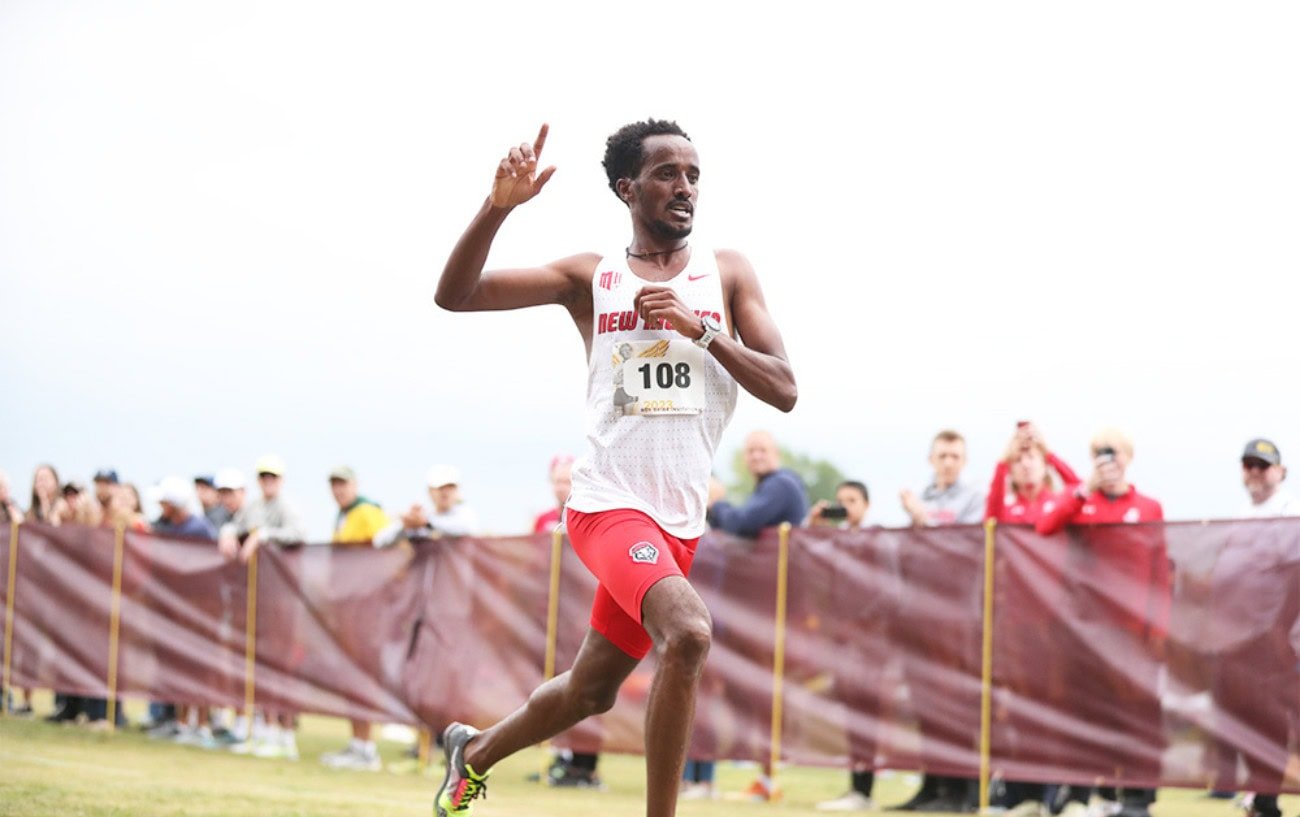
The men’s NCAA Cross Country Championships in Columbia, Missouri, should have been remembered for Habtom Samuel’s breakthrough win and Oklahoma State’s dominant team performance. Instead, the event has become a case study in how quickly a race can lose control when its boundaries don’t hold (literally).
Samuel finally claimed the title he had chased after two seasons of silver, pulling away late on the Gans Creek course to secure New Mexico’s first individual men’s champion. Behind him, Oklahoma State scored an emphatic 57-point victory.
Those were the storylines that were supposed to define the morning. But as soon as the ESPNU broadcast circulated online, the attention shifted to something else: repeated, visible course-cutting by a number of athletes in the main pack.
The first sign of mass course-cutting came just before the 4K split.
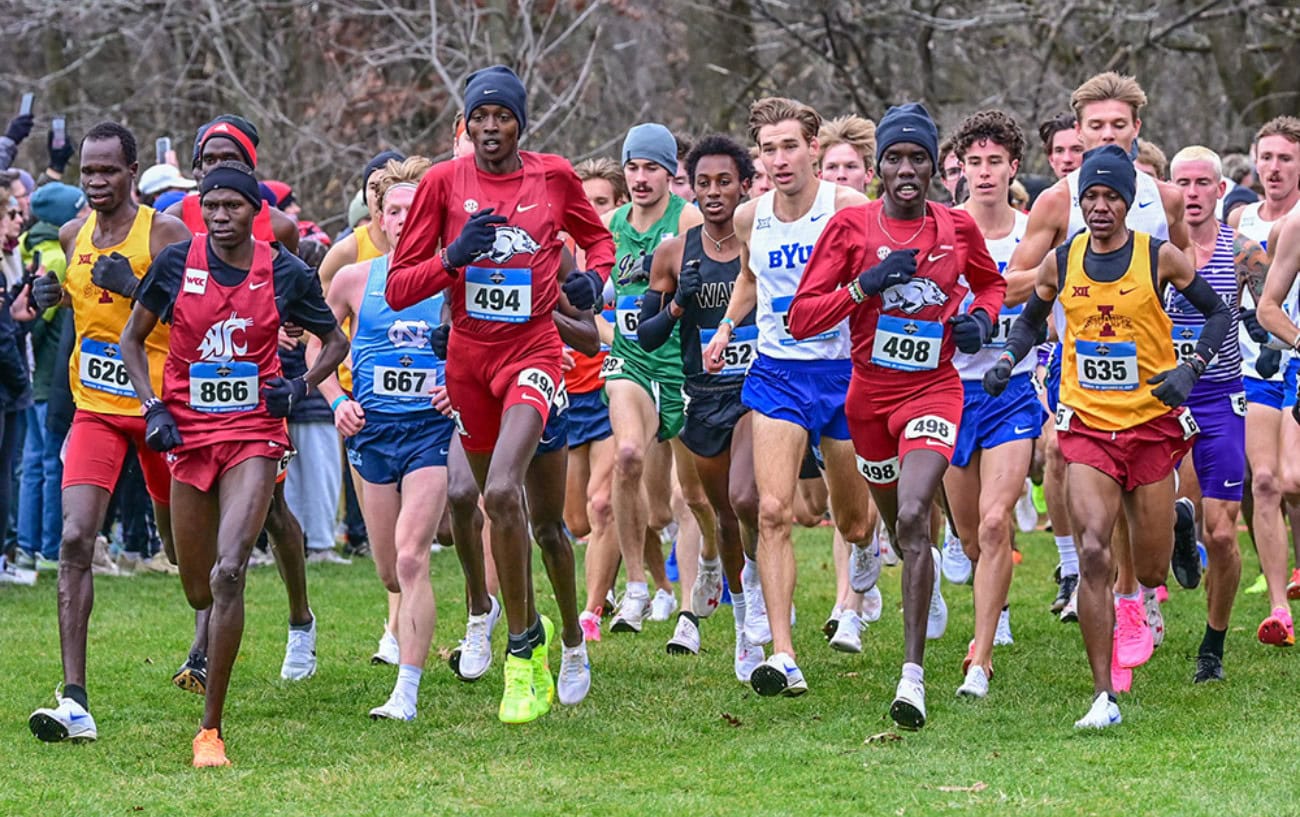
As the field approached a left-hand bend lined with hay bales outlining the turn, the camera captured a long stream of runners stepping to the inside of the white boundary line and weaving around the hay bales.
No one appeared to be forced or jostled there. The inside line simply offered a shorter route, and without a physical barrier, dozens took it.
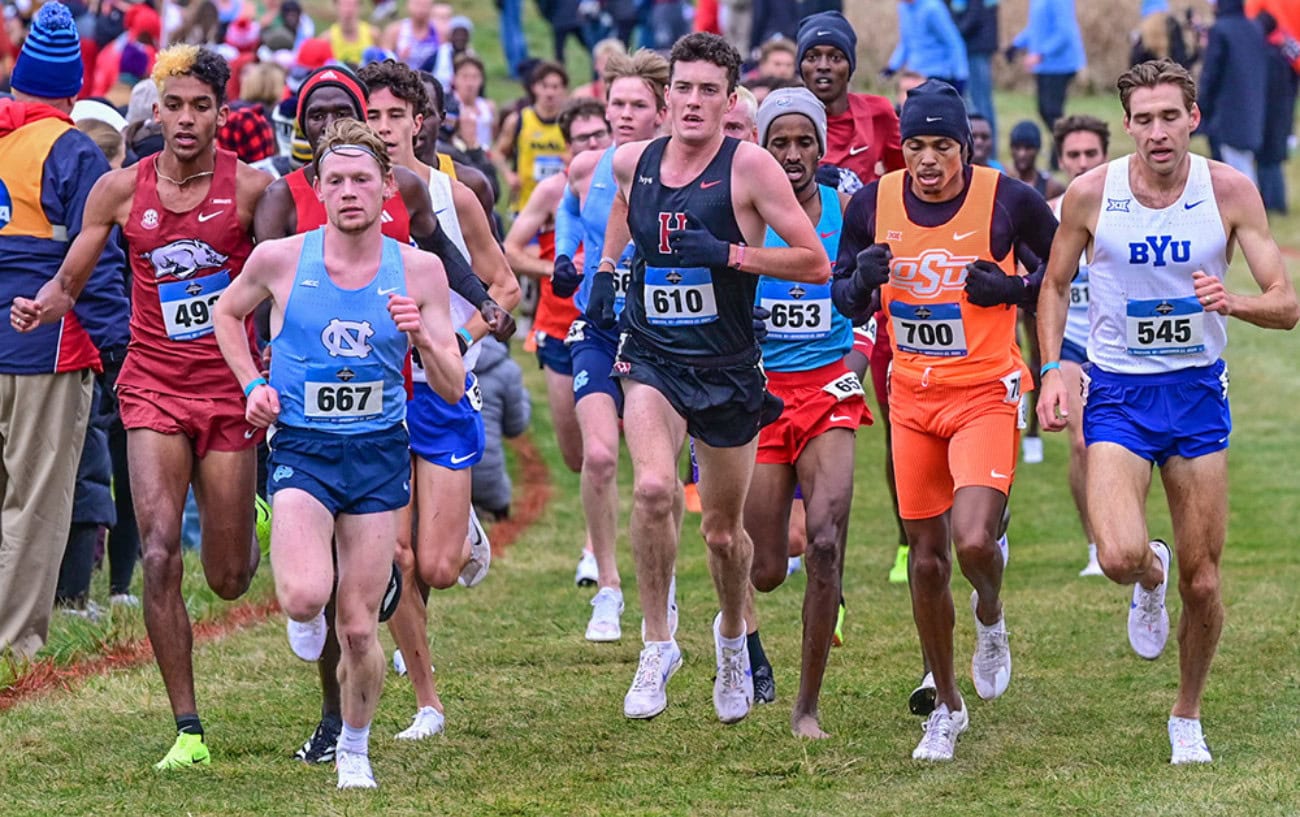
A similar pattern unfolded between 7K and 8K, when the front pack began to thin and individuals were easier to identify. Oklahoma State’s Fouad Messaoudi, one of Iowa State’s leading scorers, and Hofstra’s Fredrick Kipkosgei were among those shown running inside the hay bales on the wrong side of the marked course.
Broadcasters noticed it immediately. “We’ve got some guys hugging the line here,” John Anderson said on the call. After one Iowa State athlete clipped a bale, he added: “You’ve got to be on the other side of the hay bale.” Carrie Tollefson pointed out how visible the weaving had been from the overhead angles.
Another instance between 3K and 4K. https://t.co/LcPYmqXyV2 pic.twitter.com/I5E7MELdyE
— Theo Kahler (@tckahler) November 22, 2025
The Rulebook’s Gray Zone
The NCAA confirmed afterward that no athletes were disqualified. No protests were filed. And without a protest or an official’s report, the meet referee had no obligation to initiate a review.
That procedural gap explains part of the outcome. But Saturday’s race also exposed something deeper: the NCAA rulebook’s most ambiguous clause.
Under Rule 21, an athlete may be disqualified if they “gain a meaningful advantage by failing to complete the prescribed course,” or if they leave the course in a way that affects the fairness of competition.
But that same section also notes that a runner is allowed to move freely anywhere on the course as long as they are within its legal boundaries and do not impede others.
The language tries to account for pack dynamics and uneven terrain because cross country isn’t track, and runners aren’t always able to follow a rigid line.
Multiple athletes running on the left side of the hay bales and white line.
— Theo Kahler (@tckahler) November 22, 2025
This is between 7K and 8K. https://t.co/F8hDOrMSrO pic.twitter.com/DGnYIdvhhl
The problem is that “meaningful advantage” and “failing to complete the prescribed course” are subjective terms. There is no defined distance threshold. No metric. No guidance on whether “intent” matters.
Was an athlete deliberately cutting? Were they following others? Were they avoiding contact? How long is too long? The rulebook doesn’t say, leaving referees to interpret context on the fly.
Saturday highlighted the consequences of that vagueness.
Athletes didn’t hop fences or skip entire segments, but they did run inside physical course markers for long stretches, which is behavior that would easily qualify as “failing to complete the prescribed course” in most road races.
Yet because the NCAA’s standard hinges on proving a “meaningful advantage” and because no official raised a flag in the moment, enforcement never materialized.
Course Design and the Aftermath
The course design definitely contributed to the situation. Gans Creek is a visually impressive venue with wide fields and clean sightlines, but its interior turns were marked only with paint and isolated hay bales.
When 250 collegiate runners fight for space, soft boundaries leave too much room for interpretation.
Other major courses around the world take the opposite approach. Terre Haute’s Lavern Gibson course uses rope or fencing on the inside of nearly every turn. World Cross Country championships employ full barriers. Even many club-level races double-flag vulnerable areas to remove ambiguity.
The goal isn’t to just police intent; instead, it’s to eliminate the option entirely.
But Saturday showed what happens when that option remains open.
Once the first few athletes drifted inside the bales, others followed as if it were just another part of the course. By the time the broadcast cameras caught the pattern clearly, entire sections of the field had begun treating the inside lane as usable space.
The fallout overshadowed everything else.
Samuel’s win, earned cleanly with a late, decisive move, struggled to hold the spotlight. Oklahoma State’s victory, one of the program’s strongest in recent years, landed under the cloud of a race where boundaries seemed optional.
Fans spent the afternoon rewatching clips, identifying moments where packs peeled off course, and debating how results might have shifted if every runner had adhered to the marked line.
The NCAA now needs to face reality.
Cross country has become more visible than ever, with drone shots and live broadcasts exposing every angle of a race. The sport can no longer rely on informal boundaries and discretionary judgment when the footage is this clear.
Whether the solution is tighter course marking, mandatory use of official video review, or a sharper definition of “meaningful advantage,” something has to change.
The athletes will always race the course in front of them. And on Saturday, that course wasn’t as defined as it should have been.
RunClub
Get more running stories — join RunClub
Daily running news, a community of 300,000+ runners, free training plans for every distance, and a daily running game. Free to join — no card.
Already a member? Log in →











Start the conversation