


If you’re a running nerd like me, you’ve probably heard plenty about the Norwegian method of training. Double thresholds, lactate sensors, and the Ingebrigtsens running circles around the world.
But let’s be honest: while double thresholds are fascinating on paper, most of us juggle work, family, sleep, and a life outside of running. Training hard twice a day just isn’t happening for most recreational runners, even the very dedicated ones.
Recommended Reading
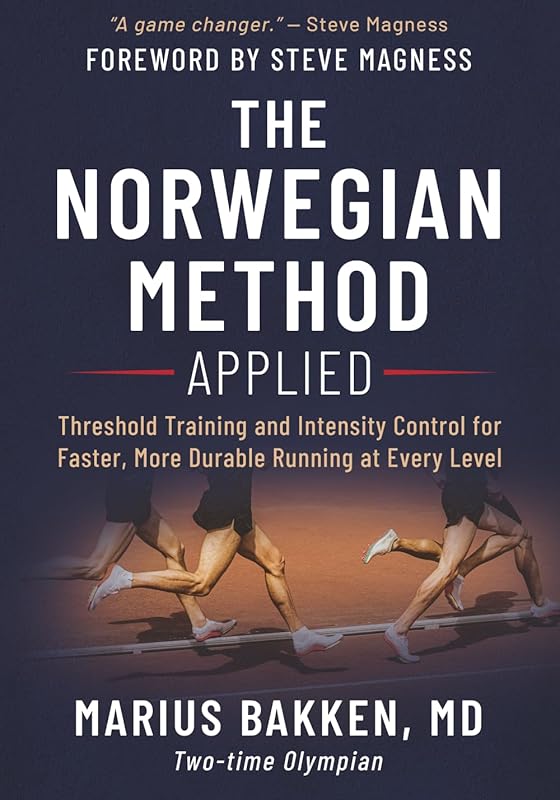
The Norwegian Method, straight from the architect
Before it powered Jakob Ingebrigtsen and a generation of sub-elite runners, the Norwegian Method was shaped over two decades and 5,500+ lactate tests by Marius Bakken — two-time Olympian and holder of the Norwegian 5,000m record (13:06.49) for over 20 years. In The Norwegian Method Applied, Bakken translates that framework into a practical threshold-based system any runner can use.
More recently, a new Norwegian school-inspired training method has been getting impressive results: Norwegian singles.
Norwegian singles training involves running two-to-three sub-lactate-threshold sessions across your week, and making all your other runs easy.
It’s less taxing and time-consuming than doubles, and recreational runners have been using it to level up their training, bust through performance plateaus, and set new PRs.
Let’s break it down.

The Honest Truth About Norwegian Singles Training
The Norwegian singles method has spread through the running world on the back of Jakob and Henrik Ingebrigtsen’s middle-distance dominance and Bashir Abdi’s European marathon record. The popular framing collapses the method into “double threshold days”, but the literature behind the method is more specific: the methodological core is sub-threshold (LT1) volume accumulated through twice-daily lower-intensity sessions, with weekly threshold dose much higher than traditional polarised plans deliver. Knowing what makes this method specifically Norwegian-singles — rather than just “more threshold work” — prevents the typical adopter from training too hard on each session and missing the framework’s actual mechanism.
Sub-threshold (LT1) is the binding intensity, not LT2
The defining feature of Norwegian singles is that “threshold” sessions sit at LT1 (the first lactate inflection, around 2 mmol/L), not LT2 (the maximal lactate steady state, 3.5–4.5 mmol/L). Faude and colleagues’ review of lactate-threshold concepts documents that LT1 corresponds to roughly marathon pace for trained runners, while LT2 sits at roughly half-marathon pace 1Faude O, Kindermann W, Meyer T. Lactate threshold concepts: how valid are they? Sports Med. 2009;39(6):469-90.. Running at LT1 produces a fraction of the metabolic and neuromuscular fatigue cost of running at LT2, which is what allows Norwegian singles to accumulate the high weekly threshold dose that drives the method’s adaptation. The runner who treats Norwegian singles as “tempo runs at LT2” is following a different protocol entirely — one with much higher fatigue cost and lower weekly volume capacity.
Twice-daily structure and the recovery-cost economics
The “singles” framing means individual sessions, with each threshold session intentionally kept short and conservative. The classic Norwegian-singles week typically includes two double-threshold days (e.g., morning 5×6 minutes at LT1 with short recoveries, evening 8x1000m at slightly faster sub-threshold pace) plus easy aerobic running on other days. Casado and colleagues documented in elite Spanish distance runners that polarised distributions outperformed pyramidal and threshold-emphasis distributions for 10K and half-marathon performance over 8–14 weeks 2Casado A, Hanley B, Santos-Concejero J, Ruiz-Perez LM. World-class long-distance running performances are best predicted by volume of easy runs and deliberate practice of short-interval and tempo runs. J Strength Cond Res. 2021;35(9):2525-31.. The Norwegian-singles framework sits at the high-volume end of the polarised spectrum, with sub-threshold work counted as the lower of the two intensity buckets in a 80/20 distribution. The implication: this method is specifically designed for runners with capacity for 100–160 km weekly, much of which is easy aerobic; runners at 50–70 km/wk gain less from the method than from a more conventional polarised plan.
What the method specifically adapts
The dominant adaptation from sub-threshold volume is improved lactate clearance and mitochondrial enzyme density in slow-twitch fibres — the same adaptations that drive marathon performance, but at higher weekly dose than traditional plans deliver 3Holloszy JO, Coyle EF. Adaptations of skeletal muscle to endurance exercise and their metabolic consequences. J Appl Physiol. 1984;56(4):831-8.. The Seiler 80/20 polarised distribution and the Esteve-Lanao polarised-vs-pyramidal comparisons both support volume-at-controlled-intensity over higher-intensity short-duration work for endurance-event performance 4Seiler S. What is best practice for training intensity and duration distribution in endurance athletes? Int J Sports Physiol Perform. 2010;5(3):276-91. 5Esteve-Lanao J, Foster C, Seiler S, Lucia A. Impact of training intensity distribution on performance in endurance athletes. J Strength Cond Res. 2007;21(3):943-9.. The cumulative weekly time-at-threshold in Norwegian singles for an elite typically runs 90–180 minutes, well above the 30–60 minutes of LT2 work in conventional polarised plans for amateurs. The mechanism that scales the method up is the lower per-session intensity, which permits the higher session frequency without overrunning recovery capacity.
Calibrating sub-threshold pace
Lab-based lactate testing identifies LT1 with 1–2 percent precision; for runners without lab access, the practical proxies are heart rate (LT1 typically sits at approximately 78–82 percent of maximum heart rate for trained amateurs), perceived effort (a strong but conversational pace where you can speak in full sentences with effort), or back-calculation from race times (approximately 30–45 seconds per mile slower than LT2 / current half-marathon race pace) 6Daniels J. Daniels’ Running Formula. 4th ed. Human Kinetics; 2021.. The error mode in Norwegian-singles adoption is running sub-threshold sessions too fast — if you can’t hold the prescribed pace for the full second session of the day with comparable feel, you ran the first session too hard. The Foster session-RPE work shows that intensity drift past target is one of the most common training-error patterns in distance runners, and Norwegian singles is unusually unforgiving of that drift because the second session of the day exposes any first-session over-cooking 7Foster C, Florhaug JA, Franklin J, et al. A new approach to monitoring exercise training. J Strength Cond Res. 2001;15(1):109-15..
Who Norwegian singles fits and who it doesn’t
The clean candidates for Norwegian singles: runners with established 80–120+ km/wk volumes, time and energy availability for two-a-day training, and ambitious 5K-to-marathon targets where the volume ceiling matters. The candidates the method doesn’t serve: amateur runners at 30–60 km/wk who would benefit more from raising weekly volume incrementally before manipulating intensity distribution; runners with limited training time who can’t consistently hit two sessions on key days; and runners new to threshold work, where adding volume to a system that hasn’t adapted to single threshold sessions raises injury risk. Hulme’s systematic review of running injury identifies sudden volume or intensity spikes as the dominant injury predictor 8Hulme A, Nielsen RO, Timpka T, et al. Risk and protective factors for symptoms and risk of injury among long-distance runners. Sports Med. 2017;47(5):869-86.. The honest reading: Norwegian singles is a high-end optimisation framework for runners already at high volume, not a beginner-to-intermediate intervention. Most amateur runners would benefit more from base volume, polarised intensity distribution, and consistency than from copying the methodological details of Ingebrigtsen-style training.
What Are Norwegian Singles?
Norwegian Singles take the original double-threshold concept and simplify it for runners who don’t have enough time or bandwidth for double sessions or all that threshold running.
Instead of scheduling two threshold workouts on the same day, you spread out two-to-three sub-threshold sessions across the week, then keep every other run easy. That’s the backbone of the system: repeatable quality work, surrounded by relaxed mileage.
For amateur runners, this typically translates to 20–25% of weekly mileage at sub-threshold intensity. You get the same aerobic benefits as more intense sessions, but with far less strain on your recovery system.
Compared to other coaching methods, such as Jack Daniels, Norwegian singles removes much of the traditional intensity variety. Instead of a VO2 max day, a threshold day, and a long-run-hard-finish day, you get two or three moderate but highly controlled aerobic sessions and then lots of easy running.
And compared to the full Ingebrigtsen approach, Norwegian singles skip the time-consuming and intensity of double-threshold days. You still target similar physiological adaptations, but the structure finally fits inside a normal person’s life.
How To Find Your Sub-Threshold Sweet Spot
You may be wondering how fast or how hard you should be running these workouts.
Your lactate threshold is the effort you could race for roughly an hour. This is the point where lactate starts building faster than your body can clear it. For most trained runners, the true threshold sits around 4 mmol/L of blood lactate, though it varies from athlete to athlete.
Sub-threshold, the zone we’re aiming for in the Norwegian Singles method, sits comfortably below that, typically in the 2.5–3.5 mmol/L range. If you happen to train with a lactate meter, that’s your target: stay under the ~4 mmol line and spend the bulk of the workout accumulating time in that lower, steadier range.
For the rest of us, effort and pace are the best guides.
As the name implies, sub-threshold means you’re still below that first rise in lactate, which is the point where your anaerobic system starts kicking in and running shifts from “working” to “grinding.”
This should feel firm and controlled. If the pace feels like it’s tipping toward strain, it is too hard. These sessions should live solidly in the rate of perceived exertion (RPE) 5–6/10 zone—never more than “comfortably hard,” never close to gasping, or something that leaves you wrecked afterward.
A sub-lactate pace is one in which you can still speak in full, but short, sentences.
James Copeland, a runner and cyclist who has spent years experimenting with Norwegian-style training, has written extensively about this approach and his success using it.
He points out that heart rate isn’t a reliable tool mid-workout, and running power is still too inconsistent to anchor a session.
Pace, on the other hand, gives you a steady, repeatable proxy for sub-threshold, allowing you to hit workouts you can comfortably repeat two or three times a week without trashing your legs.
You can think if sub-lactate pace as the aerobic intensity between marathon and half-marathon pace. It sits just below your lactate threshold, so it’s hard but controlled. Fast enough to build stamina without accumulating excessive fatigue.
The exact pace you use depends on your fitness level and the workout structure. Longer intervals or continuous efforts will be closer to marathon pace, while shorter intervals drift toward half-marathon pace.

Why Norwegian Singles Work
The magic of Norwegian singles isn’t intensity, it’s consistency.
Many traditional marathon training programs revolve around one all-out VO2 max session and one super-tough threshold workout each week, plus a long run that often turns into a stealth “tempo” when we end up running them too fast (which most of us do).
Sub-threshold work, on the other hand, keeps intensity steady and manageable. You can accumulate far more minutes at or just below threshold without burning out.
That means more aerobic stimulus, better metabolic efficiency, and fewer days feeling like you fell down a flight of stairs. You finish sessions feeling worked, not wrecked, and that’s the whole point.
Who Is This Method For?
This method is particularly effective for marathoners and half-marathoners, or anyone with a strong aerobic foundation who wants a smarter way to add quality training to their routine.
If you’ve been running consistently for several years and average 50–70 miles per week, you’re likely a good candidate. If you’re a newer runner or are currently building mileage, it’s best to hold off until you have the durability this approach requires.
Where it’s less ideal is for true middle-distance specialists like 800m and 1,500m runners, or fast-twitch-dominant athletes who rely heavily on anaerobic power. Too much sub-threshold work can dull the very system they depend on.
That said, if any runner stays in the sub-threshold lane for too long, they risk gradually losing their top-end speed and neuromuscular sharpness.

A Typical Week Using Norwegian Singles
Here’s what a well-structured Norwegian singles week might look like in practice, along with sample sessions to help you understand how each day fits together:
- Monday: Sub-threshold session: Example: 3 × 10 min at sub-threshold pace with 60-second gentle jog recoveries
- Tuesday: Easy run
- Wednesday: Sub-threshold session: Example: 5 x 6 min at sub-threshold pace with 60-second gentle jog recoveries
- Thursday: Easy run
- Friday: Optional third sub-threshold session (shorter set) or another easy day, depending on durability and recovery readiness
- Saturday: Long, easy run
- Sunday: Rest Day
Run your easy days truly easy, including the long run. This protects your recovery so you can hit your sub-threshold sessions consistently and get the full benefit of the method.
When To Shift Toward Specific Race Prep
Norwegian singles are fantastic during base training or early-season builds because they push your threshold up quickly. But as you get within six to eight weeks of a goal race, it’s time to shift toward more specific work.
For 5K and 10K training, this means adding race-pace intervals and a bit of controlled work above threshold.
Marathoners transition toward longer blocks at marathon pace and lower-lactate aerobic work to improve fuel efficiency.
How To Make Norwegian Singles Work for You
Norwegian singles are an effective way for experienced recreational runners to build a massive aerobic base quickly, without overloading the body with excessive intensity.
But they’re not a year-round solution. Blend in speed maintenance during base phases, transition to race-specific work as your event approaches, and always keep your easy runs truly easy.
No single method works for everyone, but Norwegian singles can be a great tool for creating reliable, sustainable fitness in runners who want to get faster without burning out.
If you are interested in double thresholds, check out this next guide:
References
RunClub — Free
Join 300,000+ runners in RunClub
Free training plans for every distance, a daily running game, exclusive coaching content, and a real community of runners. Create your free account in 20 seconds — no card.
Already a member? Log in →











Start the conversation