


For years, I’d heard the term “running economy” being used among my nerdier running friends and fellow coaches, and since the advent of the super shoe phenomenon, it feels like the term is now constantly being used as a reference point for running at your best.
But I have to admit, until recently, I realized that most of my athletes didn’t truly understand what it meant. So, I decided to do a deep dive into the term to explain clearly how to measure it, and why we should strive to increase our running economy to become better runners.
Running economy is both exactly what you’d expect it to mean, but also slightly more complex than merely “running efficiently.” Yes, simply put, your running economy is how efficiently you run. But more specifically, it’s a measure of how well your body uses oxygen while running at a given speed.
Studies show1Barnes, K. R., & Kilding, A. E. (2015). Running economy: measurement, norms, and Determining Factors. Sports Med – Open, 1(1). that two runners with similar fitness levels (VO2 max) can have varying running speeds if one has better running economy than the other. The runner with better runner economy can run up to 30% faster.
The bottom line is that the better your running economy, the faster you can run while expending less effort.
In this guide, I will delve into the concept of running economy, its determinants, and offer my expert coach’s best tips on how to improve yours for enhanced endurance running performance.

What Is Running Economy?
It is important for coaches and distance runners to have a good understanding of what running economy is to be able to plan training cycles and running sessions.
As mentioned, running economy is the amount of oxygen your body uses to maintain a certain pace at a submaximal level.
An endurance runner who utilizes less oxygen while running will have better running economy than a runner who uses more oxygen at the same running speed.
This is why improving running economy is so important; we all want to run faster.
What Factors Can Affect RE In Endurance Athletes?
How good or bad your running economy is depends on various factors.
Your metabolic (energy efficiency), cardiopulmonary (heart and lungs), biomechanical (how your body moves), and neuromuscular (brain and muscle) systems all play a part in how efficiently you run.
Running economy is a compilation of various factors, some of which we can control and improve through hard work and specific training, while others are beyond our control and largely dependent on our genetic makeup.
Some of the most prominent factors include:
- Metabolic Efficiency: How effectively your body uses energy in physical activity.
- Cardiopulmonary Efficiency: How quickly oxygen is shuttled to your muscles for use and how efficiently waste products are eliminated.
- Biomechanics: Running form specifics, including gait, tendon stiffness, and elastic energy, ground contact time, stride rate, stride length, and footstrike.
- Body Composition: Lower limb length, body mass, percentages of lean muscle and fat, and Achilles tendon moment arm length.
- Muscle Fiber Type: Slow-twitch vs. fast-twitch muscles.
- Neuromuscular Efficiency: The coordination between your nervous system and muscles, and how quickly they react and work together.

How Can You Calculate Yours?
To briefly get into the sports science of it all, running economy is the volume of oxygen used per kilogram body weight per kilometer run (ml/kg/km).2Intelligent Triathlon Training – Expert Swim, Bike and Run Coaching Services. (n.d.). Www.intelligent-Triathlon-Training.com. https://www.intelligent-triathlon-training.com/economy#:~:text=To%20measure%20running%20economy%20you
Therefore, measuring running economy should be done in a lab with specialized equipment to measure oxygen uptake (oxygen consumption) during running.
The technician will have you run on a treadmill for periods of time, beginning at a steady-state pace and gradually increasing the pace as you go.
These tests range from around 3 to 15 minutes in total.
They determine how much oxygen you use (oxygen cost) for each kilo of body weight per minute or how much oxygen you need to run one kilometer per kilo of your body weight.3Saunders, P. U., Pyne, D. B., Telford, R. D., & Hawley, J. A. (2004). Factors Affecting Running Economy in Trained Distance Runners. Sports Medicine, 34(7), 465–485.
Due to various factors, determining a “good” or “average” running economy is challenging. However, the study Running economy: measurement, norms, and determining factors4Table – PMC. (2015). Nih.gov. https://pmc.ncbi.nlm.nih.gov/articles/PMC4555089/table/Tab1/?report=objectonly gives us an idea of different measurements regarding athletes at different fitness levels, from recreational to elite runners, in the following table:


How Can I Improve My Running Economy?
#1: Train Consistently
Running more will ultimately lead to better running.
Consistently logging miles, gradually increasing training volume, and incorporating speedwork into your training program will all help improve your running economy. As your body adapts to more running, you will be able to run for longer distances at faster speeds, using less energy.
As a running coach, I strongly suggest gradually increasing your volume and/or intensity by using the 10% rule as a guideline to decrease the risk of overuse injury while still improving your performance.
As endurance athletes rack up miles, they experience adaptations such as a lower resting heart rate and lower heart rate while running, which result in faster speeds with less energy expenditure.
Endurance training will also naturally improve how our muscles work together because we become more skilled in controlling our movements, resulting in better running efficiency.
#2: Add Variety To Your Training Plan
By incorporating a variety of running workouts into your training plan and varying your running velocities, your body will adapt to utilizing different energy systems (aerobic and anaerobic) as needed.
Depending on your current training cycle, include a mix of runs at different speeds, including slower running (long runs, easy runs, and recovery runs) and faster running (speed workouts such as track intervals, tempo and threshold runs, and hill sprints) to maximize fuel utilization.
High-intensity runs should account for about 20% of your weekly training time, while low-intensity runs account for a whopping 80%.
Following a training plan written by a certified coach will ensure efficient and gradual improvements in performance.

#3: Add Plyometrics To Your Resistance Training
To be more efficient distance runners, we want quicker muscle activation, shorter ground contact time, and increased leg stiffness.
In addition to consistent running, plyometric training can help improve muscle strength, power, and neuromuscular characteristics that are linked to an improved running economy.
Plyometrics are exercises that include jumping.
Some exercises to add to your strength training program include box jumps, jump squats, jump lunges, jump rope, skaters, single-leg hops, and broad jumps.
#4: Add Running Drills To Your Warm Up
As a complement to plyometric exercises, you can add specific running drills to your dynamic warm-up before each run, including: A skips, B skips, carioca, bounding, and skipping.
Not only will these drills improve mind-body control, but they will also help improve biomechanical factors such as foot strike, ground reaction time, and turnover.

#5: Improve Your Breathing Technique
Focus on developing an efficient breathing technique and rhythm to conserve energy. Experiment with different patterns—such as a 2:2 rhythm—and practice using the one that feels most natural until it becomes second nature on your runs.
Whenever possible, breathe through your nose and save mouth breathing for when the effort really demands it. Keep your breathing steady and controlled to minimize wasted energy, leaving more in the tank for your run instead of struggling to catch your breath.
Related article: How To Breathe While Running + 5 Expert Tips And Techniques
#6: Improve Your Stride Length And Cadence
Stride mechanics can be tricky to dial in. A stride that’s too long demands more power at push-off and places extra stress on your joints. On the other hand, a stride that’s too short forces your muscles to work harder and more frequently, which can also sap your efficiency.
So, which is better? The truth is, there’s no universal formula. Finding the sweet spot between stride length and stride rate comes with experience—miles and miles of it.
When it comes to cadence (stride rate), research shows that it can influence your running economy, but not always in the way people assume.
A higher cadence often reduces overstriding, which lowers impact forces on the body and can improve efficiency. However, forcing your stride rate to an “ideal” number may backfire, as it can increase energy demand if it feels unnatural.
The often-quoted benchmark is around 180 steps per minute, and being in the 170–180 range generally aligns with efficient running mechanics for many athletes.
Still, what matters most is finding a rhythm that feels sustainable for you. By gradually experimenting and letting your body adapt, you’ll discover the cadence and stride length that maximize your comfort, efficiency, and speed.
#7: Control Vertical Oscillation
Excessive up-and-down movement while running can waste valuable energy that could be better used to propel you forward. Some vertical oscillation is natural and unavoidable, but if you feel your bounce is interfering with your forward momentum, it may be time to adjust your form.
A slight forward lean from the ankles—not the waist—can help. This subtle shift encourages quicker foot turnover and reduces the tendency to bounce, keeping your stride more efficient and your energy focused on moving ahead.

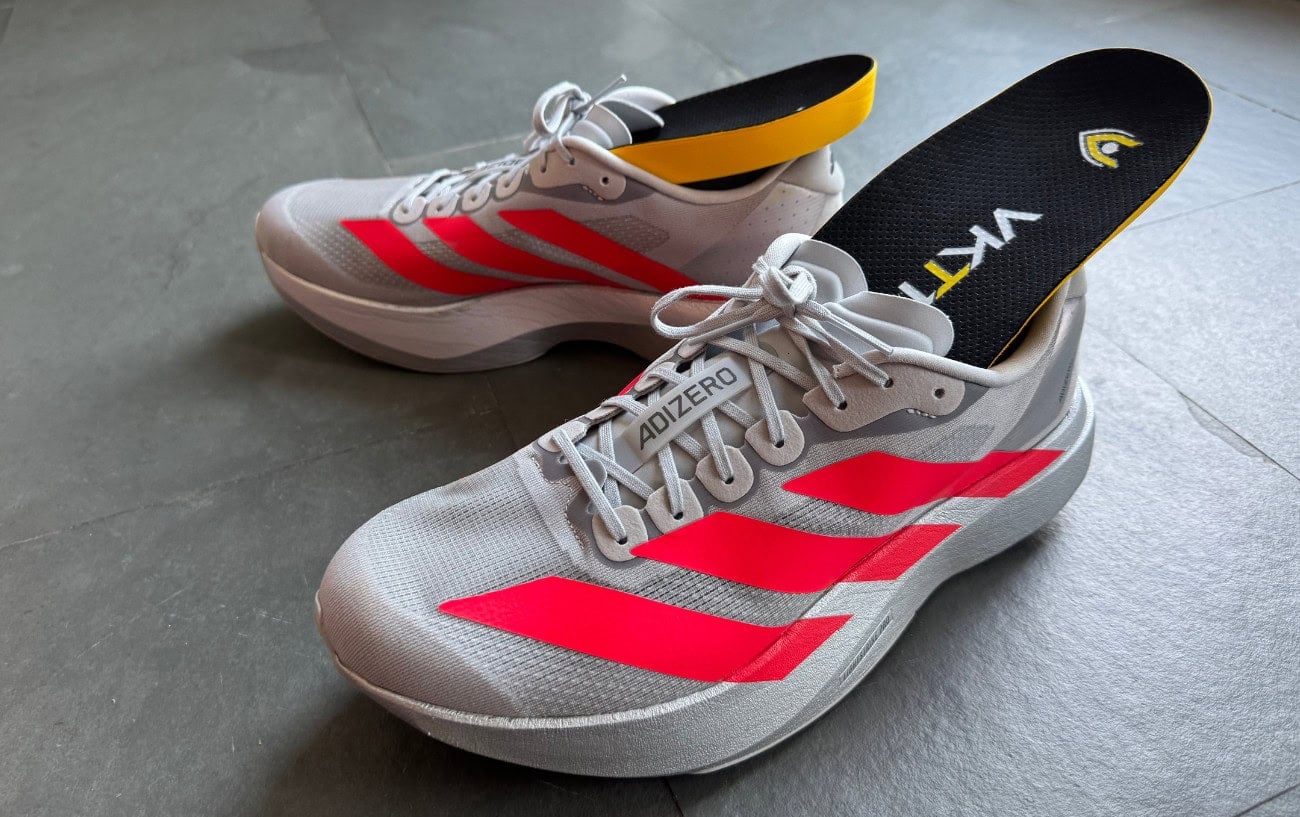
#8: Try Carbon-Plated Running Shoes
If you are interested in getting some outside help, try a pair of supershoes. The Nike Vaporfly has been tested and retested, showing a 0.9% to 4.2% improvement.5 Effects of a Carbon-Plated Racing Shoe on Running Economy at Slower Running Speeds. International Journal of Exercise Science: Conference Proceedings, 2(14). https://digitalcommons.wku.edu/ijesab/vol2/iss14/15/ improvement in running economy depending on your fitness level.
Whether you are a 5K, 10K, half-marathon, marathon runner, or ultra runner, working on these different aspects of your running can lower the amount of energy you use at race pace to improve your running economy and, ultimately, your speed and race times.
Another interesting metric used by many coaches and short and long-distance runners to measure performance is the lactate threshold. For more information on how to use this metric to improve your running, check out this next guide:
References
RunClub — Free
Join 300,000+ runners in RunClub
Free training plans for every distance, a daily running game, exclusive coaching content, and a real community of runners. Create your free account in 20 seconds — no card.
Already a member? Log in →











Join the conversation
Great recommendations by the way!
Where is the strength training? Good evidence for improvements in RE.
Start here, Bob!
Thomas from Marathon Handbook