


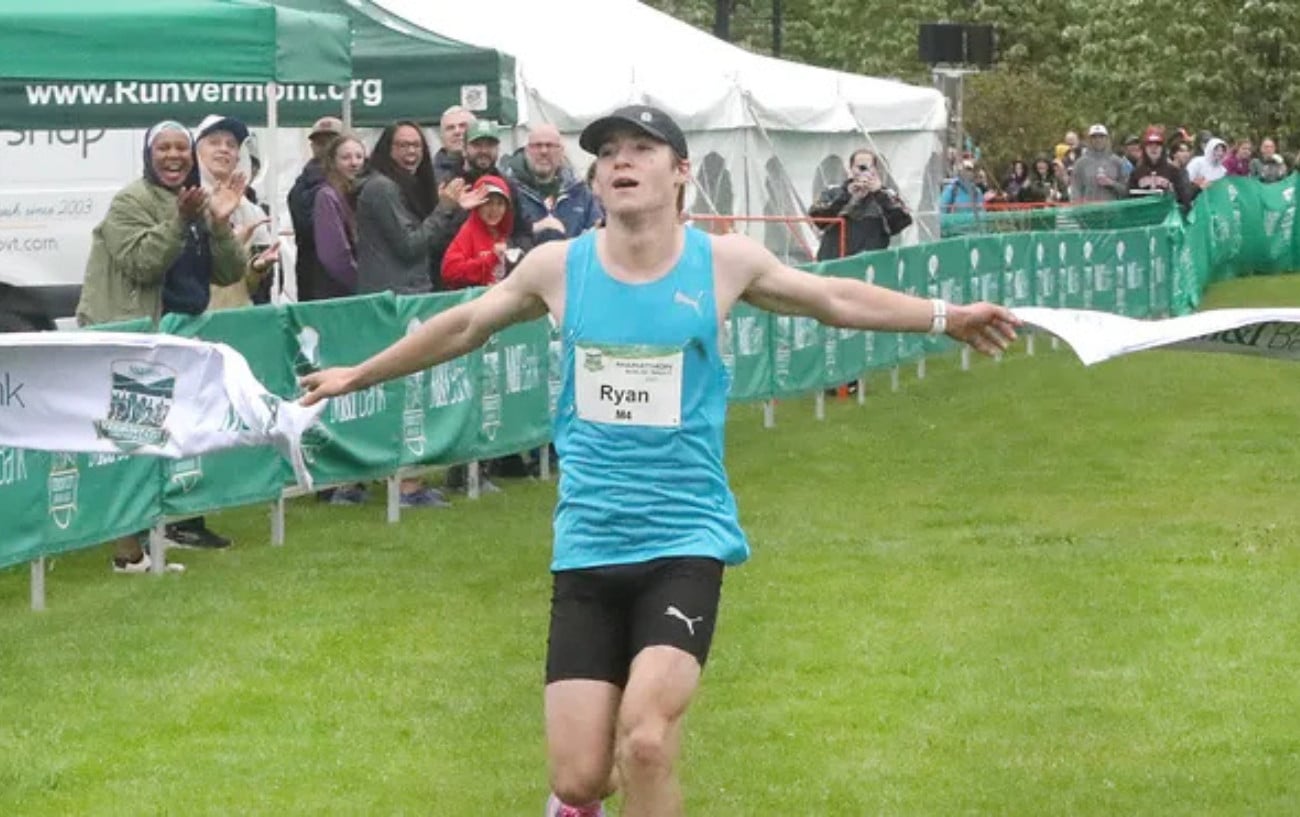
Ryan Smith arrived at the start line of the M&T Bank Vermont City Marathon hoping to win. He left with a course record that had stood for nearly a quarter-century and an automatic spot in the 2028 U.S. Olympic Marathon Trials, becoming one of the few American men to qualify for the Trials on his first attempt at the distance.
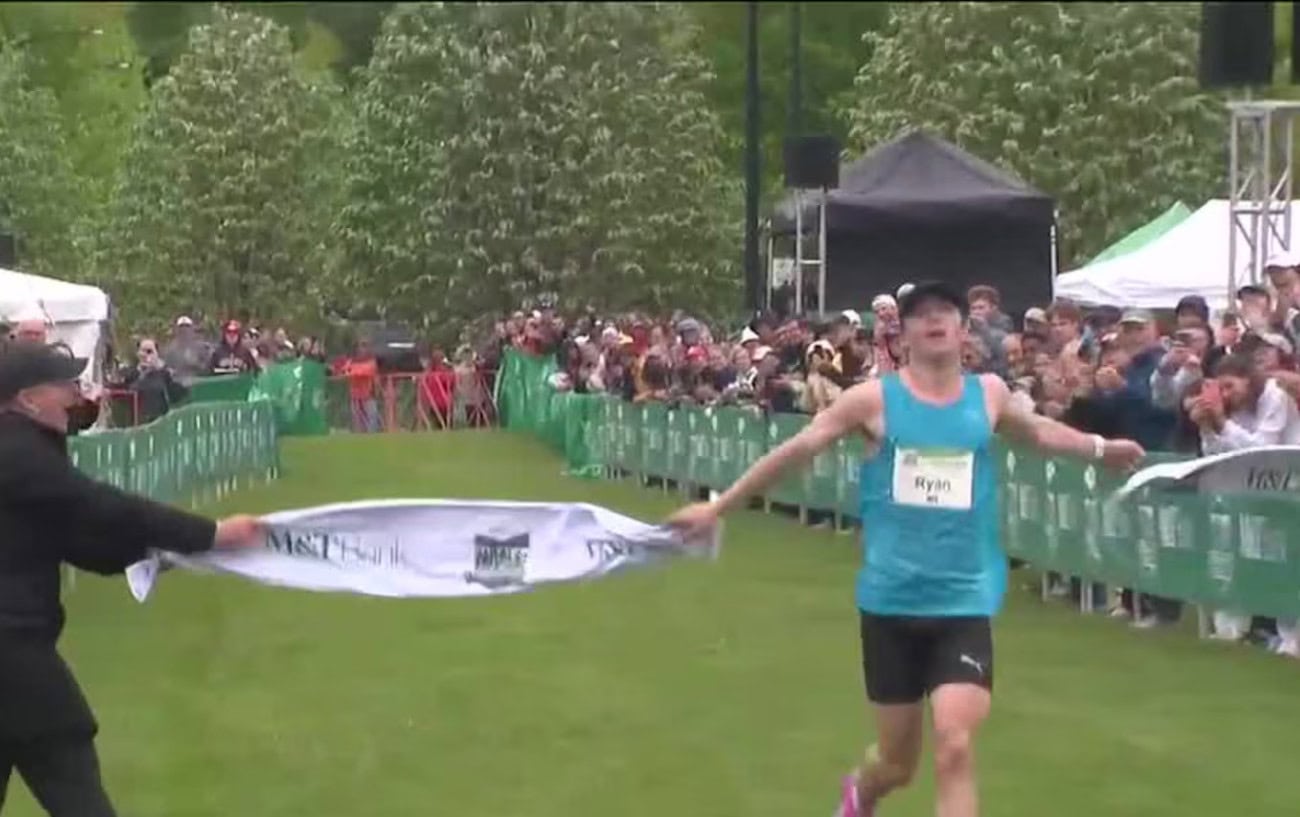
Smith, a 24-year-old from Westport, Conn., now living in Boston, finished in 2 hours, 15 minutes and 52 seconds on Sunday, May 24. That was 1 minute and 10 seconds quicker than the previous men’s open record of 2:17:03, which had stood since 2001. He averaged 5:11 per mile across 26.2 miles and led the entire 1,834-person field from start to finish.
“I mean, holy cow! What? I don’t know. I’m, ah, I have no words. That exceeded all my goals,” Smith told WCVB shortly after crossing the finish line at Waterfront Park.
A Solo Effort in the Rain
Rain was falling when the gun went off at 7:15 a.m., and the cool temperatures that followed turned out to be favorable for fast times. Smith had hoped to share the work with a pack, but no one in the elite field went with his early pace.
“The plan went out the window right away,” he said. “I was going to wait and be patient and sit in a group. But I was excited. I ran the whole thing alone. I was, I felt good.”
The Vermont City Marathon is run as two 13.1-mile loops in a figure-8 pattern, weaving through Burlington’s downtown, past Church Street Marketplace, into a handful of city parks, and out along the Burlington Bike Path beside Lake Champlain. Kevin Heeman finished second in 2:19:25, more than three and a half minutes back. Paul Neilan was third in 2:19:54.
Smith was not thinking about the course record for most of the race. It was only after he crested the long climb up Main Street near mile 19 that he started running the numbers. He figured he needed roughly a 32-minute final 10K to dip under the Olympic Trials standard.
“I knew I was, I was pretty on my way to, you know, a pretty good time,” he told the D3 Glory Days podcast. “I just knew that I could do that. Like I was, I was like, I it’s going to be hard, but like, I know I’m close.”
He dropped a 5:02 at mile 22, his fastest split of the day. He finished with eight seconds to spare under the 2:16:00 Olympic Trials qualifying standard.
An Unconventional Build
Smith did not get to the start line on a textbook block of training. He suffered a stress fracture in early August and went more than three months without running. The rebuild that followed was bumpy too — a flu, a flare-up in the same tibia — and marathon-specific work only started a handful of weeks before race day.
His marathon-specific block ran just three weeks: 95 miles, then 107, then 95 again, before a two-week taper. Through the rest of the spring he held around 80 miles a week on the run, layered with two to three hours of elliptical work. He avoided traditional long runs because he was wary of putting the tibia back under continuous load.
“This wasn’t necessarily the goal,” he said on the podcast. “I felt like it was too big of a risk for my leg.”
Smith ran cross country and indoor and outdoor track at Bates College, a Division III program in Maine, and was a captain in all three sports. He graduated in 2023 with personal bests of 14:45 in the 5,000 meters and 30:46 in the 10,000. He nearly walked away from the sport during the 2020-21 season, after the pandemic wiped out cross country.
After college, he moved to Boston for a job in the energy industry and kept training with about ten former Bates teammates who had also landed in the city. The group meets up for a workout once a week.
“I felt like I had more to give,” he told The Boston Globe. “I felt like my results didn’t reflect what I was capable of.”
Next up, he said, is the Beach to Beacon 10K in Maine in August, then the California International Marathon in December. He does not have a coach. He told the podcast he plans to “look up a book on how to train for the marathon.”
The U.S. Olympic Marathon Trials are scheduled for Los Angeles in March 2028, giving him close to two years to build.
“I have so many opportunities to try different things,” he said. “I can take bigger swings in training.”
RunClub
Get more running stories — join RunClub
Daily running news, a community of 300,000+ runners, free training plans for every distance, and a daily running game. Free to join — no card.
Already a member? Log in →




Start the conversation