


The marathon wall is usually explained metabolically: glycogen runs low and pace falls apart. That story is real, but it may be incomplete. A new Journal of Applied Biomechanics study suggests the wall also has a recognizable mechanical signature.1Hirakawa, N., & Sakaguchi, M. (2026). Relationship Between the Patterns of Time-Course Changes in Running Pace and Running Mechanics in a Full Marathon. Journal of Applied Biomechanics, -1(aop), 1–8. https://doi.org/10.1123/jab.2025-0042
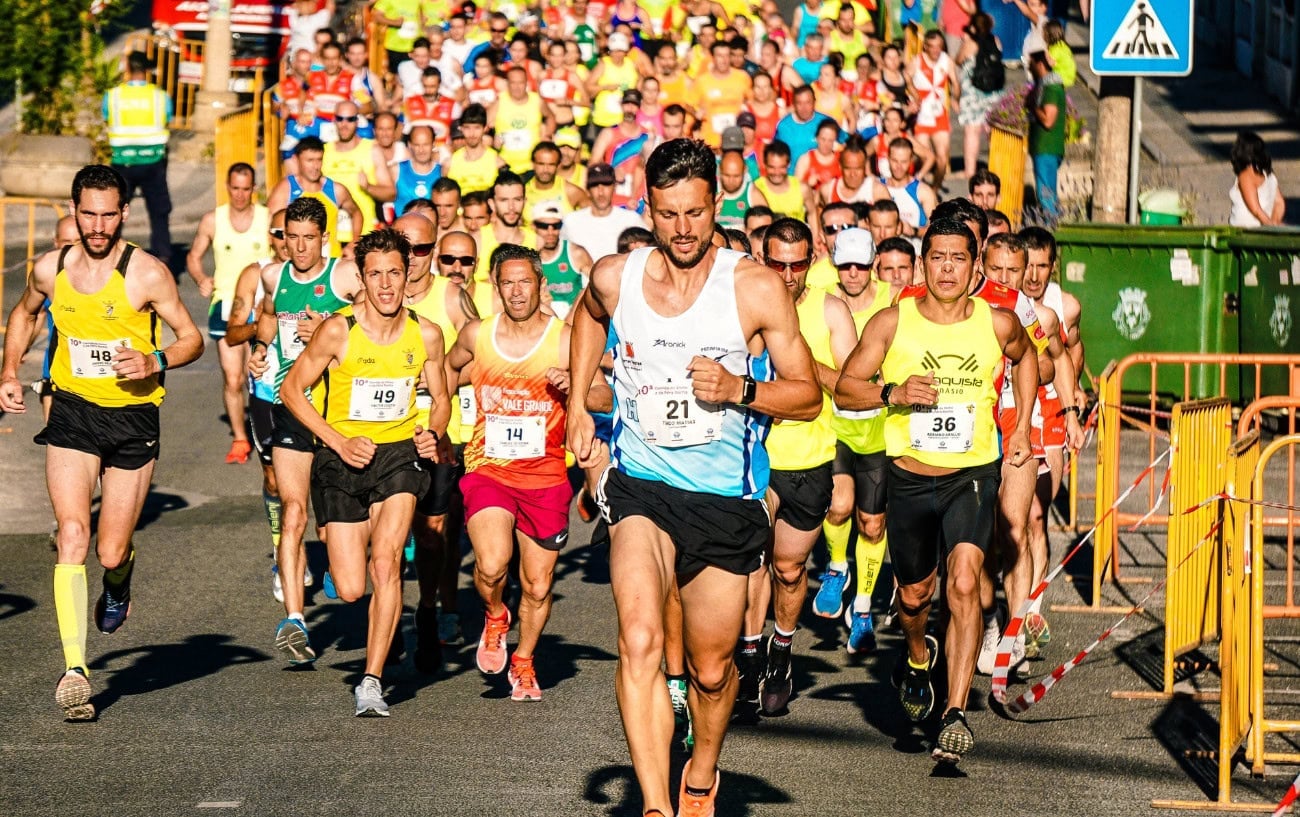
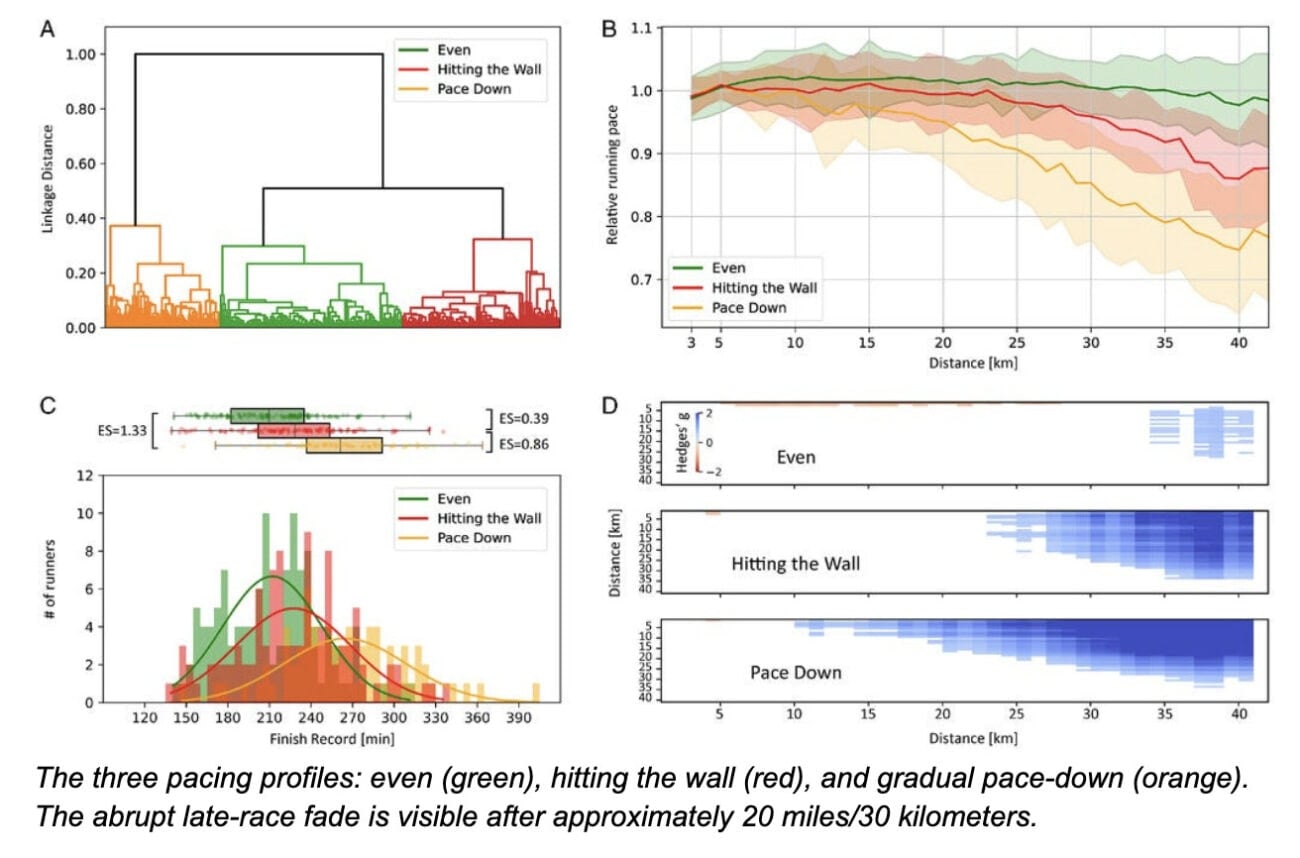
Researchers analyzed 297 finishers across 58 marathons in Japan. Each runner wore a waist-mounted sensor that estimated pace, step length, step frequency, ground-contact time, vertical motion, and vertical stiffness for every kilometer. The runners separated into three pacing patterns:
- 119 maintained a relatively even pace.
- 103 “hit the wall” with a sharp slowdown after about 30 kilometers (18 miles).
- 75 began fading gradually from roughly 15 kilometers (9 miles) onward.
The even-paced group finished fastest. The wall group was next, and the early pace-down group was slowest. Both slowdown groups shortened their stride, spent longer on the ground, and lost vertical stiffness as the race progressed. But the timing differed. The pace-down group deteriorated gradually, while the wall group changed abruptly late in the race. Step frequency (cadence) also declined late in both slowdown groups while remaining stable among the even pacers.
What this means for runners
The wall is not simply a moment when motivation (or glycogen) disappears. It seems that by the time your pace collapses, the spring-like behavior of the legs and the ability to preserve step length may be deteriorating, too.
Do not interpret this as a cue to consciously “force” a longer stride late in a marathon. A better goal is to arrive at the ~20-mile mark with enough metabolic and muscular reserve that your normal stride remains available. Conservative early pacing, practiced carbohydrate intake, progressive long runs, and strength training are still the practical levers, even if this study cannot tell us which one prevents the wall.
References
RunClub — Free
Join 300,000+ runners in RunClub
Free training plans for every distance, a daily running game, exclusive coaching content, and a real community of runners. Create your free account in 20 seconds — no card.
Already a member? Log in →









Start the conversation