


Sodium bicarbonate has a strong evidence base for some high-intensity efforts. Its practical problem is equally well known—an effective dose can be difficult to consume and may produce enough gastrointestinal distress to erase any performance benefit.
A new study tested a different approach—spreading bicarbonate across a prolonged ride in a carbohydrate gel.1Norte, B. R., Hickman, A., Megias, A. M., Mosquera‐Lopez, E., Bermon, S., Garrandes, F., Adami, P. E., Johnson, K. O., Mahon, E., Shepherd, S. O., Strauss, J. A., & Louis, J. B. (2026). Bicarbonate and Carbohydrate Co‐Ingestion During Exercise in a Novel Gel Format Improves Time‐Trial Performance After 3 h of Moderate‐Intensity Exercise in Trained Cyclists. Scandinavian Journal of Medicine & Science in Sports, 36(10). https://doi.org/10.1111/sms.70373
Eleven trained cyclists completed two trials. In both conditions, they rode for three hours at 95% of their ventilatory threshold (a hard but sustainable intensity) while consuming 80 grams of carbohydrate per hour. In one trial, the gels also delivered 18 grams of sodium bicarbonate and 2 grams of potassium bicarbonate.
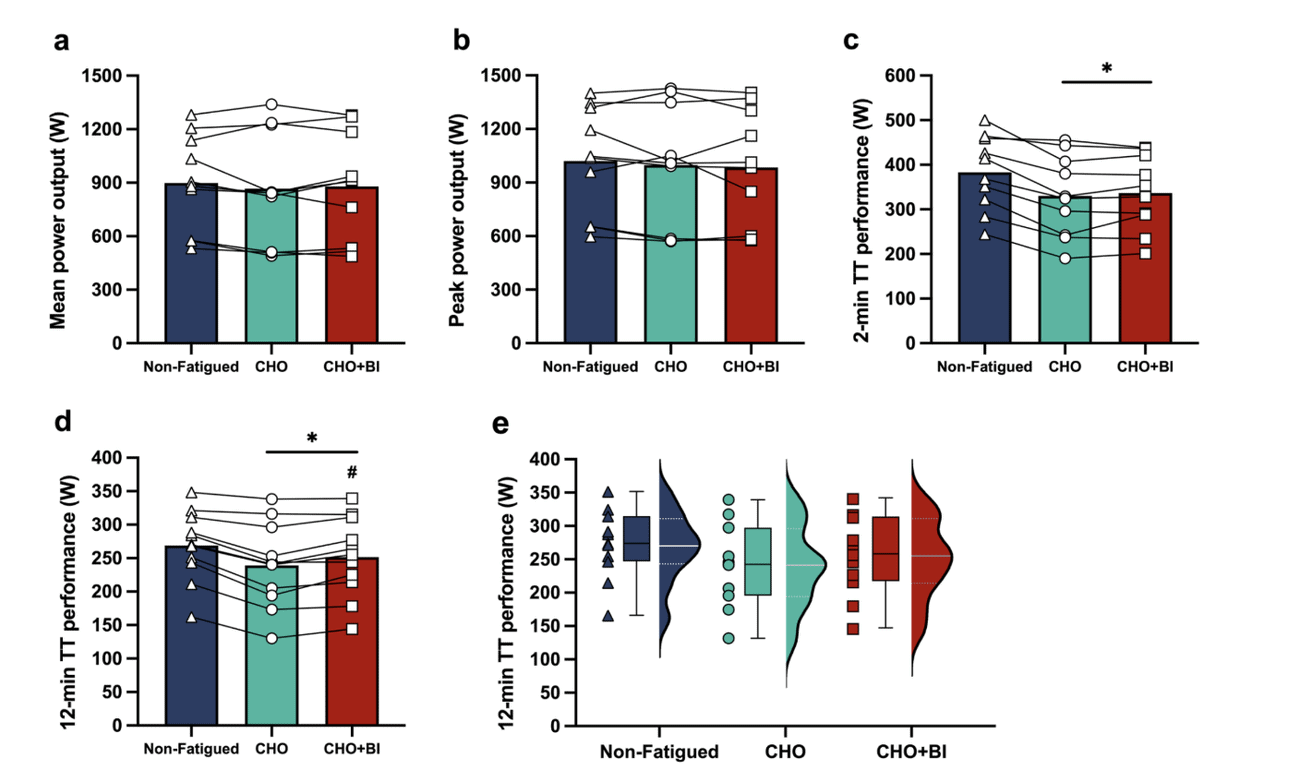
After the three-hour ride, the cyclists completed three 6-second sprints, a 2-minute time trial, and a 12-minute time trial.
- Bicarbonate did not improve the sprints or the 2-minute effort. The difference emerged during the final 12-minute trial, when mean power increased from 239 watts with carbohydrate alone to 251 watts with carbohydrate plus bicarbonate (a roughly 6% improvement when bicarb was added).
That is an impressive difference late in a long protocol. But bicarbonate did not fully restore performance: fresh 12-minute power had averaged 269 ± 55 watts. The supplement attenuated part of the fatigue-related decline rather than eliminating it (i.e., it helped preserve “durability”).
Gastrointestinal symptoms were negligible and did not differ between conditions, which may be the study’s most encouraging finding. However, participants rated the bicarbonate gels as less pleasant, and some preferred diluting them with water.
What this means for runners
Bicarbonate consumed during prolonged exercise may be useful when a long race ends with a decisive hard effort lasting roughly 10–15 minutes.
This result came from 11 cyclists using a proprietary gel while consuming 80 g/h of carbohydrate. Treat it as a promising proof of concept, not a do-it-yourself baking-soda protocol. If you experiment with bicarbonate, use a measured product and rehearse the complete strategy in training, including dose, timing, fluid, carbohydrate, and gastrointestinal tolerance.
References
RunClub — Free
Join 300,000+ runners in RunClub
Free training plans for every distance, a daily running game, exclusive coaching content, and a real community of runners. Create your free account in 20 seconds — no card.
Already a member? Log in →








Start the conversation