


A hard training block should leave you tired, but it shouldn’t leave you steadily slower, injured, and emotionally frayed. That distinction is at the heart of overtraining: training stress has exceeded the recovery needed to turn it into adaptation.

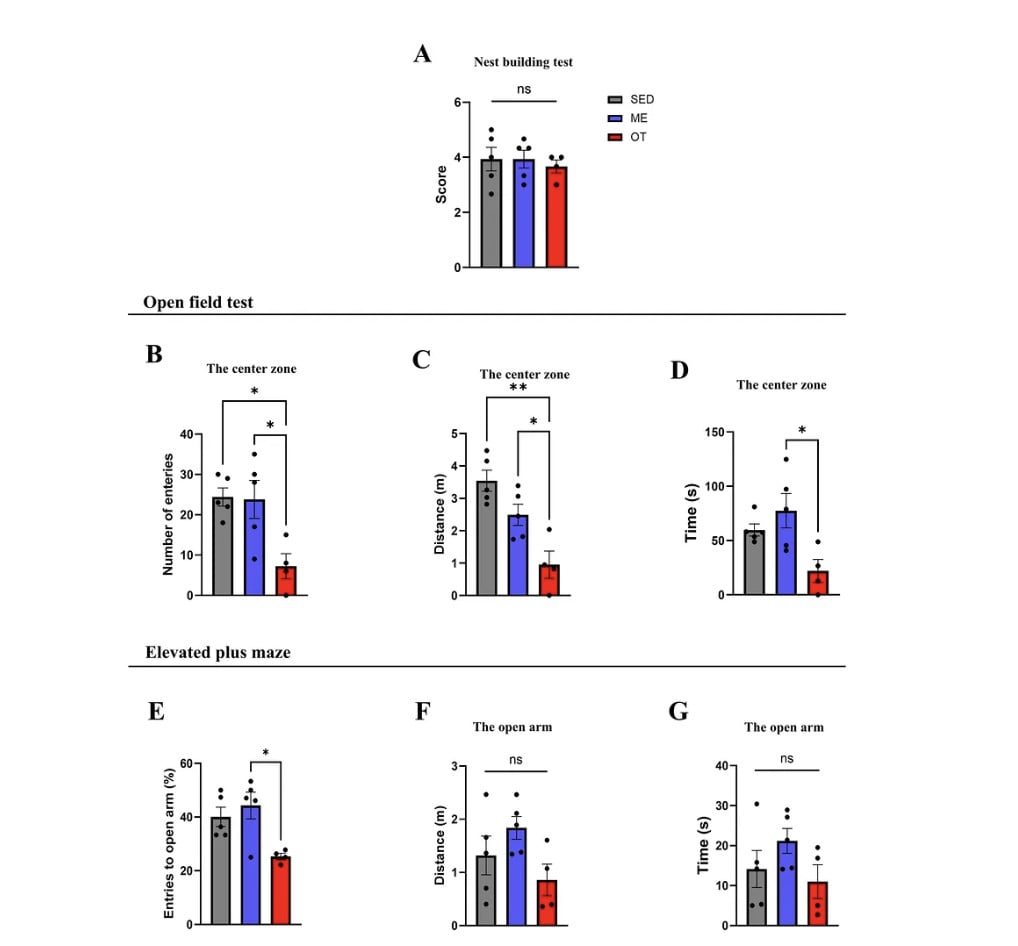
A new experiment explored whether that maladaptation may reach beyond muscle. Researchers randomized male mice to a sedentary control condition, moderate exercise, or six weeks of progressively intensified overtraining. The moderate group ran for 50 minutes once a day on a level treadmill. The overtraining group eventually reached two 75-minute downhill sessions per day, six days per week, with only four hours between sessions (miserable for a mouse… and probably you and me too). But the protocol was severe: six of the ten mice assigned to overtraining were removed because of tail or hindlimb injuries, leaving only four in the final analysis.1Hwang, E., Shin, M., Park, T., Kim, J. J., Yi, D., Park, J., & Moon, H. Y. (2026). The Impact of Overtraining on Anxiety‐Like Behavior and Tight Junction Proteins of the Blood–Brain Barrier in Mice. Brain and Behavior, 16(9). https://doi.org/10.1002/brb3.71709
- Moderate exercise increased the time mice could run on a treadmill until exhaustion by 13 minutes (they got better).
- Overtraining reduced time to exhaustion by nearly 10 minutes.
- The overtrained mice also had less leg muscle mass and higher levels of inflammation in their thigh muscles.
- The researchers also saw signs of anxiety-like behavior in the overtrained mice.
- In a brain region known as the hippocampus, overtraining was associated with lower levels of a protein that keeps the brain’s protective barrier intact and higher levels of inflammation.
What this means for runners
Do not interpret this study as evidence that a hard workout damages your blood-brain barrier. Its more useful message is that performance and mood may deteriorate together when training stress stays above recovery capacity. A persistent performance decline accompanied by irritability, anxiety, poor sleep, lost motivation, or repeated injuries deserves more attention than one flat workout.
When several of those signals converge, reduce your load and restore the basics: sleep, sufficient energy and carbohydrate intake, genuinely easy days, and time away from hard sessions. If the pattern persists, see a qualified clinician to investigate other causes. Human overtraining syndrome is a diagnosis of exclusion—not ordinary fatigue after a demanding week, which is something we all experience (and should—it’s a normal side effect of hard training).
References
RunClub — Free
Join 300,000+ runners in RunClub
Free training plans for every distance, a daily running game, exclusive coaching content, and a real community of runners. Create your free account in 20 seconds — no card.
Already a member? Log in →












Start the conversation